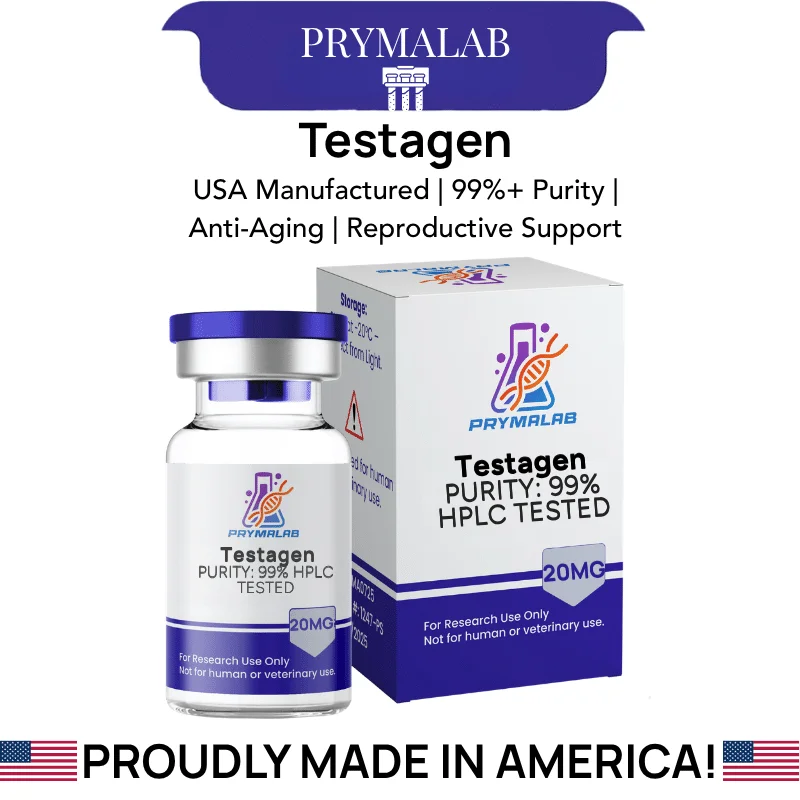
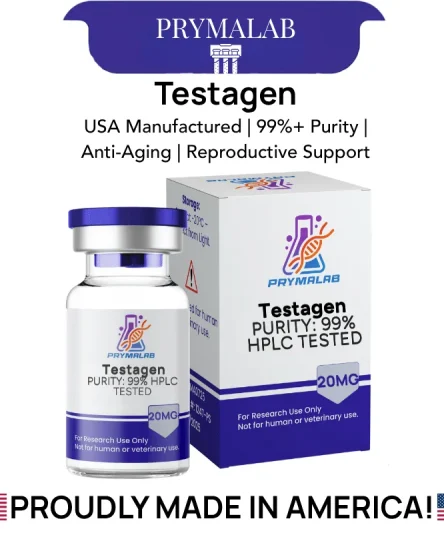
Testagen peptide is a Khavinson bioregulator peptide complex targeting testicular tissue. This research-grade compound modulates gene expression in Leydig cells and Sertoli cells for preclinical testicular aging, hormonal research, and male reproductive function studies. 20mg lyophilized powder, =98% purity, COA included.
Mechanism: Epigenetic gene expression modulation via peptide-DNA interaction
Quantity: 20mg lyophilized powder
Purity: ≥98% (HPLC-verified per batch)
Price: $45.99 / month – $389.99
Use: Lab research only — not for human or veterinary treatment
What Is Testagen? The Testagen 20mg Testes Bioregulator Explained
Testagen peptide is a synthetic bioregulator peptide complex developed by Professor Vladimir Khavinson at the St. Petersburg Institute of Bioregulation and Gerontology. This bioregulator targets testicular tissue, functioning as a testes bioregulator that modulates gene expression in Leydig cells, Sertoli cells, and supporting fertility structures. It belongs to the Khavinson bioregulator peptides class — short control peptides that demonstrate tissue-specific gene expression modulation at physiological concentrations — and has been studied in lab models of testicular aging, hormonal decline, spermatogenic function, and male fertility anti-aging research.
Male fertility aging involves progressive decline in testosterone synthesis, reduced spermatogenic capacity, and decline of testicular tissue architecture. These changes are driven in part by epigenetic alterations in testicular gene expression that impair Leydig cell steroidogenic function and Sertoli cell spermatogenic support. Unlike exogenous hormonal use, which can suppress endogenous production through negative feedback, this peptide addresses fertility aging at the gene expression level, regulating the transcriptional programs that govern testicular function. Among the Khavinson bioregulators, this Khavinson peptide is the dedicated testes peptide bioregulator for male fertility endocrine research. PrymaLab Testagen 20mg is manufactured to high purity standards and supplied exclusively for qualified lab research.
Epigenetic Gene Expression Modulation in Testicular Tissue
Testagen operates through the peptide-DNA interaction mechanism characterized by Professor Khavinson’s research group, wherein short control peptides selectively bind specific DNA sequences within gene promoter regions and alter chromatin conformation, directly influencing gene activity in target tissues. In testicular tissue, testagen tunes the expression of genes governing steroidogenesis, spermatogenesis, Leydig cell function, and Sertoli cell signaling. This epigenetic mechanism targets the transcriptional programs underlying fertility function rather than directly supplementing hormonal output.
Leydig Cell Steroidogenic Function
Leydig cells are the main testosterone-producing cells in the testes, and their age-related functional decline is the central driver of male hormonal aging. Testagen research has demonstrated modulation of steroidogenic gene expression in Leydig cells. This includes genes encoding steroidogenic acute regulatory protein (StAR), cytochrome P450 enzymes in the testosterone synthesis pathway, and luteinizing hormone receptor expression. The luteinizing hormone receptor — through which the pituitary gland signals testicular Leydig cells — is central to this cascade: the anterior pituitary releases luteinizing hormone (LH), a key stimulating hormone that drives Leydig cell steroidogenesis. By targeting the gene expression programs governing testosterone biosynthesis rather than providing exogenous hormone, this bioregulator offers a fundamentally different research approach to male fertility endocrine aging.
Sertoli Cell Support and Spermatogenic Maintenance
Sertoli cells provide the structural and nutritional microenvironment essential for spermatogenesis. Age-related Sertoli cell dysfunction impairs this supportive function, contributing to declining sperm quality and fertility. Testagen research targets Sertoli cell gene expression programs including androgen-binding protein production, growth factor secretion, and blood-testis barrier maintenance, addressing the paracrine signaling network that sustains spermatogenic function throughout the male fertility lifespan.
Testagen Peptide Benefits Reported in Preclinical Research
Published studies on testagen peptide benefits report multiple testicular-specific effects relevant to male fertility aging research. All findings described below are from lab animal and cell culture models.
Age-related decline in sperm quality involves reduced spermatogonial stem cell renewal, impaired meiotic progression, and decreased sperm motility and morphology. Among the documented testagen benefits, improved spermatogenic gene expression, enhanced Sertoli cell paracrine signaling, and maintained seminiferous tubule architecture in aged models have been consistently reported. These findings position testagen as a research tool for studying whether epigenetic interventions can preserve spermatogenic function during male fertility aging.
Anti-Inflammatory Effects in Testicular Tissue
Chronic testicular swelling (orchitis) contributes to fertility tissue damage and accelerates functional decline during aging. Testagen research reports modulation of inflammatory gene expression in testicular tissue, including reduced pro-inflammatory cytokine production and normalized immune cell infiltration. These anti-swelling effects help maintain the immunoprivileged environment essential for normal spermatogenesis.
Testicular Antioxidant Defense
Spermatogenic cells are highly vulnerable to oxidative damage due to their high metabolic rate and rapid division. Lab testagen studies report upregulation of endogenous antioxidant enzyme gene expression (SOD, catalase, glutathione peroxidase) in testicular tissue, enhancing the protective environment for developing spermatozoa and reducing oxidative stress-mediated damage to fertility cells.
Reproductive Anti-Aging in Longitudinal Models
Long-term animal studies by the Khavinson group have reported that testagen use is linked with maintained testicular function, preserved hormonal output, and improved fertility parameters in aged male cohorts compared to controls. These fertility anti-aging findings support the hypothesis that tissue-specific bioregulation can counteract the age-related decline in male fertility capacity at the gene expression level.
Testagen Peptide Dosage in Research Applications
Published research provides context for testagen peptide dosage parameters across different experimental paradigms. The following represents reported dosage ranges from lab literature and is intended solely to inform research protocol design.
Testagen vs. Prostamax: Male Reproductive Bioregulator Comparison
Researchers studying male fertility aging often compare testagen and prostamax because both target the male fertility system within the Khavinson bioregulator framework. Understanding their distinct tissue targets is essential for designing full male fertility research protocols.
Paired: testes + prostate = full male reproductive system coverage
Paired: prostate + testes = full male reproductive system coverage
The the compound-prostamax combination represents the most comprehensive male fertility bioregulator research approach in the Khavinson system, with this peptide addressing the endocrine and spermatogenic function of the testes and prostamax targeting the prostatic gland. Researchers studying systemic male fertility aging benefit from protocols incorporating both peptides for complete fertility tract coverage.
Testagen Peptide as a Research Compound: Important Distinctions
Researchers searching for testagen supplement information should note that PrymaLab Testagen 20mg is a research-grade bioregulator peptide, not a dietary supplement. Key distinctions include verification at ≥98% purity by analytical HPLC (far exceeding supplement-grade standards), identity confirmation by mass spectrometry, batch-specific Certificate of Test with independent third-party testing, and form as freeze-dried powder needing proper laboratory mixing. These research-grade specifications ensure the cell-level integrity and reproducibility necessary for meaningful lab research, distinguishing PrymaLab This bioregulator from consumer supplement products that may use the same name but lack analytical check.
How to Store and Handle PrymaLab Testagen 20mg
Store freeze-dried at −20°C. Keep sealed, desiccated, and protected from light. Stable for 24+ months.
Allow vial to reach room heat before opening to prevent condensation.
Reconstitute with appropriate sterile solvent. Add slowly along vial wall.
Use mixed solution within 2–4 weeks. Refrigerate at 2–8°C.
Avoid repeated freeze-thaw cycles. Aliquot into single-use portions.
Testagen is a bioregulator peptide complex developed by Professor Khavinson targeting testicular tissue. It tunes gene expression in Leydig cells, Sertoli cells, and seminiferous tubules. Research uses include testicular aging, hormonal decline, spermatogenic function, and male fertility anti-aging in lab models.
What are the reported testagen peptide benefits in research?
Published lab research reports testagen peptide benefits including restored steroidogenic enzyme gene expression in aged Leydig cells (StAR, CYP enzymes), improved spermatogenic function and seminiferous tubule architecture, anti-swelling effects in testicular tissue, enhanced antioxidant defense gene expression, and kept fertility parameters in longitudinal aging models. All benefits are from lab research.
How does testagen differ from exogenous testosterone?
Testagen operates through epigenetic gene expression tuning in testicular cells, targeting the transcriptional programs governing endogenous testosterone synthesis rather than supplementing exogenous hormone. This approach aims to restore the testes’ own steroidogenic capacity rather than bypassing it, avoiding the negative feedback suppression linked with exogenous hormone use in research models.
What is the recommended testagen peptide dosage for research?
Store freeze-dried testagen at −20°C, desiccated and protected from light, for 24+ months shelf life. After mixing, store at 2–8°C and use within 2–4 weeks. Aliquot to avoid freeze-thaw cycles.
Research Disclaimer
Endocrine Context: Testagen and the HPG Axis
The hypothalamic-pituitary-gonadal (HPG) axis is the central regulatory network governing male reproductive endocrinology. The pituitary gland — specifically its anterior pituitary lobe — secretes luteinizing hormone (LH) and follicle-stimulating hormone (FSH), both of which are key stimulating hormones that act directly on testicular Leydig and Sertoli cells. While testagen’s primary tissue target is the testes, researchers studying the broader endocrine environment may also consider interactions with related axes. For example, the thyroid gland plays a supportive role in male reproductive function: thyroid hormones influence Sertoli cell maturation and spermatogenic capacity, making thyroid status a relevant variable in comprehensive male fertility aging protocols.
By modulating gene expression at the testicular level — what Khavinson termed the testosterone synthesis inductor application mechanism — testagen acts as a true synthesis inductor application testagen model: a short peptide that enters the cell, interacts with specific DNA sequences, and upregulates gene activity governing steroidogenesis and spermatogenesis. This mechanism is grounded in Khavinson’s foundational research on the penetration of short fluorescence-labeled peptides into the nucleus in HeLa cells and in vitro specific interaction of the peptides with deoxyribooligonucleotides and DNA, which established the theoretical basis for tissue-specific short peptide bioregulators. Supporting healthy testosterone levels through this gene-level approach may benefit research models examining energy levels, muscle mass, and male vitality endpoints.
For Research Use Only.PrymaLab Testagen 20mg is intended exclusively for qualified lab research use. This product is not intended for human consumption, treatment use, veterinary treatment, or any use outside controlled research environments. Testagen has not been approved by the FDA or any equivalent control authority for treatment use. All research uses described are from published lab and gerontological literature. Researchers are responsible for control compliance.
Additional information
Weight
N/A
Dimensions
N/A
14 reviews for Testagen Peptide 20mg
Brandon Owens
Rated 5 out of 5
July 12, 2026
Best source ive found
So happy i found this place.
Helpful?
0
0
Beverly Powell
Rated 5 out of 5
July 11, 2026
Legit...
Cannot recommend enough.
Helpful?
0
0
Sophia Berry
Rated 5 out of 5
July 8, 2026
My new go to!
Repeat customer here. The quality is exactly what i was hoping for, consistent and pure. Also most companies overcharge for the same thing but the pri...More
Repeat customer here. The quality is exactly what i was hoping for, consistent and pure. Also most companies overcharge for the same thing but the pricing here beat everyone else i checked.
Helpful?
0
0
Maria Kim
Rated 5 out of 5
July 6, 2026
Super impressed!
Happy with the order. Quality was there fasho.
Helpful?
0
0
Tara West
Rated 5 out of 5
July 1, 2026
Blown away honestly
Honestly cant complain at all. The quality is exactly what i was hoping for. Also other brands packaging shows up crushed but this came double boxed w...More
Honestly cant complain at all. The quality is exactly what i was hoping for. Also other brands packaging shows up crushed but this came double boxed with ice packs. These guys got a customer for life.
Helpful?
0
0
Grant Thomas
Rated 5 out of 5
July 1, 2026
Def worth it
happy wit the order. No real issues with the product. Will def order again. just wish shipping was faster
Helpful?
0
0
Karen Weaver
Rated 5 out of 5
June 25, 2026
10/10 would buy again
First time ordering and im impressed. Everything showed up perfect and sealed. I switched over after corepeptides sent the powder wus half melted but ...More
First time ordering and im impressed. Everything showed up perfect and sealed. I switched over after corepeptides sent the powder wus half melted but the lyophilized powder here was a perfect intact puck. You can tell the difference when a company actually cares. Cant wait for my next order.
Helpful?
0
0
Janet Harrison
Rated 5 out of 5
June 24, 2026
went smoothly
Honestly cant complain at all. Everything arrived as expected and I feel amazing. Thank you.
Helpful?
0
0
Marie Collins
Rated 5 out of 5
June 16, 2026
Love you guys ❤️
Wont be buying from anywhere else. Tested 3 products from pryma through janoshik myself, all came back 99.96+ pure, swiss chems only came back 96 at t...More
Wont be buying from anywhere else. Tested 3 products from pryma through janoshik myself, all came back 99.96+ pure, swiss chems only came back 96 at the highest.
Helpful?
0
0
Craig Gomez
Rated 5 out of 5
June 12, 2026
Perfect
Packaging an product were both on point. Keep it up guys.
Helpful?
0
0
Janet Harrison
Rated 5 out of 5
June 8, 2026
no issues
u can tell they actually care about what they send out.
Helpful?
0
0
Denise Turner
Rated 5 out of 5
June 2, 2026
Repeat customer for life!
I used to order from penguin peptides but I kept getting vials that were sealed bad and leaked but every vial here was sealed perfect. Gonna be my mai...More
I used to order from penguin peptides but I kept getting vials that were sealed bad and leaked but every vial here was sealed perfect. Gonna be my main source from now on for sure. Much love
Helpful?
0
0
Edward Berry
Rated 5 out of 5
May 14, 2026
very pleased
Good stuff no doubt.
Helpful?
0
0
Eric Smith
Rated 5 out of 5
April 3, 2026
Legit and high quality!
Ordered again an its the same great quality.
Helpful?
0
0
Only logged in customers who have purchased this product may leave a review.
Bacteriostatic water peptide science is the foundation of safe, accurate peptide reconstitution. This 2026 guide covers bacteriostatic water composition, how to reconstitute peptides using a peptide reconstitution calculator and peptide dosage calculator, bacteriostatic water vs sterile water differences, peptide storage best practices, and a 10-step reconstitution protocol. Expert insights from PrymaLab.
The Wolverine stack peptide combines BPC-157 and TB-500 for research into tendon, ligament, and joint recovery. This 2026 guide covers BPC-157 peptide where to buy responsibly, BPC 157 peptide side effects, peptides for tendon repair, peptides for joint recovery, peptides for elbow pain, and the BPC-157 TB-500 peptide blend scientific research. Expert insights from PrymaLab.
Are peptides good for you? This comprehensive 2026 guide explores peptide therapy benefits, safety, side effects, and how peptides work in the body. Learn about peptide health benefits, research findings, and what you need to know before considering peptide therapy. Expert insights from PrymaLab.
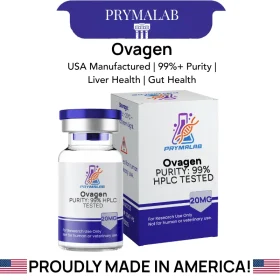
Ovagen peptide is a short-chain liver bioregulator developed at the St. Petersburg Institute of Bioregulation and Gerontology under Professor Vladimir Khavinson. It contains the AC-3 peptide complex (glutamic acid and aspartic acid) designed to target hepatocyte gene expression for liver cell repair, bile production, and detoxification. This guide covers dosing protocols, cycling schedules, side effects, a head-to-head comparison with NAC, milk thistle, TUDCA, and BPC-157, cost analysis ($120-360 per year), and how to verify genuine Ovagen products online.
GHK-Cu peptide is a naturally occurring copper tripeptide that modulates over 4,000 human genes involved in collagen synthesis, wound healing, and tissue regeneration. This comprehensive guide covers injection dosage protocols, clinical research on skin rejuvenation and hair growth, side effects, safety data, and how to reconstitute GHK-Cu 50mg vials. Includes dosage charts, comparison tables, and 10 frequently asked questions answered by a peptide research specialist.
Sermorelin acetate is a growth hormone-releasing hormone (GHRH) analog that stimulates natural GH production from the pituitary gland. This comprehensive dosage guide covers protocols for anti-aging, muscle growth, weight loss, and sleep optimization — along with side effects, before-and-after timelines, and comparisons to HGH and ipamorelin.
Repeat customer here. The quality is exactly what i was hoping for, consistent and pure. Also most companies overcharge for the same thing but the pri...More
Repeat customer here. The quality is exactly what i was hoping for, consistent and pure. Also most companies overcharge for the same thing but the pricing here beat everyone else i checked.
Honestly cant complain at all. The quality is exactly what i was hoping for. Also other brands packaging shows up crushed but this came double boxed w...More
Honestly cant complain at all. The quality is exactly what i was hoping for. Also other brands packaging shows up crushed but this came double boxed with ice packs. These guys got a customer for life.
First time ordering and im impressed. Everything showed up perfect and sealed. I switched over after corepeptides sent the powder wus half melted but ...More
First time ordering and im impressed. Everything showed up perfect and sealed. I switched over after corepeptides sent the powder wus half melted but the lyophilized powder here was a perfect intact puck. You can tell the difference when a company actually cares. Cant wait for my next order.
Wont be buying from anywhere else. Tested 3 products from pryma through janoshik myself, all came back 99.96+ pure, swiss chems only came back 96 at t...More
Wont be buying from anywhere else. Tested 3 products from pryma through janoshik myself, all came back 99.96+ pure, swiss chems only came back 96 at the highest.
I used to order from penguin peptides but I kept getting vials that were sealed bad and leaked but every vial here was sealed perfect. Gonna be my mai...More
I used to order from penguin peptides but I kept getting vials that were sealed bad and leaked but every vial here was sealed perfect. Gonna be my main source from now on for sure. Much love










14 reviews for Testagen Peptide 20mg