

Bac Water (Bacteriostatic Water): What Is in It, How Long It Lasts After Opening, and When Sterile Water Is the Right Choice Instead
Bac water is the short name for bacteriostatic water for injection: sterile, nonpyrogenic water for injection to which 0.9% benzyl alcohol (9 mg/mL) has been added as a preservative, so that a vial can be entered repeatedly to dilute or dissolve drugs for injection. The benzyl alcohol stops microorganisms that get in from multiplying; it does not sterilize, does not touch viruses, and does not make the water isotonic. The approved article is an Rx-only drug labeled "not for use in neonates" after sixteen infant deaths in 1982, and its one practical rule, from USP General Chapter 797, is that an opened multiple-dose vial is dated and discarded within 28 days. Sterile water for injection is the same water without the preservative, packaged for a single entry. "Reconstitution solution" is a retail label that usually, but not always, means the same thing. PrymaLab supplies research-grade bacteriostatic water in 10 mL and 3 mL vials as a laboratory reagent for reconstituting research peptides; it is not the approved drug and is not for human or veterinary use.
- Composition: Water for injection, USP, plus 0.9% (9 mg/mL) benzyl alcohol; a 1.1% (11 mg/mL) strength also exists. No buffer, no salt. pH 5.7 (4.5 to 7.0). Hypotonic: it must be made approximately isotonic before intravenous use, and injected without a solute it can cause hemolysis.
- Class: Pharmaceutic aid: a sterile diluent and solvent for drugs given by intravenous, intramuscular or subcutaneous injection. The preservative is a bacteriostat, not a bactericide; USP <51> requires a preserved injection to cut a bacterial challenge by 1 log at 7 days and 3 logs at 14 days with no regrowth to 28 days.
- Used for: Diluting or dissolving drugs that are supplied as powders and drawn from the same vial more than once: somatropin (Serostim 4 mg), chorionic gonadotropin (Novarel), trastuzumab multiple-dose vials, tesamorelin (Egrifta WR) all ship with it. In laboratories, the standard solvent for lyophilized research peptides.
- Typical figures in the literature: 0.9% w/v is 83 mmol/L; a 0.1 mL withdrawal carries 0.9 mg of benzyl alcohol. Toxic infant intakes in 1982 were 99 to 405 mg/kg/day. The approved label reports that in animal studies an estimated intravenous volume of up to 30 mL of the 0.9% preparation was tolerated by an adult; 9 mL was enough to change blood pressure in a 6 kg infant.
- Storage: Unopened: 20 to 25 °C, sealed, dark, until the printed expiry. Opened: dated at first puncture and discarded within 28 days (USP <797>), refrigerated or not; refrigeration does not extend it. Discard if cloudy, if particles appear, or if the seal is broken. Once a peptide is dissolved in it, the peptide's stability, not the water's, sets the clock.
- Forms and sizes at PrymaLab: Bacteriostatic water 10 mL and bacteriostatic water 3 mL, 0.9% benzyl alcohol, multiple-dose vials, supplied as a laboratory reagent for research reconstitution. Not the FDA-approved drug and not for human or veterinary use.
- Regulatory: Bacteriostatic Water for Injection, USP is an FDA-registered prescription drug (label: 'Rx only', 'for drug diluent use only', 'not for use in neonates'). Research-grade bacteriostatic water is sold as a reagent under research-use terms and is not a substitute for the drug in any clinical setting. Benzyl alcohol is contraindicated in neonates, and preservative-free diluents are used in pregnancy where a drug's label says so.
| Bacteriostatic water | Sterile water for injection | Bacteriostatic 0.9% sodium chloride | |
|---|---|---|---|
| Preservative | 0.9% benzyl alcohol | None | 0.9% benzyl alcohol |
| Salt | None; hypotonic | None; hypotonic | 9 mg/mL NaCl; isotonic |
| Container | Multiple-dose | Single-dose only | Multiple-dose |
| Opened container | 28 days, dated (USP <797>) | Use once, discard | 28 days, dated (USP <797>) |
| Reconstituted drug | Stored per the drug's label (Serostim: 14 days refrigerated) | Used immediately (Serostim: 'use only one dose per vial') | Per the drug's label |
| Neonates | Contraindicated | The required choice | Contraindicated |
| Label status | Rx only | Rx only | Rx only |
See the reconstitution guide for technique and volumes, the storage and stability guide for what happens to a peptide after it is dissolved, the peptide calculator for concentration arithmetic, and the pen versus vial guide for formats that need no diluent at all.
Also known as: bac water, BAC water, bacteriostatic water, bacteriostatic water for injection, BWFI, Bacteriostatic Water for Injection USP, benzyl alcohol water, preserved water for injection, agua bacteriostática; often sold as 'reconstitution solution' or 'peptide water'. Not sterile water for injection (SWFI), not saline, not distilled water.
Every research peptide on the shelf arrives as a powder, and the first decision anyone makes with it is what to dissolve it in. Most of the time the answer is a small vial of bac water, and most of the time nobody reads what is in it. The contents are short: water for injection and nine milligrams per milliliter of benzyl alcohol, an aromatic alcohol that stops the organisms a needle drags in from multiplying. That one ingredient is why a vial can be entered again and again, why the vial carries a 28-day clock once it has been punctured, why it says 'not for use in neonates', and why sterile water, the same water without the preservative, is packaged to be opened once and thrown away. This reference goes through the label of the approved article line by line, sets bac water beside sterile water, saline and the vendor term 'reconstitution solution', explains where the 28 days come from and what the fridge does and does not change, and covers the one question a peptide laboratory actually needs answered: what the preservative does, and does not do, to a peptide.
Research-use-only disclaimer: Bacteriostatic water supplied by PrymaLab is a laboratory reagent for reconstituting research peptides and is not the FDA-approved drug Bacteriostatic Water for Injection, USP. It is not for human or veterinary use. Label statements quoted below describe the approved drug and are reported as label facts; nothing here is reconstitution, dosing or administration guidance for any product. Nothing here is medical advice.

TL;DR
Bac water is water for injection with 0.9% benzyl alcohol (9 mg/mL) added so that one vial can be entered many times. The preservative is bacteriostatic: it stops organisms multiplying, does not sterilize, does nothing to viruses, and does not make the water isotonic, so the approved label says it must be made approximately isotonic before intravenous use and warns of hemolysis without a solute. Sterile water for injection is the same water with no preservative, packaged for a single entry and the only choice for neonates, because benzyl alcohol killed sixteen infants in 1982 at intakes of 99 to 405 mg/kg/day. An opened multiple-dose vial is dated and discarded within 28 days under USP General Chapter 797, whether or not it is refrigerated; unopened it lasts to the printed expiry at room temperature. 'Reconstitution solution' is a retail name with no monograph; read the label, and if it says 0.9% benzyl alcohol it is bac water. The approved article is Rx only; research-grade vials are sold as reagents. Benzyl alcohol can unfold and aggregate some proteins, which is why several biologics limit the preserved solution to 14 or 28 days; short research peptides have almost no tertiary structure to unfold. Research use only.
What it is: Sterile, nonpyrogenic water for injection with 0.9% (9 mg/mL) benzyl alcohol as a bacteriostatic preservative, in a multiple-dose container; pH 5.7 (4.5 to 7.0); no buffer, no salt; hypotonic. A 1.1% strength also exists.
What the preservative does: Stops microbial multiplication so repeated withdrawals are possible. USP <51>: a preserved injection must show a 1-log bacterial reduction at 7 days, 3 logs at 14, and no regrowth to 28. It is not a sterilant and has no effect on viruses.
How long it lasts: Unopened: to the printed expiry, at 20 to 25 degrees. Opened: dated at the first puncture and discarded within 28 days unless the manufacturer states another date (USP <797>, per CDC). The fridge does not reset or extend the clock.
Versus sterile water: Same water, no preservative, single-dose containers, used once. Serostim shows the difference on one label: the 4 mg vial with bacteriostatic water keeps 14 days refrigerated; the 5 and 6 mg vials with sterile water are used immediately and the rest discarded.
Versus 'reconstitution solution': No USP monograph; a retail label. Most listings under that name declare water and benzyl alcohol, which is bac water; some are sterile water or dilute acetic acid. The ingredient line decides, not the product name.
Regulatory: The USP article is an Rx-only drug labeled 'for drug diluent use only' and 'not for use in neonates'. Research-grade bac water is a reagent sold under research-use terms; it is not the drug and is not for human or veterinary use.
Status: research use only.
What is in bacteriostatic water: the label, line by line
The clearest description of bac water is the one on the approved product, so this reference starts there. The current Hospira (Pfizer) label for Bacteriostatic Water for Injection, USP reads: 'a sterile, nonpyrogenic preparation of water for injection containing 0.9% (9 mg/mL) or 1.1% (11 mg/mL) of benzyl alcohol added as a bacteriostatic preservative. It is supplied in a multiple-dose container from which repeated withdrawals may be made to dilute or dissolve drugs for injection. The pH is 5.7 (4.5 to 7.0).'[1] That is the whole formula. There is no buffer, no salt and no other excipient; the two Hospira presentations differ only in strength and container, a 30 mL polyolefin plastic vial at 0.9% and a 20 mL fill in a 30 mL glass vial at 1.1%.[1]
Three words in that description carry most of the meaning. Water for injection is a pharmacopeial grade: purified by distillation or an equivalent process, with limits on conductivity, organic carbon and bacterial endotoxin, which is what 'nonpyrogenic' refers to. Bacteriostatic describes what the benzyl alcohol does, and what it does not do; a bacteriostat stops bacteria reproducing rather than killing them outright, and when it is removed or diluted away the survivors resume growth.[2] Multiple-dose is the reason the preservative is there at all: a container that will be punctured more than once needs something to hold back what each puncture lets in.
| Component | Amount | Why it is there | Source |
|---|---|---|---|
| Water for injection, USP | To volume | The solvent; distilled or equivalently purified, endotoxin-limited | Hospira label |
| Benzyl alcohol | 0.9% w/v = 9 mg/mL = 83 mmol/L | Bacteriostatic preservative for repeated entry | Hospira label |
| Buffer | None | The pH is whatever the water and benzyl alcohol give: 5.7, range 4.5 to 7.0 | Hospira label |
| Electrolytes | None | Hypotonic; must be made approximately isotonic before intravenous use | Hospira label |
| Container | 30 mL polyolefin (0.9%) or 20 mL in glass (1.1%) | Multiple-dose fliptop vials, trays of 25 | Hospira label |
Benzyl alcohol itself is a small aromatic alcohol, C7H8O, 108.14 g/mol, soluble in water to about 3.5 g per 100 mL at 20 °C, so 0.9% sits comfortably in solution with no cosolvent.[3] It is 'used as a bacteriostatic preservative at low concentration in injectable medications, cosmetics, and topical drugs', and a 2007 survey of licensed parenteral products found that 'phenol and benzyl alcohol are the two most common antimicrobial preservatives used in peptide and protein products'.[3][4] In the body it 'oxidizes rapidly in healthy individuals to benzoic acid, conjugated with glycine in the liver, and excreted as hippuric acid'.[3] That metabolic route is the hinge of the neonatal warning covered below: newborns cannot run it fast enough.
The arithmetic that matters to a laboratory is small. Nine milligrams per milliliter means that each 0.1 mL drawn from a vial carries 0.9 mg of benzyl alcohol, and a 2 mL reconstitution of a peptide vial carries 18 mg in total, spread across however many withdrawals follow. The label's own exposure figures, for the drug and for the infants who could not clear it, are set out in the benzyl alcohol section below.
How 9 mg/mL of benzyl alcohol keeps an opened vial usable
The moment a needle passes through the stopper, the vial stops being a sealed sterile system. Each withdrawal can carry in skin flora, airborne organisms or whatever was on the needle, and a vial of plain water at room temperature would let those organisms multiply between uses. Benzyl alcohol is there to prevent the multiplication. Its action is on the microbial membrane and on protein function, which is also why it can trouble some therapeutic proteins, a point taken up in the peptide section below. It does not sterilize the contents, and the CDC's plain statement about preserved multi-dose vials is the one to keep in mind: the preservative helps 'limit the growth of bacteria', but 'does not have an effect on viruses nor does it provide complete protection against bacterial contamination'.[5]
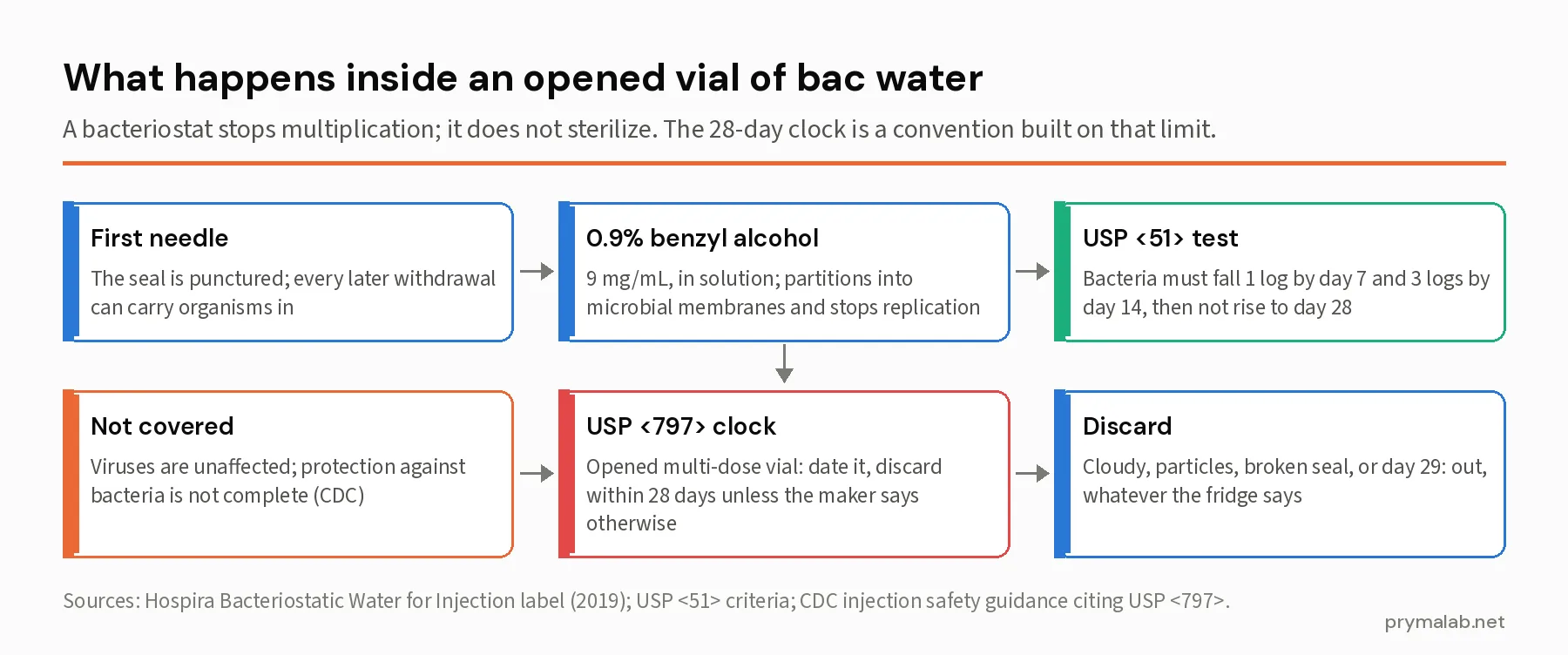
The standard that defines 'preserved' is USP General Chapter 51, the antimicrobial effectiveness test. A product is inoculated with a panel of challenge organisms, bacteria, a yeast and a mold, and counted over four weeks. For Category 1 products, which are injections, the bacteria must show 'no less than 1.0 log reduction for the initial calculated count at 7 days', 'not less than 3.0 log reduction at 14 days', and 'no increase from the 14 days' count at 28 days'; yeasts and molds must show 'no increase from the initial calculated count at 7, 14, and 28 days'.[6] Read that carefully: a preserved injection is allowed to take two weeks to knock a bacterial challenge down a thousandfold, and the requirement for yeast and mold is only that they do not grow. This is a standard for holding contamination in check across a defined window, not for making a dirty vial clean.
Two consequences follow. The first is that technique still matters: a preserved vial entered with an unswabbed stopper or a reused needle is being asked to do more than it was tested for. The second is that the window has an end. The 28-day test period in USP <51>, and the 28-day discard convention in USP <797> described next, are two separate rules, but they describe the same reality: the data on how a preservative performs run out at four weeks.
How long is bacteriostatic water good for: the expiry date, the 28-day rule and the fridge
This is the most-asked question about bac water, and it has two answers depending on whether the seal is intact. Unopened, the vial is good until the expiry printed on it, stored as the label says, 'at 20 to 25°C (68 to 77°F)', which is controlled room temperature, not a refrigerator.[1] Opened, the answer comes from a different document. The Hospira label sets no discard date for a punctured vial; the rule is in USP General Chapter 797 and the CDC states it in one sentence: 'Once a multi-dose vial is opened (e.g., needle-punctured) the vial should be dated and discarded within 28 days unless the manufacturer states another date for that opened vial.'[5] The instruction has two halves and both are meant: write the date on the vial, and throw it away at four weeks.
| Question | Answer | Basis |
|---|---|---|
| Does bac water expire? | Yes. Unopened, it is good to the printed expiry date at controlled room temperature. | Hospira label: store at 20 to 25 °C |
| How long is it good for once opened? | 28 days from the first puncture, dated on the vial, unless the manufacturer states another date. | USP <797>, as stated by CDC |
| How long does it last in the fridge? | The same 28 days. Refrigeration is not required by the label and does not extend the USP window. | Hospira label; USP <797> |
| Can it be used after 28 days? | The convention says discard. The preservative's tested window (USP <51>) ends at 28 days; nothing shows what happens after. | USP <51> and <797> |
| What if it looks cloudy? | Discard. The label: 'Do not use unless the solution is clear and seal intact.' | Hospira label |
| What about the peptide dissolved in it? | A different question. The peptide's stability sets the clock from then on, and it is usually shorter than 28 days. | Peptide storage guide |
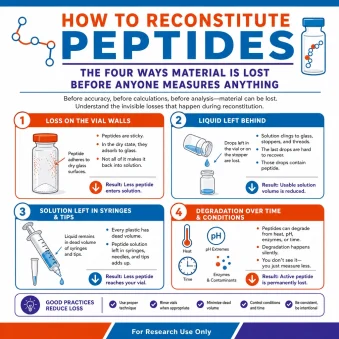
The refrigerator question deserves its own sentence because the searches suggest people expect cold to buy time. It does not, for the water. Benzyl alcohol works at room temperature and the USP window is written without regard to storage temperature; a vial kept cold since opening is still a 28-day vial. Cold matters for what is dissolved in the water, and that is where the storage and stability guide takes over: a reconstituted peptide has its own degradation chemistry, hydrolysis, oxidation and aggregation among them, and a preserved diluent does nothing to slow any of those. The 28 days are the ceiling for the solvent, not a promise about the solute.
A practical habit follows from all of this. Write the date on the vial at the first entry, keep it sealed and out of light between uses, swab the stopper every time, and treat cloudiness, particles or a compromised seal as the end of the vial whatever the calendar says. PrymaLab's own product page puts it as 'Record the date. Preserved does not mean indefinite', which is the right summary.
Bacteriostatic water vs sterile water: one ingredient, every difference
Sterile Water for Injection, USP is defined by what it lacks. A current label describes it as 'a sterile, nonpyrogenic preparation of water for injection which contains no bacteriostat, antimicrobial agent or added buffer and is supplied only in single-dose containers to dilute or dissolve drugs for injection', with a pH of 5.0 to 7.0.[7] Take the benzyl alcohol out of bac water and this is what remains, and because nothing holds back contamination once the container is opened, the packaging rule is absolute: single-dose containers, entered once. The CDC's instruction for anything packaged that way is 'never use medications packaged as single-dose vials for more than one patient'.[5]
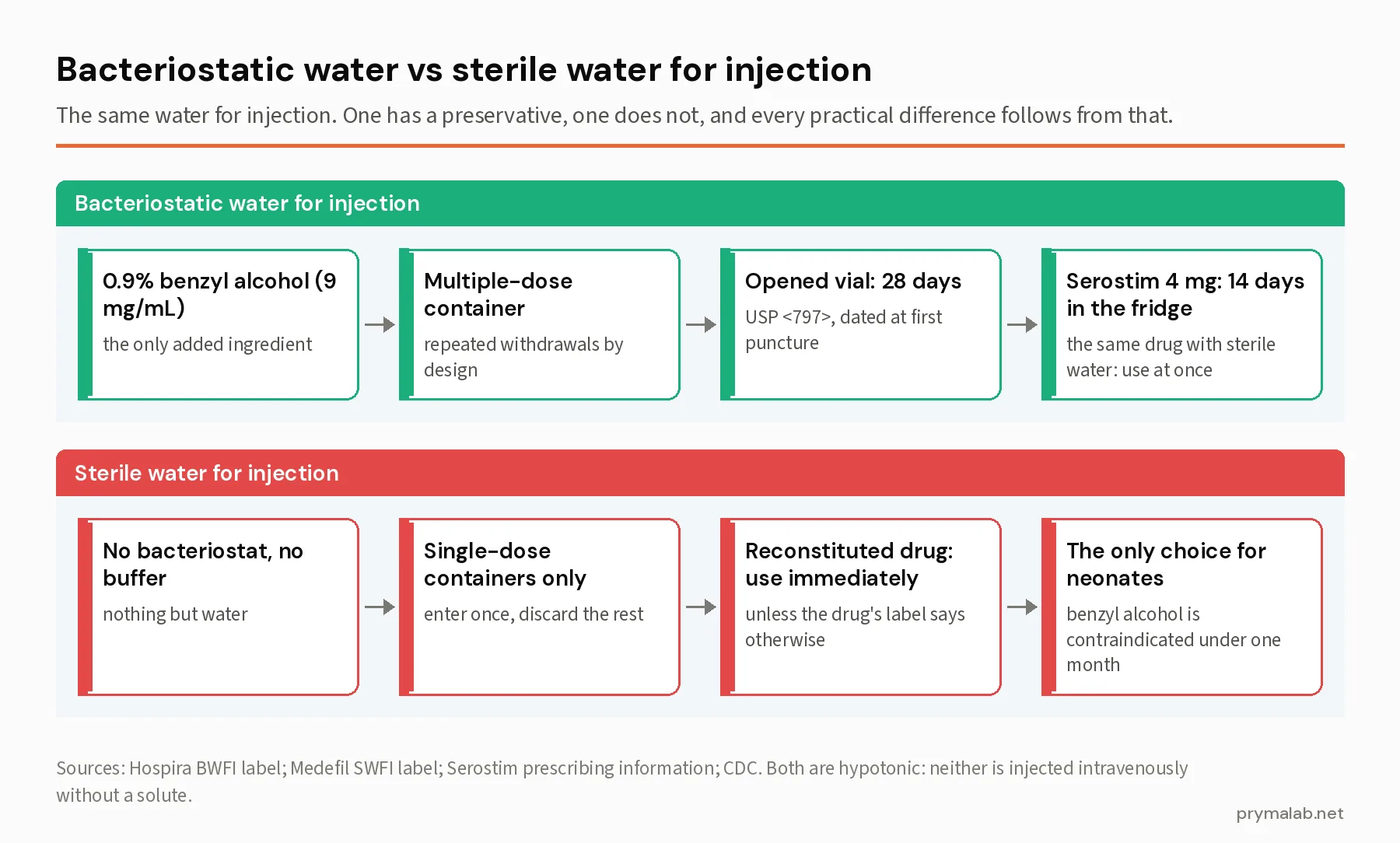
What the two share is as important as what separates them. Both are hypotonic, and both labels carry the same warning: intravenous administration 'without a solute may result in hemolysis', with the instruction not to inject intravenously 'unless the osmolar concentration of additives results in an approximate isotonic admixture'.[1][7] Neither is saline. Both are 'Rx only'. And both are, chemically, the same water; the preservative changes how the container is handled, not what the water can dissolve.
The neatest demonstration of the difference sits on one prescribing information sheet. Serostim, a somatropin product, comes in three vial sizes with two diluents. The 4 mg vial is reconstituted with 'Bacteriostatic Water for Injection with 0.9% benzyl alcohol as a preservative' and the resulting solution 'may be refrigerated at 2°C to 8°C (36°F to 46°F) for up to 14 days'. The 5 mg and 6 mg vials are reconstituted with sterile water, and for those the label says: 'Use the reconstituted solution immediately and use only one dose per vial for one patient. Discard any unused portion.'[8] Same protein, same manufacturer, same day; fourteen days of use with the preservative, one use without it. The label adds a third instruction that belongs in this comparison: the preserved diluent is not used for a patient with a known hypersensitivity to benzyl alcohol 'or in pregnant or lactating women', who get the sterile water and the single-use rule instead.[8]
Trastuzumab tells the same story at a larger scale. The 420 mg multiple-dose vial of Ogivri ships with a 20 mL vial of bacteriostatic water for injection at 0.9 to 1.1% benzyl alcohol, and the reconstituted solution is refrigerated and discarded 'after 28 days'; the label continues, 'If Ogivri is reconstituted with SWFI without preservative, use immediately and discard any unused portion.'[9] Chorionic gonadotropin (Novarel) is a third example: 'When reconstituted with Bacteriostatic Water for Injection preserved with benzyl alcohol 0.9%, the solution should be refrigerated and used within 30 days.'[10] Fourteen, twenty-eight and thirty days: the number is set by the drug's own stability data, and the preservative is what makes any number above zero possible.
Bac water vs saline, bacteriostatic saline and 'reconstitution solution'
Two more bottles get confused with bac water, and one label does. The first is 0.9% sodium chloride injection, normal saline, which is isotonic because of its salt and is packaged with or without a preservative. The preserved version, Bacteriostatic 0.9% Sodium Chloride Injection, USP, is 'a sterile, nonpyrogenic, isotonic solution of sodium chloride in water for injection. Each milliliter (mL) contains sodium chloride 9 mg and 0.9% (9 mg/mL) benzyl alcohol added as a bacteriostatic preservative', with a pH of 5.0 (4.5 to 7.0), in multiple-dose 10, 20 and 30 mL vials, and it carries the same 'not for use in neonates' warning as bac water.[11] It is bac water with salt in it. The salt is the difference that matters for anything going into tissue or a vein, because the preserved saline is isotonic and bac water is not; for dissolving a powder in a laboratory, the salt is simply another variable, and some peptides are less soluble in it.
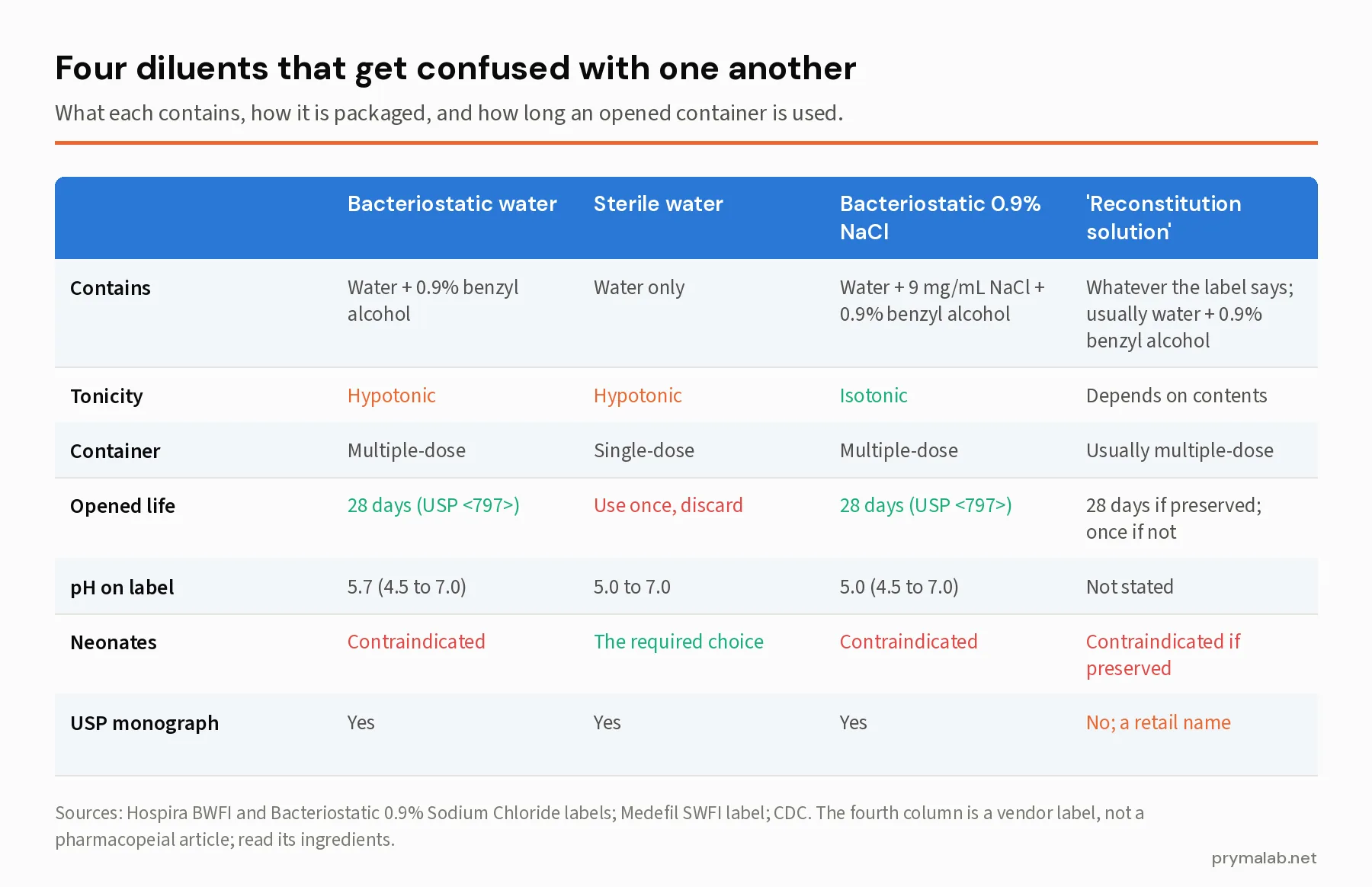
Is reconstitution solution the same as bacteriostatic water?
Usually, and the word 'usually' is the whole problem. 'Reconstitution solution' has no monograph in the United States Pharmacopeia and no meaning in a drug label; it is a name that research-chemical vendors put on diluent vials. On most such listings the declared ingredients are water and benzyl alcohol at 0.9%, in which case the vial is bacteriostatic water under a different name and everything above applies to it, including the 28 days. On others the contents are sterile water with no preservative, in which case the vial should be treated as single-use, and a few are dilute acetic acid, sold for peptides that dissolve poorly at neutral pH. There is no way to tell from the name. The ingredient line decides, and a listing that has no ingredient line has answered the question in its own way.
| The label says | What it is | Opened-container rule | Notes |
|---|---|---|---|
| Water for injection, 0.9% benzyl alcohol | Bacteriostatic water | 28 days, dated (USP <797>) | The standard research-peptide diluent |
| Water for injection, 1.1% benzyl alcohol | Bacteriostatic water, higher strength | 28 days, dated | Used with some biologics (trastuzumab) |
| Water for injection, nothing else | Sterile water | Single entry; discard the rest | Only choice where benzyl alcohol is excluded |
| Sodium chloride 9 mg/mL, 0.9% benzyl alcohol | Bacteriostatic saline | 28 days, dated | Isotonic; salt can reduce solubility of some peptides |
| Sodium chloride 9 mg/mL, no preservative | Normal saline, single-dose | Single entry | Isotonic; nasal spray vehicles are usually this |
| Acetic acid, dilute | Acidic reconstitution vehicle | Per the vendor | For peptides that need low pH to dissolve; not preserved |
| No ingredients listed | Unknown | Unknown | Do not assume it is preserved |
Distilled water, deionized water and bottled water are not on that table because they are not injection-grade: no sterility, no endotoxin limit, no preservative, and no place in reconstituting anything that will be measured. The 'how to make bac water at home' searches get a one-line answer in the regulatory section below.
Why the label says 'not for use in neonates': the 1982 gasping syndrome
Every vial of bacteriostatic water and bacteriostatic saline carries the same capitalized warning, and it has a specific origin. In June 1982 the CDC reported sixteen neonatal deaths at two medical centers, ten at one institution over six months and six at the other over sixteen months. The infants, all premature and of low birth weight, had developed 'metabolic acidosis progressing to respiratory distress and gasping respirations', with central nervous system dysfunction, hypotension and cardiovascular collapse. The common factor was bacteriostatic normal saline 'containing 9 mg/ml benzyl alcohol' used to flush their intravascular catheters, many times a day, in babies too small to metabolize it; their estimated 'daily intake of benzyl alcohol ranging from 99 to 405 mg/kg/day'. The FDA's response was to advise that 'intravascular flush solutions containing benzyl alcohol not be used for newborns and that diluents with this preservative not be used as medications for these infants', and the report notes that at both centers 'similar deaths have not occurred since flush solutions without preservatives have been substituted'.[12]
The label language descends from that report. Contraindications: 'Due to the potential toxicity of benzyl alcohol in neonates, solutions containing benzyl alcohol must not be used in this patient population.' Warnings: 'Where water is required for preparing or diluting medications for use in neonates, only preservative-free Sterile Water for Injection should be used.'[1] The label also excludes the preparation from epidural and spinal anesthesia and from fluid replacement, both of which would deliver far more benzyl alcohol than a diluent volume ever does.[1]
Two things keep the warning in proportion. The intakes in 1982 were enormous relative to any diluent use: 99 mg/kg/day at the low end is the benzyl alcohol content of eleven milliliters of bac water per kilogram of body weight per day, in infants weighing around a kilogram. And the mechanism is metabolic capacity, not an allergy or a reaction to benzyl alcohol as such; adults clear the compound through benzoic acid to hippuric acid quickly, and the label's own animal-derived figure for the adult margin is an estimated 30 mL intravenously.[1][3] The warning is absolute for neonates because their capacity is absent, and it is a reason for care rather than alarm everywhere else. Hypersensitivity to benzyl alcohol exists and is the reason drug labels such as Serostim's provide a sterile-water alternative.[8]
| Figure | Value | Context | Source |
|---|---|---|---|
| Concentration | 9 mg/mL (0.9%) | The preservative content of bac water and bacteriostatic saline | Hospira labels |
| Per 0.1 mL withdrawn | 0.9 mg | Arithmetic from the concentration | Calculation |
| Toxic intakes, 1982 | 99 to 405 mg/kg/day | Premature infants, catheter flushes many times daily | CDC MMWR 1982 |
| Infant sensitivity | 9 mL to a 6 kg infant | 'Potentially capable of producing blood pressure changes' | Hospira label |
| Adult margin (animal-derived) | Up to 30 mL intravenously | 'Without toxic effects', from animal studies of the 0.9% preparation | Hospira label |
| Metabolism | Benzoic acid, then hippuric acid | Glycine conjugation in the liver; rapid in healthy adults, deficient in neonates | Wikipedia |
Bac water for peptides: what the preservative does and does not do to a peptide
The question a peptide laboratory needs answered is whether the benzyl alcohol interferes with the thing being dissolved. For proteins, sometimes it does, and the formulation literature is candid about it. Benzyl alcohol is 'the most widely used antimicrobial preservative in multidose protein formulations, and has been shown to cause protein aggregation', a process that the same group showed proceeds 'via partial unfolding'.[13] A study of recombinant human G-CSF found that 0.9% benzyl alcohol 'accelerated aggregation of rhGCSF at pH 7.0, an effect that was much greater at 37 degrees C than at 25 degrees C', and that the preservative 'altered the tertiary structure of rhGCSF at both pH, without detectably altering secondary structure'.[14] That is the mechanism in one line: benzyl alcohol loosens the folded, three-dimensional structure of a protein, and a loosened protein is more likely to stick to its neighbors. It is why several biologics limit their preserved solution to 14 or 28 days and why some are formulated with sterile water and used at once.
Most research peptides are a different kind of molecule. A 16-residue peptide, a tripeptide or a 28-residue analog has little or no tertiary structure to loosen; it is a chain, not a fold, and the aggregation route that troubles a 20 kDa protein has much less to work on. The honest statement is a bounded one: the published benzyl alcohol data are on proteins; peptide-specific studies of the preservative are thin; and the effects that dominate a reconstituted peptide's shelf life, hydrolysis, oxidation of methionine and cysteine, deamidation and adsorption to glass and plastic, are the same in bac water as in any other water. The storage and stability guide covers those four chemistries and which sequences they apply to.
Two properties of the water do matter to a peptide, and neither is the preservative. The first is pH. Bacteriostatic water is unbuffered; its label pH of 5.7 with a range of 4.5 to 7.0 is what the water and the benzyl alcohol happen to give, and a peptide with basic or acidic residues will move it.[1] Peptides that dissolve poorly near neutrality are the reason dilute acetic acid vehicles exist, and the reconstitution guide covers solubility by sequence. The second is compatibility in the general sense the label uses: 'Some drugs for injection may be incompatible in a given vehicle, or when combined in the same vehicle or in a vehicle containing benzyl alcohol.'[1] For a research peptide that means one thing: the vendor's certificate and the reconstitution guide are the references for the vehicle, and a blend of several peptides in one vial is a compatibility experiment with no label behind it.
The remaining questions are mechanical and are answered elsewhere so as not to repeat them: how much water to add is concentration arithmetic, covered by the peptide calculator; the technique of adding it is in the reconstitution guide; and the case for skipping the diluent altogether, a preloaded pen, is in the pen versus vial guide. PrymaLab's 10 mL and 3 mL vials are 0.9% benzyl alcohol in water for injection, supplied as a laboratory reagent for research reconstitution, and the product pages state the first-entry-date and 28-day conventions described above.
Prescription status, research-grade bac water, and the 'make it at home' question
The regulatory position is simpler than the search volume suggests. Bacteriostatic Water for Injection, USP is a drug. Its label says 'Rx only', 'for drug diluent use only' and 'not for use in neonates', it is registered with the FDA under a National Drug Code, and it is manufactured by Hospira and, on current DailyMed listings, by other labelers including a Chinese manufacturer whose 30 mL vials appeared in 2026.[1] A pharmacy dispenses it against a prescription; it is not an over-the-counter product, and the searches asking whether a prescription is needed are answered by the two words on the vial.
Research-grade bacteriostatic water is a different article. It is sold as a laboratory reagent for dissolving research materials, under research-use terms, and PrymaLab's own listing says so directly: it is 'not a drug product', 'approved bacteriostatic water for injection is a separate regulated article', and the product 'must not be given to humans or animals'. That is the line this whole reference sits on. Everything quoted above from the approved label is quoted to explain what the preserved water is and how a multiple-dose vial behaves; none of it converts a reagent into a drug, and none of it is guidance for administering anything. The legal status guide covers the research-use framework in general.
| Article | Status | What the label or listing says | Source |
|---|---|---|---|
| Bacteriostatic Water for Injection, USP | FDA-registered prescription drug | 'Rx only'; 'for drug diluent use only'; 'not for use in neonates' | Hospira label, DailyMed |
| Sterile Water for Injection, USP | FDA-registered prescription drug | Single-dose; no bacteriostat; hemolysis warning | Medefil label, DailyMed |
| Bacteriostatic 0.9% Sodium Chloride, USP | FDA-registered prescription drug | Isotonic; 0.9% benzyl alcohol; 'not for use in neonates' | Hospira label, DailyMed |
| Research-grade bacteriostatic water | Laboratory reagent, research use only | 'Not a drug product'; 'must not be given to humans or animals' | PrymaLab product page |
| 'Reconstitution solution' | Retail name; no monograph | Whatever its ingredient line declares | Vendor listings |
| Home-made 'bac water' | Not an article of any kind | No sterility, no endotoxin control, no USP water | This reference |
Can bac water be made at home?
No, and the reason is not the benzyl alcohol, which is easy to buy. It is everything else on the label. 'Sterile' means processed and sealed so that no viable organism is present, verified by a test; 'nonpyrogenic' means bacterial endotoxin below a set limit, which boiling does not remove because endotoxin is heat-stable; 'water for injection' is a grade produced by distillation or equivalent under conditions that keep it that way. A kitchen can produce clean water with benzyl alcohol in it. It cannot produce a nonpyrogenic sterile preparation, cannot verify one, and cannot preserve one, because the preservative was never meant to rescue a solution that started contaminated. The USP <51> criteria above are a test of holding a challenge in check, not of curing it.[6]
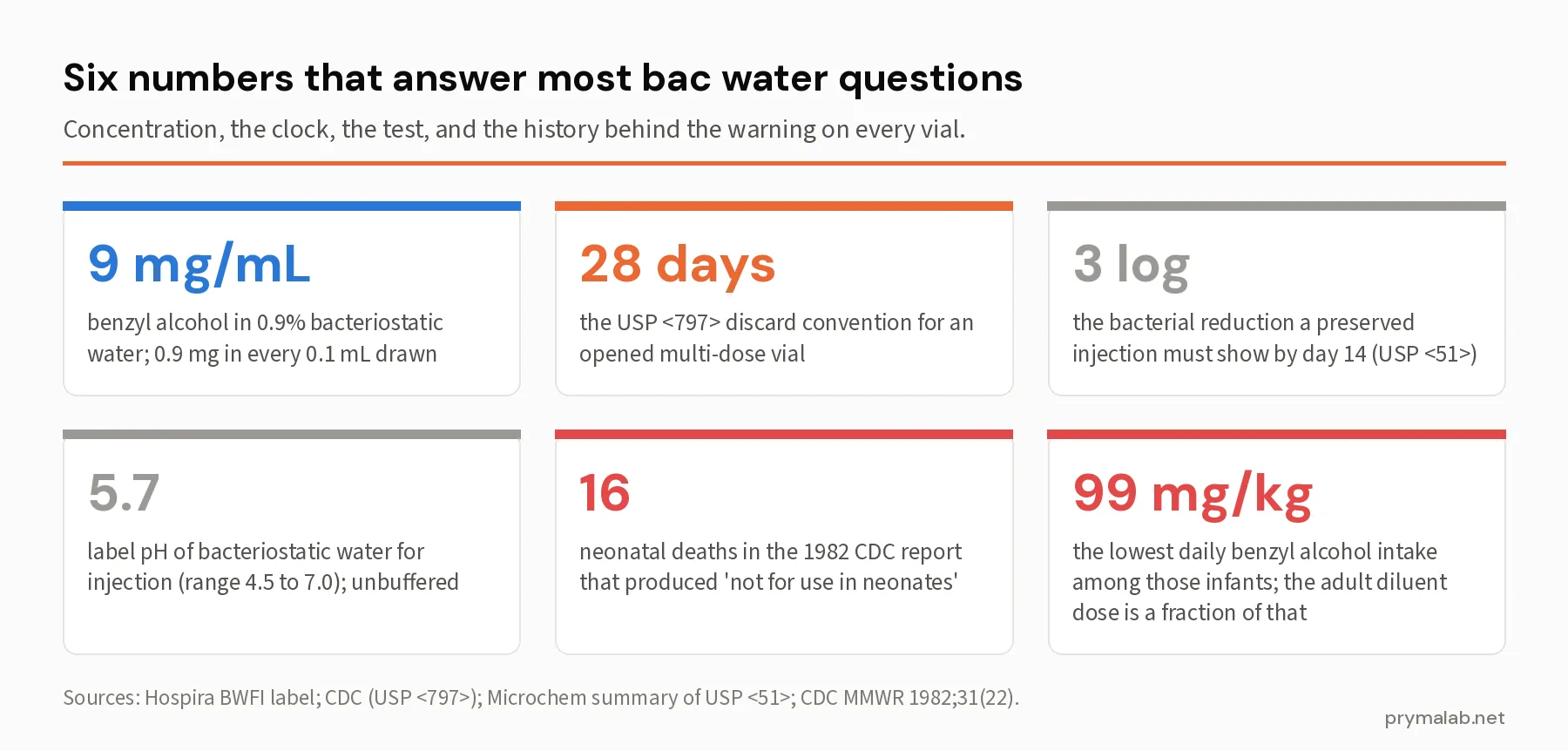
The version of the story the documents support: bac water is water for injection with nine milligrams per milliliter of benzyl alcohol, a preservative that holds contamination in check for a tested window of four weeks and does nothing else; sterile water is the same water without it, opened once; saline is a different thing with salt; 'reconstitution solution' is a name; the neonatal warning comes from sixteen deaths in 1982 at intakes no diluent approaches; the approved article is a prescription drug and research-grade vials are reagents; and for a short research peptide the preservative is neither a threat nor a help, because what limits the peptide's life is the peptide.
What this article does not settle
Peptide-specific preservative effects. The aggregation data are on proteins (G-CSF, interferon alpha-2a, IL-1 receptor antagonist and others). I could not find published studies of benzyl alcohol's effect on the short research peptides most laboratories dissolve in it, so the article reasons from structure and says so.
Manufacturer-specific opened-vial dates. The Hospira label states none, so the USP <797> 28-day convention applies; another labeler's vial could state a different date and that date would govern.
What research-grade vials contain beyond their declared ingredients. A reagent is only as good as its certificate; the article describes the pharmacopeial article and the conventions, not the contents of any particular vendor's vial.
Behavior after day 28. No retrievable source characterizes a preserved vial beyond the tested window. The absence of data is the reason for the rule, not evidence that day 29 is safe.
What is well established: the composition, pH and container of the approved article; the bacteriostatic mechanism and its limits; the USP <51> criteria and the USP <797> 28-day convention; the single-dose rule for sterile water; the 1982 report and the neonatal contraindication; the label warnings on tonicity and hemolysis; the diluent instructions on the Serostim, Ogivri and Novarel labels; and the prescription status of the USP article.
Bac water, BWFI, SWFI, USP and BUD: what the names mean
Bac water is shorthand for bacteriostatic water, and 'bacteriostatic' means an agent that stops bacteria multiplying without necessarily killing them, as distinct from 'bactericidal'.[2] BWFI is Bacteriostatic Water for Injection, the USP article containing 0.9% or 1.1% benzyl alcohol; SWFI is Sterile Water for Injection, the same grade of water with no preservative in single-dose containers.[1][7] USP is the United States Pharmacopeia, whose monographs define both articles and whose General Chapter 51 sets the antimicrobial effectiveness test and General Chapter 797 the handling of sterile preparations, including the 28-day beyond-use date, or BUD, for an opened multiple-dose container.[5][6] 'Rx only' on a label means the article is dispensed by prescription. 'Nonpyrogenic' means bacterial endotoxin is below the pharmacopeial limit. 'Reconstitution solution' is a vendor term with no pharmacopeial definition.
Frequently asked questions
What is bac water?
Bacteriostatic water for injection: water for injection with 0.9% (9 mg/mL) benzyl alcohol added so a multiple-dose vial can be entered repeatedly. No salt, no buffer, hypotonic.
What is in bacteriostatic water?
Water for injection and 0.9% (9 mg/mL) benzyl alcohol, nothing else; pH 5.7 (4.5 to 7.0). A 1.1% strength also exists.
How long is bacteriostatic water good for?
Unopened: to the printed expiry at room temperature. Opened: dated at first puncture and discarded within 28 days (USP <797>). Cloudy or particles: discard at once.
How long does bac water last in the fridge?
Still 28 days from the first puncture. Refrigeration is not required for the water and does not extend the USP window; it matters for the dissolved peptide, not the diluent.
What is the difference between bacteriostatic water and sterile water?
Bacteriostatic water has 0.9% benzyl alcohol and is a multiple-dose vial (28 days); sterile water has no preservative and is single-dose, used once. Both are hypotonic; sterile water is the only choice for neonates.
Is reconstitution solution the same as bacteriostatic water?
Usually, but not by definition: it is a retail name. If the ingredients say water and 0.9% benzyl alcohol, it is bac water. Some are unpreserved sterile water or dilute acetic acid. The ingredient line decides.
Is bacteriostatic water the same as saline?
No. Saline is 0.9% sodium chloride and isotonic; bac water has no salt and is hypotonic. Bacteriostatic saline exists and is saline plus 0.9% benzyl alcohol.
Why does bacteriostatic water say 'not for use in neonates'?
Benzyl alcohol. Sixteen premature infants died in 1982 after repeated flushes with 9 mg/mL benzyl alcohol saline (99 to 405 mg/kg/day); newborns cannot metabolize it. The label has said 'not for use in neonates' since.
Does benzyl alcohol damage peptides?
It can unfold and aggregate folded proteins (documented for G-CSF and interferon alpha-2a). Short linear peptides have little structure to unfold; their shelf life is set by their own chemistry, not the preservative.
Do I need a prescription for bacteriostatic water?
The USP drug is 'Rx only'. Research-grade bacteriostatic water is sold as a laboratory reagent for research use, and is not the drug and not for human or animal use.
Can you make bacteriostatic water at home?
No. Sterility, endotoxin control and water-for-injection grade cannot be produced or verified at home, and a preservative does not rescue a solution that starts contaminated.
How much bac water goes in a peptide vial?
It is concentration arithmetic, not a property of the water; the peptide calculator and the reconstitution guide cover volumes and technique. The label puts it the same way: the volume depends on the drug and its manufacturer's instructions.
References
- Hospira, Inc. (Pfizer). Bacteriostatic Water for Injection, USP: prescribing information, revised 08/2019. Composition, pH, indications, contraindications, warnings, precautions, adverse reactions, dosage and administration, how supplied. DailyMed. DailyMed
- Wikipedia. Bacteriostatic agent. Definition and the distinction from bactericides. Wikipedia
- Wikipedia. Benzyl alcohol. Formula, molar mass, water solubility, preservative use, neonatal toxicity and metabolism. Wikipedia
- Meyer BK, Ni A, Hu B, Shi L. Antimicrobial preservative use in parenteral products: past and present. J Pharm Sci. 2007;96(12):3155-3167. doi:10.1002/jps.20976. PMID 17722087. Wiley
- Centers for Disease Control and Prevention. Injection safety: clinical safety guidance for healthcare providers. Multi-dose vial dating and the 28-day discard rule citing USP General Chapter 797; single-dose vials; the limits of preservatives. CDC
- Microchem Laboratory. USP <51> passing criteria. Category 1 (injections) log-reduction requirements for bacteria, yeasts and molds at 7, 14 and 28 days. Microchem
- Medefil, Inc. Sterile Water for Injection, USP: prescribing information. Composition, single-dose packaging, pH, hemolysis warning. DailyMed. DailyMed
- EMD Serono, Inc. Serostim (somatropin) for injection: prescribing information. Section 2.2, preparation with bacteriostatic water (4 mg vial, 14 days refrigerated) versus sterile water (5 mg and 6 mg vials, immediate use); benzyl alcohol hypersensitivity and pregnancy. DailyMed. DailyMed
- Biocon Biologics. Ogivri (trastuzumab-dkst) for injection: prescribing information. Reconstitution of the 420 mg multiple-dose vial with 20 mL bacteriostatic water for injection (0.9 to 1.1% benzyl alcohol), 28-day refrigerated storage, and immediate use with sterile water. DailyMed. DailyMed
- Ferring Pharmaceuticals. Novarel (chorionic gonadotropin) for injection: prescribing information. Reconstitution with bacteriostatic water 0.9% benzyl alcohol; refrigerate and use within 30 days. DailyMed. DailyMed
- Hospira, Inc. Bacteriostatic 0.9% Sodium Chloride Injection, USP: prescribing information, revised 02/2019. Composition, isotonicity, pH, vial sizes, neonatal warning. DailyMed. DailyMed
- Centers for Disease Control and Prevention. Neonatal deaths associated with use of benzyl alcohol: United States. MMWR. 1982;31(22):290-291. Sixteen deaths, the gasping syndrome, intakes of 99 to 405 mg/kg/day, and the FDA advice. CDC MMWR
- Bis RL, Singh SM, Cabello-Villegas J, Mallela KM. Role of benzyl alcohol in the unfolding and aggregation of interferon α-2a. J Pharm Sci. 2015;104(2):407-415. doi:10.1002/jps.24105. PMID 25100180. Wiley
- Thirumangalathu R, Krishnan S, Brems DN, Randolph TW, Carpenter JF. Effects of pH, temperature, and sucrose on benzyl alcohol-induced aggregation of recombinant human granulocyte colony stimulating factor. J Pharm Sci. 2006;95(7):1480-1497. doi:10.1002/jps.20619. PMID 16729274. Wiley
Label statements come from the current prescribing information on DailyMed for the Hospira, Medefil, EMD Serono, Biocon and Ferring products named above, read on 23 September 2026. The 28-day convention is USP General Chapter 797 as stated by the CDC; the antimicrobial effectiveness criteria are USP General Chapter 51 as summarized by a contract testing laboratory. PrymaLab's product pages are quoted for the research-use statements only.
Final disclaimer: This article is an educational reference on the composition, handling and regulatory status of bacteriostatic water and related diluents. Bacteriostatic water supplied by PrymaLab is a laboratory reagent sold for research use only; it is not the FDA-approved drug Bacteriostatic Water for Injection, USP and is not for human or veterinary use. Statements have not been evaluated by the FDA. Nothing here is medical advice.
Prescribing-information statements are quoted to describe the approved articles and are reported as label facts; they do not describe or support any use of research-grade material. No reconstitution volume, dose or administration guidance appears here. Always verify the legal status of any research material in your jurisdiction before purchase or use.