15% fall discount applied automatically at checkoutFree USA shipping over $100Free worldwide shipping over $200Credit/debit checkout disabled for updates
Sign in 0

KissPeptin-10 (10mg)

(19 customer reviews)

$59.99 or subscribe for $49.99/mo

Four peptides come from the KISS1 gene and all four end in the same ten residues. The number in kisspeptin-10 is a fragment length rather than a version number, and the human and rodent decapeptides are different articles. Laboratory research use only.

Description

PrymaLab · Research Use Only

Kisspeptin-10 10mg

The number in the name is a fragment length, not a version

Kisspeptin-10 is named for its length. One gene produces a precursor, the precursor is cleaved into four peptides of different sizes, and this is the shortest of them. All four end in the same ten residues, which is why the number in the name describes where a molecule was cut rather than which version of it you have.

Specification Table

Kisspeptin-10 identity data
Property Value
Compound Kisspeptin-10, human
Also called KP-10, and metastin 45-54
CAS number 374675-21-5
Sequence, human Tyr-Asn-Trp-Asn-Ser-Phe-Gly-Leu-Arg-Phe-NH2
Sequence, rat and mouse Identical except the C-terminal residue, which is tyrosine rather than phenylalanine
Molecular formula, human C63H83N17O14
Molecular weight, human 1302.46
Molecular weight, rat and mouse Approximately 1318.5, around sixteen daltons heavier
Gene KISS1
Sibling peptides Kisspeptin-54, kisspeptin-14 and kisspeptin-13, all sharing this C-terminal decapeptide
C terminus Amidated. An RF-amide in the human form
Receptor The kisspeptin receptor, previously named GPR54 and also written KISS1R
Numbering, human Residues 45 to 54 of the metastin numbering, or 112 to 121 of the KiSS-1 numbering
Numbering, rodent Residues 110 to 119, which is why catalogue entries disagree
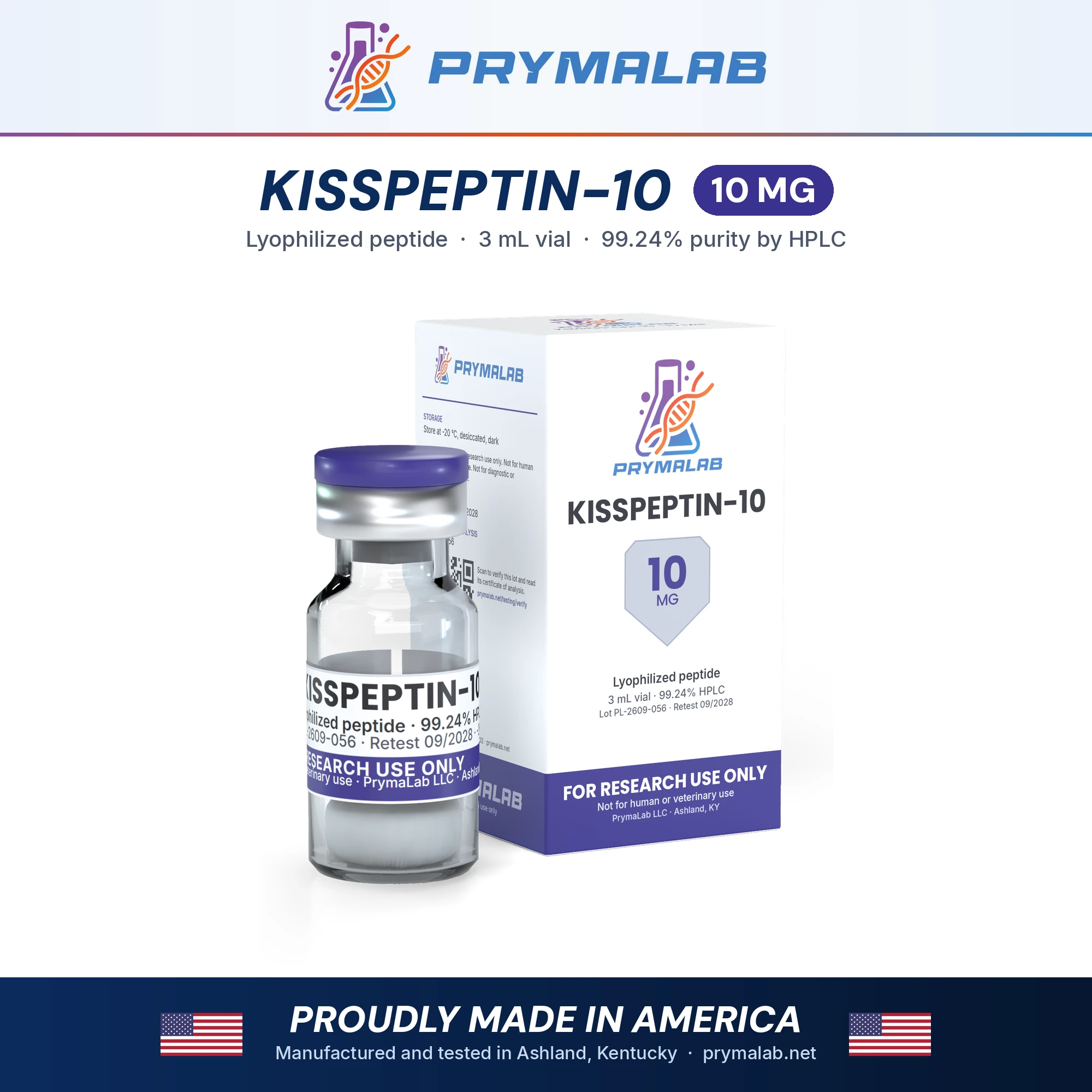
Vial 10mg lyophilized
Storage Sealed at minus 20°C. Protect from light and moisture

What Does the Number in Kisspeptin-10 Mean?

The KISS1 gene encodes a precursor protein. Processing cleaves that precursor into peptides, and four of them have established activity.

They are named by length: kisspeptin-54, kisspeptin-14, kisspeptin-13 and kisspeptin-10.

The largest was originally called metastin, because the gene was identified as a metastasis suppressor in melanoma before its endocrine role was understood, and a paper using that older name may still be describing work done with kisspeptin-10.

The four are not variants of one another in the way that isoforms usually are, and kisspeptin-10 is not the odd one out among them. They are nested. Each shorter peptide is contained within the longer ones, and all four terminate at the same point.

The shared ending is the C-terminal decapeptide, which is kisspeptin-10.

So kisspeptin-10 is not a truncated version of kisspeptin-54 in the sense of being a partial one. It is the conserved active portion that all four carry, with the additional residues stripped away.

Kotani and colleagues established this arrangement in 2001, isolating the peptides from human placenta and showing that the 54, 14 and 13 residue forms all activate the same receptor.

The practical consequence is that a paper reporting an effect of kisspeptin may have used any of the four, and the reader has to check which.

Does Kisspeptin-10 Behave Like Its Longer Siblings?

They share a receptor and they share the sequence that engages it, which is why they are grouped together at all.

They do not share everything else.

Length affects clearance, distribution and susceptibility to peptidases, and a 54 residue peptide and a 10 residue one differ substantially on all three.

The published literature is correspondingly split. Some questions have been addressed mainly with the decapeptide and some mainly with the longer form, and results from one are not automatically transferable to the other.

The review by Pinilla and colleagues covers this in depth, and the useful discipline it suggests is simple: when reading a figure, check which peptide generated it before carrying the number anywhere.

For kisspeptin-10 specifically, the short length is both the attraction and the limitation.

It is the smallest fragment that retains activity, which makes it the cleanest tool for asking receptor level questions, and it is short enough that its behaviour in a whole animal differs from the endogenous peptides in ways that matter for interpretation.

None of that is a criticism of the compound. It is a statement about what a fragment can and cannot stand in for.

Which Species Is on the Label?

This is the kisspeptin-10 identity question most likely to go unnoticed, and it changes what is in the vial.

The human decapeptide ends in phenylalanine. The rat and mouse decapeptide ends in tyrosine.

Everything before that final residue is identical across the three species. One position differs, and it is the last one.

A tyrosine is a phenylalanine with a hydroxyl group added to the ring, so the substitution adds sixteen daltons. The human form calculates to 1302.46 and the rodent form to approximately 1318.5.

That is not a trivial distinction for two reasons.

The first is analytical. Sixteen daltons on 1302 is just over one percent, and it happens to be the same mass shift that oxidation of a susceptible residue would produce, so a mass spectrum read without knowing which species was ordered can be misread in either direction.

The second is the tyrosine itself, which introduces a phenol group the human sequence does not have. That gives the rodent peptide a different absorbance profile and a different chemistry, including a site available for iodination in radioligand work.

Suppliers frequently list both forms and the difference is often buried in a product code rather than stated on the front of a listing.

The species should therefore be read from the certificate rather than inferred from the compound name, and it should be recorded, because a laboratory that switches supplier can switch species without noticing.

Why Do the Numbering Systems Disagree?

A researcher comparing catalogue entries for kisspeptin-10 will find it described as residues 45 to 54, as residues 112 to 121, and as residues 110 to 119.

All three are correct and they are counting from different starting points.

The 45 to 54 numbering counts within kisspeptin-54, the largest processed peptide, where the decapeptide occupies the last ten positions.

The 112 to 121 numbering counts within the full length human KiSS-1 precursor protein, which includes the signal sequence and the residues removed during processing.

The 110 to 119 numbering does the same thing for the rodent precursor, which is a slightly different length.

So the numbers are not in conflict. They are answers to different questions, and the disagreement is a labelling convention rather than a discrepancy in the material.

This is worth understanding rather than memorising, because the same pattern appears across the processed peptides in this catalogue and it is a recurring source of confusion when comparing suppliers.

The one thing worth checking is that a listing quoting a rodent numbering is describing rodent material, since the numbering and the species usually travel together.

Why Does the Older Receptor Name Still Appear?

The receptor was identified as an orphan G protein-coupled receptor and named GPR54 before its ligand was known.

When the kisspeptins were shown to be its ligands, the naming convention in pharmacology called for the receptor to be renamed after the ligand, and the Kirby and Davenport nomenclature review formalised the kisspeptin receptor name.

Three names are therefore in active use: GPR54, KISS1R and the kisspeptin receptor.

This is a literature retrieval problem rather than a scientific one.

A database search on one name will miss papers indexed under another, and the older name dominates the work published before the renaming, which includes the foundational receptor pharmacology.

Anyone building a kisspeptin-10 reference list should search all three terms and should expect the GPR54 results to be older and the KISS1R results to be more recent.

The same applies to the ligand side, where metastin still appears in the oncology literature that predates the endocrine work.

Searching the modern names alone returns a partial picture that looks complete, which is the worst kind of incomplete search.

A practical note on how to run that search rather than simply to intend it.

The three receptor names and the two ligand names give six starting points, and the union of those searches is materially larger than any one of them.

Running them once and keeping the combined list is a modest amount of work at the start of a project and saves rediscovering a foundational paper halfway through it.

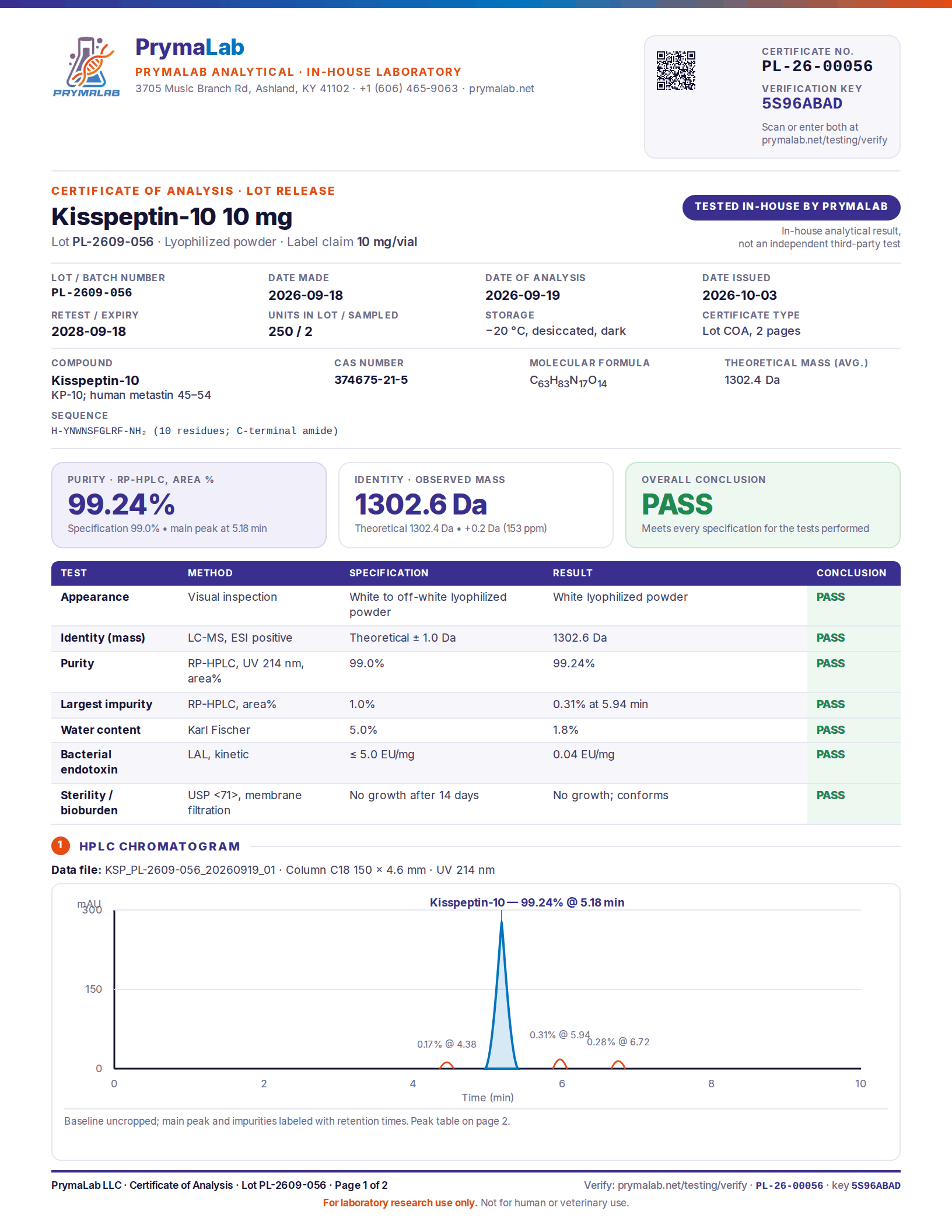
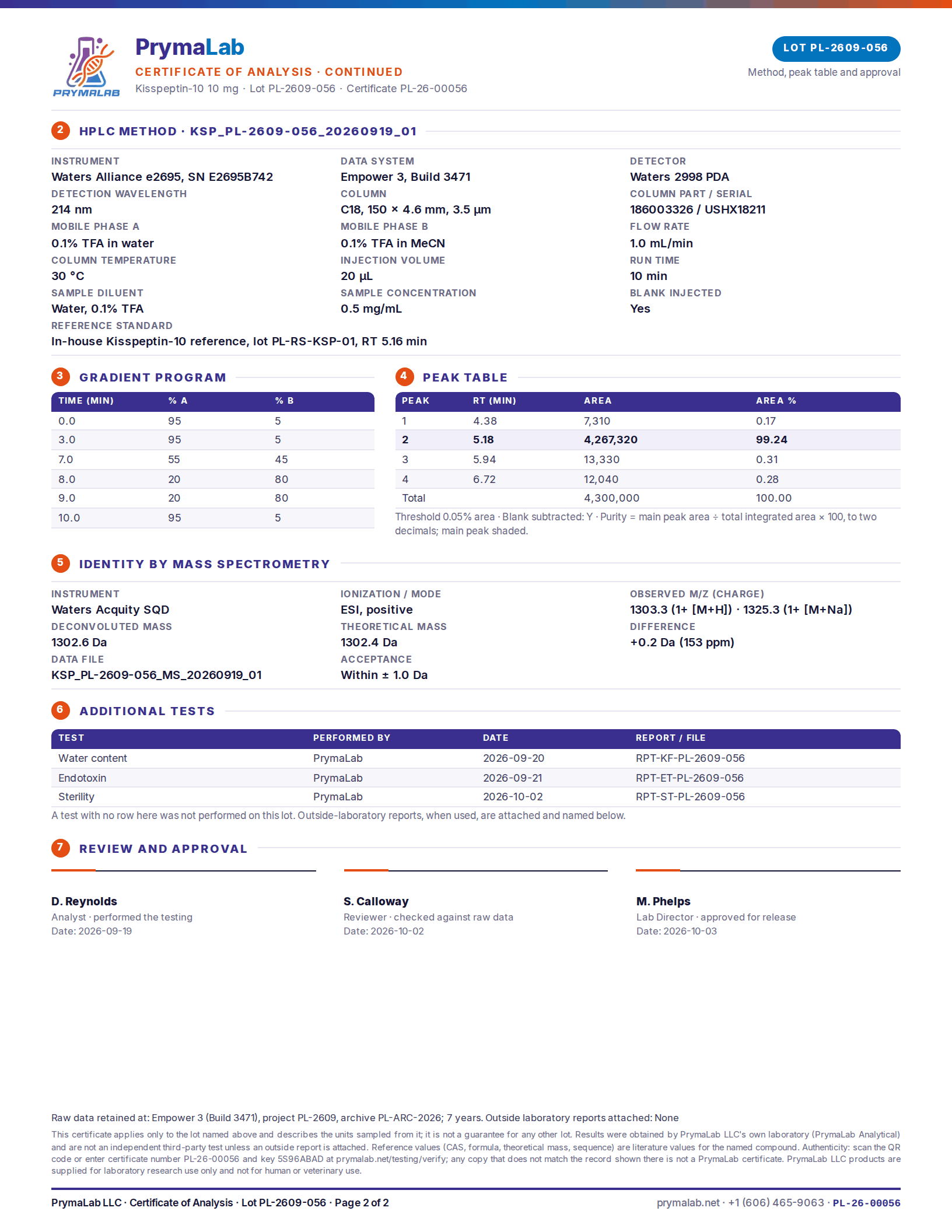
What Should a Kisspeptin-10 Certificate Show?

The full sequence in single or three letter code, which is the only field that settles both the fragment length and the species in one line.

Observed mass by spectrometry against the calculated figure for the species stated, 1302.46 for the human form.

Confirmation of the C-terminal amide, since the free acid is a different molecule with reduced activity.

Purity by chromatography, with the gradient and the column both named.

Net peptide content and the salt form, because the vial mass includes counterion and residual water.

The species, written plainly rather than encoded in a product number.

Lot number and manufacturing date.

Of those, the sequence line does the most work. A certificate that names the compound and gives a purity figure without writing the sequence out has left both the fragment identity and the species unresolved, and on a peptide family this closely nested that is not a small gap.

How Should the Vial Be Handled?

The kisspeptin-10 residues set the handling requirements: a tryptophan, two asparagines, a serine and an amidated C terminus.

Sealed lyophilized powder holds at minus 20 degrees Celsius, protected from light and moisture.

Light protection is for the tryptophan, which is photosensitive, and it is worth doing properly rather than nominally on solutions held more than a day.

Bring the vial to ambient temperature before opening, since the powder is hygroscopic and cold glass condenses room moisture onto it.

Reconstitute gently by adding diluent down the wall and letting it stand.

Keep prepared solutions near neutral pH and cold. The asparagine residues and the C-terminal amide are both hydrolytically vulnerable, and both routes accelerate away from neutral.

Aliquot on first reconstitution rather than freezing and thawing a working stock repeatedly.

Use low-binding consumables. The arginine gives the molecule a positive charge at neutral pH, and untreated glass takes cationic peptides out of dilute solution.

Record lot, species, sequence as supplied, net peptide content, diluent, pH, storage temperature and date.

Species belongs at the top of that list, because it is the one field that cannot be recovered from the vial once the paperwork has been separated from it.

Published Literature

Selected references on the identification of the peptide family, on the receptor nomenclature, on the physiology reviewed at length and on peptide storage generally.

  1. Kotani M, Detheux M, Vandenbogaerde A, Communi D, Vanderwinden JM, Le Poul E, et al. Journal of Biological Chemistry. 2001;276(37):34631-34636. DOI: 10.1074/jbc.M104847200
  2. Kirby HR, Maguire JJ, Colledge WH, Davenport AP. Pharmacological Reviews. 2010;62(4):565-578. DOI: 10.1124/pr.110.002774
  3. Pinilla L, Aguilar E, Dieguez C, Millar RP, Tena-Sempere M. Physiological Reviews. 2012;92(3):1235-1316. DOI: 10.1152/physrev.00037.2010
  4. Manning MC, Chou DK, Murphy BM, Payne RW, Katayama DS. Pharmaceutical Research. 2010;27(4):544-575. DOI: 10.1007/s11095-009-0045-6

Frequently Asked Questions

What does the 10 in kisspeptin-10 refer to?

The number of residues. The KISS1 gene product is cleaved into four active peptides of 54, 14, 13 and 10 residues, and this is the shortest of them.

Are the four different versions of one peptide?

They are nested rather than variant. Each shorter peptide sits inside the longer ones and all four end at the same point, on the decapeptide sold here as kisspeptin-10.

What was metastin?

The original name for kisspeptin-54. The gene was identified as a metastasis suppressor in melanoma before its endocrine role was understood, and the older name persists in that literature.

Do the four behave the same way?

They share a receptor and the sequence that engages it. Length affects clearance, distribution and peptidase susceptibility, so figures generated with one form do not transfer automatically to another.

How do the human and rodent forms differ?

By one residue. The human decapeptide ends in phenylalanine and the rat and mouse form ends in tyrosine, which adds a hydroxyl group and sixteen daltons.

Why is sixteen daltons awkward?

Because it is the same mass shift that oxidation produces. A spectrum read without knowing which species was ordered can be misinterpreted in either direction.

Does the tyrosine change anything else?

Yes. It introduces a phenol group the human sequence lacks, which alters the absorbance profile and provides a site available for iodination in radioligand work.

Why do catalogue entries give different residue numbers?

They count from different starting points. 45 to 54 counts within kisspeptin-54, 112 to 121 counts within the human precursor protein, and 110 to 119 does the same for the rodent precursor.

Which receptor does it engage?

The kisspeptin receptor, which appears in the literature as GPR54, as KISS1R and under its current name. All three refer to the same protein.

Why does the old receptor name matter?

For literature retrieval. A database search on one name misses papers indexed under another, and the foundational receptor pharmacology was published under GPR54.

What single field settles identity?

The written sequence. It resolves the fragment length and the species in one line, which a compound name and a purity percentage together do not.

What are the handling liabilities?

A photosensitive tryptophan, two asparagines and a C-terminal amide, all of which are hydrolytically vulnerable away from neutral pH. Light protection and cold neutral storage cover them.

Compliance Statement

Kisspeptin-10 is sold exclusively for laboratory research use. It is not a drug, food, or cosmetic product, and it is not a dietary product of any kind. It is not approved by the FDA or any comparable authority for human or veterinary use, it is one of four related peptides from a single gene and published findings generated with one form do not transfer automatically to another, the human and rodent decapeptides differ by one residue and are separate articles, its receptor appears in the literature under three names so any single search returns a partial record, and no compound in this range is offered for any human or veterinary purpose. This product is not intended to diagnose, treat, cure, or prevent any disease. It must not be given to humans or animals. Purchase is restricted to qualified researchers and institutions operating within applicable laws. All handling is the responsibility of the purchasing laboratory.

Other formats of KissPeptin-10

KissPeptin-10 is also stocked as Kisspeptin-10 10mg Nasal Spray, Kisspeptin-10 10mg preloaded 3ml pen and KissPeptin-10 5mg. Each listing states its own quantity and concentration, and the pen and vial comparison explains what changes between formats.
Additional information

Weight 0.5 lbs
Dimensions 3 × 2 × 3.5 in

19 reviews for KissPeptin-10 (10mg)

  1. Spencer Sanders
    August 2, 2026
    Tested good
    Had this order sent off to Janoshik for testing and it just came back with a perfect on the endotoxin testing and a purity of 99.97%. I will be shoppi...More
    Had this order sent off to Janoshik for testing and it just came back with a perfect on the endotoxin testing and a purity of 99.97%. I will be shopping here from now on, no vendor that I trust has better pricing.
    Helpful? 0 0
    Damon Gray
    August 2, 2026
    Thanks.
    Shipping was slow but everything came as it should.
    Helpful? 0 0
    Paula Harper
    August 1, 2026
    quality on point!
    test came back 99.71%. Will be back fs
    Helpful? 0 0
    Beverly Jones
    August 1, 2026
    Already seeing results!
    Shipping was slow but after only a week I am already seeing amazing results. Thank you.
    Helpful? 0 0
    Curtis Harper
    July 30, 2026
    will be back
    thanks
    Helpful? 0 0
    Brandon Owens
    July 12, 2026
    Best source ive found
    So happy i found this place.
    Helpful? 0 0
    Beverly Powell
    July 11, 2026
    Legit...
    Cannot recommend enough.
    Helpful? 0 0
    Sophia Berry
    July 8, 2026
    My new go to!
    Repeat customer here. The quality is exactly what i was hoping for, consistent and pure. Also most companies overcharge for the same thing but the pri...More
    Repeat customer here. The quality is exactly what i was hoping for, consistent and pure. Also most companies overcharge for the same thing but the pricing here beat everyone else i checked.
    Helpful? 0 0
    Maria Kim
    July 6, 2026
    Super impressed!
    Happy with the order. Quality was there fasho.
    Helpful? 0 0
    Tara West
    July 1, 2026
    Blown away honestly
    Honestly cant complain at all. The quality is exactly what i was hoping for. Also other brands packaging shows up crushed but this came double boxed w...More
    Honestly cant complain at all. The quality is exactly what i was hoping for. Also other brands packaging shows up crushed but this came double boxed with ice packs. These guys got a customer for life.
    Helpful? 0 0
    Grant Thomas
    July 1, 2026
    Def worth it
    happy wit the order. No real issues with the product. Will def order again. just wish shipping was faster
    Helpful? 0 0
    Karen Weaver
    June 25, 2026
    10/10 would buy again
    First time ordering and im impressed. Everything showed up perfect and sealed. I switched over after corepeptides sent the powder wus half melted but ...More
    First time ordering and im impressed. Everything showed up perfect and sealed. I switched over after corepeptides sent the powder wus half melted but the lyophilized powder here was a perfect intact puck. You can tell the difference when a company actually cares. Cant wait for my next order.
    Helpful? 0 0
    Janet Harrison
    June 24, 2026
    went smoothly
    Honestly cant complain at all. Everything arrived as expected and I feel amazing. Thank you.
    Helpful? 0 0
    Marie Collins
    June 16, 2026
    Love you guys ❤️
    Wont be buying from anywhere else. Tested 3 products from pryma through janoshik myself, all came back 99.96+ pure, swiss chems only came back 96 at t...More
    Wont be buying from anywhere else. Tested 3 products from pryma through janoshik myself, all came back 99.96+ pure, swiss chems only came back 96 at the highest.
    Helpful? 0 0
    Craig Gomez
    June 12, 2026
    Perfect
    Packaging an product were both on point. Keep it up guys.
    Helpful? 0 0
    Janet Harrison
    June 8, 2026
    no issues
    u can tell they actually care about what they send out.
    Helpful? 0 0
    Denise Turner
    June 2, 2026
    Repeat customer for life!
    I used to order from penguin peptides but I kept getting vials that were sealed bad and leaked but every vial here was sealed perfect. Gonna be my mai...More
    I used to order from penguin peptides but I kept getting vials that were sealed bad and leaked but every vial here was sealed perfect. Gonna be my main source from now on for sure. Much love
    Helpful? 0 0
    Edward Berry
    May 14, 2026
    very pleased
    Good stuff no doubt.
    Helpful? 0 0
    Eric Smith
    April 3, 2026
    Legit and high quality!
    Ordered again an its the same great quality.
    Helpful? 0 0

Only logged in customers who have purchased this product may leave a review.

Peptide Research Articles

Bacteriostatic water depiction

Bacteriostatic Water Peptide Science: Why It Matters in Reconstitution & Research

Bacteriostatic water peptide science is the foundation of safe, accurate peptide reconstitution. This 2026 guide covers bacteriostatic water composition, how to reconstitute peptides using a peptide reconstitution calculator and peptide dosage calculator, bacteriostatic water vs sterile water differences, peptide storage best practices, and a 10-step reconstitution protocol. Expert insights from PrymaLab.

wolverine blend article vial

Peptides for Injury Recovery: The Wolverine Stack Peptide Guide (BPC-157 + TB-500)

The Wolverine stack peptide combines BPC-157 and TB-500 for research into tendon, ligament, and joint recovery. This 2026 guide covers BPC-157 peptide where to buy responsibly, BPC 157 peptide side effects, peptides for tendon repair, peptides for joint recovery, peptides for elbow pain, and the BPC-157 TB-500 peptide blend scientific research. Expert insights from PrymaLab.

are peptides healthy

Are Peptides Good for You? A Complete 2026 Guide

Are peptides good for you? This comprehensive 2026 guide explores peptide therapy benefits, safety, side effects, and how peptides work in the body. Learn about peptide health benefits, research findings, and what you need to know before considering peptide therapy. Expert insights from PrymaLab.

Ovagen peptide capsules for liver health with dosage cycling chart showing 10-20 day protocols repeated 2-3 times per year

Ovagen Peptide Guide: Uses, Research, Safety & Buying Info

Ovagen peptide is a short-chain liver bioregulator developed at the St. Petersburg Institute of Bioregulation and Gerontology under Professor Vladimir Khavinson. It contains the AC-3 peptide complex (glutamic acid and aspartic acid) designed to target hepatocyte gene expression for liver cell repair, bile production, and detoxification. This guide covers dosing protocols, cycling schedules, side effects, a head-to-head comparison with NAC, milk thistle, TUDCA, and BPC-157, cost analysis ($120-360 per year), and how to verify genuine Ovagen products online.

GHK-Cu peptide vial and syringe with dosage chart showing injection protocols for skin rejuvenation and hair growth

GHK-Cu Peptide: Benefits, Dosage, Side Effects & Complete Research Guide (2026)

GHK-Cu peptide is a naturally occurring copper tripeptide that modulates over 4,000 human genes involved in collagen synthesis, wound healing, and tissue regeneration. This comprehensive guide covers injection dosage protocols, clinical research on skin rejuvenation and hair growth, side effects, safety data, and how to reconstitute GHK-Cu 50mg vials. Includes dosage charts, comparison tables, and 10 frequently asked questions answered by a peptide research specialist.

Sermorelin dosage guide for anti-aging muscle growth and weight loss showing GHRH analog pituitary stimulation

Sermorelin Dosage Guide 2025: Complete Protocol for Anti-Aging, Muscle Growth & Weight Loss

Sermorelin acetate is a growth hormone-releasing hormone (GHRH) analog that stimulates natural GH production from the pituitary gland. This comprehensive dosage guide covers protocols for anti-aging, muscle growth, weight loss, and sleep optimization — along with side effects, before-and-after timelines, and comparisons to HGH and ipamorelin.

Customer reviews

4.89
Based on 19 reviews
5
89%
17
4
11%
2
3
0%
0
2
0%
0
1
0%
0
1 2
Spencer Sanders
August 2, 2026
Tested good
Had this order sent off to Janoshik for testing and it just came back with a perfect on the endotoxin testing and a purity of 99.97%. I will be shoppi...More
Had this order sent off to Janoshik for testing and it just came back with a perfect on the endotoxin testing and a purity of 99.97%. I will be shopping here from now on, no vendor that I trust has better pricing.
Helpful? 0 0
Damon Gray
August 2, 2026
Thanks.
Shipping was slow but everything came as it should.
Helpful? 0 0
Paula Harper
August 1, 2026
quality on point!
test came back 99.71%. Will be back fs
Helpful? 0 0
Beverly Jones
August 1, 2026
Already seeing results!
Shipping was slow but after only a week I am already seeing amazing results. Thank you.
Helpful? 0 0
Curtis Harper
July 30, 2026
will be back
thanks
Helpful? 0 0
Brandon Owens
July 12, 2026
Best source ive found
So happy i found this place.
Helpful? 0 0
Beverly Powell
July 11, 2026
Legit...
Cannot recommend enough.
Helpful? 0 0
Sophia Berry
July 8, 2026
My new go to!
Repeat customer here. The quality is exactly what i was hoping for, consistent and pure. Also most companies overcharge for the same thing but the pri...More
Repeat customer here. The quality is exactly what i was hoping for, consistent and pure. Also most companies overcharge for the same thing but the pricing here beat everyone else i checked.
Helpful? 0 0
Maria Kim
July 6, 2026
Super impressed!
Happy with the order. Quality was there fasho.
Helpful? 0 0
Tara West
July 1, 2026
Blown away honestly
Honestly cant complain at all. The quality is exactly what i was hoping for. Also other brands packaging shows up crushed but this came double boxed w...More
Honestly cant complain at all. The quality is exactly what i was hoping for. Also other brands packaging shows up crushed but this came double boxed with ice packs. These guys got a customer for life.
Helpful? 0 0
Grant Thomas
July 1, 2026
Def worth it
happy wit the order. No real issues with the product. Will def order again. just wish shipping was faster
Helpful? 0 0
Karen Weaver
June 25, 2026
10/10 would buy again
First time ordering and im impressed. Everything showed up perfect and sealed. I switched over after corepeptides sent the powder wus half melted but ...More
First time ordering and im impressed. Everything showed up perfect and sealed. I switched over after corepeptides sent the powder wus half melted but the lyophilized powder here was a perfect intact puck. You can tell the difference when a company actually cares. Cant wait for my next order.
Helpful? 0 0
1 2
24/7 Online support

support@prymalab.net info@prymalab.net

Money back guarantee

30 Day return window. Satisfaction guaranteed or your money back.

FREE shipping and return

All orders over %150 in value will receive free shipping.