
Description
PrymaLab · Research Use Only
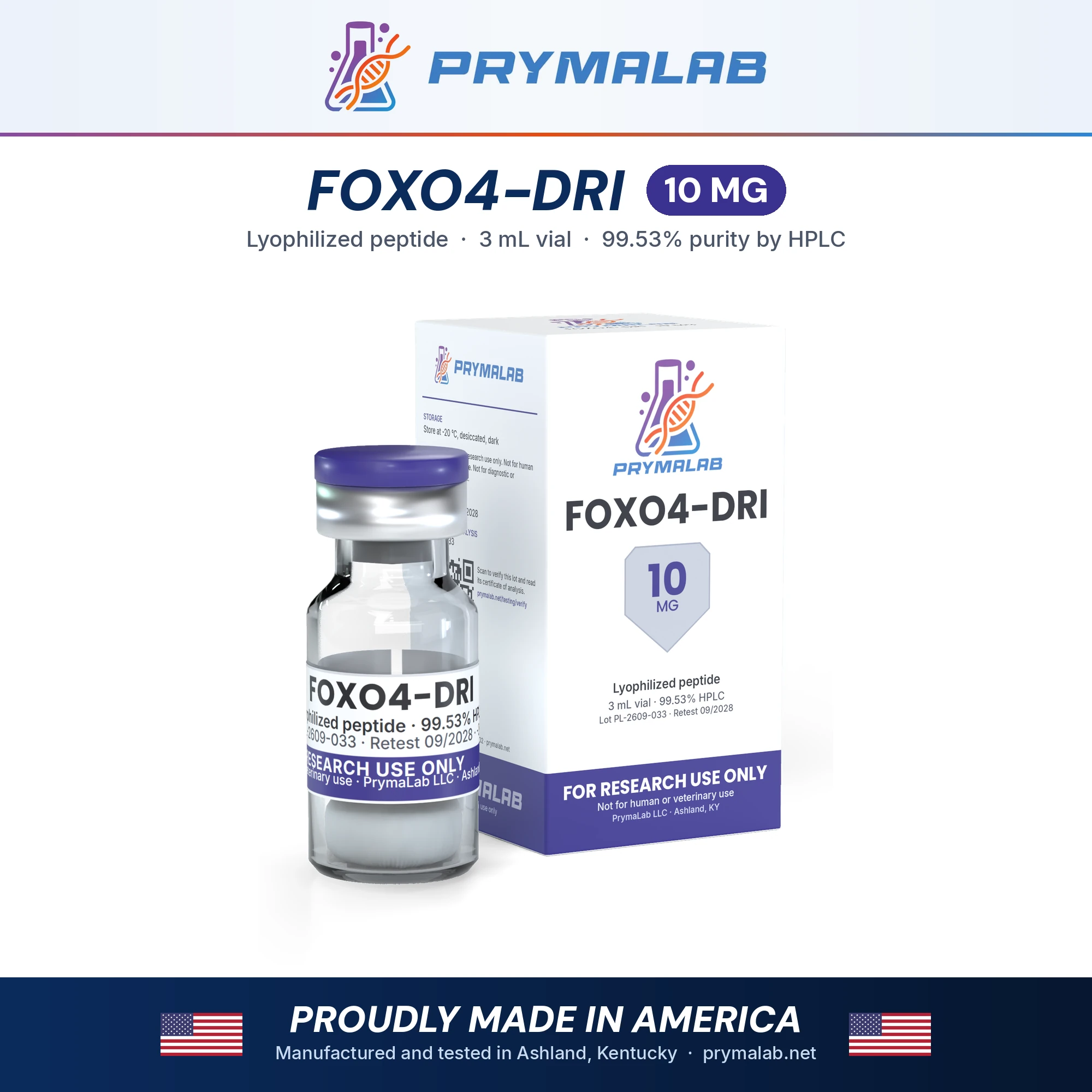
FOXO4-DRI 10MG
D-retro-inverso senolytic peptide · FOXO4-p53 interaction · Baar 2017
FOXO4-DRI 10mg senolytic supplies a D-retro-inverso peptide engineered to interfere with the protein interaction between FOXO4 and p53. Published work reports that disrupting this interaction drives p53 out of the nucleus and triggers cell-intrinsic apoptosis, with selectivity for senescent cells over proliferating ones.
Specification Table
| Property | Value |
|---|---|
| Compound | FOXO4-DRI |
| Full designation | FOXO4 D-retro-inverso interfering peptide |
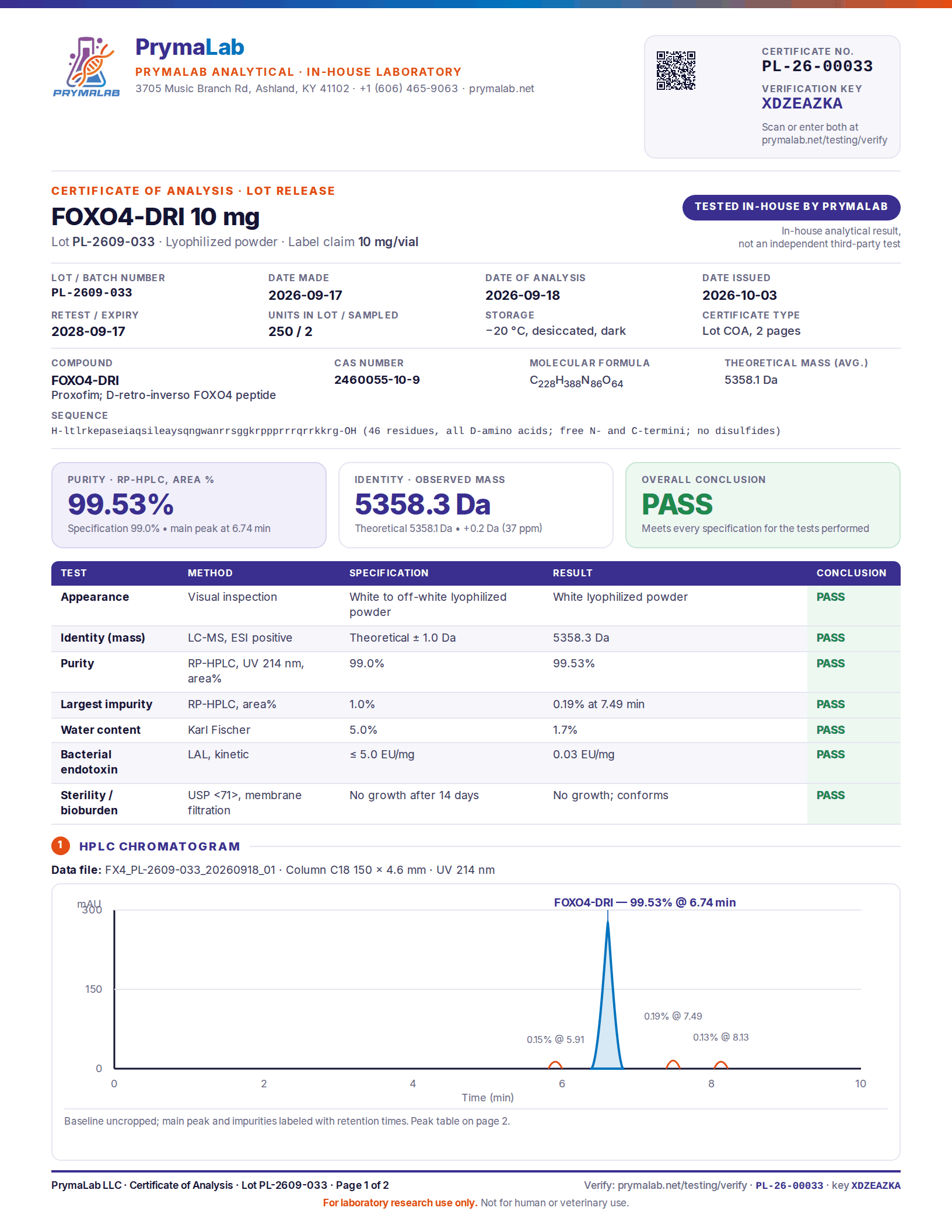
| CAS number | Not assigned. Research peptide without a registry entry |
| Peptide chemistry | Composed entirely of D-amino acids in reversed sequence order |
| Parent sequence | The FOXO4 domain that interacts with p53 |
| Cell-penetrating element | Included in the published construct to enable intracellular access |
| Molecular target | FOXO4-p53 protein-protein interaction |
| Reported mechanism | p53 nuclear exclusion followed by cell-intrinsic apoptosis |
| Reported selectivity | Senescent cells over proliferating cells |
| Primary publication | Baar et al., Cell, 2017;169(1):132-147 |
| Reported animal models | Doxorubicin-exposed mice, XpdTTD/TTD fast-aging mice, naturally aged mice |
| Reported animal readouts | Fitness, fur density, renal function |
| Vial content | 10 mg lyophilized powder |
| Appearance | White lyophilized cake |
| Purity | Per lot-specific certificate of analysis |
| Solubility | Soluble in sterile water and bacteriostatic water |
| Storage, lyophilized | -20°C, protected from light and moisture |
| Storage, reconstituted | 2-8°C, protected from light |
| Reconstituted stability | Not established under arbitrary conditions |
| Human clinical data | None published |
| Regulatory status | No approved human or veterinary formulation in any jurisdiction |
What Does D-Retro-Inverso Mean?
It describes two modifications applied together, and understanding them explains why the peptide exists in this form rather than as a conventional sequence.
D refers to amino acid chirality. Biological proteins are built almost exclusively from L-amino acids, and proteases have evolved to recognise that stereochemistry. A peptide made from D-amino acids is largely invisible to those enzymes and survives far longer in a biological environment.
Retro-inverso refers to reversing the sequence order. Simply swapping L for D would produce a molecule whose side chains point the wrong way relative to the backbone, destroying the binding surface. Reversing the sequence at the same time restores the spatial arrangement of the side chains, so the topology that the target protein recognises is preserved while the backbone stereochemistry is inverted.
The combination gives a peptide that presents approximately the original binding surface while resisting proteolysis. It is an elegant piece of design and a standard technique for turning a protein-interaction motif into something that survives long enough to be useful.
How Does Disrupting FOXO4 and p53 Kill a Senescent Cell?
Senescent cells occupy an unusual state. They have sustained damage sufficient to halt division permanently, yet they resist apoptosis and persist, remaining metabolically active and secreting inflammatory mediators.
Part of what keeps them alive is an arrangement involving p53. In a normal damaged cell, p53 would drive apoptosis. Baar and colleagues identified FOXO4 as a factor that binds p53 and sequesters it in the nucleus in a configuration where it maintains the growth arrest without triggering cell death (Baar et al., Cell, 2017).
The interfering peptide competes for that interaction. When FOXO4 can no longer hold p53 in place, p53 is excluded from the nucleus, and in a cell already carrying substantial damage that relocation is sufficient to initiate cell-intrinsic apoptosis.
Selectivity follows from the biology rather than from targeting. A proliferating cell without accumulated damage does not depend on this arrangement for survival, so disrupting it has comparatively little consequence. The senescent cell is the one holding a loaded apoptotic programme in check.
What Did the Animal Work Report for FOXO4-DRI 10mg Senolytic Research?
Three model systems appear in the primary publication, and they address different questions.
The first concerns chemotoxicity. Doxorubicin induces senescence as part of its damage profile, and the peptide was reported to neutralise doxorubicin-induced chemotoxicity in mice. This is the model closest to an acute intervention.
The second uses XpdTTD/TTD mice, which carry a DNA repair defect and age rapidly. The third uses naturally aged mice, which removes the artificial acceleration and asks whether the same finding holds under ordinary ageing.
Reported readouts across the aged models included restoration of fitness, fur density and renal function, under conditions the authors described as well tolerated. Fur density is a more meaningful endpoint than it first appears, since it is an externally visible marker of tissue renewal capacity that requires no invasive measurement.
These are mouse findings in mouse models. No human clinical data exists for this peptide, and the gap between a mouse renal function measurement and any human question is substantial.
What Should Researchers Be Careful About Here?
Senescence markers are the first difficulty. There is no single definitive marker for the senescent state. Senescence-associated beta-galactosidase staining, p16 expression, p21 expression, and the secretory phenotype are all used, and none is fully specific on its own. Work in this area conventionally requires several markers in combination, and a study using one will not convince readers familiar with the field.
Cell penetration is the second. The published construct includes a cell-penetrating element, because the target is an intracellular protein interaction and a peptide that cannot cross the membrane cannot engage it. Preparations differ in whether and how this element is included, which directly affects whether the compound reaches its target at all. This is worth confirming against the certificate of analysis rather than assuming.
Third, D-amino acid peptides raise their own analytical questions. Standard proteomic methods assume L-stereochemistry, and confirming the identity and purity of a D-peptide preparation requires methods chosen accordingly.
Finally, senescent cell clearance is not uniformly desirable in every biological context. Senescence contributes to wound repair and tumour suppression, and removing senescent cells indiscriminately in a model system may produce effects unrelated to the ageing question being asked.
How Is Senescent Cell Clearance Quantified?
The claim being tested is that a population of cells has been selectively removed. Demonstrating that requires more than showing a change in a bulk tissue measurement.
Senescence-associated beta-galactosidase staining is the conventional starting point, detecting lysosomal beta-galactosidase activity at pH 6. It is easy, it is visual, and it produces false positives in confluent or serum-starved cultures often enough that it should never stand alone.
Transcript and protein markers give a second dimension. p16INK4a and p21 are the usual pair, and components of the senescence-associated secretory phenotype, such as IL-6 and IL-8, add a third. None of these is specific in isolation. Convergence across several is what makes the case.
For the specific mechanism at issue here, p53 localisation is the direct readout. If the peptide works by driving p53 out of the nucleus, then immunofluorescence showing nuclear-to-cytoplasmic redistribution is testing the proposed mechanism rather than its downstream consequence. Apoptosis measurement, by annexin V or caspase-3 cleavage, then completes the chain.
The most informative design includes a proliferating control population in parallel. Selectivity is a comparative claim, and it cannot be established from senescent cells alone regardless of how thoroughly they are characterised.
Why Senescent Cells Resist Apoptosis
The peptide only makes sense against the background of why these cells are difficult to remove in the first place.
A senescent cell has typically sustained damage that would trigger apoptosis in most contexts: telomere attrition, oxidative injury, or oncogene activation. Instead of dying, it enters permanent growth arrest and upregulates anti-apoptotic machinery. The BCL-2 family proteins are the best characterised part of this, and they are the target of a separate class of senolytic compounds.
The FOXO4 arrangement is a different survival mechanism operating in parallel. Rather than blocking the apoptotic machinery downstream, it sequesters p53 in a configuration that maintains arrest without triggering death. The cell holds a loaded apoptotic programme and keeps its finger off the trigger.
That difference explains why senolytic compounds targeting different mechanisms are not interchangeable, and why a cell resistant to one may remain vulnerable to another. It also means a study comparing senolytic approaches should not assume a shared mechanism of selectivity.
Reconstitution and Storage in Laboratory Practice
Introduce diluent slowly against the vial wall and swirl gently until the cake dissolves. Avoid shaking. Although D-amino acid composition confers resistance to enzymatic breakdown, it confers no protection against mechanical shear, thermal denaturation or aggregation.
Sterile or bacteriostatic water is appropriate depending on whether the preparation is single-use or multi-draw. Ten milligrams is a substantial quantity for a peptide of this type, so the reconstitution volume determines the working range across an extended series of experiments and should be decided deliberately.
Hold lyophilized material at -20°C away from light and moisture. Aliquot reconstituted solution before freezing to avoid repeated freeze-thaw. Record lot, diluent, volume, concentration and date, and note whether the preparation includes a cell-penetrating element, since that detail determines whether an absence of effect is a biological finding or a delivery failure.
Published Literature
Each entry was traced to the publisher record or a primary index. Nearly every mechanistic claim above goes back to the 2017 Cell paper, and the remaining references frame the senescence field rather than this peptide specifically.
- Baar MP, Brandt RMC, Putavet DA, Klein JDD, Derks KWJ, Bourgeois BRM, Stryeck S, Rijksen Y, van Willigenburg H, Feijtel DA, van der Pluijm I, Essers J, van Cappellen WA, van IJcken WF, Houtsmuller AB, Pothof J, de Bruin RWF, Madl T, Hoeijmakers JHJ, Campisi J, de Keizer PLJ. Cell. 2017;169(1):132-147.e16.
- Childs BG, Gluscevic M, Baker DJ, Laberge RM, Marquess D, Dananberg J, van Deursen JM. Nature Reviews Drug Discovery. 2017;16(10):718-735.
- Campisi J, d’Adda di Fagagna F. Nature Reviews Molecular Cell Biology. 2007;8(9):729-740.
- Baker DJ, Wijshake T, Tchkonia T, LeBrasseur NK, Childs BG, van de Sluis B, Kirkland JL, van Deursen JM. Nature. 2011;479(7372):232-236.
Frequently Asked Questions
What is FOXO4-DRI 10mg senolytic?
FOXO4-DRI 10mg senolytic is a lyophilized vial of a D-retro-inverso peptide designed to disrupt the protein interaction between FOXO4 and p53. Published work reports that disruption causes p53 nuclear exclusion and cell-intrinsic apoptosis with selectivity for senescent cells. Supplied for laboratory research use only.
What does D-retro-inverso mean?
Two modifications applied together. D refers to using D-amino acids rather than the L-amino acids proteases recognise, which confers resistance to enzymatic breakdown. Retro-inverso refers to reversing the sequence order, which restores the spatial arrangement of side chains that swapping chirality alone would have destroyed.
How does the peptide selectively affect senescent cells?
Selectivity follows from the biology rather than from targeting. Senescent cells depend on FOXO4 holding p53 in a configuration that maintains growth arrest without triggering cell death. Disrupting that arrangement releases an apoptotic programme already loaded in those cells. Proliferating cells without accumulated damage do not depend on it.
What animal models were used in the primary study?
Three. Doxorubicin-exposed mice, addressing chemotoxicity. XpdTTD/TTD mice, which carry a DNA repair defect and age rapidly. And naturally aged mice, which removes the artificial acceleration. Reported readouts across the aged models included fitness, fur density and renal function.
Is there human data on FOXO4-DRI?
No. The published evidence base is preclinical, centred on the 2017 Cell paper from de Keizer and colleagues. No human clinical study of this peptide has been published. The distance between a mouse renal function measurement and any human question is substantial and should not be minimised.
Why does cell penetration matter for this compound?
The target is an intracellular protein-protein interaction, so a peptide that cannot cross the cell membrane cannot engage it. The published construct includes a cell-penetrating element. Preparations differ in whether and how that element is included, so it should be confirmed against the certificate of analysis rather than assumed.
What senescence markers should accompany this work?
Several, in combination. No single definitive marker for the senescent state exists. Senescence-associated beta-galactosidase staining, p16 expression, p21 expression and the secretory phenotype are all used, and none is fully specific alone. A study relying on one marker will not satisfy readers familiar with the field.
Is clearing senescent cells always desirable?
No, and this is worth building into experimental design. Senescence contributes to wound repair and to tumour suppression. Removing senescent cells indiscriminately in a model system may produce effects unrelated to the ageing question under investigation, and those effects can be misattributed.
How should the vial be stored?
Store the dry cake at minus 20 Celsius, sealed against light and moisture. Reconstituted solution sits between 2 and 8 Celsius in the dark, divided into aliquots before it is frozen for the first time. D-amino acid composition buys resistance to enzymes and nothing else. Shear, heat and aggregation all still apply, so handle it gently.
How is senescent cell clearance quantified?
Through convergence across several markers, since none is specific alone. Senescence-associated beta-galactosidase staining is conventional but produces false positives in confluent or serum-starved cultures. p16INK4a and p21 add a transcript and protein dimension, and secretory phenotype components such as IL-6 and IL-8 add a third.
What is the most direct test of the proposed mechanism?
p53 localisation by immunofluorescence. If the peptide works by driving p53 out of the nucleus, then showing nuclear-to-cytoplasmic redistribution tests the mechanism rather than its downstream consequence. Apoptosis measurement by annexin V or caspase-3 cleavage then completes the chain.
Compliance Statement
FOXO4-DRI 10mg is sold exclusively for laboratory research use. It is not a drug, food, or cosmetic product, and it is not a dietary product of any kind. It is not approved by the FDA or any comparable authority for human or veterinary use, and no human clinical study of this peptide has been published. This product is not intended to diagnose, treat, cure, or prevent any disease. It must not be given to humans or animals. Purchase is restricted to qualified researchers and institutions operating within applicable laws. All handling is the responsibility of the purchasing laboratory.
Other formats of FOXO4
FOXO4 is also stocked as FOXO4-DRI 10mg preloaded 3ml pen. Each listing states its own quantity and concentration, and the pen and vial comparison explains what changes between formats.







1 review for FOXO4 10MG