
Description
PrymaLab · Research use only
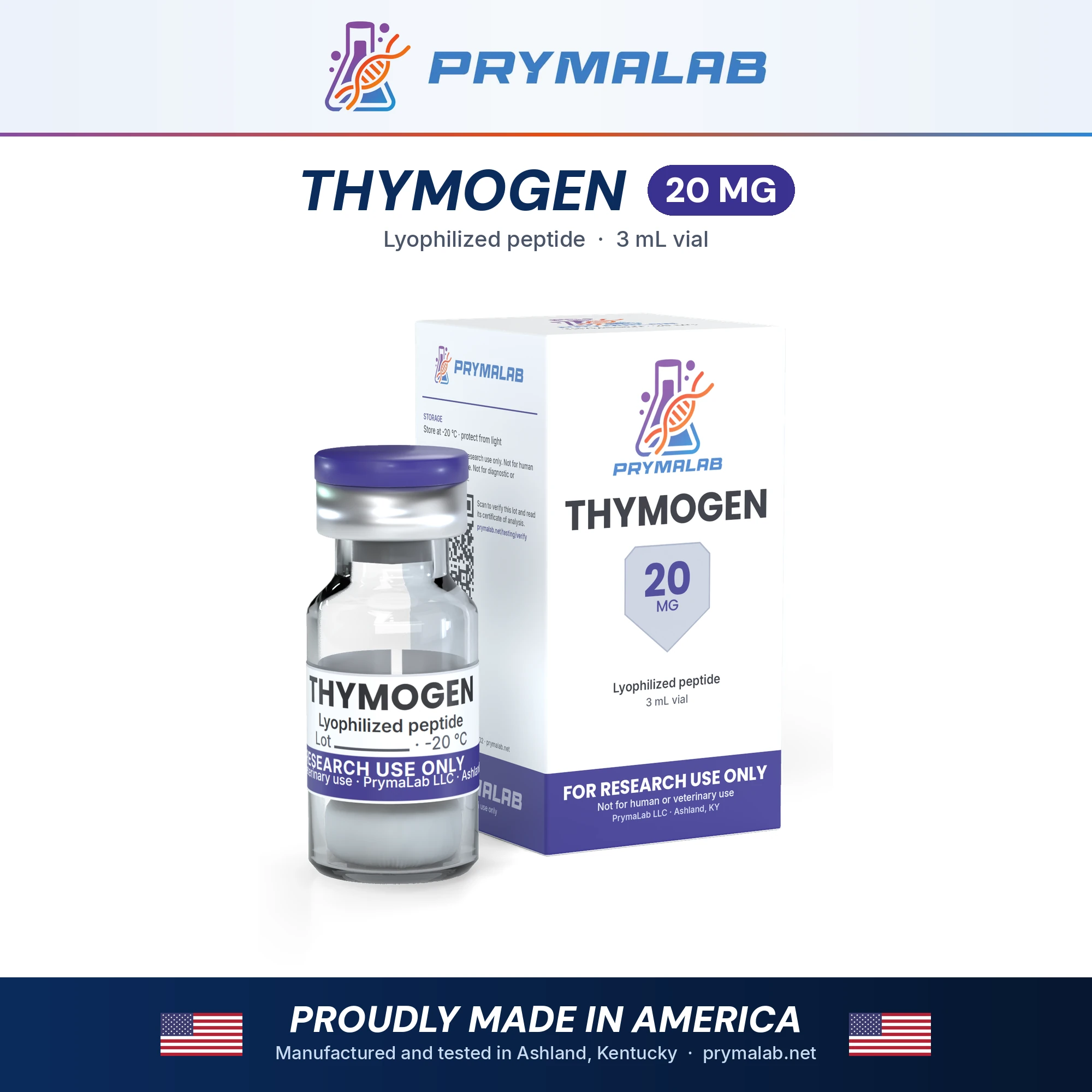
Thymogen Peptide 20mg
Synthetic L-Glu-L-Trp thymic dipeptide, 20 mg of freeze-dried powder per vial
Thymogen is the synthetic dipeptide L-glutamyl-L-tryptophan (Glu-Trp), first isolated by Khavinson’s group from the calf thymus extract Thymalin and registered in Russia as an immunomodulator. This listing is a 20 mg vial of freeze-dried powder. Research on Glu-Trp covers T-cell and neutrophil function, a lifelong rat study and cell-line work from the developers’ circle, along with Western cancer trials of the same dipeptide under the code IM862.
Specifications
| Property | Value |
|---|---|
| Compound | Thymogen (Glu-Trp dipeptide (EW); oglufanide) |
| CAS number | 38101-59-6 |
| Molecular formula | C16H19N3O5 |
| Label claim | 20 mg per vial |
| Form | Lyophilized (freeze-dried) powder or cake in a sealed glass vial with a rubber stopper and aluminium crimp cap |
| Safety data sheet | PL-SDS-169 |
Handling notes
The safety data sheet gives −20 °C for the sealed vial, desiccated and protected from light, with 2 to 8 °C acceptable for short periods. It also notes that the powder is hygroscopic and that its tryptophan is sensitive to light and oxidation, and both points have a literature behind them. Under hydrogen peroxide, free tryptophan and tryptophan in short peptides degraded faster than tryptophan held in a protein, with oxindolylalanine and N-formylkynurenine among the main products1. Ultraviolet light damages tryptophan directly and singlet oxygen damages it indirectly2. Glu-Trp also starts with a free glutamate, and an N-terminal glutamate can cyclise to pyroglutamate in solution; in antibody studies this was slowest near pH 6.2 and faster at pH 4 and 83. Keep the vial dark and dry, and let it reach room temperature before opening.
What the research covers
Where Glu-Trp came from
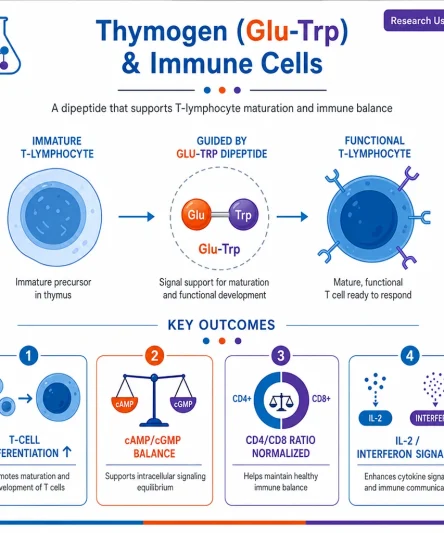
Anisimov, Khavinson and Morozov described how L-Glu-L-Trp was isolated from Thymalin, a natural calf thymus peptide complex, by reverse-phase HPLC; a medicine was then designed around the synthesised dipeptide and later given the brand name Thymogen4. In their summary of the earlier work, the dipeptide activated T-cell differentiation and T-cell recognition of peptide-MHC complexes, changed the intracellular composition of cyclic nucleotides, and activated neutrophil chemotaxis and phagocytosis4.
Rat and cell studies
The same 2000 paper reported a lifelong study in female rats, 44 given the dipeptide and 32 controls. Mean lifespan was similar in both groups, but the longest-lived tenth of treated rats outlived the longest-lived controls, the Gompertz estimate of the ageing rate was lower, and total, malignant and blood-cell tumours were less frequent, by 1.5, 1.7 and 3.4 times respectively4. A 2022 study with Khavinson among its authors tested five of his peptides, Thymogen and the Thymalin complex among them, on the human monocytic THP-1 cell line5. All five increased tyrosine phosphorylation of mitogen-activated kinases, all inhibited TNF and IL-6 expression stimulated by bacterial lipopolysaccharide in differentiated cells, and peptide-treated cells adhered less to activated endothelial cells5.
Trials of the same molecule as IM862
Outside Russia, L-Glu-L-Trp was developed under the code IM862 as an angiogenesis inhibitor; the report of a renal cancer trial describes it as a naturally occurring dipeptide with immunomodulatory and antiangiogenic properties6. A randomised phase II study of a nasal solution in 44 patients with AIDS-related Kaposi’s sarcoma reported tumour responses and mild, short-lived side effects7. The randomised, double-blind, placebo-controlled phase III trial that followed, in 202 HIV-positive patients, found no significant difference in response rate (23% against 21% on placebo) and a shorter median time to progression on IM8628. Its authors judged that concurrent antiretroviral therapy probably explained much of the response seen earlier8. In 25 patients with metastatic renal cell carcinoma, a phase II trial recorded no objective responses, although plasma VEGF fell6. Its authors advised against studying IM862 further as a single agent in that setting, while suggesting the VEGF result deserved more work6.
What is not established
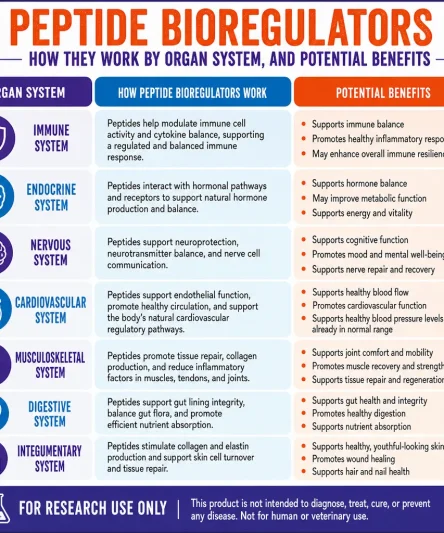
The immune-cell and rodent findings come from the developers and their collaborators, and the one lifespan study used groups of a few dozen rats4. The cell-line study found broadly similar effects for five different peptides, so it says little about what is specific to Glu-Trp5. The only placebo-controlled trial among these references was the IM862 phase III, and it was negative8. The Thymogen guide covers the T-cell, cyclic nucleotide and tumour-model work in more detail, and the peptide bioregulators overview places Glu-Trp among the Khavinson peptides. None of these papers tested PrymaLab material.
How each lot is tested
Every lot is tested in PrymaLab’s own laboratory in Ashland, Kentucky before release: RP-HPLC for purity, LC-MS for identity, Karl Fischer titration for water, LAL for endotoxin and USP <71> for sterility. Published certificates are listed on the results page and can be checked by number and key on the verify page. These are in-house results from PrymaLab Analytical, not an independent test, and the lab is not accredited to ISO 17025. The third-party testing guarantee on this page still applies: if any independent laboratory finds the wrong compound, or less than the stated purity or amount, the order is refunded and the cost of the test is reimbursed.
Frequently asked questions
What is Thymogen?
The synthetic dipeptide L-glutamyl-L-tryptophan (Glu-Trp, EW), CAS 38101-59-6, formula C16H19N3O5, about 333 Da. It was first isolated from the calf thymus extract Thymalin and is also known as oglufanide; under the code IM862 it was tested in cancer trials in the United States and Europe.
How is Thymogen different from Thymalin and Thymodepressin?
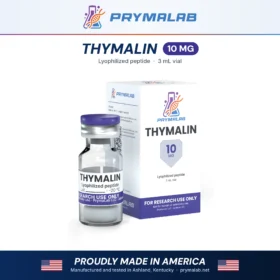
Thymalin is the calf thymus extract, a mixture of many peptides, and Thymogen is one defined dipeptide identified in it. Thymodepressin has the same two amino acids in their D-forms and is described as an immunosuppressant, the opposite of the activity reported for the L-form, so stereochemistry matters for this sequence.
How is the identity of a Glu-Trp vial checked?
Glu-Trp is a defined molecule, so identity comes down to one mass and one main peak: an LC-MS result close to 333 Da and an RP-HPLC trace dominated by a single peak. Both are part of PrymaLab's in-house testing. A profile of many peaks would point to an extract instead.
How do the vial, pen and spray differ?
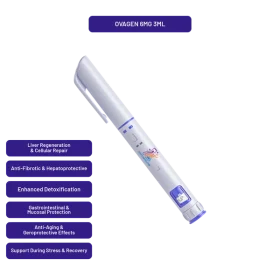
The vial holds 20 mg of freeze-dried Glu-Trp, stored at −20 °C until the laboratory dissolves it. The pen holds 10 mg in 3 mL of preserved solution and the spray 10 mg in a metered bottle. Both solutions are kept at 2 to 8 °C, away from light, and never frozen.
What did the IM862 trials find?
A phase II study in AIDS-related Kaposi's sarcoma reported responses, but the placebo-controlled phase III trial found no difference from placebo and a shorter time to progression. A renal cancer trial recorded no objective responses. Those trials tested a pharmaceutical formulation in patients and say nothing about this research material.
Is Thymogen for human use?
Not this product. It is sold only for laboratory research and is not approved by the FDA or any comparable authority for human or veterinary use. A medicine of the same name is registered in Russia, but this vial is not that medicine and must not be given to people or animals.
References
- Simat TJ, Steinhart H. Oxidation of Free Tryptophan and Tryptophan Residues in Peptides and Proteins. J Agric Food Chem. 1998;46(2):490-498. DOI · PubMed
- Pattison DI, Rahmanto AS, Davies MJ. Photo-oxidation of proteins. Photochem Photobiol Sci. 2012;11(1):38-53. DOI · PubMed
- Chelius D, Jing K, Lueras A, et al. Formation of pyroglutamic acid from N-terminal glutamic acid in immunoglobulin gamma antibodies. Anal Chem. 2006;78(7):2370-6. DOI · PubMed
- Anisimov VN, Khavinson VK, Morozov VG. Immunomodulatory synthetic dipeptide L-Glu-L-Trp slows down aging and inhibits spontaneous carcinogenesis in rats. Biogerontology. 2000;1(1):55-9. DOI · PubMed
- Avolio F, Martinotti S, Khavinson VK, et al. Peptides Regulating Proliferative Activity and Inflammatory Pathways in the Monocyte/Macrophage THP-1 Cell Line. Int J Mol Sci. 2022;23(7). DOI · PubMed
- Deplanque G, Madhusudan S, Jones PH, et al. Phase II trial of the antiangiogenic agent IM862 in metastatic renal cell carcinoma. Br J Cancer. 2004;91(9):1645-50. DOI · PubMed
- Tulpule A, Scadden DT, Espina BM, et al. Results of a randomized study of IM862 nasal solution in the treatment of AIDS-related Kaposi's sarcoma. J Clin Oncol. 2000;18(4):716-23. DOI · PubMed
- Noy A, Scadden DT, Lee J, et al. Angiogenesis inhibitor IM862 is ineffective against AIDS-Kaposi's sarcoma in a phase III trial, but demonstrates sustained, potent effect of highly active antiretroviral therapy: from the AIDS Malignancy Consortium and IM862 Study Team. J Clin Oncol. 2005;23(5):990-8. DOI · PubMed
Research use only
For laboratory research use only. Thymogen Peptide 20mg is not a drug, food, cosmetic or dietary supplement, is not approved by the FDA or any comparable authority for human or veterinary use, and must not be given to people or animals. It is sold to qualified researchers and institutions, and the buyer is responsible for lawful handling and disposal.
Other formats of Thymogen
Thymogen is also stocked as Thymogen 10mg preloaded 3ml pen and Thymogen 10mg Nasal Spray. Each listing states its own quantity and concentration, and the pen and vial comparison explains what changes between formats.






Reviews
There are no reviews yet.