Description
PrymaLab · Research use only
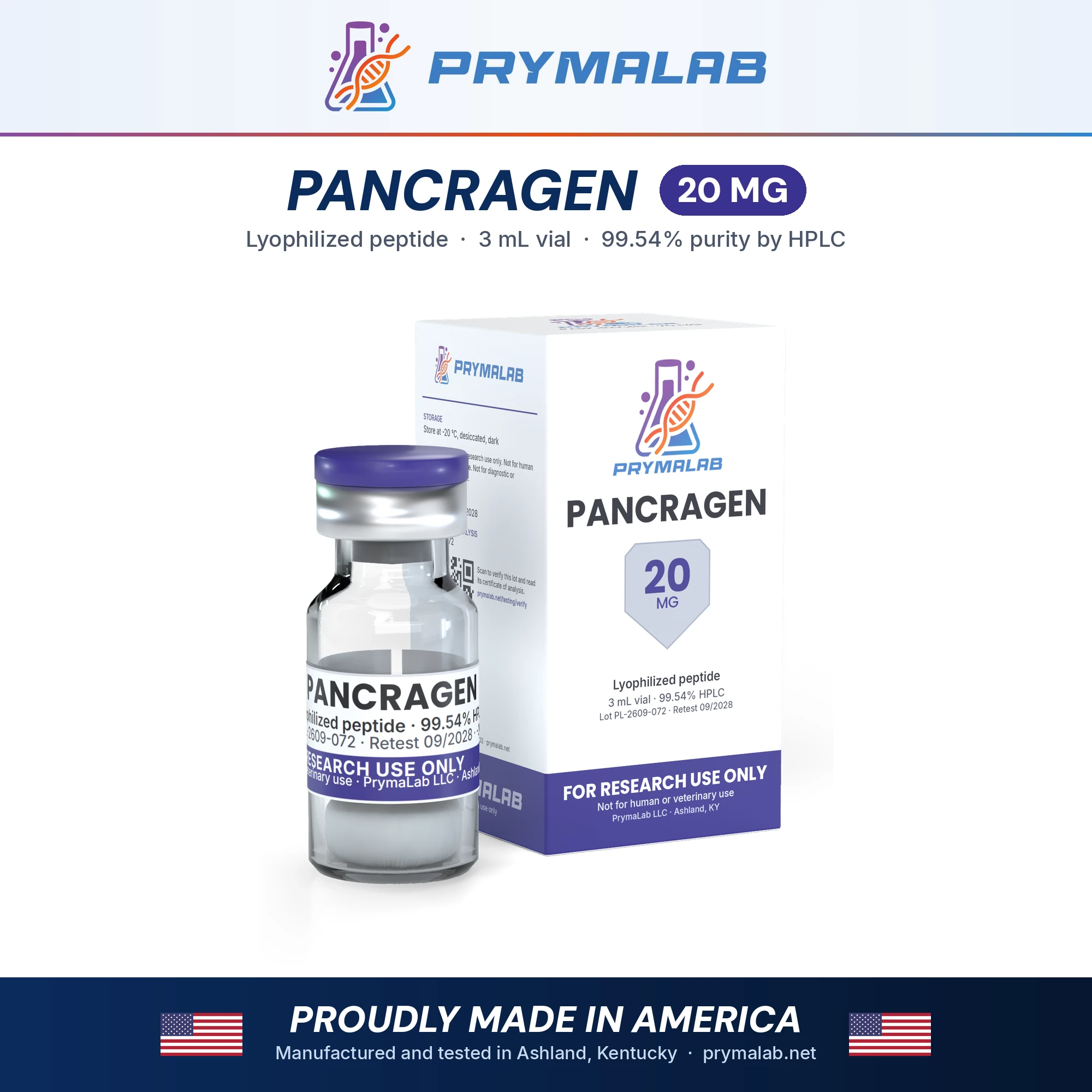
Pancragen Peptide 20mg
Lys-Glu-Asp-Trp (KEDW) free acid, 20 mg of freeze-dried powder per vial
Pancragen is the Khavinson tetrapeptide Lys-Glu-Asp-Trp (KEDW), developed in St Petersburg and assigned by its makers to the pancreas. This listing is a 20 mg vial of freeze-dried Pancragen in the free-acid form, H-KEDW-OH, while the published studies describe a C-terminal amide. Research on Pancragen covers differentiation markers in cultured pancreatic cells, glucose and capillary measures in diabetic rats, and one small study in older adults, nearly all of it from the developers’ own group.
Specifications
| Property | Value |
|---|---|
| Compound | Pancragen Lys-Glu-Asp-Trp (KEDW); Khavinson pancreatic peptide bioregulator (free-acid form as supplied) |
| CAS number | Not assigned |
| Molecular formula | C26H36N6O9 |
| Theoretical mass | 576.6 Da |
| Sequence / structure | H-KEDW-OH (4 residues; free N- and C-termini) |
| Label claim | 20 mg/vial |
| Form | Lyophilized (freeze-dried) powder or cake in a sealed glass vial with a rubber stopper and aluminium crimp cap |
| Storage, sealed | −20 °C, desiccated, dark |
| Purity specification | 99.0% or higher by RP-HPLC |
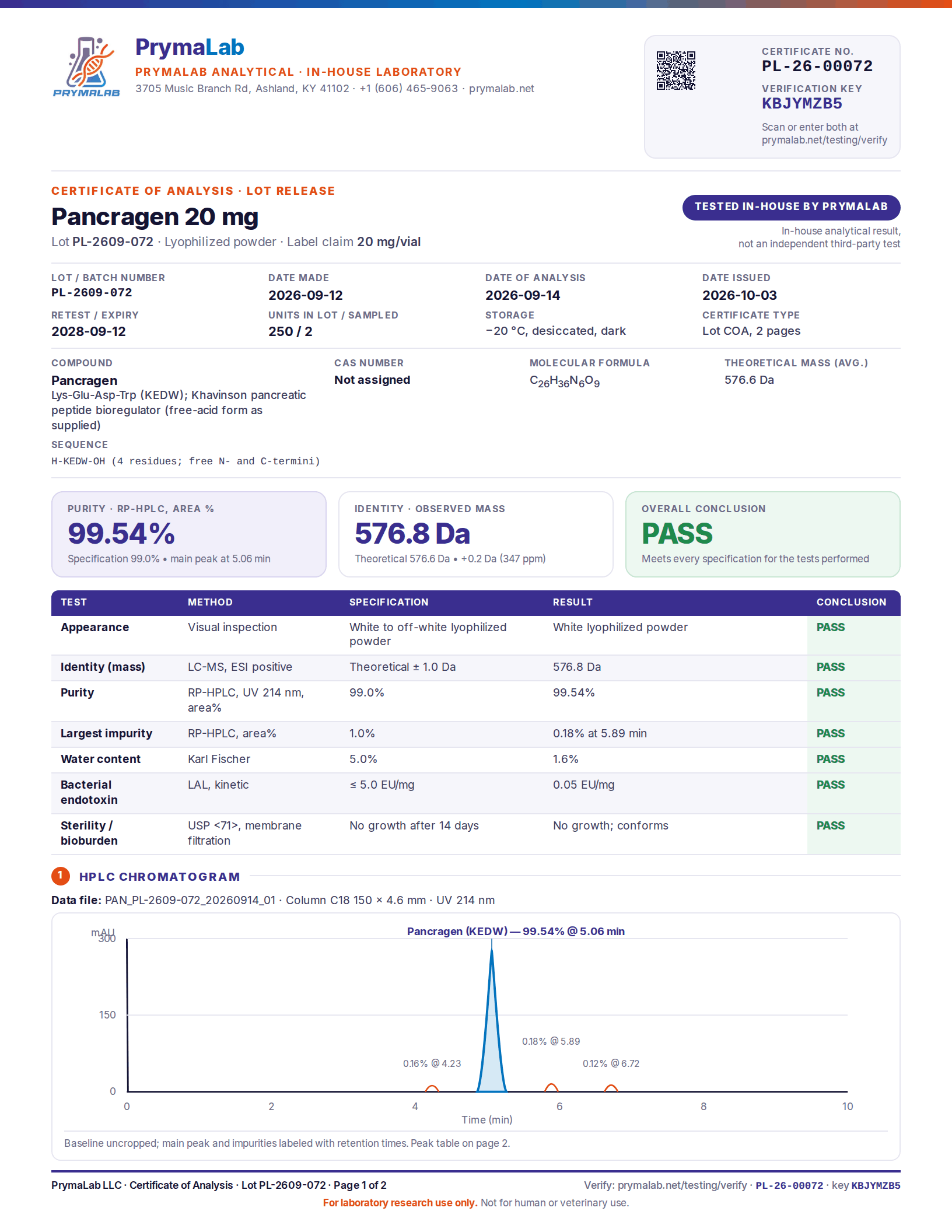
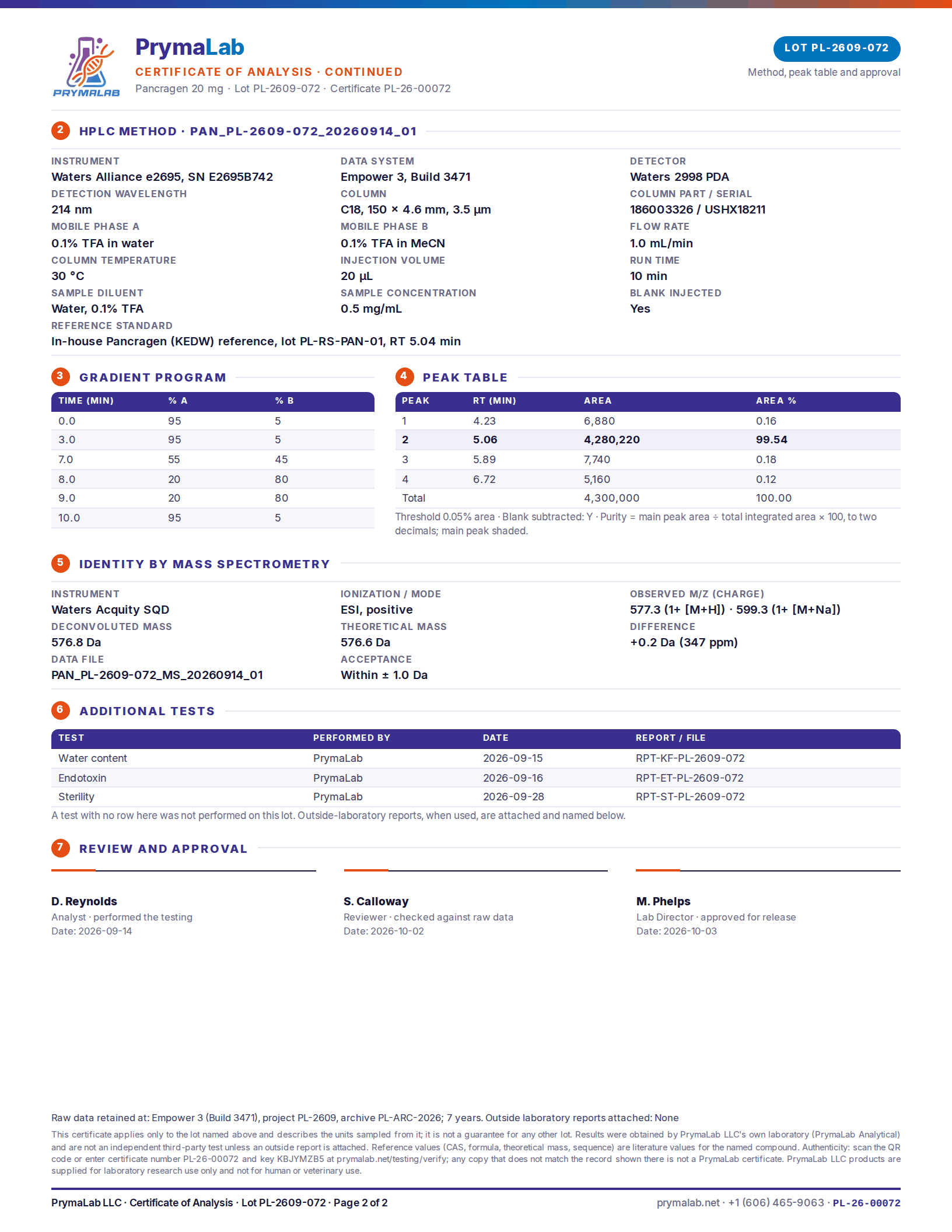
| Lot certificate | Results for the lot now shipping are in the certificate panel on this page |
| Safety data sheet | PL-SDS-125 |
Free acid, not the amide
The certificate identifies this material as Lys-Glu-Asp-Trp with a free carboxyl group at the C-terminus: formula C26H36N6O9, theoretical mass 576.6 Da. The papers on Pancragen describe Lys-Glu-Asp-Trp-NH2, with the C-terminus capped as an amide1. The two share a sequence but are different compounds with different formulas, and the LC-MS identity result on the certificate is the check that a lot is the free acid. No study cited here compared the two forms, so results obtained with the amide may not carry over.
In molar terms, 20 mg of a 576.6 Da peptide is about 35 µmol, a little lower after the water the certificate reports. The same free acid is also sold in solution as the Pancragen preloaded pen.
Handling notes
Tryptophan, the residue that sets Pancragen apart from the other Lys-Glu-Asp peptides, is sensitive to light. Grosvenor and colleagues exposed synthetic peptides containing tryptophan and tyrosine to light and identified the products by tandem mass spectrometry, among them hydroxytryptophan, N-formylkynurenine, kynurenine and tryptophandiones2. Each of these changes the mass of the peptide, so LC-MS can pick them up. For the vial, the label conditions are the practical rule: store it sealed at −20 °C, dry and dark, and keep any solution at 2 to 8 °C away from light.
What the research covers
Origin and proposed mechanism
Pancragen was developed at the St Petersburg Institute of Bioregulation and Gerontology under Vladimir Khavinson. Nearly every paper on it comes from that group and its collaborators, most in the Bulletin of Experimental Biology and Medicine, the English edition of a Russian journal. According to the Pancragen guide, the group chose the KEDW sequence by analysing insulinotropic polypeptides rather than by isolating it from pancreas. The group’s model of action, summarised in a 2021 systematic review, is that peptides of two to seven residues enter the nucleus, bind histones and DNA and regulate gene expression and DNA methylation3. The review extends this to recognition of specific sequences in gene promoters3.
Pancreatic cell cultures
In a 2013 study, expression of differentiation markers fell as pancreatic cells aged in culture4. Pancragen raised the expression of factors that mark acinar cells (Pdx1, Ptf1a) and islet cells (Pdx1, Pax6, Pax4, Foxa2, Nkx2.2) in both young and aged cultures4. The authors went on to name these transcription factors as the peptide’s pharmacological target4. The study measured marker expression, not insulin secretion or any other function of the cells.
Diabetic rats
A 2007 study used Wistar rats with diabetes induced by streptozotocin1. Given by mouth, Pancragen lowered blood glucose during the treatment period; given by another route, it normalised adhesion in the endothelium of mesenteric capillaries but did not change capillary permeability1. The authors described the results as homeostatic and protective of the endothelium early in the disease1. The abstract gives no group sizes and no glucose values.
The study in older adults
Korkushko and colleagues examined 30 healthy older people and 33 with type 2 diabetes5. They measured night-time melatonin production, which was markedly lower in the diabetic group, and, in the diabetic participants, fasting glucose, a standard glucose tolerance test, plasma insulin and an insulin-resistance index5. The abstract reports changes in these measures in participants given Pancragen and none in those who were not5. It does not describe randomisation, blinding or a placebo, and it gives no size for either arm of that comparison. The authors concluded that impaired melatonin production by the pineal gland contributes to insulin resistance in older people5, an interpretation the study design cannot settle on its own.
What is not established
Whether any of this applies to the free acid sold here is unknown, because the studies describe the amide1. The cell work measured transcription factors, the rat abstract reports no numbers, and the human study is small, without a described placebo or blinding, and has Khavinson among its authors. A primate study and patent experiments are discussed in the Pancragen guide; they are not among the references here. None of the studies used PrymaLab material.
How each lot is tested
Every lot is tested in PrymaLab’s own laboratory in Ashland, Kentucky before release: RP-HPLC for purity, LC-MS for identity, Karl Fischer titration for water, LAL for endotoxin and USP <71> for sterility. The results for the lot now shipping are in the certificate panel on this page, and the certificate number, key and QR code can be checked on the verify page. These are in-house results from PrymaLab Analytical, not an independent test, and the lab is not accredited to ISO 17025. The third-party testing guarantee on this page still applies: if any independent laboratory finds the wrong compound, or less than the stated purity or amount, the order is refunded and the cost of the test is reimbursed.
Frequently asked questions
Is this the same Pancragen as in the published studies?
Not exactly. The studies describe Lys-Glu-Asp-Trp with a C-terminal amide. This vial holds the free acid, H-KEDW-OH, with a theoretical mass of 576.6 Da, as the certificate states. The two share a sequence but are different compounds, and no study cited here compared them.
What does the certificate show for this vial?
The certificate panel on this page gives RP-HPLC purity, LC-MS identity, water content, endotoxin and sterility for the lot now shipping. Match its lot number to your vial; older lots are on the testing results page, and the verify page checks any certificate by number and key.
Why does tryptophan matter for storage?
Tryptophan reacts with light. Studies of tryptophan-containing peptides found a range of oxidation products after light exposure, each with a changed mass. Keep the sealed vial at −20 °C in the dark, and protect any solution from light at 2 to 8 °C.
How does Pancragen differ from Livagen and Vesugen?
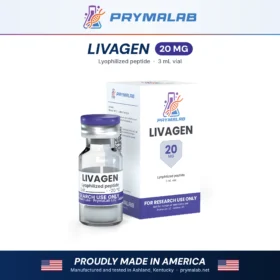
All three share Lys-Glu-Asp. Vesugen is that tripeptide alone, Livagen adds alanine and Pancragen adds tryptophan. The developers assigned them to blood vessels, the liver and the pancreas respectively. Their masses differ, which the certificate's LC-MS result reflects.
What do the Pancragen studies show, and what do they leave open?
They report raised differentiation markers in pancreatic cell cultures, lower blood glucose in diabetic rats and changes in glucose measures in a small study of older adults. All used the amide form, most come from one group, and none had a described placebo or blinding.
Can Pancragen be used in people or animals?
No. It is sold for laboratory research only, is not approved by the FDA or any other authority for human or veterinary use, and must not be given to people or animals.
References
- Khavinson VKh, Gavrisheva NA, Malinin VV, et al. Effect of pancragen on blood glucose level, capillary permeability and adhesion in rats with experimental diabetes mellitus. Bull Exp Biol Med. 2007;144(4):559-62. DOI · PubMed
- Grosvenor AJ, Morton JD, Dyer JM. Profiling of residue-level photo-oxidative damage in peptides. Amino Acids. 2010;39(1):285-96. DOI · PubMed
- Khavinson VK, Popovich IG, Linkova NS, et al. Peptide Regulation of Gene Expression: A Systematic Review. Molecules. 2021;26(22). DOI · PubMed
- Khavinson VKh, Durnova AO, Polyakova VO, et al. Effects of pancragen on the differentiation of pancreatic cells during their ageing. Bull Exp Biol Med. 2013;154(4):501-4. DOI · PubMed
- Korkushko OV, Khavinson VKh, Shatilo VB, et al. Prospects of using pancragen for correction of metabolic disorders in elderly people. Bull Exp Biol Med. 2011;151(4):454-6. DOI · PubMed
Research use only
For laboratory research use only. Pancragen Peptide 20mg is not a drug, food, cosmetic or dietary supplement, is not approved by the FDA or any comparable authority for human or veterinary use, and must not be given to people or animals. It is sold to qualified researchers and institutions, and the buyer is responsible for lawful handling and disposal.






1 review for Pancragen Peptide 20mg