
-
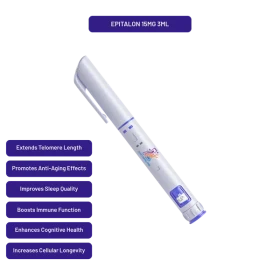
Preloaded Autoinjector | Epithalon | 3ml Pen | 15mg
$69.99 or subscribe for $59.49/mo This product has multiple variants. The options may be chosen on the product page -

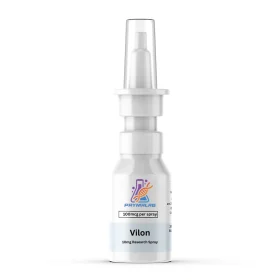
Vilon 10mg Nasal Spray
$59.99 or subscribe for $49.99/mo This product has multiple variants. The options may be chosen on the product page -
Vilon Peptide 20mg
$54.99 or subscribe for $45.99/mo This product has multiple variants. The options may be chosen on the product page

What the endpoint actually is · and how to read a lifespan figure
Longevity peptides are sold against an endpoint that most listings never define. Lifespan is measurable, and it is measurable in several different ways that answer different questions and frequently disagree. This page sets out what a survival study actually reports, why median and maximum lifespan are not the same claim, what the telomerase work on this family found, and how much of the published record survives careful reading.
Specification Table
| Property | Value |
|---|---|
| Primary endpoint in lifespan work | Survival, reported as a curve rather than a single number |
| Median lifespan | The age by which half the cohort has died. Shifted by removing early causes of death |
| Maximum lifespan | Typically the mean of the longest-lived decile. Much harder to shift |
| Why the distinction matters | A compound can raise median survival without touching the rate of ageing at all |
| Gompertz slope | The rate at which mortality risk accelerates with age. The parameter a rate-of-ageing claim needs |
| Healthspan | A separate endpoint measuring functional period rather than duration of survival |
| Compounds in this range | Epitalon and the related Khavinson compounds carrying longevity assignments |
| Principal telomerase citation | A 2003 report of telomerase activity and telomere elongation in cultured human somatic cells |
| What that study was | In vitro, in cultured cells, not a lifespan study and not in a whole organism |
| Independent replication | Thin relative to publication volume. No adequately powered independent Western trial |
| Model organism caveat | Rodent survival results transfer poorly on magnitude and better on direction |
| Page type | Category hub, not a product page |
| Schema page type | CollectionPage |
| Cornerstone content | Yes |
| Meta robots | index, follow |
| Regulatory status | No approved human or veterinary formulation in any jurisdiction |
What Does a Longevity Study Actually Measure?
Survival is the endpoint, and survival is a curve rather than a number, which is where most reporting of longevity peptides goes wrong.
A cohort is followed until every animal has died, and the result is a survival function: the proportion still alive as a function of age.
From that curve two very different summary figures are taken. Median lifespan is the age by which half the cohort has died. Maximum lifespan is usually reported as the mean age of the longest-lived decile.
Those two respond to different things. Median lifespan rises when early deaths are removed, which any intervention reducing infection, tumour burden or husbandry stress will do.
Maximum lifespan is far harder to move, because shifting it requires slowing the process that kills the animals that were already going to live longest.
A compound that raises median survival by twenty percent while leaving maximum survival unchanged has improved the cohort and has not altered the rate of ageing.
The parameter that speaks to rate directly is the Gompertz slope, which describes how fast mortality risk accelerates with age. A claim about ageing rather than about survival needs that figure.
Most reporting in this category quotes a median figure and describes it in rate-of-ageing language, which is a category error rather than a small imprecision.
That distinction has a direct consequence for how longevity peptides should be evaluated as research material. A study design targeting median survival and one targeting the Gompertz slope need different cohort sizes, different follow-up periods and different statistics.
Choosing which of the two a project is running is the first decision. It is made before any compound is ordered.
What Did the Telomerase Work Actually Report?
One study is cited more than any other in support of longevity peptides from this family, and it is worth reading precisely rather than through the citations.
A 2003 report describes telomerase activity and telomere elongation in cultured human somatic cells following exposure to the tetrapeptide.
That is an in vitro result in cultured cells. It is not a lifespan study, it is not in a whole organism, and it does not measure survival.
The finding is interesting on its own terms, since telomerase activity in somatic cells is normally very low and a compound raising it is doing something specific.
What the study does not establish is that the same thing happens in a living animal, that it happens at achievable concentrations, or that it extends survival if it does.
The gap between the in vitro finding and the lifespan claim is routinely closed in marketing copy by implication rather than by evidence, and closing it requires studies that have not been published.
There is also a tension worth stating. Telomerase activation is not unambiguously desirable, since it is a property that transformed cells acquire, and the literature on telomerase and neoplasia is substantial.
A page selling on the telomerase finding without noting that tension is presenting half of a scientific conversation.
None of that makes the finding uninteresting. It makes it a starting point rather than a conclusion, which is a distinction the marketing around this compound routinely collapses.
How Should a Survival Curve Be Read?
Four things determine whether a reported survival result means anything, and all four are frequently absent.
Cohort size. Survival studies need large cohorts because the tail of the distribution is where the interesting signal sits, and the tail is thinly populated by definition.
Whether the control cohort was housed and handled identically, since husbandry differences produce survival differences larger than most interventions.
The strain, because inbred rodent strains have characteristic causes of death, and a compound suppressing the strain-typical cancer will extend median survival in that strain and nowhere else.
Whether the study was blinded, because survival scoring involves judgement calls about euthanasia timing that are not immune to expectation.
A result reported without those four is not necessarily wrong, and it is not interpretable either, which is a different problem from being wrong.
The broader ageing literature has converged on a framework of interacting hallmarks rather than a single controlling process, which sets the bar for what a mechanistic claim in this area has to address.
Against that bar, the published record for this family sits at the level of an interesting in vitro observation with an associated animal literature from one programme.
One further methodological point is worth stating because it is where survival studies most often go wrong in practice.
Animals removed from a study for reasons other than death have to be censored correctly in the analysis, and how censoring was handled is rarely reported.
Mishandled censoring biases the curve in whichever direction the removals were correlated with. That correlation is usually invisible from the published figure alone.
Why Is Healthspan a Different Question for Longevity Peptides?
Duration of survival and duration of function are separate endpoints, and conflating them is the second most common error in this area after the median and maximum confusion.
Healthspan measures the period during which an organism retains function, assessed through grip strength, gait, cognitive tasks, coat condition and similar functional markers.
The two endpoints can move independently and they can move in opposite directions. An intervention extending survival without extending function has lengthened the period of decline.
That is not a hypothetical failure mode, and it is the reason the ageing field increasingly reports both rather than survival alone.
For a study designed around compounds in this range, deciding which endpoint the work is measuring before it starts determines the entire protocol.
A survival study needs a large cohort and years of follow-up. A healthspan study needs functional assays at defined intervals and can produce a result much sooner.
Those are different experiments with different costs, and material selection is the smallest decision in either of them.
Where a supplier describes a compound as extending lifespan, the useful question is which of these two endpoints the underlying study measured, and the answer is frequently neither.
What Should Be Verified Before Ordering?
The standard family checks apply, with two additions specific to compounds sold against this endpoint.
The explicit sequence in three-letter or single-letter form, since this family differs internally by one or two residues and a trade name carries no chemical information. Ovagen is Glu-Asp-Leu, Livagen is Lys-Glu-Asp-Ala and Cardiogen is Ala-Glu-Asp-Arg, which is the whole of the difference between them.
Whether the compound carries an Asp-Gly motif, because that arrangement rearranges in aqueous solution to a mass-identical isomer that no resolution detects. Several compounds in this range carry it, including Chonluten and Testagen.
For those compounds, the fill date matters more than the purity figure for any solution-state format, since elapsed time is the only practical proxy for a degradation route that instruments cannot see.
Counterion identity and net peptide content, which are proportionally large corrections for compounds this light.
Purity by chromatography at 214 nanometres, since these compounds carry no aromatic residue and 280 nanometre detection is nearly blind to them.
And a question about the supplier rather than the material: which specific study supports any longevity claim attached to the listing, and what endpoint did that study measure.
A supplier who can name the study and the endpoint has read it. One who cites longevity research generally has not.
The broader point about longevity peptides is that material quality is rarely the limiting factor in this area. Study design is.
A survival experiment with an underpowered cohort produces an uninterpretable result regardless of how pure the compound was, and a well-powered one tolerates a good deal of material variation.
Spending the verification effort proportionately is therefore reasonable here in a way it is not for a short assay where the compound is the whole experiment.
Published Literature
Selected references on ageing endpoints, on the telomerase report and on the originating programme.
- Khavinson VK, Bondarev IE, Butyugov AA. Epithalon peptide induces telomerase activity and telomere elongation in human somatic cells. Bull Exp Biol Med. 2003;135(6):590-592. DOI: 10.1023/A:1025493705728
- Lopez-Otin C, Blasco MA, Partridge L, Serrano M, Kroemer G. The hallmarks of aging. Cell. 2013;153(6):1194-1217. DOI: 10.1016/j.cell.2013.05.039
- Anisimov VN, Khavinson VK. Peptide bioregulation of aging. Biogerontology. 2010;11(2):139-149. DOI: 10.1007/s10522-009-9249-8
- Kirkwood TBL. Deciphering death: a commentary on Gompertz (1825). Philos Trans R Soc Lond B Biol Sci. 2015;370(1666):20140379. DOI: 10.1098/rstb.2014.0379
Frequently Asked Questions
What do longevity peptides claim to affect?
Survival, which in a study is reported as a curve rather than a single number. Two very different summary figures are taken from that curve. They answer different questions.
What is the difference between median and maximum lifespan?
Median is the age by which half the cohort has died. Maximum is usually the mean age of the longest-lived decile. Median rises when early deaths are removed. Maximum requires slowing the process killing the animals that already lived longest.
Why does that distinction matter?
Because a compound can raise median survival by a large margin while leaving maximum survival untouched. That has improved the cohort without altering the rate of ageing, and the two are frequently described as though they were the same claim.
What figure speaks to rate of ageing directly?
The Gompertz slope, which describes how fast mortality risk accelerates with age. A claim about ageing rather than about survival needs that parameter, and it is almost never reported in this market.
What did the telomerase study actually find?
Telomerase activity and telomere elongation in cultured human somatic cells following exposure to the tetrapeptide. It is an in vitro result in cultured cells, not a lifespan study and not in a whole organism.
Is telomerase activation unambiguously desirable?
No. It is a property transformed cells acquire, and the literature connecting telomerase and neoplasia is substantial. A page citing the telomerase finding without noting that tension is presenting half a conversation.
What makes a survival result interpretable?
Cohort size, identical housing and handling for controls, the strain, and whether scoring was blinded. A result missing those is not necessarily wrong, but it is not interpretable, which is a different problem.
Why does rodent strain matter?
Inbred strains have characteristic causes of death. A compound suppressing the strain-typical cancer will extend median survival in that strain and nowhere else, which looks like a longevity effect and is not one.
What is healthspan?
The period during which an organism retains function, assessed through grip strength, gait, cognitive tasks and similar markers. It is a separate endpoint from survival and the two can move independently.
Can they move in opposite directions?
Yes. An intervention extending survival without extending function has lengthened the period of decline, which is why the ageing field increasingly reports both rather than survival alone.
Which compounds here carry an Asp-Gly motif?
Several in this range do. That arrangement rearranges in aqueous solution to a mass-identical isomer no resolution detects, so for solution-state formats the fill date carries more information than the purity figure.
What is the most useful question to ask a supplier?
Which specific study supports the longevity claim attached to the listing, and what endpoint that study measured. A supplier who can name both has read it.
Compliance Statement
Longevity peptides are sold exclusively for laboratory research use. They are not a drug, food, or cosmetic product, and they are not a dietary product of any kind. They are not approved by the FDA or any comparable authority for human or veterinary use, the principal telomerase citation is an in vitro result in cultured cells rather than a lifespan study, no adequately powered independent Western trial has been published for any compound in this range, telomerase activation carries an unresolved tension with the neoplasia literature, and survival and healthspan are separate endpoints that are frequently conflated. These products are not intended to diagnose, treat, cure, or prevent any disease. They must not be given to humans or animals. Purchase is restricted to qualified researchers and institutions operating within applicable laws. All handling is the responsibility of the purchasing laboratory.
All 3 products in the Anti-Aging & Longevity Bioregulators range
Every listing states its quantity, concentration and format and carries a batch certificate of analysis. Products are supplied for laboratory research only.