Description
PrymaLab · Research use only
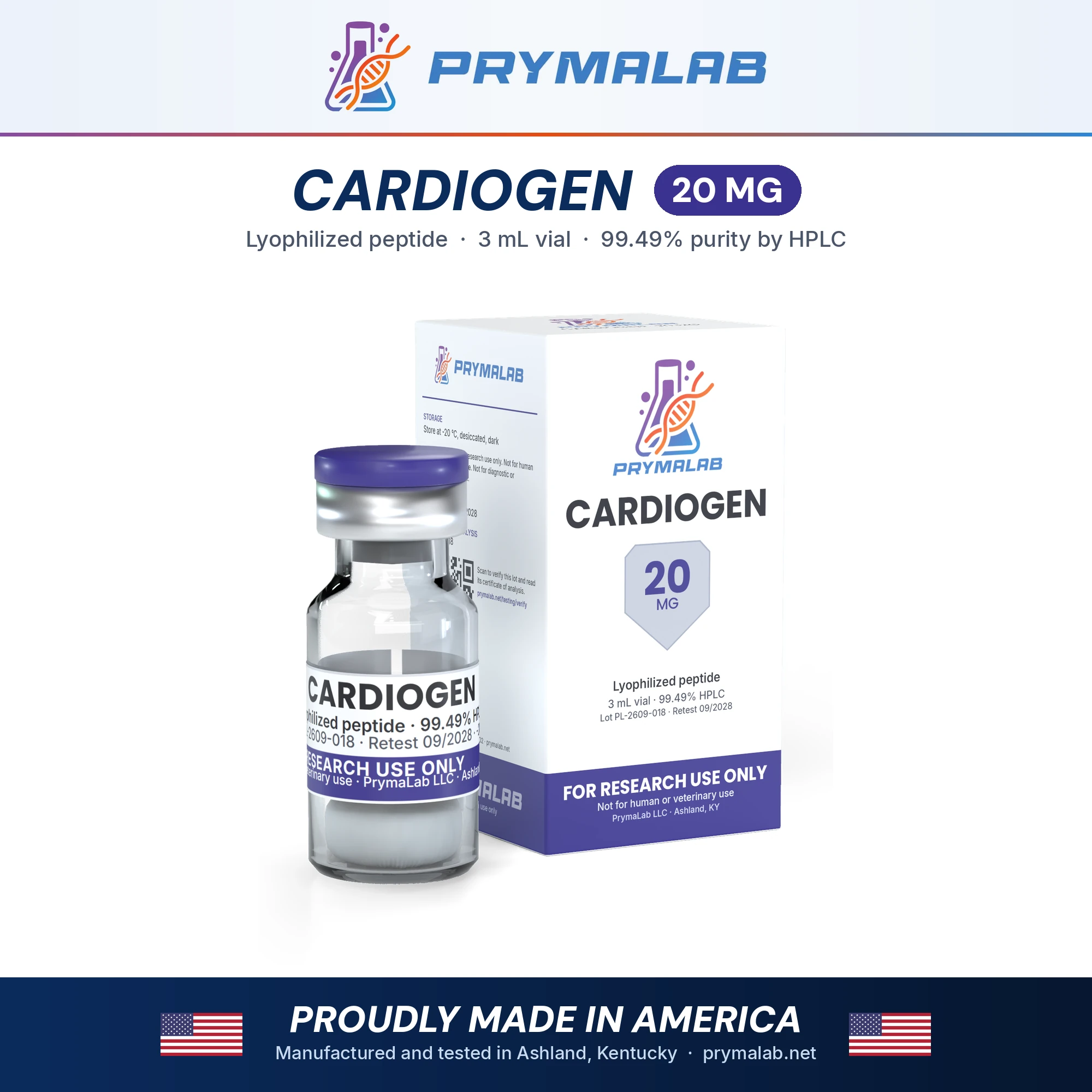
Cardiogen Peptide 20mg
Ala-Glu-Asp-Arg (AEDR), the Khavinson heart-assigned tetrapeptide, in a 20 mg vial
Cardiogen is the synthetic tetrapeptide Ala-Glu-Asp-Arg (AEDR), the peptide that Vladimir Khavinson’s bioregulator series assigns to heart tissue. It has nothing to do with Cardiogen-82, a rubidium-82 generator used in cardiac imaging. This listing is a 20 mg vial of freeze-dried Cardiogen with a theoretical mass of 489.5 Da. The literature on AEDR is small: one study of cytoskeletal proteins in mouse fibroblasts, computer docking work, and the St Petersburg group’s general model of gene regulation by short peptides.
Specifications
| Property | Value |
|---|---|
| Compound | Cardiogen Ala-Glu-Asp-Arg (AEDR); Khavinson cardiac peptide bioregulator |
| CAS number | Not assigned |
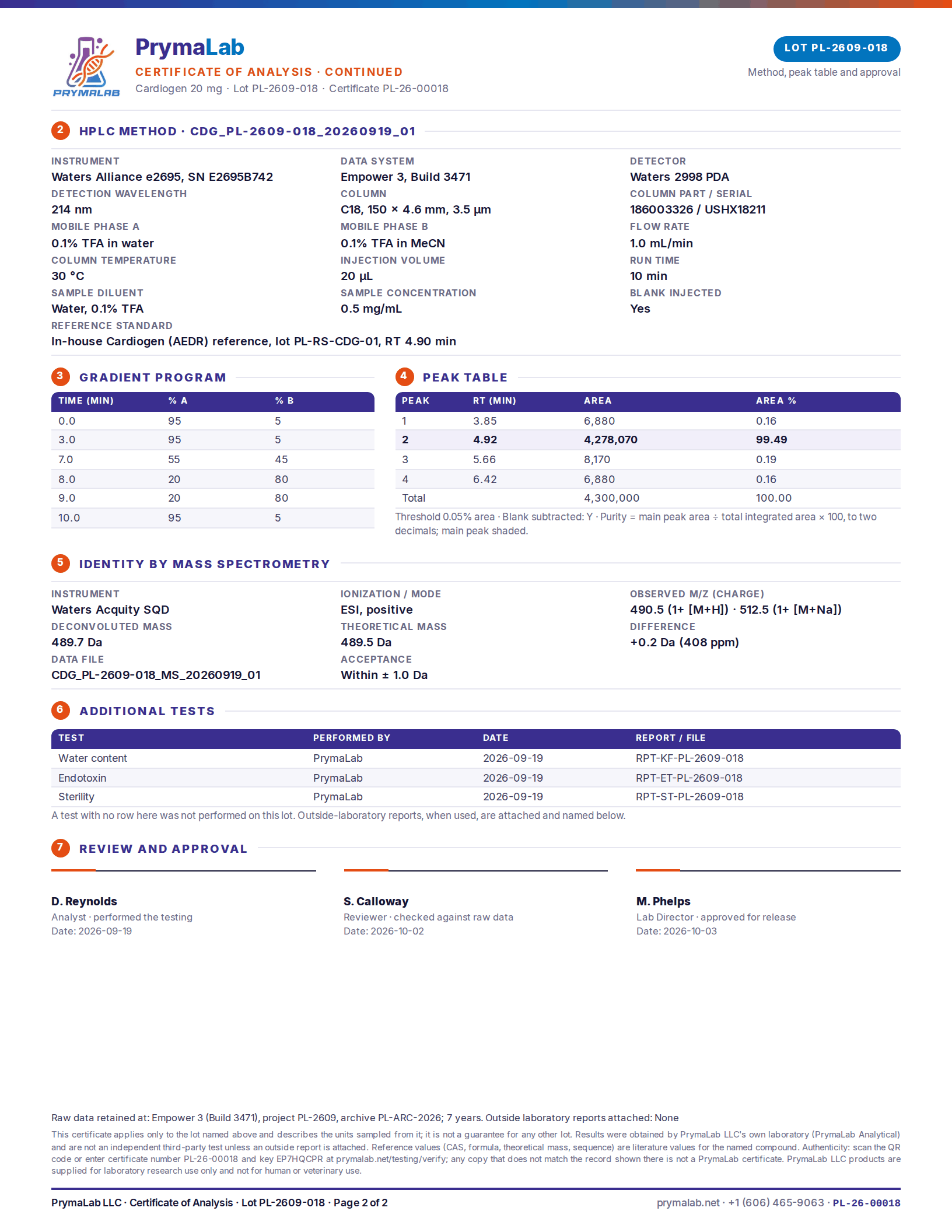
| Molecular formula | C18H31N7O9 |
| Theoretical mass | 489.5 Da |
| Sequence / structure | H-AEDR-OH (4 residues; free N- and C-termini) |
| Label claim | 20 mg/vial |
| Form | Lyophilized (freeze-dried) powder or cake in a sealed glass vial with a rubber stopper and aluminium crimp cap |
| Storage, sealed | −20 °C, desiccated, dark |
| Purity specification | 99.0% or higher by RP-HPLC |
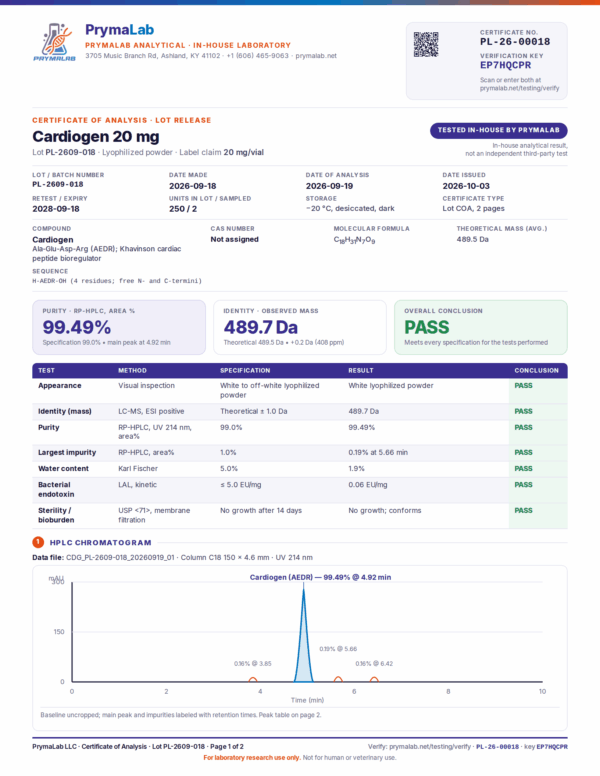
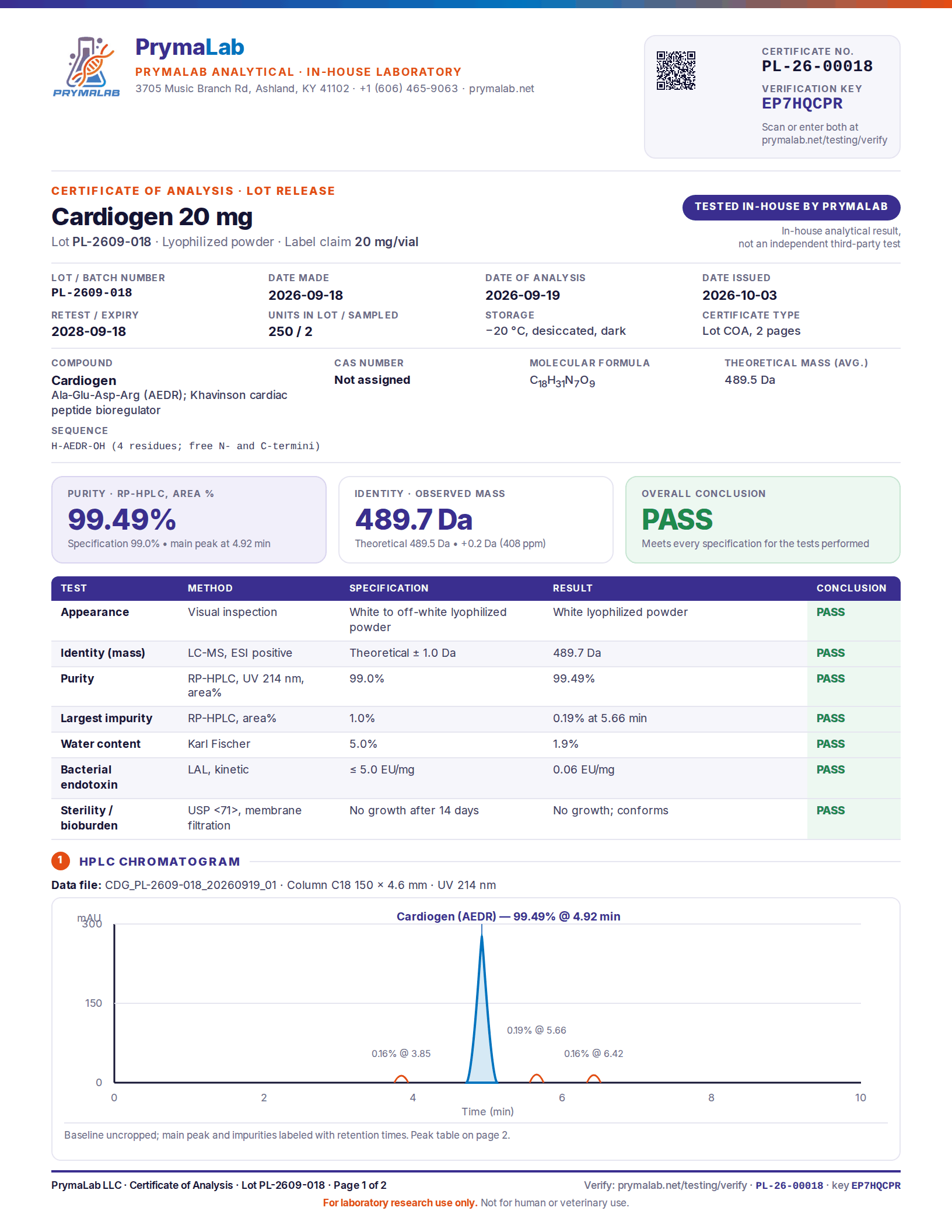
| Lot certificate | Results for the lot now shipping are in the certificate panel on this page |
| Safety data sheet | PL-SDS-029 |
Which Cardiogen this vial contains
The vial contains H-AEDR-OH: alanine, glutamic acid, aspartic acid and arginine with free termini, formula C18H31N7O9 and theoretical mass 489.5 Da. The LC-MS identity figure on the lot certificate is the number to compare with it. In molar terms 20 mg is about 41 µmol, slightly less after the residual water the certificate reports. The last three residues, Glu-Asp-Arg, are the sequence of Pinealon1, so Cardiogen is Pinealon with an alanine added at the N-terminus. The two are separate compounds with separate literatures.
The name is shared with Cardiogen-82, the brand of a rubidium Rb-82 generator that produces a radioactive tracer for cardiac PET imaging. Searches for the name return both, and only the peptide is sold here.
What the research covers
What Cardiogen is and the model behind it
Cardiogen comes from Khavinson’s long-running programme on peptide bioregulators. Anisimov and Khavinson’s 2010 review describes how small peptides were isolated from organs and tissues and then reproduced as synthetic di-, tri- and tetrapeptides2. The group proposes that peptides of two to seven residues get into the nucleus, interact with histones and DNA, and change gene expression and DNA methylation3. Part of the evidence is a fluorescence study in which labelled peptides, Pinealon among them, entered the cytoplasm, nucleus and nucleolus of HeLa cells1. AEDR is not named in that abstract.
Cytoskeletal and nuclear matrix proteins
The one cell experiment on Cardiogen in these references is a 2012 paper by Khavinson, Lin’kova, Polyakova and colleagues4. In cultured mouse embryonic fibroblasts, H-Ala-Glu-Asp-Arg-OH increased expression of the cytoskeletal proteins actin, tubulin and vimentin two- to five-fold, and of the nuclear matrix proteins lamin A and lamin C two- to three-fold. The authors proposed that this explains the cardioprotective activity reported for the peptide in earlier work, by stimulating cell proliferation and reducing apoptosis4. The cells were fibroblasts rather than heart muscle cells, and the earlier cardiac reports are not among the references checked here.
Transporter modelling
A 2023 study from the same group used molecular modelling and docking to ask whether 26 biologically active ultrashort peptides, AEDR included, could enter cells through the amino acid transporters LAT1 and LAT2 and the peptide transporter PEPT15. The binding sites were large enough for di-, tri- and tetrapeptides, and the 26 active peptides scored consistently higher than di- and tripeptides with no established activity, drawn from all 8,400 possible combinations5. This is a computed prediction. No uptake of AEDR into cells was measured.
What is not established
No study here measured AEDR in cardiomyocytes, heart tissue or a living animal, and none reports human data. The cardiac label rests on the programme’s tissue assignment and on earlier reports this page could not check. Most of the work appeared in Bulletin of Experimental Biology and Medicine, the English edition of a Russian journal, and all of it shares authors with Khavinson’s group. The Cardiogen guide covers the programme’s wider claims, which go well beyond these abstracts.
How each lot is tested
Every lot is tested in PrymaLab’s own laboratory in Ashland, Kentucky before release: RP-HPLC for purity, LC-MS for identity, Karl Fischer titration for water, LAL for endotoxin and USP <71> for sterility. The results for the lot now shipping are in the certificate panel on this page, and the certificate number, key and QR code can be checked on the verify page. These are in-house results from PrymaLab Analytical, not an independent test, and the lab is not accredited to ISO 17025. The third-party testing guarantee on this page still applies: if any independent laboratory finds the wrong compound, or less than the stated purity or amount, the order is refunded and the cost of the test is reimbursed.
Frequently asked questions
Is Cardiogen the same as Cardiogen-82?
No. Cardiogen-82 is the brand name of a rubidium-82 generator used to make a radioactive tracer for cardiac PET scans. This product is the synthetic tetrapeptide Ala-Glu-Asp-Arg, a research peptide from the Khavinson series that happens to share the name.
How is Cardiogen related to Pinealon?
Pinealon is the tripeptide Glu-Asp-Arg. Cardiogen has the same three residues with an alanine in front, giving Ala-Glu-Asp-Arg. The extra residue makes it a different compound, and the studies of one do not describe the other.
How do I check the certificate for my vial?
Start from the lot number on the vial label. The certificate panel on this page covers the current lot, earlier lots are on the testing results page, and the verify page will confirm any certificate from its number and key.
How should Cardiogen be stored?
Keep the sealed vial at −20 °C, desiccated and away from light, and bring it to room temperature before opening. Reconstituted solutions should be held at 2 to 8 °C, protected from light, within a period your laboratory has established.
What does the research show about the heart?
Very little directly. The only cell study of AEDR in these references used mouse fibroblasts and measured cytoskeletal and nuclear matrix proteins. There are no heart-cell, animal or human results here, and the cardioprotective claims trace back to earlier work that was not checked.
Is Cardiogen approved for any use in people?
No. It is not approved by the FDA or any other authority, and PrymaLab sells it for laboratory research only. It must not be given to people or animals.
References
- Fedoreyeva LI, Kireev II, Khavinson VKh, et al. Penetration of short fluorescence-labeled peptides into the nucleus in HeLa cells and in vitro specific interaction of the peptides with deoxyribooligonucleotides and DNA. Biochemistry (Mosc). 2011;76(11):1210-9. DOI · PubMed
- Anisimov VN, Khavinson VKh. Peptide bioregulation of aging: results and prospects. Biogerontology. 2010;11(2):139-49. DOI · PubMed
- Khavinson VK, Popovich IG, Linkova NS, et al. Peptide Regulation of Gene Expression: A Systematic Review. Molecules. 2021;26(22). DOI · PubMed
- Khavinson VKh, Lin'kova NS, Polyakova VO, et al. Tetrapeptide H-Ala-Glu-Asp-Arg-OH stimulates expression of cytoskeletal and nuclear matrix proteins. Bull Exp Biol Med. 2012;153(4):559-62. DOI · PubMed
- Khavinson VK, Linkova NS, Rudskoy AI, et al. Feasibility of Transport of 26 Biologically Active Ultrashort Peptides via LAT and PEPT Family Transporters. Biomolecules. 2023;13(3). DOI · PubMed
Research use only
For laboratory research use only. Cardiogen Peptide 20mg is not a drug, food, cosmetic or dietary supplement, is not approved by the FDA or any comparable authority for human or veterinary use, and must not be given to people or animals. It is sold to qualified researchers and institutions, and the buyer is responsible for lawful handling and disposal.
Other formats of Cardiogen
Cardiogen is also stocked as Cardiogen 20mg Nasal Spray and Cardiogen 20mg preloaded 3ml pen. Each listing states its own quantity and concentration, and the pen and vial comparison explains what changes between formats.






Reviews
There are no reviews yet.