
Description
PrymaLab · Research use only
MT-1 (Melanotan 1) 10mg
Afamelanotide (melanotan I), the linear 13-residue alpha-MSH analogue, in a 10 mg vial
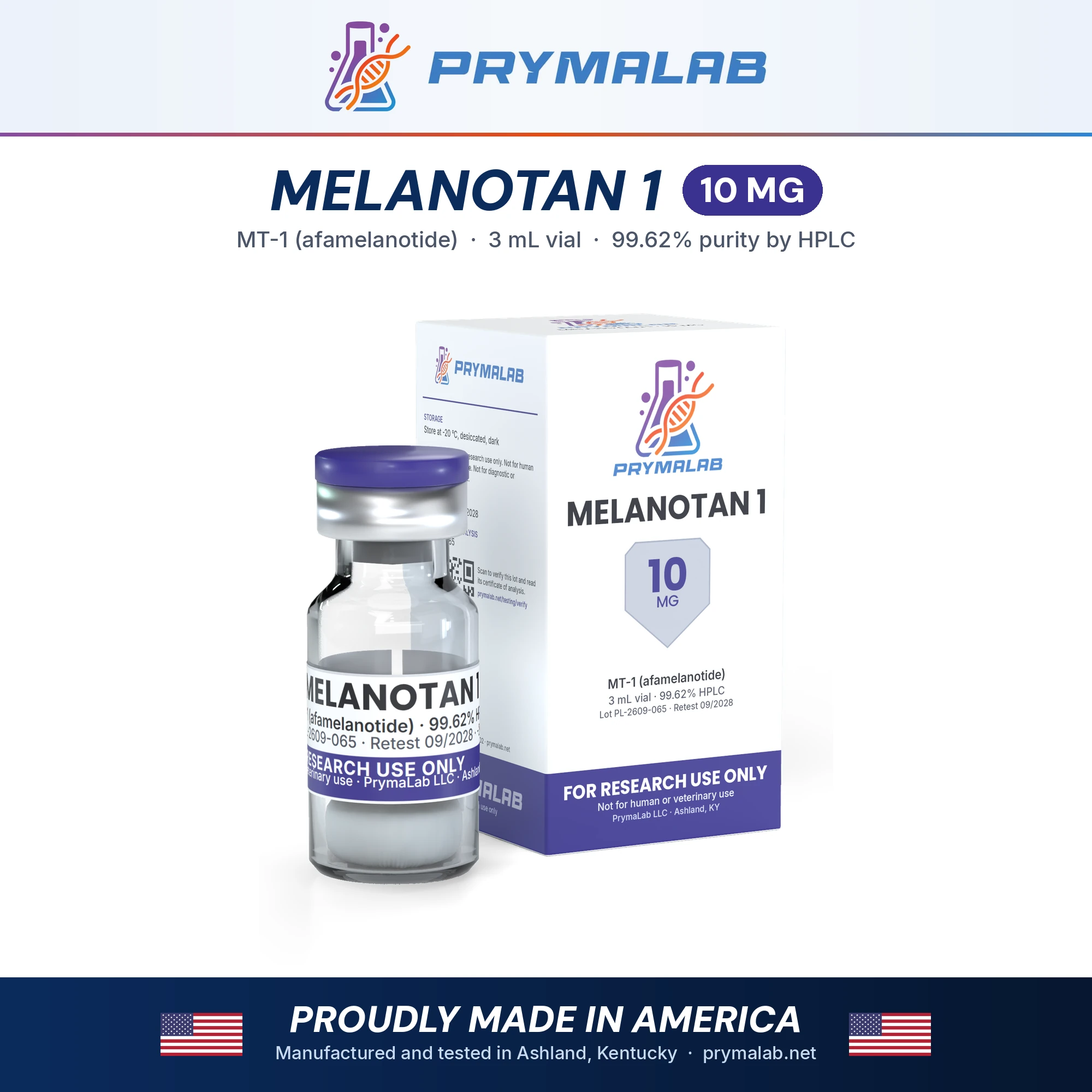
Melanotan I, also called MT-1 and afamelanotide, is [Nle4, D-Phe7]-alpha-MSH: the full 13-residue sequence of alpha-melanocyte-stimulating hormone with two substitutions, kept linear. This listing is a sealed vial holding 10 mg of the peptide as freeze-dried powder, acetylated at the N-terminus and amidated at the C-terminus. Research on it runs from 1980s structure-activity work on alpha-MSH analogues through early clinical studies of skin pigmentation to two randomised trials of an implant formulation in erythropoietic protoporphyria.
Specifications
| Property | Value |
|---|---|
| Compound | Melanotan I Afamelanotide; [Nle4, D-Phe7]-α-MSH |
| CAS number | 75921-69-6 |
| Molecular formula | C78H111N21O19 |
| Theoretical mass | 1646.9 Da |
| Sequence / structure | Ac-SYS-Nle-EH-[D-Phe]-RWGKPV-NH₂ (13 residues; N-acetyl; C-terminal amide) |
| Label claim | 10 mg/vial |
| Form | Lyophilized (freeze-dried) powder or cake in a sealed glass vial with a rubber stopper and aluminium crimp cap |
| Storage, sealed | −20 °C, desiccated, dark |
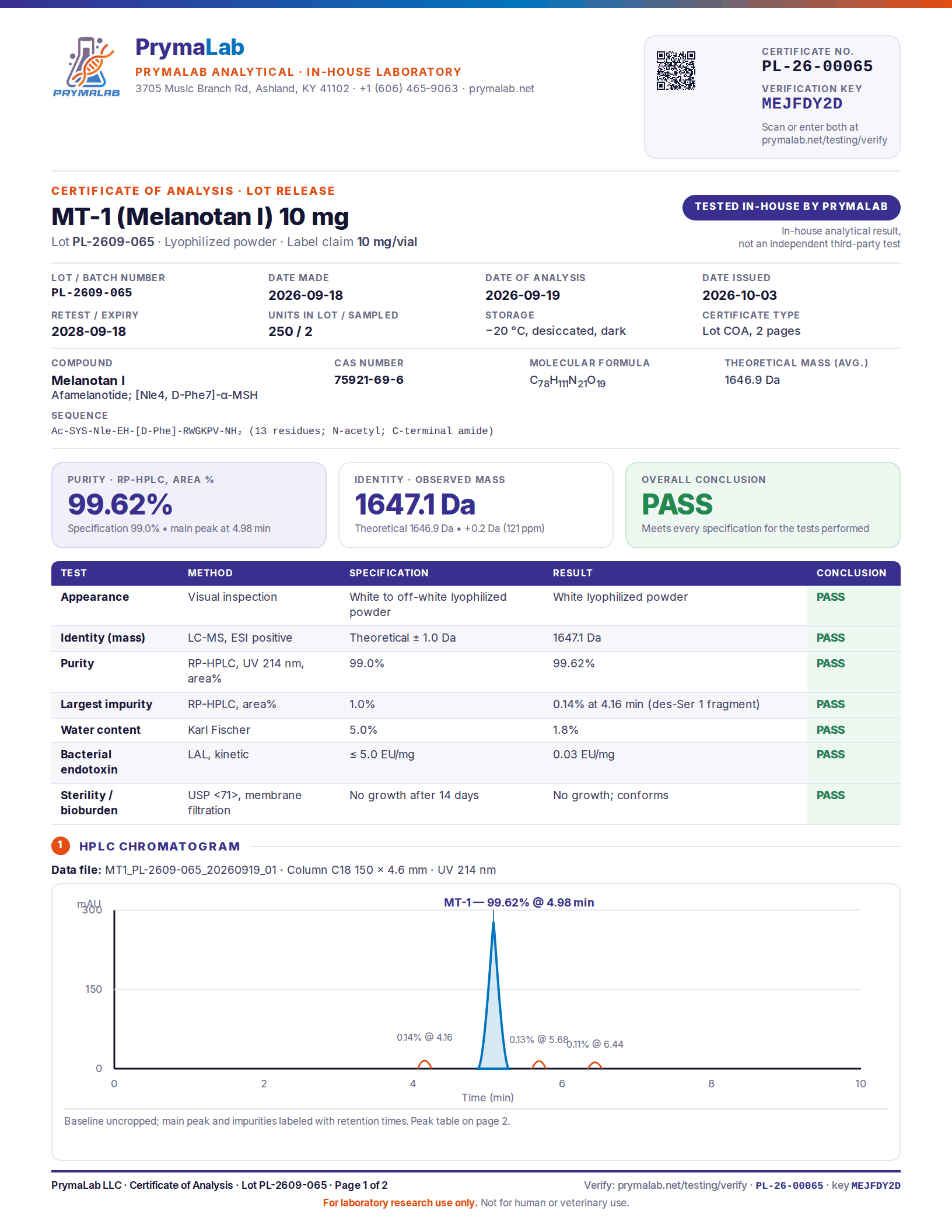
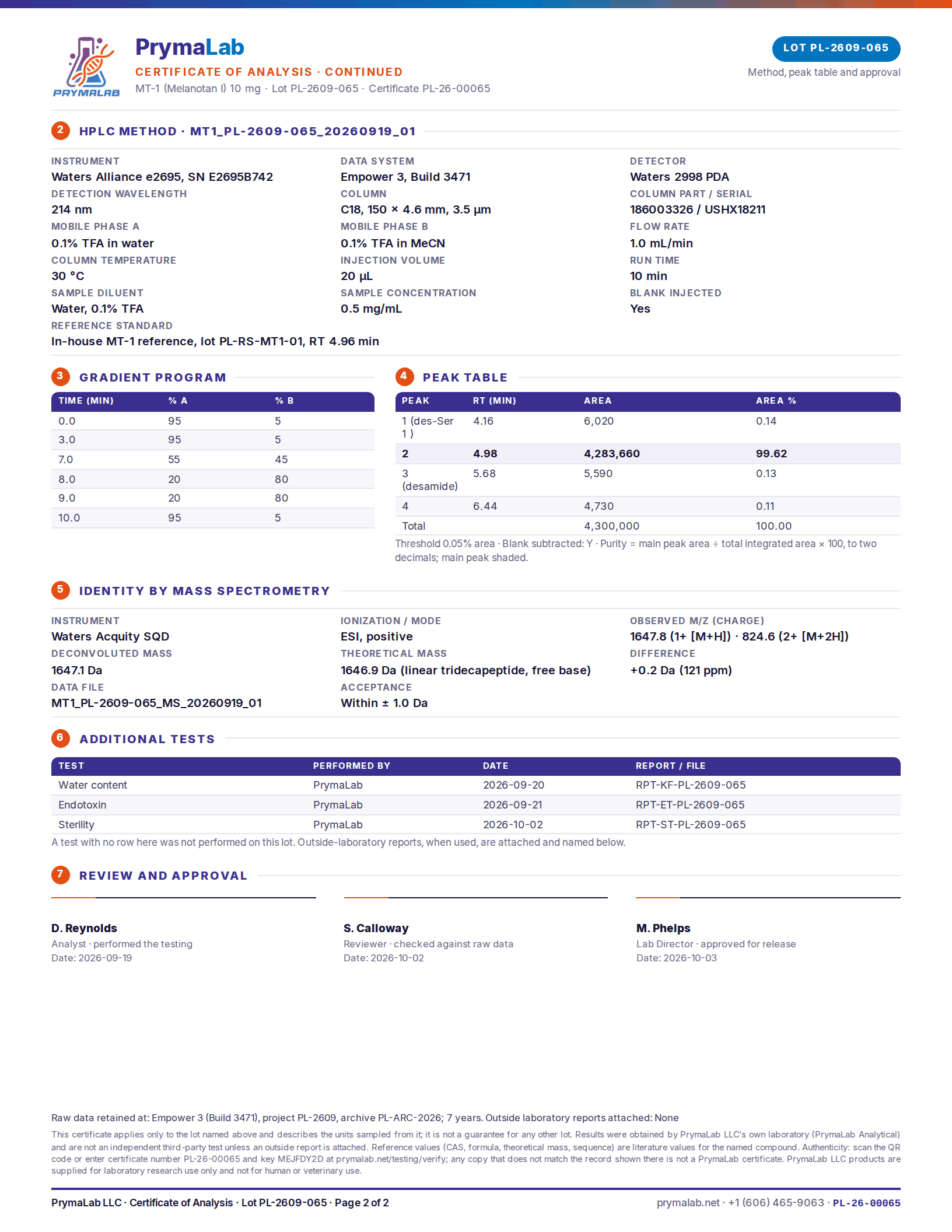
| Purity specification | 99.0% or higher by RP-HPLC |
| Lot certificate | Results for the lot now shipping are in the certificate panel on this page |
| Safety data sheet | PL-SDS-107 |
Melanotan I is not a milder melanotan II
The two names suggest two strengths of one product, but they are different molecules. Melanotan I keeps the whole backbone of alpha-MSH, Ac-Ser-Tyr-Ser-Nle-Glu-His-D-Phe-Arg-Trp-Gly-Lys-Pro-Val-NH2, with norleucine at position 4 in place of methionine and D-phenylalanine at position 7. Swapping out methionine removes the oxidation-prone thioether that the native hormone carries. Melanotan II is a seven-residue fragment closed into a ring by a lactam bridge.
The masses are far apart: 1646.9 Da for melanotan I against 1024.2 Da for melanotan II, so the LC-MS identity result on the certificate tells them apart at a glance. From the theoretical mass, 10 mg of melanotan I is about 6.1 µmol, slightly less after the water content the certificate reports. The melanotan 1 vs melanotan 2 guide compares the two receptor by receptor.
What the research covers
A superpotent linear analogue
Alpha-MSH is a 13-residue peptide, Ac-Ser-Tyr-Ser-Met-Glu-His-Phe-Arg-Trp-Gly-Lys-Pro-Val-NH21. Structure-activity work in the 1980s produced analogues far more potent than the hormone, and in 1989 Al-Obeidi and colleagues named Ac-[Nle4,D-Phe7]-alpha-MSH, the compound now called melanotan I or afamelanotide, as one of two superpotent analogues their new designs started from1. Those designs were cyclic lactam fragments, and their potency was measured against alpha-MSH in frog and lizard skin bioassays, the standard tests of melanotropic activity at the time1. Melanotan I therefore came first; the cyclic peptides that led to melanotan II were designed from what it and its relatives had shown about the hormone1.
A 2006 review by Hadley and Dorr described the melanocortin analogues from this work as superpotent, prolonged acting and resistant to enzymatic breakdown2. Two were patented and moved into clinical testing: melanotan I, the linear peptide, and melanotan II, a truncated cyclic one2.
Clinical development
According to Hadley and Dorr, melanotan I was tested clinically in studies of skin tanning, while melanotan II went toward the diagnosis and treatment of male erectile dysfunction2. The review abstract gives no results for the tanning studies.
The largest controlled human data in these references concern a different use. Langendonk and colleagues ran two multicentre, randomised, double-blind, placebo-controlled trials of afamelanotide implants in erythropoietic protoporphyria, a photodermatosis in which light exposure causes acute pain3. The European trial enrolled 74 patients and the US trial 94; over study periods of 180 and 270 days they recorded the type and duration of sun exposure, the number and severity of phototoxic reactions, adverse events and quality of life, with photoprovocation testing in a US subgroup3. The primary end point was the number of hours of direct sunlight without pain. In the US study the median after six months was 69.4 hours in the afamelanotide group against 40.8 hours with placebo (P=0.04)3. The trial material was a solid implant, a different article from freeze-dried powder in a vial.
What is not established
The evidence in these references is narrow. Potency comes from amphibian and reptile skin assays1, the controlled human data from two implant trials in one rare disease3, and the tanning work is mentioned in a review without figures2. None of the cited abstracts measures receptor selectivity; the melanotan guide sets out what is known about it, along with afamelanotide’s regulatory history. None of the studies used research-grade powder or PrymaLab material.
The Melanotan 1 vs Melanotan 2 guide covers the literature in more depth.
How each lot is tested
Every lot is tested in PrymaLab’s own laboratory in Ashland, Kentucky before release: RP-HPLC for purity, LC-MS for identity, Karl Fischer titration for water, LAL for endotoxin and USP <71> for sterility. The results for the lot now shipping are in the certificate panel on this page, and the certificate number, key and QR code can be checked on the verify page. These are in-house results from PrymaLab Analytical, not an independent test, and the lab is not accredited to ISO 17025. The third-party testing guarantee on this page still applies: if any independent laboratory finds the wrong compound, or less than the stated purity or amount, the order is refunded and the cost of the test is reimbursed.
Frequently asked questions
Is melanotan I the same as afamelanotide?
Yes. Afamelanotide is the nonproprietary name for [Nle4, D-Phe7]-alpha-MSH, the peptide also sold as melanotan I or MT-1. This vial holds that 13-residue sequence: CAS 75921-69-6, formula C78H111N21O19, theoretical mass 1646.9 Da.
How does MT-1 differ from MT-2?
They are different molecules. MT-1 is linear, 13 residues and 1646.9 Da. MT-2 is a seven-residue lactam ring of 1024.2 Da that reaches more melanocortin receptors. Findings for one cannot be carried over to the other, and PrymaLab sells them as separate products.
Where is the certificate for my vial?
The lot number printed on the vial label matches a certificate. The panel on this page shows the lot now shipping, earlier lots are on the testing results page, and the verify page confirms a certificate from its number and key. The LC-MS identity figure should sit close to 1646.9 Da.
How should the vial be stored?
Keep it sealed at −20 °C, dry and dark. Allow it to warm to room temperature before opening to stop condensation forming on the powder. For reconstituted solutions the safety data sheet gives 2 to 8 °C, protected from light, for a period set by your laboratory.
What does the published research on afamelanotide show?
It shows a superpotent linear alpha-MSH analogue from 1980s structure-activity work, clinical tanning studies mentioned without results in a 2006 review, and two randomised implant trials in erythropoietic protoporphyria that measured pain-free time in sunlight. None of it used freeze-dried research material.
Is this vial for human use?
No. MT-1 from PrymaLab is sold for laboratory research only. This product is not approved for human or veterinary use by the FDA or any other authority, and it must not be given to people or animals.
References
- Al-Obeidi F, Castrucci AM, Hadley ME, et al. Potent and prolonged acting cyclic lactam analogues of alpha-melanotropin: design based on molecular dynamics. J Med Chem. 1989;32(12):2555-61. DOI · PubMed
- Hadley ME, Dorr RT. Melanocortin peptide therapeutics: historical milestones, clinical studies and commercialization. Peptides. 2006;27(4):921-30. DOI · PubMed
- Langendonk JG, Balwani M, Anderson KE, et al. Afamelanotide for Erythropoietic Protoporphyria. N Engl J Med. 2015;373(1):48-59. DOI · PubMed
Research use only
For laboratory research use only. MT-1 (Melanotan 1) 10mg is not a drug, food, cosmetic or dietary supplement, is not approved by the FDA or any comparable authority for human or veterinary use, and must not be given to people or animals. It is sold to qualified researchers and institutions, and the buyer is responsible for lawful handling and disposal.
Other formats of MT-1
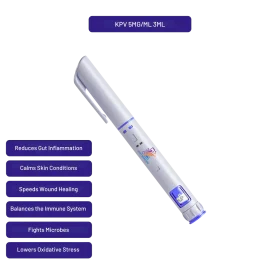
MT-1 is also stocked as Melanotan II 10mg Nasal Spray, Melanotan 2 10mg preloaded 3ml pen and MT-2 (Melanotan 2 Acetate) 10mg. Each listing states its own quantity and concentration, and the pen and vial comparison explains what changes between formats.








Reviews
There are no reviews yet.