
Description
PrymaLab · Research use only
Adipotide 5mg
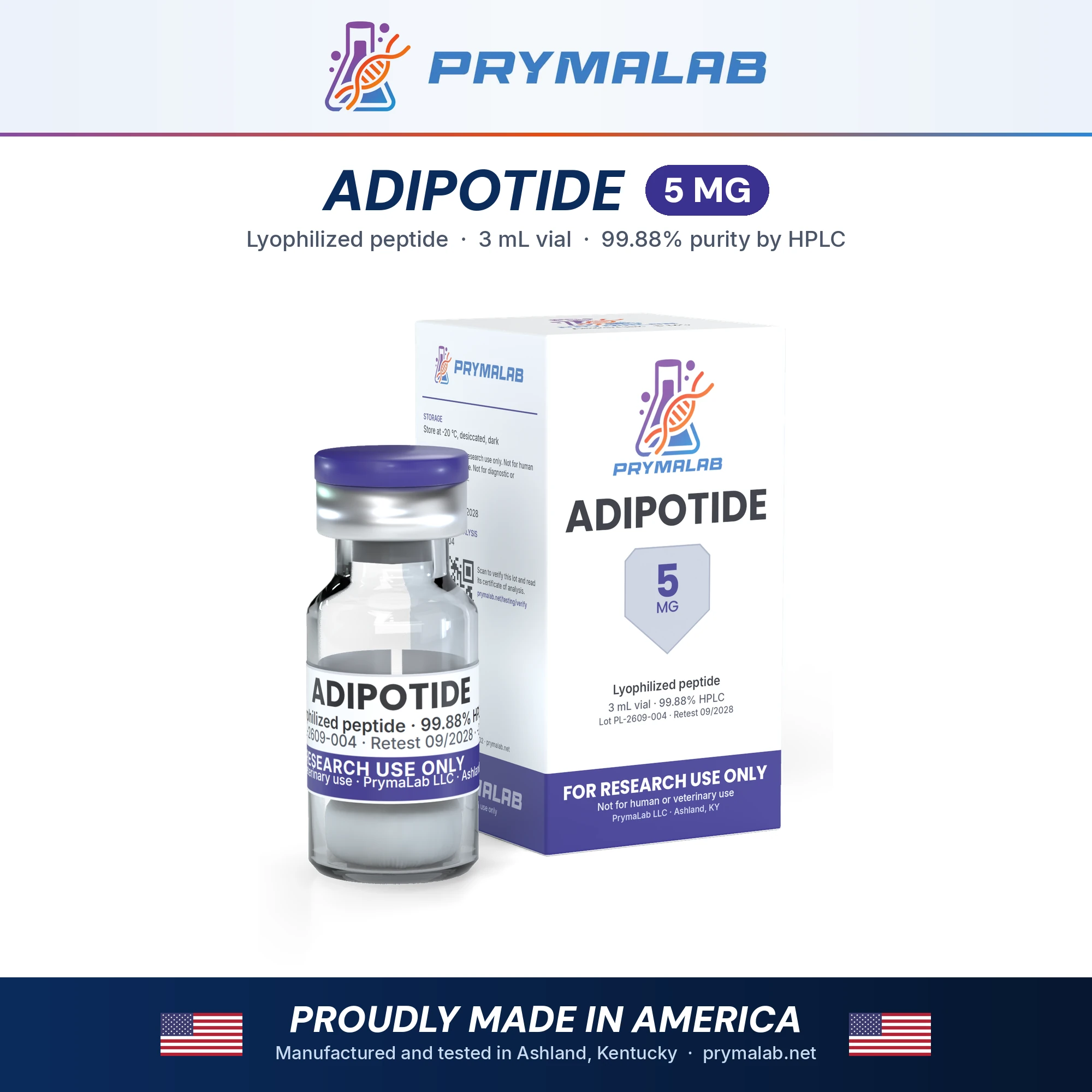
Prohibitin-targeted proapoptotic peptidomimetic, freeze-dried, 5 mg per vial
Adipotide, also called FTPP, is an experimental peptidomimetic made of two parts: a cyclic homing motif, CKGGRAKDC, that associates with prohibitin on blood vessels in white fat, and a proapoptotic sequence built from D-amino acids, (KLAKLAK)2. This listing is a 5 mg vial of freeze-dried powder. The published research on adipotide comes entirely from cell and animal studies, including one in obese monkeys.
Specifications
| Property | Value |
|---|---|
| Compound | Adipotide FTPP; prohibitin-targeting proapoptotic peptide CKGGRAKDC-GG-D(KLAKLAK)₂ |
| CAS number | 859216-15-2 |
| Molecular formula | C111H204N36O28S2 |
| Theoretical mass | 2555.2 Da |
| Sequence / structure | H-CKGGRAKDC-GG-klaklakklaklak-OH (25 residues; Cys1–Cys9 disulfide; lower case = D-amino acids; free N- and C-termini) |
| Label claim | 5 mg/vial |
| Form | Lyophilized (freeze-dried) powder or cake in a sealed glass vial with a rubber stopper and aluminium crimp cap |
| Storage, sealed | −20 °C, desiccated, dark |
| Purity specification | 99.0% or higher by RP-HPLC |
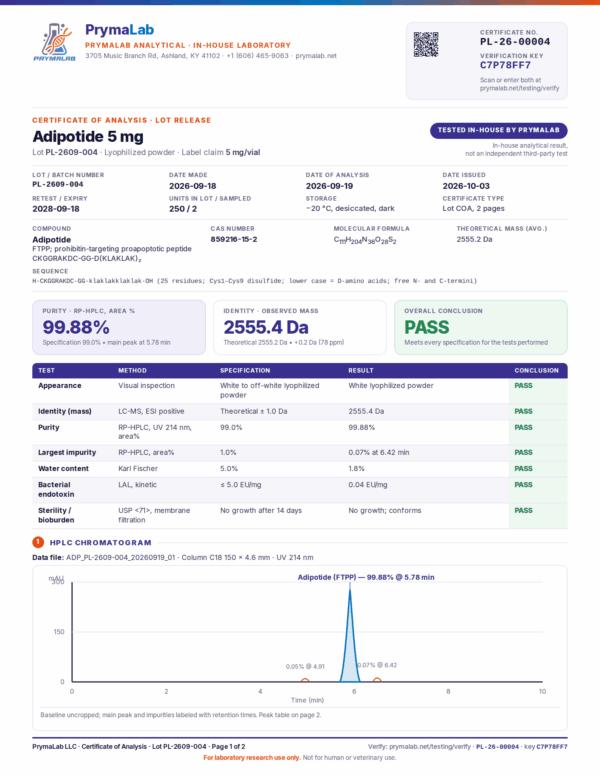
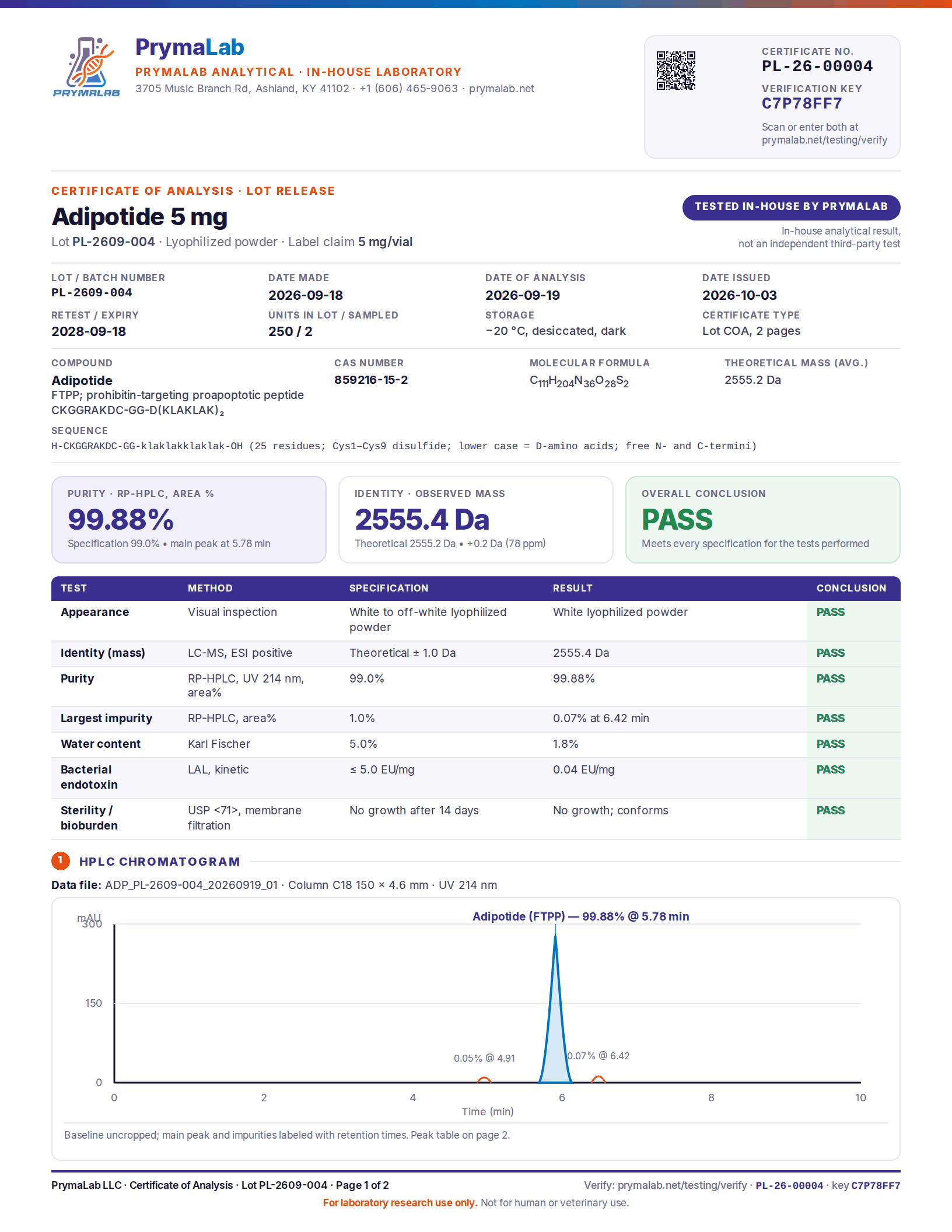
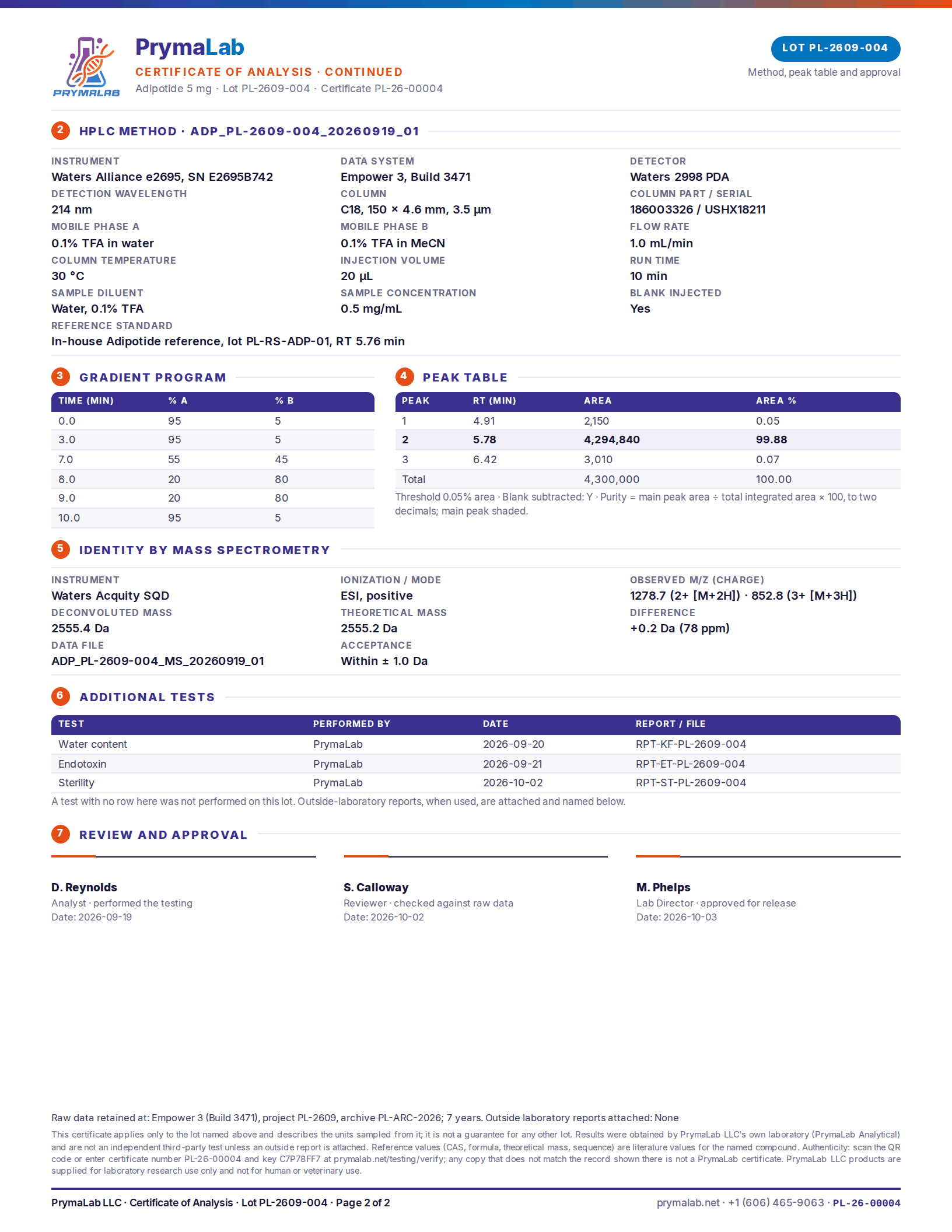
| Lot certificate | Results for the lot now shipping are in the certificate panel on this page |
| Safety data sheet | PL-SDS-007 |
How the molecule is built
The certificate writes adipotide as H-CKGGRAKDC-GG-klaklakklaklak-OH: 25 residues, with a disulfide between cysteine 1 and cysteine 9 that closes the first nine residues into a ring. Lower-case letters mark D-amino acids, so the fourteen-residue effector, two repeats of KLAKLAK, is made from the mirror-image forms of lysine, leucine and alanine. Two glycines link the halves, and both termini are free. The theoretical mass is 2555.2 Da, which makes 5 mg about 2.0 µmol before allowing for the water the certificate reports; the LC-MS identity result is the number to compare with it.
Each half has its own origin. CKGGRAKDC was found by in vivo phage display, a method that recovers peptides homing to particular vascular beds1,2. The KLAKLAK repeat matches de novo antimicrobial peptides designed to be perfectly amphipathic as helices3. Putting a homing domain and a proapoptotic domain into one short peptide follows the targeted proapoptotic peptides that Ellerby and colleagues described in 19994.
What the research covers
Targeted proapoptotic peptides
Ellerby and colleagues introduced the approach in 1999 with short peptides built from two functional domains: a motif that homes to tumour blood vessels and a sequence that induces programmed cell death4. The proapoptotic domain was meant to be non-toxic outside cells and toxic once internalised, by disrupting mitochondrial membranes4. Their prototypes, of 21 and 26 residues, were selectively toxic to angiogenic endothelial cells and showed anti-cancer activity in mice4. The effector in adipotide matches a de novo antimicrobial design. Javadpour and colleagues made (KLAKLAK)n and related peptides as perfectly amphipathic helices and found that the 14-residue versions were bacteriostatic at micromolar concentrations, with much lower cytotoxicity toward mouse 3T3 fibroblasts and higher selectivity than the natural antimicrobial peptides magainin 2 and cecropin B; the 7-residue versions had neither activity nor secondary structure3.
An address in fat vasculature
Arap and colleagues developed in vivo phage display to find peptides that home to particular vascular beds, and in 2002 reported the first such screen in a patient, surveying 47,160 motifs and finding that circulating peptides distribute to organs non-randomly1. With the same approach, Kolonin and colleagues isolated CKGGRAKDC as a motif homing to the vasculature of white fat, showed that it associates with prohibitin and proposed prohibitin as a vascular marker of adipose tissue2. Aiming a proapoptotic peptide at prohibitin ablated white fat in their model, and they reported resorption of established fat and normalised metabolism without detectable adverse effects2. Prohibitin was also found in blood vessels of human white fat2.
The primate study
Barnhart and colleagues moved the work to primates, citing differences between rodents and primates as a major hurdle for translating anti-obesity strategies developed in rodents5. In obese Old World monkeys, adipotide induced targeted apoptosis in the blood vessels of white adipose tissue; the animals lost weight and their insulin resistance improved, and MRI and dual-energy x-ray absorptiometry confirmed a marked reduction in white adipose tissue5. Monkeys of three species also showed predictable, reversible changes in renal proximal tubule function5. A 2011 review by Daquinag, Zhang and Kolonin set this work in a wider frame: white adipose tissue grows by adipocyte hypertrophy and hyperplasia that depend on angiogenesis, so its vasculature, or the stromal cells that support it, could be targeted6.
What is not established
All of the results above come from cell culture and animals, and none of the abstracts reports a human study of adipotide. The 2004 paper reported no detectable adverse effects, yet the monkey study found changes in kidney tubule function2,5. The prohibitin work traces largely to one group: Kolonin is an author on the phage display, fat ablation and review papers cited here1,2,6. Adipotide is an experimental compound with no approved use, and none of these studies used PrymaLab material.
How each lot is tested
Every lot is tested in PrymaLab’s own laboratory in Ashland, Kentucky before release: RP-HPLC for purity, LC-MS for identity, Karl Fischer titration for water, LAL for endotoxin and USP <71> for sterility. The results for the lot now shipping are in the certificate panel on this page, and the certificate number, key and QR code can be checked on the verify page. These are in-house results from PrymaLab Analytical, not an independent test, and the lab is not accredited to ISO 17025. The third-party testing guarantee on this page still applies: if any independent laboratory finds the wrong compound, or less than the stated purity or amount, the order is refunded and the cost of the test is reimbursed.
Frequently asked questions
What is adipotide made of?
One 25-residue chain: a nine-residue ring, CKGGRAKDC, closed by a disulfide, then two glycines, then two repeats of KLAKLAK built from D-amino acids. The ring is the prohibitin-homing motif and the D-amino acid half is the proapoptotic domain. The theoretical mass is 2555.2 Da.
How does the vial differ from the adipotide pen?
The vial holds 5 mg of freeze-dried peptide that is stored at −20 °C and dissolved when the work needs it, at a concentration you choose. The pen holds 10 mg already in 3 mL of bacteriostatic water and is kept at 2 to 8 °C. The peptide is the same.
How do I check the certificate for my vial?
Read the lot number on the vial and compare it with the certificate panel on this page. The LC-MS identity result should sit close to the theoretical 2555.2 Da, and the verify page confirms any certificate from its number and key.
How should the vial be stored?
Sealed, at −20 °C, desiccated and protected from light, and brought to room temperature before opening. Reconstituted solution belongs at 2 to 8 °C, out of the light, for a period your laboratory has established. The safety data sheet does not classify adipotide as hazardous.
Has adipotide been studied in humans, and is it for human use?
None of the papers cited here reports a human study; the evidence comes from cell culture, mice and obese monkeys. Adipotide is an experimental compound with no approved use. This vial is sold for laboratory research only and must not be given to people or animals.
References
- Arap W, Kolonin MG, Trepel M, et al. Steps toward mapping the human vasculature by phage display. Nat Med. 2002;8(2):121-7. DOI · PubMed
- Kolonin MG, Saha PK, Chan L, et al. Reversal of obesity by targeted ablation of adipose tissue. Nat Med. 2004;10(6):625-32. DOI · PubMed
- Javadpour MM, Juban MM, Lo WC, et al. De novo antimicrobial peptides with low mammalian cell toxicity. J Med Chem. 1996;39(16):3107-13. DOI · PubMed
- Ellerby HM, Arap W, Ellerby LM, et al. Anti-cancer activity of targeted pro-apoptotic peptides. Nat Med. 1999;5(9):1032-8. DOI · PubMed
- Barnhart KF, Christianson DR, Hanley PW, et al. A peptidomimetic targeting white fat causes weight loss and improved insulin resistance in obese monkeys. Sci Transl Med. 2011;3(108):108ra112. DOI · PubMed
- Daquinag AC, Zhang Y, Kolonin MG. Vascular targeting of adipose tissue as an anti-obesity approach. Trends Pharmacol Sci. 2011;32(5):300-7. DOI · PubMed
Research use only
For laboratory research use only. Adipotide 5mg is not a drug, food, cosmetic or dietary supplement, is not approved by the FDA or any comparable authority for human or veterinary use, and must not be given to people or animals. It is sold to qualified researchers and institutions, and the buyer is responsible for lawful handling and disposal.
Other formats of Adipotide
Adipotide is also stocked as Adipotide (FTPP) 10mg preloaded 3ml pen. Each listing states its own quantity and concentration, and the pen and vial comparison explains what changes between formats.








Reviews
There are no reviews yet.