
Description
PrymaLab · Research use only
Cartalax 20mg Peptide
Ala-Glu-Asp (AED, T-31), the Khavinson cartilage tripeptide, in a 20 mg vial
Cartalax is the synthetic tripeptide Ala-Glu-Asp (AED), CAS 85806-95-7, the member of Vladimir Khavinson’s short-peptide series assigned to cartilage and connective tissue, coded T-31 in his group’s papers. This listing is a 20 mg vial of freeze-dried Cartalax with a theoretical mass of 333.3 Da. The published work on AED is cell and tissue culture, mostly from the St Petersburg group: skin fibroblasts, rat kidney explants and human stem-cell lines. None of the abstracts here studied cartilage.
Specifications
| Property | Value |
|---|---|
| Compound | Cartalax Ala-Glu-Asp (AED; T-31); Khavinson cartilage peptide bioregulator |
| CAS number | 85806-95-7 |
| Molecular formula | C12H19N3O8 |
| Theoretical mass | 333.3 Da |
| Sequence / structure | H-AED-OH (3 residues; free N- and C-termini) |
| Label claim | 20 mg/vial |
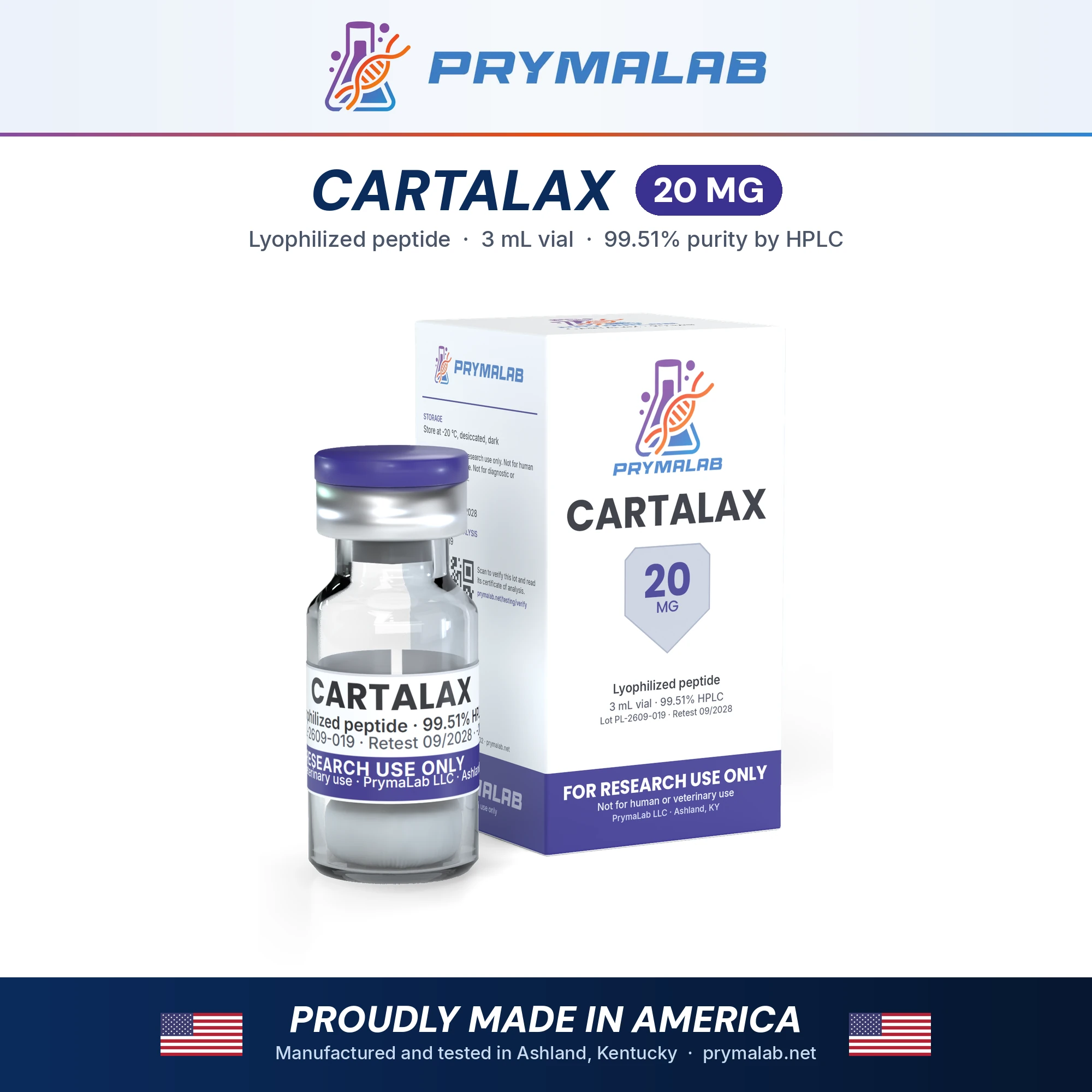
| Form | Lyophilized (freeze-dried) powder or cake in a sealed glass vial with a rubber stopper and aluminium crimp cap |
| Storage, sealed | −20 °C, desiccated, dark |
| Purity specification | 99.0% or higher by RP-HPLC |
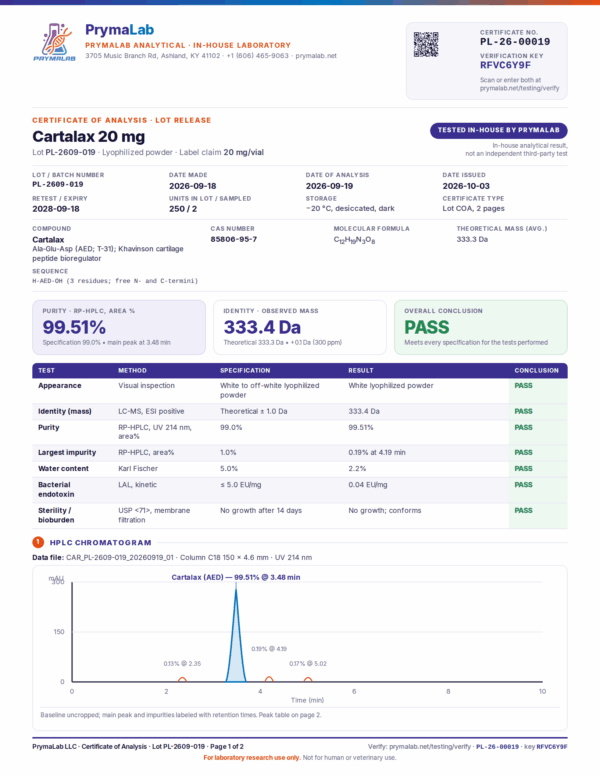
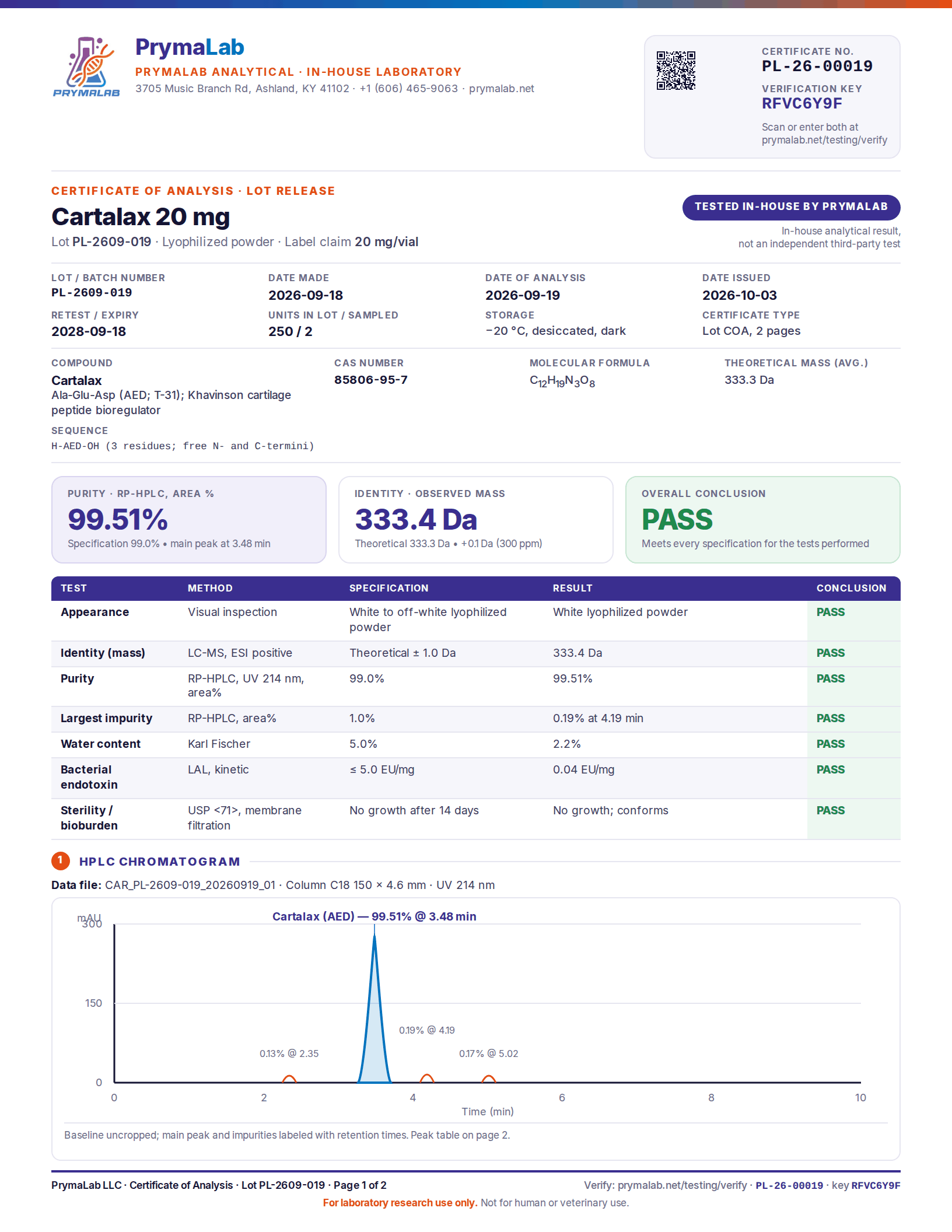
| Lot certificate | Results for the lot now shipping are in the certificate panel on this page |
| Safety data sheet | PL-SDS-032 |
AED alongside its relatives
The vial holds H-AED-OH, formula C12H19N3O8, and its theoretical mass of 333.3 Da is the figure to compare with the LC-MS identity result on the lot certificate. In molar terms 20 mg is about 60 µmol, slightly less once residual water is counted. AED is Epitalon, Ala-Glu-Asp-Gly1, without its C-terminal glycine, and it differs from KED (Lys-Glu-Asp) only in the first residue. Those near neighbours matter when reading the literature, because AED was almost always tested side by side with them: with KE, KED and AEDG in skin fibroblasts2, with KED and KE in stem cells3, and with T-35 (EDL) in kidney tissue4. A result reported for the group of peptides is not always a result for AED.
What the research covers
What Cartalax is
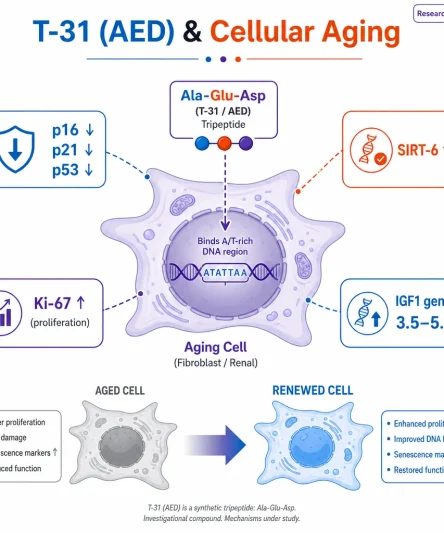
Cartalax is one of the synthetic short peptides from Khavinson’s programme. The group’s systematic review describes the model it uses for all of them: peptides of two to seven residues enter cell nuclei, interact with histones and DNA, and regulate gene expression, including through DNA methylation5. For AED there is a specific prediction. Khavinson, Lin’kova and Tarnovskaya built docking models of DNA-peptide complexes for 19 short peptides and placed AED, together with KEDW, on the DNA sequence acct6. That was a computer model. The abstract reports no binding measurement, and the authors wrote that the molecular mechanism remained unclear6.
Fibroblasts and kidney tissue
Lin’kova and colleagues studied human skin fibroblasts as they aged in culture, comparing KE, KED, AED and AEDG by immunofluorescent confocal microscopy2. All four peptides inhibited MMP-9, which rose as the cells aged, and raised Ki-67 and CD98hc, which fell. AED and AEDG also suppressed caspase-dependent apoptosis2. In organotypic kidney tissue cultures from young and old rats, Chalisova and colleagues found that T-31 and T-35 stimulated proliferation and reduced apoptosis, though less than a polypeptide complex isolated from calf kidney4.
Stem-cell cultures
Ashapkin and colleagues measured expression of IGF1, FOXO1, TERT, TNKS2 and NFκB in a human embryonic bone marrow mesenchymal stem cell line aged in two ways, by repeated passaging and by stationary culture3. IGF1 expression rose 3.5 to 5.6-fold when the peptides were added, and AED, KED and KE all stimulated NFκB; the sharper differences between the two models involved KED and KE rather than AED3. A 2019 study by Caputi and colleagues looked at neuronal differentiation of human periodontal ligament stem cells and found higher GAP43 and Nestin with a mixture of AED, KED, KE and AEDG and with KED alone7. Its abstract reports no effect of AED on its own.
What is not established
Nothing in these references tests AED on chondrocytes, cartilage or joints, so the cartilage assignment comes from the programme’s naming rather than from a cited experiment. The Cartalax (T-31) guide describes a chondrogenic culture model that is not among the references checked here. All of the work is in cells or explants, with no animal or human data in the abstracts, and most of it was published by Khavinson’s group in Bulletin of Experimental Biology and Medicine, the English edition of a Russian journal.
How each lot is tested
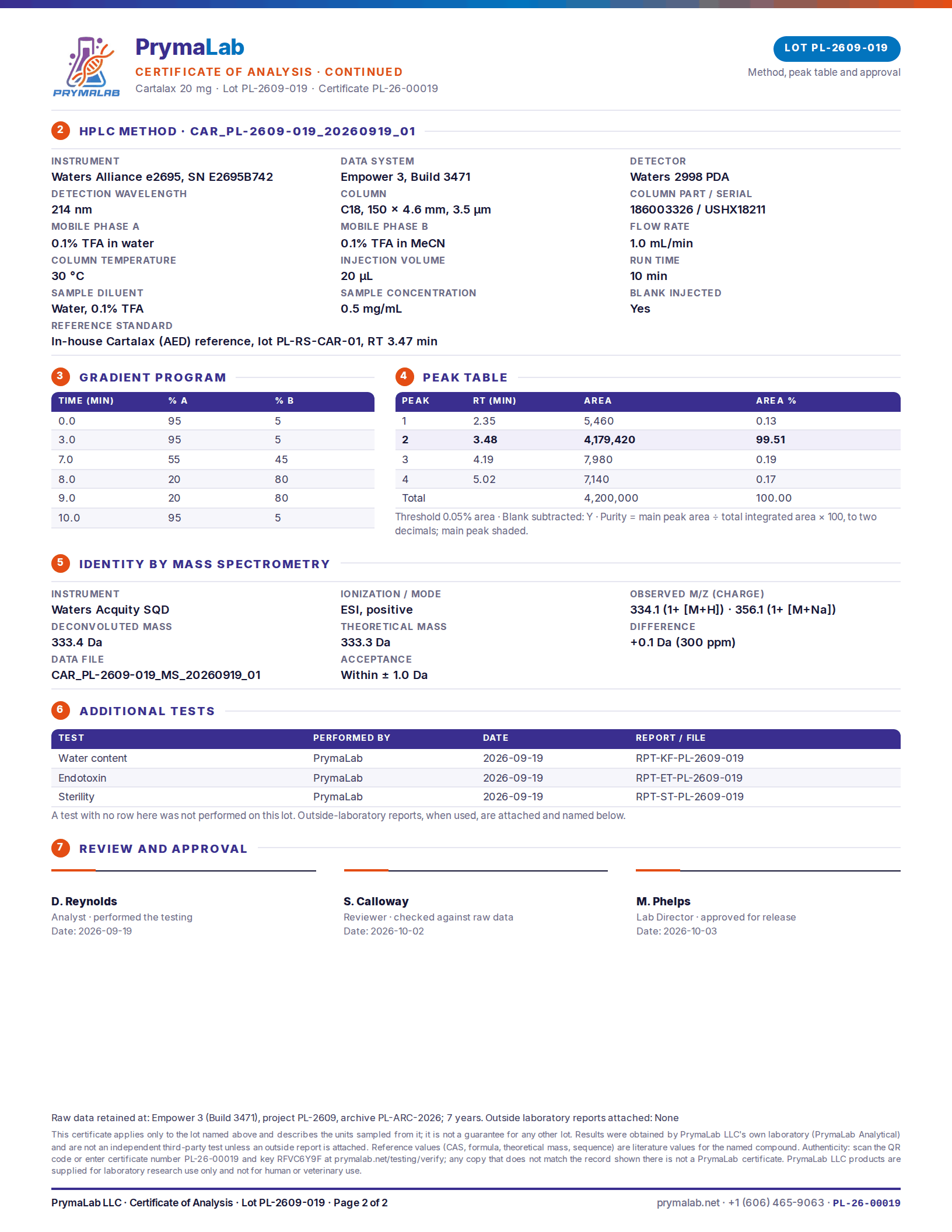
Every lot is tested in PrymaLab’s own laboratory in Ashland, Kentucky before release: RP-HPLC for purity, LC-MS for identity, Karl Fischer titration for water, LAL for endotoxin and USP <71> for sterility. The results for the lot now shipping are in the certificate panel on this page, and the certificate number, key and QR code can be checked on the verify page. These are in-house results from PrymaLab Analytical, not an independent test, and the lab is not accredited to ISO 17025. The third-party testing guarantee on this page still applies: if any independent laboratory finds the wrong compound, or less than the stated purity or amount, the order is refunded and the cost of the test is reimbursed.
Frequently asked questions
Is Cartalax the same as T-31?
Yes. T-31 is the code Khavinson's group uses for Ala-Glu-Asp in its culture papers, and Cartalax is the trade name for the same tripeptide. When reading those papers, check which peptide each result belongs to, since T-31 is usually tested alongside related sequences.
Has Cartalax been studied in cartilage?
Not in any of the papers cited on this page. The measured AED results come from skin fibroblasts, rat kidney explants and stem-cell lines. The cartilage label is the programme's tissue assignment, and the guide covers the chondrogenic culture study separately.
How do I match the certificate to my vial?
Use the lot number printed on the vial. This page's certificate panel covers the lot now shipping, older lots appear on the testing results page, and the verify page confirms a certificate from its number and key.
How should the vial be stored?
Sealed vials go at −20 °C, desiccated and dark. Warm the vial to room temperature before opening so moisture does not settle on the powder. Reconstituted solutions belong at 2 to 8 °C, out of light, for no longer than your laboratory's established period.
Is Cartalax for human use?
No. Cartalax is supplied strictly for laboratory research. No regulator has approved it for human or veterinary use, and it must not be given to people or animals.
References
- Fedoreyeva LI, Kireev II, Khavinson VKh, et al. Penetration of short fluorescence-labeled peptides into the nucleus in HeLa cells and in vitro specific interaction of the peptides with deoxyribooligonucleotides and DNA. Biochemistry (Mosc). 2011;76(11):1210-9. DOI · PubMed
- Lin'kova NS, Drobintseva AO, Orlova OA, et al. Peptide Regulation of Skin Fibroblast Functions during Their Aging In Vitro. Bull Exp Biol Med. 2016;161(1):175-8. DOI · PubMed
- Ashapkin V, Khavinson V, Shilovsky G, et al. Gene expression in human mesenchymal stem cell aging cultures: modulation by short peptides. Mol Biol Rep. 2020;47(6):4323-4329. DOI · PubMed
- Chalisova NI, Lin'kova NS, Nichik TE, et al. Peptide Regulation of Cells Renewal Processes in Kidney Tissue Cultures from Young and Old Animals. Bull Exp Biol Med. 2015;159(1):124-7. DOI · PubMed
- Khavinson VK, Popovich IG, Linkova NS, et al. Peptide Regulation of Gene Expression: A Systematic Review. Molecules. 2021;26(22). DOI · PubMed
- Khavinson VK, Lin'kova NS, Tarnovskaya SI. Short Peptides Regulate Gene Expression. Bull Exp Biol Med. 2016;162(2):288-292. DOI · PubMed
- Caputi S, Trubiani O, Sinjari B, et al. Effect of short peptides on neuronal differentiation of stem cells. Int J Immunopathol Pharmacol. 2019;33:2058738419828613. DOI · PubMed
Research use only
For laboratory research use only. Cartalax 20mg Peptide is not a drug, food, cosmetic or dietary supplement, is not approved by the FDA or any comparable authority for human or veterinary use, and must not be given to people or animals. It is sold to qualified researchers and institutions, and the buyer is responsible for lawful handling and disposal.
Other formats of Cartalax
Cartalax is also stocked as Cartalax 20mg preloaded 3ml pen. Each listing states its own quantity and concentration, and the pen and vial comparison explains what changes between formats.






5 reviews for Cartalax 20mg Peptide