
Description
PrymaLab · Research use only
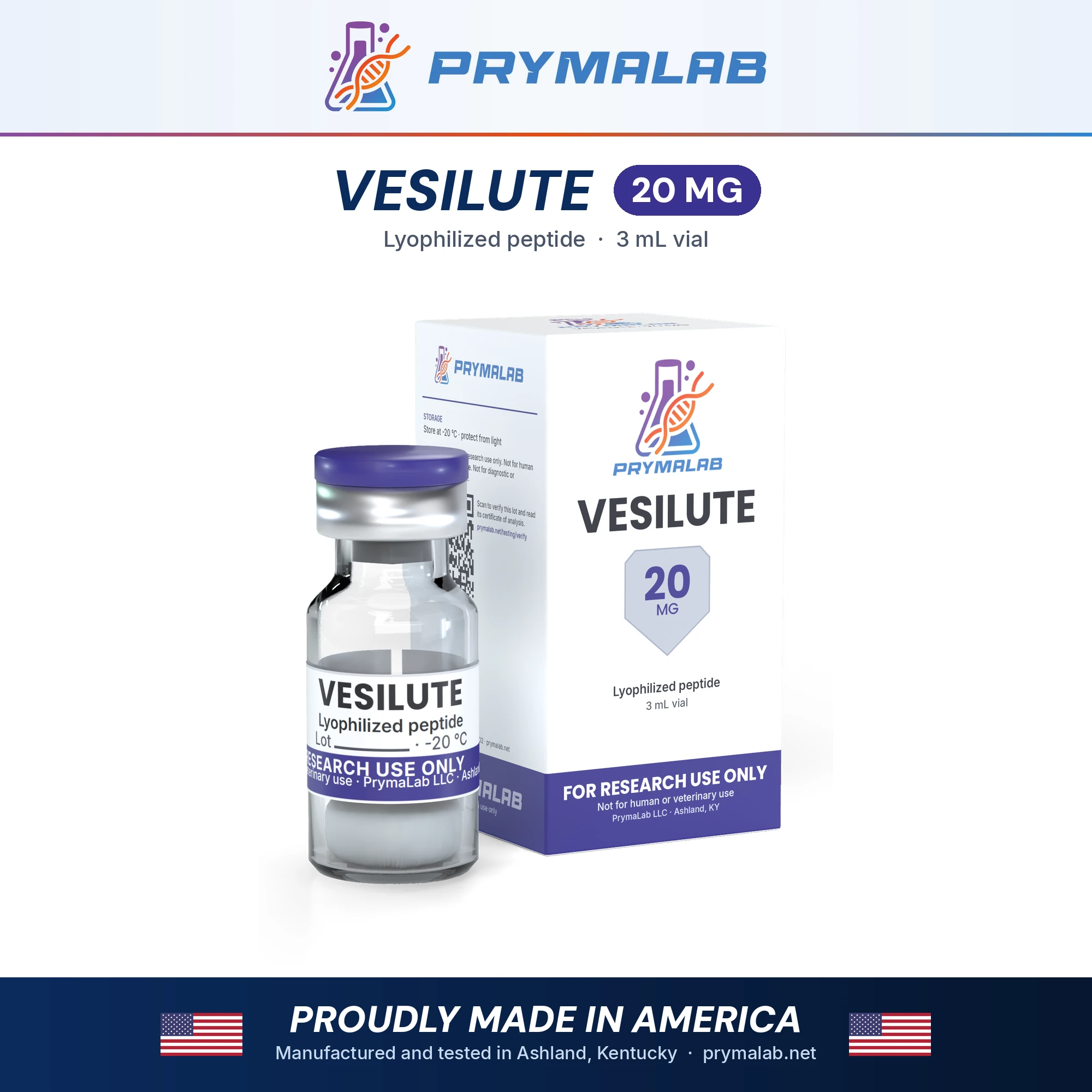
Vesilute Peptide 20mg
Glu-Asp (ED) dipeptide bioregulator, 20 mg of freeze-dried powder per vial
Vesilute is a dipeptide bioregulator from the Khavinson series, listed on PrymaLab’s safety data sheet as Glu-Asp (ED), formula C9H14N2O7, and assigned by the series’ developers to the bladder and urinary tract. This listing is a 20 mg vial of freeze-dried Vesilute. Research on the Vesilute sequence itself is close to absent: the references on this page cover the developers’ short-peptide model and the chemistry of an N-terminal glutamic acid, not experiments with Vesilute.
Specifications
| Property | Value |
|---|---|
| Compound | Vesilute (Glu-Asp dipeptide (ED)) |
| CAS number | Not assigned |
| Molecular formula | C9H14N2O7 |
| Label claim | 20 mg per vial |
| Form | Lyophilized (freeze-dried) powder or cake in a sealed glass vial with a rubber stopper and aluminium crimp cap |
| Safety data sheet | PL-SDS-177 |
Which dipeptide the vial contains
The safety data sheet gives the contents as the dipeptide Glu-Asp, glutamic acid followed by aspartic acid, with the formula C9H14N2O7 and no CAS number assigned. Some descriptions of Vesilute give the reverse order, Asp-Glu. The two orders share a formula and therefore a mass, so a mass result alone cannot tell them apart; a method that reads sequence, such as comparison with a reference standard of known order, is needed for that.
Vesilute is also easy to mix up with its relatives. Glu-Asp is Vesugen’s Lys-Glu-Asp with the lysine removed, and Vilon is Lys-Glu, the first two residues of that tripeptide. Vesilute is not KED; that sequence is Vesugen. A ready-made solution of Vesilute is sold as the Vesilute preloaded pen.
What the research covers
What Vesilute is supposed to do
Vesilute comes from Vladimir Khavinson’s bioregulator programme at the St Petersburg Institute of Bioregulation and Gerontology, which produced short synthetic peptides and assigned each to an organ; Vesilute’s assignment is the bladder. The programme’s general claim, set out in a 2021 systematic review, is that peptides of two to seven residues enter cell nuclei and nucleoli, bind histones and single- or double-stranded DNA, and regulate gene expression, in part through DNA methylation1. The same review proposed that short peptides were among the first signalling molecules in evolution1. That model is the whole of the published rationale reachable from this page. None of the papers cited here reports an experiment in which Glu-Asp itself was tested.
KED is a different compound
Reviews from the same group often discuss the tripeptide KED. A 2022 review in Cells, for example, analysed signalling molecules of the senescence-associated secretory phenotype in cardiovascular cells and listed the KED tripeptide and the AEDR tetrapeptide among peptides reported to regulate them2. KED is Lys-Glu-Asp, the compound sold as Vesugen. Findings for KED should not be read as findings for Vesilute, which lacks the lysine.
Chemistry of an N-terminal glutamic acid
Vesilute begins with a free glutamic acid, and that residue has a known side reaction. Chelius and colleagues showed that N-terminal glutamic acid converts to pyroglutamic acid without any enzyme, a change they detected in antibody chains after a few weeks of incubation at 37 and 45 °C3. The rate depended on pH, with the least conversion at pH 6.2 and more at pH 4 and pH 8, and reversed-phase HPLC with mass spectrometry separated the converted chains from the native ones3. Those experiments used antibodies, which are large proteins, so their rates do not transfer directly to a dipeptide.
Short peptides can also close into a diketopiperazine ring. Goolcharran and Borchardt measured that reaction in Phe-Pro p-nitroanilide and related model peptides; it followed pseudo-first-order kinetics, depended strongly on pH, and ran faster when the N-terminal amino group was unprotonated, with phosphate buffers between pH 5 and 8 acting as catalysts4. Their models carried a p-nitroanilide group at the C-terminus, which Vesilute does not have. No study in this list measured either reaction for Glu-Asp. On a lot certificate, a product of this kind would be expected to show up in the RP-HPLC purity result as a separate peak.
What is not established
Almost everything about the biology of Vesilute. The bladder assignment comes from the developers’ programme, and no study on this page tested Glu-Asp in bladder tissue, in animals or in people. The residue order is not consistent across sources, and no paper here reports Vesilute’s mass, purity or stability. The references describe a model and two chemical reactions; none used PrymaLab material. The Vesilute guide and the peptide bioregulators research overview give the programme’s background.
How each lot is tested
Every lot is tested in PrymaLab’s own laboratory in Ashland, Kentucky before release: RP-HPLC for purity, LC-MS for identity, Karl Fischer titration for water, LAL for endotoxin and USP <71> for sterility. Published certificates are listed on the results page and can be checked by number and key on the verify page. These are in-house results from PrymaLab Analytical, not an independent test, and the lab is not accredited to ISO 17025. The third-party testing guarantee on this page still applies: if any independent laboratory finds the wrong compound, or less than the stated purity or amount, the order is refunded and the cost of the test is reimbursed.
Frequently asked questions
What sequence is Vesilute?
PrymaLab's safety data sheet lists Vesilute as the dipeptide Glu-Asp (ED), formula C9H14N2O7, with no CAS number assigned. Some sources give the reverse order, Asp-Glu, which has the same formula and mass, so the order cannot be confirmed from a mass result alone.
Is Vesilute the same as Vesugen?
No. Vesugen is the tripeptide Lys-Glu-Asp (KED). Vesilute has two residues, Glu-Asp, without the lysine. Research on KED, including the cardiovascular and cell culture papers, does not apply to Vesilute.
How should the Vesilute vial be stored?
Unopened, keep it frozen, dry and protected from light; −20 °C is the usual temperature for peptides on PrymaLab's safety data sheets. Let it reach room temperature before opening. Once dissolved, hold the solution at 2 to 8 °C in the dark and use it within the period your laboratory has set.
Where do I find the certificate for my vial?
Note the lot number on the vial label and look it up on the testing results page, which lists published certificates. The verify page then confirms that certificate from its certificate number and key.
Is Vesilute approved for human use?
No. It is sold for laboratory research only. It is not approved by the FDA or any other authority for human or veterinary use and must not be given to people or animals.
References
- Khavinson VK, Popovich IG, Linkova NS, et al. Peptide Regulation of Gene Expression: A Systematic Review. Molecules. 2021;26(22). DOI · PubMed
- Khavinson V, Linkova N, Dyatlova A, et al. Senescence-Associated Secretory Phenotype of Cardiovascular System Cells and Inflammaging: Perspectives of Peptide Regulation. Cells. 2022;12(1). DOI · PubMed
- Chelius D, Jing K, Lueras A, et al. Formation of pyroglutamic acid from N-terminal glutamic acid in immunoglobulin gamma antibodies. Anal Chem. 2006;78(7):2370-6. DOI · PubMed
- Goolcharran C, Borchardt RT. Kinetics of diketopiperazine formation using model peptides. J Pharm Sci. 1998;87(3):283-8. DOI · PubMed
Research use only
For laboratory research use only. Vesilute Peptide 20mg is not a drug, food, cosmetic or dietary supplement, is not approved by the FDA or any comparable authority for human or veterinary use, and must not be given to people or animals. It is sold to qualified researchers and institutions, and the buyer is responsible for lawful handling and disposal.






6 reviews for Vesilute Peptide 20mg