
Description
PrymaLab · Research use only
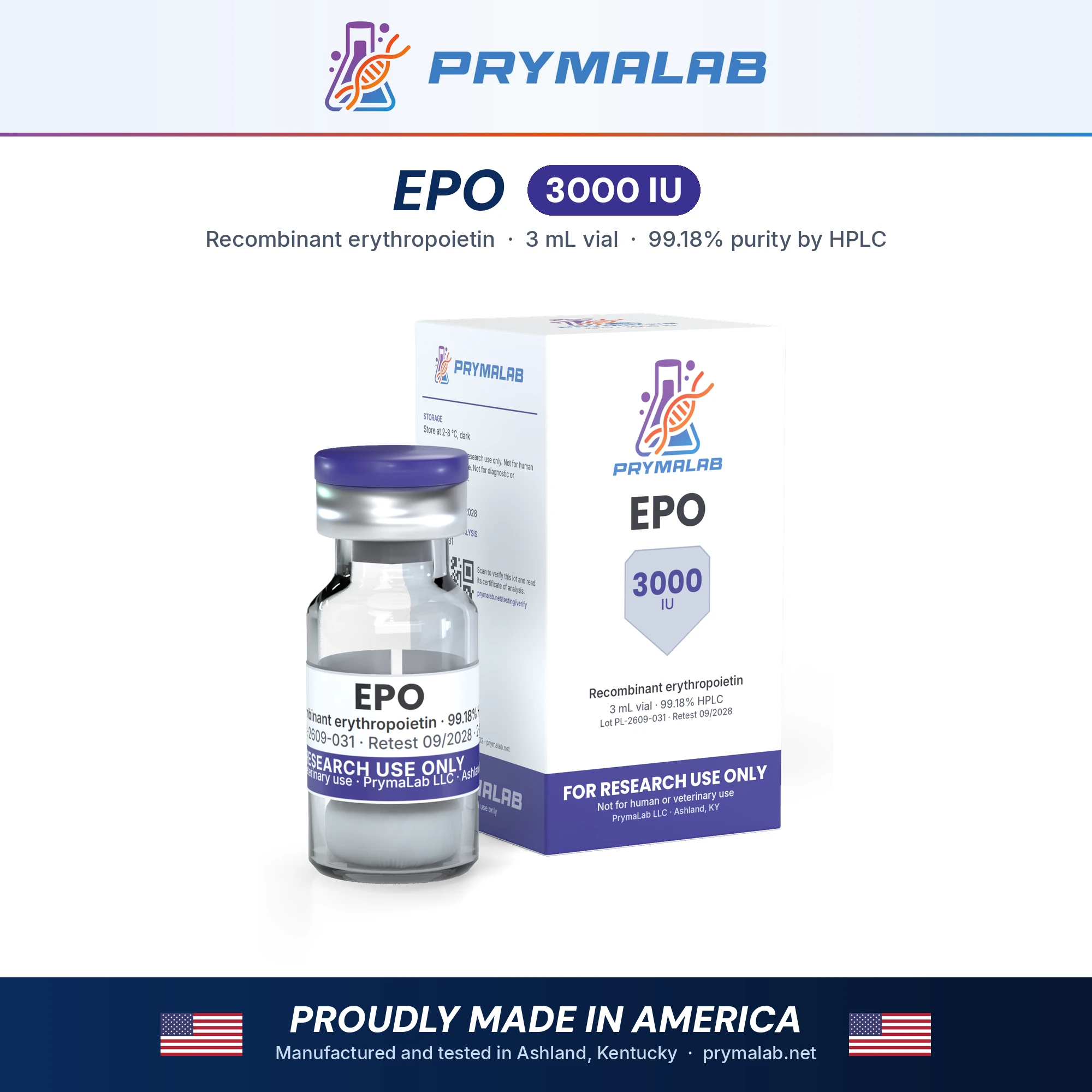
EPO (Erythropoietin) 3000IU
Recombinant human erythropoietin, epoetin class, 3000 IU as a freeze-dried cake
Erythropoietin (EPO) is the glycoprotein hormone that regulates red blood cell production; the kidneys and liver make it, with low tissue oxygen as the main stimulus. This vial holds 3000 IU of recombinant human erythropoietin of the epoetin class, expressed in CHO cells and supplied as a white freeze-dried cake. Research on EPO covers the molecule and its carbohydrate chains, the EPO receptor and its signalling, anemia in chronic kidney disease, and the detection of recombinant EPO in sport.
Specifications
| Property | Value |
|---|---|
| Compound | Erythropoietin (rhEPO) Recombinant human erythropoietin, epoetin class |
| CAS number | 11096-26-7 |
| Molecular formula | C 809 H 1301 N 229 O 240 S 5 (165-residue protein core) |
| Theoretical mass | About 30.4 kDa glycoform average; 18.2 kDa protein core |
| Sequence / structure | 165-residue mature human EPO (UniProt P01588 residues 28–192; C-terminal Arg166 removed), CHO-expressed; N-glycans at Asn24, Asn38 and Asn83, O-glycan at Ser126; disulfides Cys7–Cys161 and Cys29–Cys33. |
| Label claim | 3000 IU/vial (≈ 25 µg glycoprotein) |
| Form | Lyophilized (freeze-dried) powder or cake in a sealed glass vial with a rubber stopper and aluminium crimp cap |
| Storage, sealed | 2–8 °C, dark; do not freeze |
| Purity specification | 99.0% or higher by RP-HPLC |
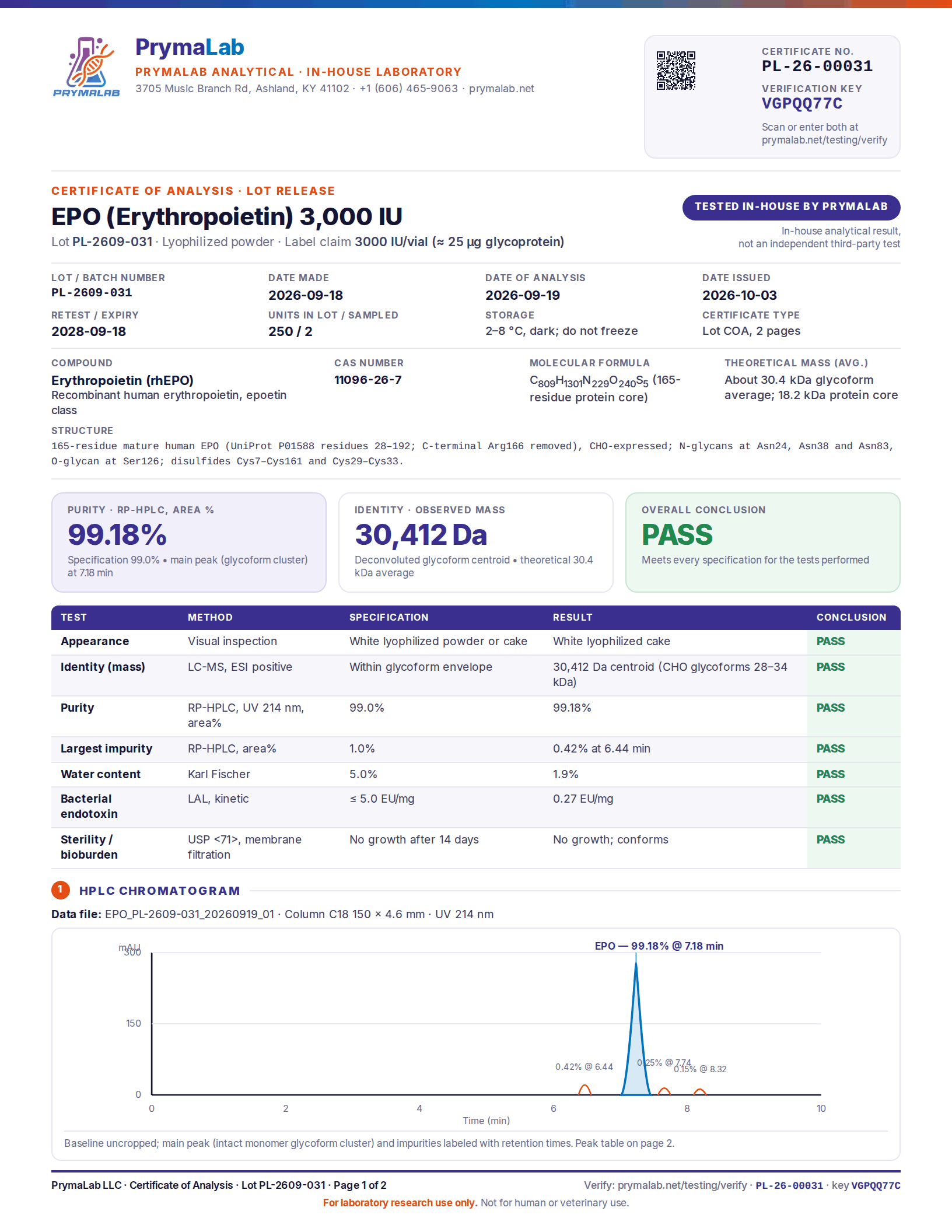
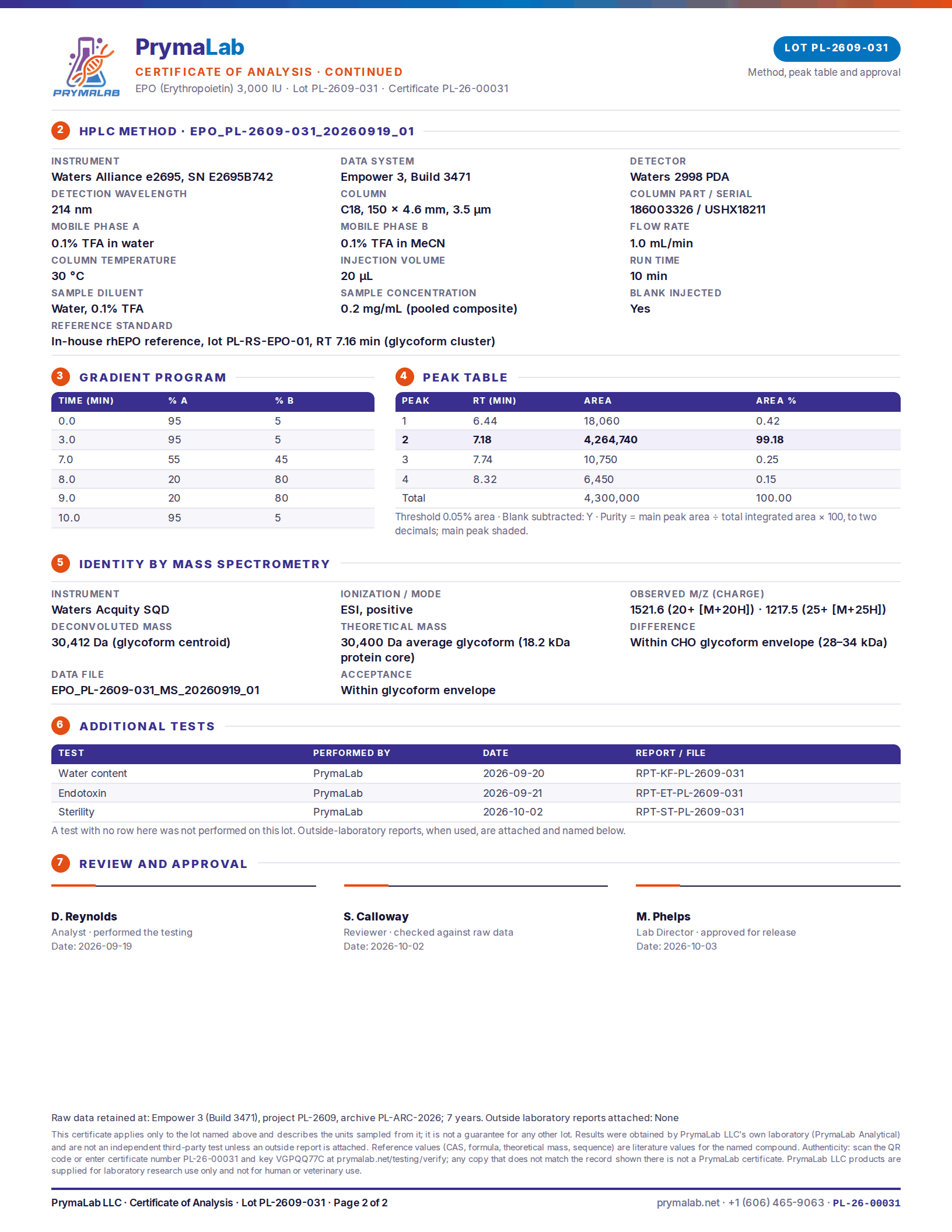
| Lot certificate | Results for the lot now shipping are in the certificate panel on this page |
| Safety data sheet | PL-SDS-052 |
What the certificate describes
The protein is the 165-residue mature form of human EPO, with the C-terminal arginine 166 removed, expressed in Chinese hamster ovary (CHO) cells. It carries three N-linked glycans, at Asn24, Asn38 and Asn83, one O-linked glycan at Ser126, and two disulfide bonds, Cys7 to Cys161 and Cys29 to Cys33. The protein core weighs 18.2 kDa, while the glycosylated molecule averages about 30.4 kDa; LC-MS gives a centroid of 30,412 Da across CHO glycoforms of 28 to 34 kDa.
The label claim is 3000 IU, which the certificate equates to roughly 25 µg of glycoprotein. The four carbohydrate chains are where recombinant and natural EPO part company: Jelkmann described the two as alike in their biological and chemical properties except for some microheterogeneity in those chains1. What the purity and identity figures on a certificate mean in general is explained in peptide purity testing.
Handling notes
EPO is handled as a protein, not as a short peptide. The certificate gives 2 to 8 °C, in the dark, for the sealed vial and states that it must not be frozen, where most freeze-dried peptides in the catalogue are kept at −20 °C. Let the vial reach room temperature before opening so moisture does not condense on the cake. A solution is kept at 2 to 8 °C, protected from light, for a period your laboratory has established. The safety data sheet classifies EPO as a suspected reproductive toxicant (category 2, H361) and asks for it to be stored locked up. More on how proteins and peptides degrade in storage is in peptide storage and stability.
What the research covers
Structure and glycosylation
EPO’s sequence was known well before its three-dimensional structure. Romanowski and Sytkowski’s 1994 review noted that the nucleotide and amino acid sequences had been determined but the tertiary structure remained elusive, and that antipeptide antibodies and mutagenesis were being used to relate structure to function2. The review described certain regions of the molecule, and its glycosylation, as clearly important to both structure and function2.
The receptor and its signals
Farrell and Lee called EPO the primary regulator of erythropoiesis: it stimulates growth, prevents apoptosis and promotes differentiation of red cell progenitors3. Its receptor belongs to the cytokine receptor superfamily3. When EPO binds, the receptor forms a homodimer and recruits signalling intermediates, including the kinase Jak2, which phosphorylates the receptor’s cytoplasmic tail and downstream effectors such as the transcription factor STAT5; the result is transcription of genes for cell survival and differentiation4. McGraw and List reviewed evidence that this signalling depends on the receptor sitting in lipid rafts, membrane microdomains packed with sphingolipids and cholesterol, and that disrupting the rafts impairs EPO signalling4.
EPO and its receptor are not confined to the bone marrow. Both have been found in the central nervous system, endothelial cells, the liver, the uterus and solid tumors3. Receptor expression in cancer cells raised a concern that recombinant EPO might promote tumor growth through cell proliferation or angiogenesis. Farrell and Lee found the evidence for a growth-promoting effect inconclusive, and cited preclinical studies in which EPO delayed tumor growth3.
Anemia in chronic kidney disease
Jelkmann’s 2000 review described the anemia of kidney failure as correctable with recombinant EPO in a predictable way, without major side effects apart from a possible rise in arterial blood pressure, and noted rare reports of antibodies forming against the recombinant protein1. It recorded approval for anemia caused by platinum chemotherapy in people with cancer, and called the cost-effectiveness and medical justification of use in cancer a matter of debate1.
Hanna and colleagues returned to anemia in chronic kidney disease in 20215. In observational data the anemia is associated with faster progression of kidney disease, cardiovascular events and death. The standard of care combines iron, erythropoiesis-stimulating agents and transfusion, each carrying its own risks, and heavy use of erythropoiesis-stimulating agents has been associated with more hospitalization, more cardiovascular events and higher mortality5. Resistance to these agents remains a problem in a subset of people, and a newer drug class that inhibits hypoxia-inducible factor prolyl-hydroxylases stabilizes the transcription factors behind red cell production instead5.
Detection in sport
Recombinant EPO also has a separate literature in anti-doping science. Sutehall and colleagues reviewed how altitude training shifts an athlete’s hematological values in ways similar to those seen after blood doping, and concluded that current detection methods appear unable to tell the two apart reliably, which makes the athlete biological passport hard to interpret6. They called for further research to improve detection6.
What is not established
The clinical findings above concern pharmaceutical epoetins used under medical care, and the structural and signalling work concerns EPO in general. None of the papers tested PrymaLab material, and none reports stability data for a freeze-dried research vial, so the storage conditions on the certificate are the ones to follow. The reviews also leave their own questions open, among them what EPO receptors on tumor cells and other non-blood tissues actually do.
How each lot is tested
Every lot is tested in PrymaLab’s own laboratory in Ashland, Kentucky before release: RP-HPLC for purity, LC-MS for identity, Karl Fischer titration for water, LAL for endotoxin and USP <71> for sterility. The results for the lot now shipping are in the certificate panel on this page, and the certificate number, key and QR code can be checked on the verify page. These are in-house results from PrymaLab Analytical, not an independent test, and the lab is not accredited to ISO 17025. The third-party testing guarantee on this page still applies: if any independent laboratory finds the wrong compound, or less than the stated purity or amount, the order is refunded and the cost of the test is reimbursed.
Frequently asked questions
How much protein is 3000 IU?
The certificate puts 3000 IU at roughly 25 µg of glycoprotein. The IU figure expresses biological activity rather than weight, and the molecule is a mixture of glycoforms averaging about 30.4 kDa, so the conversion is approximate.
Is recombinant EPO the same as the hormone made in the body?
It has the same 165-residue mature chain. The differences lie in the sugars: a 2000 review described recombinant and natural EPO as alike in biological and chemical properties apart from small variations in their four carbohydrate chains.
How do I check the certificate for my vial?
Read the lot number on the vial and find the matching certificate. The panel on this page shows the lot now shipping, the testing results page lists earlier lots, and the verify page checks a certificate against its number and key.
What does the research cover, and what does it leave open?
The papers cited describe EPO's structure, its receptor and signalling, anemia in kidney disease and doping detection. They concern natural EPO and pharmaceutical epoetins, not this product, and questions such as the role of EPO receptors on tumor cells remain unsettled.
Can this product be used in people or animals?
No. It is sold only for laboratory research. It is not approved for human or veterinary use by the FDA or any other authority and must not be given to people or animals in any setting.
References
- Jelkmann W. Use of recombinant human erythropoietin as an antianemic and performance enhancing drug. Curr Pharm Biotechnol. 2000;1(1):11-31. DOI · PubMed
- Romanowski RR, Sytkowski AJ. The molecular structure of human erythropoietin. Hematol Oncol Clin North Am. 1994;8(5):885-94. PubMed
- Farrell F, Lee A. The erythropoietin receptor and its expression in tumor cells and other tissues. Oncologist. 2004;9 Suppl 5:18-30. DOI · PubMed
- McGraw K, List A. Erythropoietin Receptor Signaling and Lipid Rafts. Vitam Horm. 2017;105:79-100. DOI · PubMed
- Hanna RM, Streja E, Kalantar-Zadeh K. Burden of Anemia in Chronic Kidney Disease: Beyond Erythropoietin. Adv Ther. 2021;38(1):52-75. DOI · PubMed
- Sutehall S, Muniz-Pardos B, Lima G, et al. Altitude Training and Recombinant Human Erythropoietin: Considerations for Doping Detection. Curr Sports Med Rep. 2019;18(4):97-104. DOI · PubMed
Research use only
For laboratory research use only. EPO (Erythropoietin) 3000IU is not a drug, food, cosmetic or dietary supplement, is not approved by the FDA or any comparable authority for human or veterinary use, and must not be given to people or animals. It is sold to qualified researchers and institutions, and the buyer is responsible for lawful handling and disposal.







Reviews
There are no reviews yet.