
Description
PrymaLab · Research use only
Hexarelin 2mg
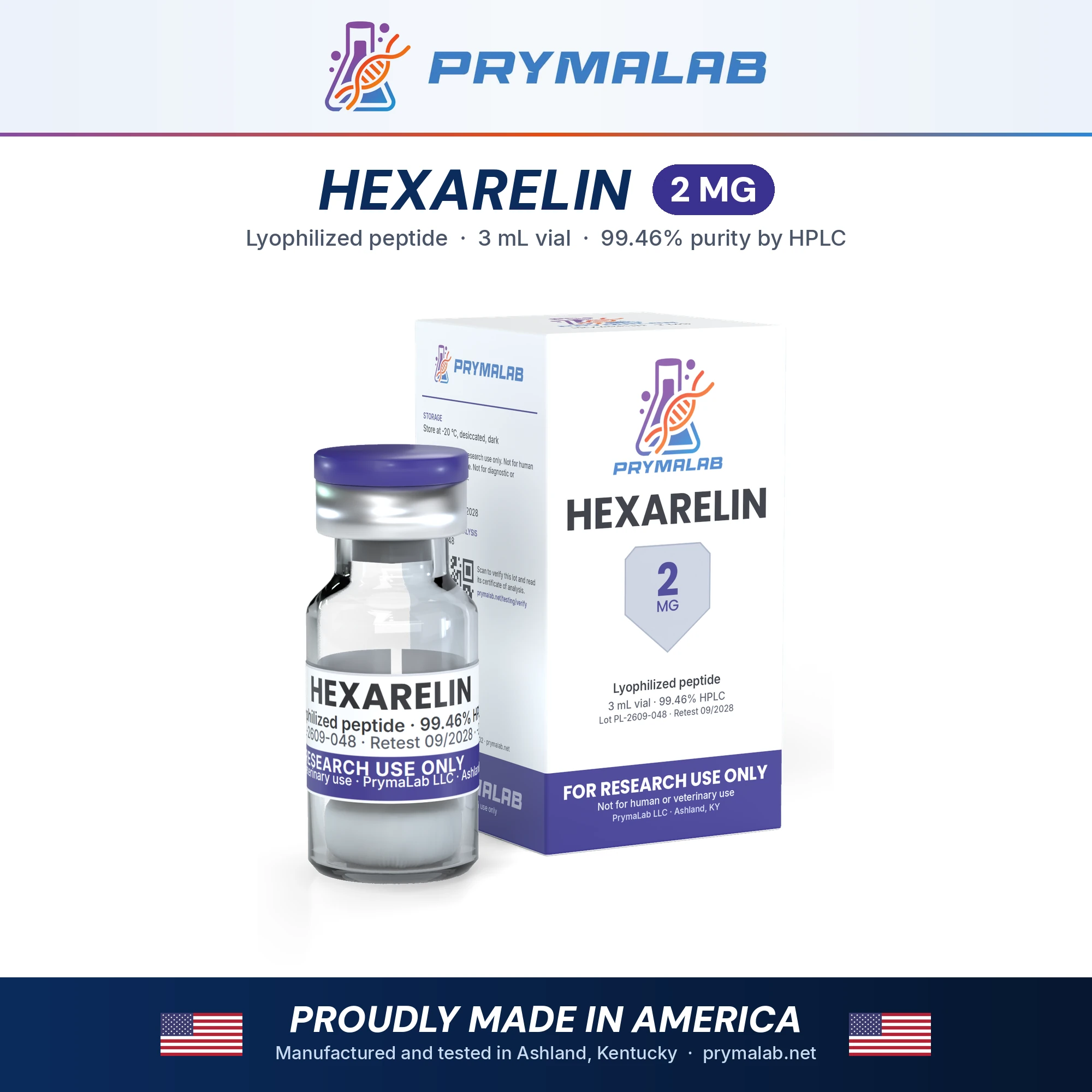
Hexarelin (examorelin), a methylated GHRP-6 analogue, freeze-dried in a 2 mg vial
Hexarelin, also called examorelin, is the synthetic hexapeptide His-D-2-methyl-Trp-Ala-Trp-D-Phe-Lys-NH2, which releases growth hormone through the growth hormone secretagogue receptor. This listing is the 2 mg vial of freeze-dried powder, the main fill, and a 5 mg vial is also sold. Research on hexarelin covers growth hormone release in healthy men and a second binding site, the scavenger receptor CD36, studied in isolated rat and mouse hearts.
Specifications
| Property | Value |
|---|---|
| Compound | Hexarelin Examorelin; growth hormone-releasing hexapeptide |
| CAS number | 140703-51-1 |
| Molecular formula | C47H58N12O6 |
| Theoretical mass | 887.1 Da |
| Sequence / structure | H-H-[D-2-MeTrp]-A-W-[D-Phe]-K-NH₂ (6 residues; C-terminal amide) |
| Label claim | 2 mg/vial |
| Form | Lyophilized (freeze-dried) powder or cake in a sealed glass vial with a rubber stopper and aluminium crimp cap |
| Storage, sealed | −20 °C, desiccated, dark |
| Purity specification | 99.0% or higher by RP-HPLC |
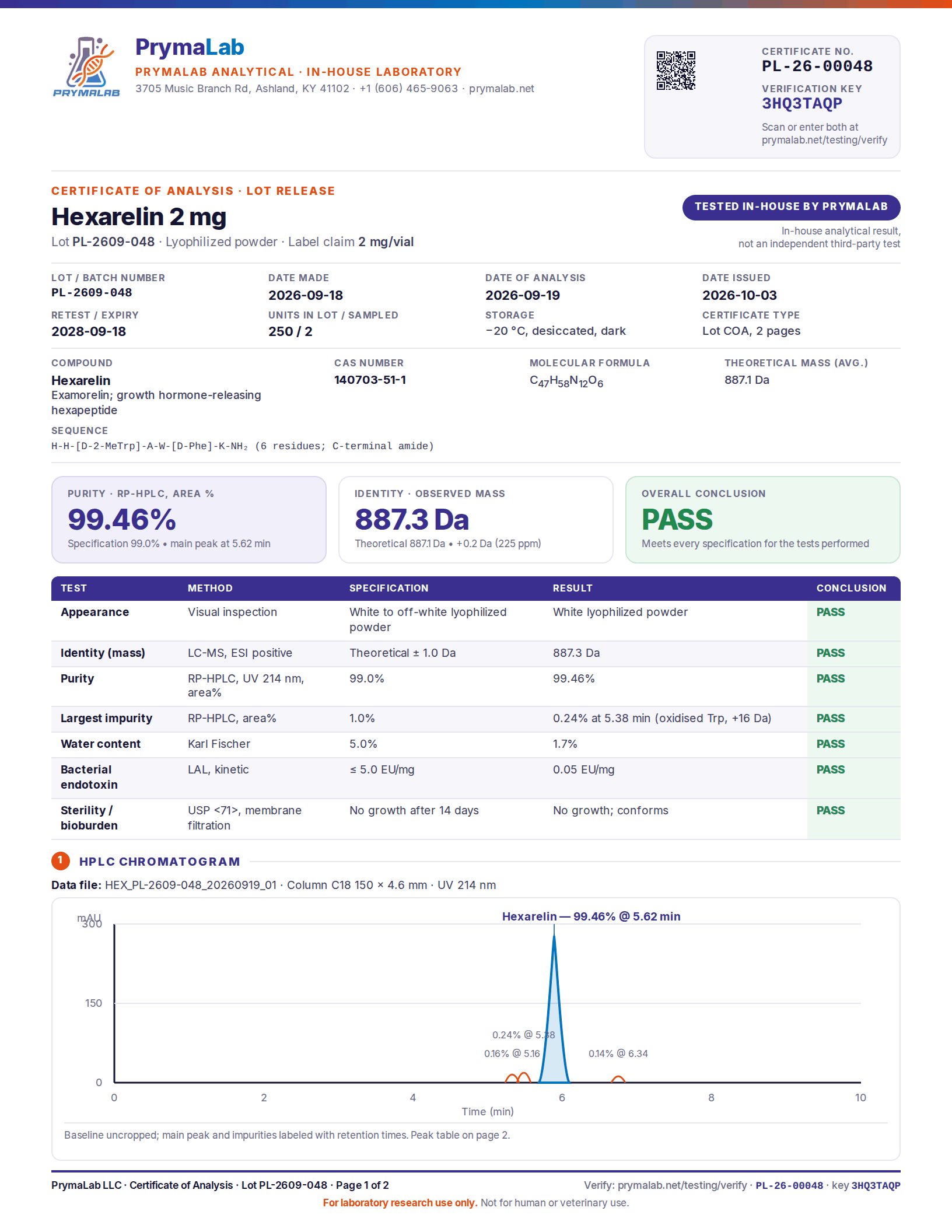
| Lot certificate | Results for the lot now shipping are in the certificate panel on this page |
| Safety data sheet | PL-SDS-078 |
Fills in this range
Hexarelin is sold in 2 fills. The compound and the testing are the same in every fill; only the amount in the vial changes.
| Fill | Listing |
|---|---|
| 2 mg | Hexarelin 2mg (this page) |
| 5 mg | Hexarelin 5mg |
Telling hexarelin from GHRP-6
Hexarelin and GHRP-6 differ at one point. Both are six residues long and end in the same C-terminal amide, but at position 2 hexarelin carries D-2-methyltryptophan where GHRP-6 has plain D-tryptophan. The lot certificate writes the sequence in one-letter code with the modified residues in brackets, H-H-[D-2-MeTrp]-A-W-[D-Phe]-K-NH2. The extra methyl group is small but measurable: the theoretical mass is 887.1 Da for hexarelin and 873.0 Da for GHRP-6, two figures that LC-MS separates easily, so the identity result on the certificate is where to confirm that the vial holds the methylated peptide. At 887.1 Da the 2 mg fill is about 2.25 µmol, slightly less once the residual water reported on the certificate is allowed for.
What the research covers
What it is and where it acts
Hexarelin is a hexapeptide that releases growth hormone both in vitro and in vivo1. Like the other growth hormone-releasing peptides it binds the growth hormone secretagogue receptor, a G protein-coupled receptor that Howard and colleagues cloned in 1996 from the pituitary and from the arcuate and infundibular regions of the hypothalamus in pigs and humans2. The receptor defines a pathway controlling pulsatile growth hormone release, and its discovery supported the idea that the synthetic secretagogues imitate an endogenous hormone that had not yet been found2.
Growth hormone release in healthy men
Imbimbo and colleagues ran a double-blind, placebo-controlled study in 12 healthy male volunteers, each tested with placebo and with three ascending amounts of hexarelin1. Plasma growth hormone rose with the amount, peaked about 30 minutes after each exposure and returned to baseline within 240 minutes, falling with a half-life of about 55 minutes1. Mean peaks at the two highest levels were close together (52.3 and 55.0 ng/mL, against 3.9 ng/mL with placebo), and the authors fitted a maximum-response model to the data, which suggests the response was near its ceiling at the top of the range tested1.
A second target in the heart: CD36
Hexarelin had been reported to have cardiovascular activity, and Bodart and colleagues set out to find the protein responsible3. Using a radioactive, light-activated derivative of hexarelin to label rat heart membranes, they isolated an 84 kDa binding protein whose N-terminal sequence matched CD36, a multifunctional glycoprotein found on heart muscle cells and on the endothelial cells of small vessels3. In isolated perfused hearts, hexarelin raised coronary perfusion pressure in a graded way3. The response was absent in hearts from CD36-null mice and from spontaneously hypertensive rats that lack CD36, and it tracked the amount of CD36 present3. The authors suggested that CD36 may be involved in the coronary vasospasm seen in hypercholesterolaemia and atherosclerosis3.
A follow-up study from the same group mapped where hexarelin binds4. Photolabelling and stepwise cleavage pointed to an 8 kDa fragment spanning residues Asn132 to Glu177, with Met169 as the likely contact point4. That region overlaps the site CD36 uses to bind oxidised LDL (Gln155 to Lys183), so the authors proposed that hexarelin might interfere with the uptake of modified lipoproteins by macrophages4. CD36 also mediates the effect of thrombospondin-1 on endothelial cells, which links it to the control of angiogenesis4.
What is not established
The human evidence cited here is one study in 12 healthy men that measured the acute growth hormone response and nothing else. The CD36 findings come from rat and mouse hearts and from protein chemistry, the two papers share authors, and the links to coronary vasospasm and lipoprotein uptake were offered as hypotheses rather than tested in people. Both abstracts report experiments with hexarelin only, so they do not show whether GHRP-2 or GHRP-6 bind CD36 in the same way. None of the studies used PrymaLab material. The CJC-1295 and hexarelin guide covers hexarelin’s receptor signalling and its study alongside GHRH analogues.
How each lot is tested
Every lot is tested in PrymaLab’s own laboratory in Ashland, Kentucky before release: RP-HPLC for purity, LC-MS for identity, Karl Fischer titration for water, LAL for endotoxin and USP <71> for sterility. The results for the lot now shipping are in the certificate panel on this page, and the certificate number, key and QR code can be checked on the verify page. These are in-house results from PrymaLab Analytical, not an independent test, and the lab is not accredited to ISO 17025. The third-party testing guarantee on this page still applies: if any independent laboratory finds the wrong compound, or less than the stated purity or amount, the order is refunded and the cost of the test is reimbursed.
Frequently asked questions
What is the difference between hexarelin and GHRP-6?
One methyl group. Hexarelin has D-2-methyltryptophan at position 2 where GHRP-6 has D-tryptophan; the other five residues and the C-terminal amide match. The theoretical masses are 887.1 Da and 873.0 Da, so the LC-MS identity result on the certificate separates them.
How do the 2 mg and 5 mg vials differ?
Only in quantity. Both contain the same freeze-dried hexarelin, and each fill is produced and tested as a separate lot with its own certificate. With equal volumes of diluent, the 5 mg vial gives two and a half times the concentration of the 2 mg.
What is CD36, and why does it matter for hexarelin?
CD36 is a scavenger receptor found on heart muscle cells, small-vessel endothelium and macrophages. Rat heart studies found that hexarelin binds it and raises coronary perfusion pressure through it, so in tissue that expresses CD36 an effect of hexarelin may not come from the growth hormone secretagogue receptor.
How should hexarelin be stored?
Keep the sealed vial at −20 °C, desiccated and out of the light, and let it reach room temperature before opening. Once reconstituted, store the solution at 2 to 8 °C, protected from light, and use it within the period your laboratory has established.
Is hexarelin approved for human use?
No. This vial is sold for laboratory research only and is not approved by the FDA or any comparable authority for human or veterinary use. The human study described on this page was a controlled clinical experiment, not a basis for using the product in people or animals.
References
- Imbimbo BP, Mant T, Edwards M, et al. Growth hormone-releasing activity of hexarelin in humans. A dose-response study. Eur J Clin Pharmacol. 1994;46(5):421-5. DOI · PubMed
- Howard AD, Feighner SD, Cully DF, et al. A receptor in pituitary and hypothalamus that functions in growth hormone release. Science. 1996;273(5277):974-7. DOI · PubMed
- Bodart V, Febbraio M, Demers A, et al. CD36 mediates the cardiovascular action of growth hormone-releasing peptides in the heart. Circ Res. 2002;90(8):844-9. DOI · PubMed
- Demers A, McNicoll N, Febbraio M, et al. Identification of the growth hormone-releasing peptide binding site in CD36: a photoaffinity cross-linking study. Biochem J. 2004;382(Pt 2):417-24. DOI · PubMed
Research use only
For laboratory research use only. Hexarelin 2mg is not a drug, food, cosmetic or dietary supplement, is not approved by the FDA or any comparable authority for human or veterinary use, and must not be given to people or animals. It is sold to qualified researchers and institutions, and the buyer is responsible for lawful handling and disposal.
Other formats of Hexarelin
Hexarelin is also stocked as Hexarelin 5mg Nasal Spray. Each listing states its own quantity and concentration, and the pen and vial comparison explains what changes between formats.







Reviews
There are no reviews yet.