Description
PrymaLab · Research use only
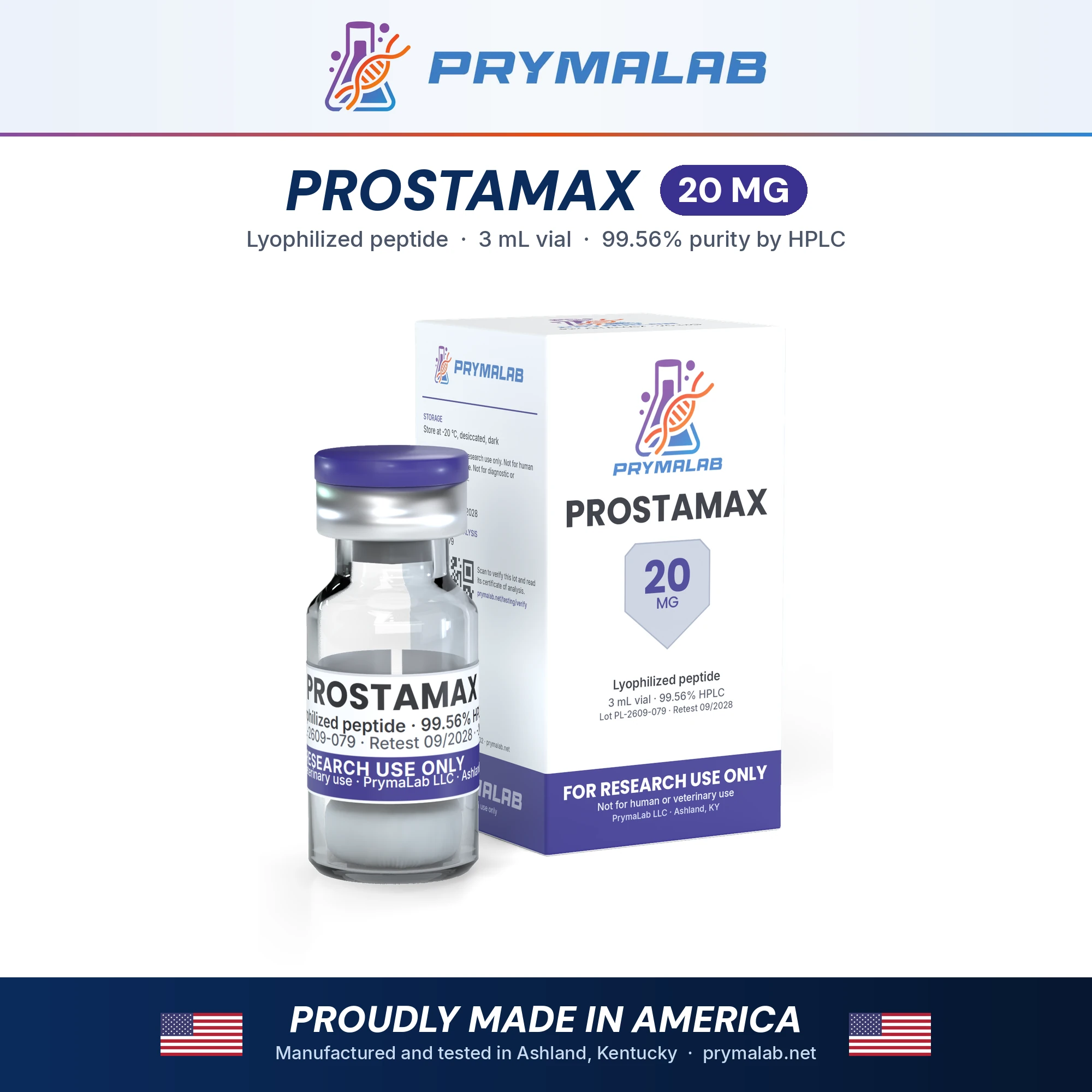
Prostamax Peptide 20mg
Lys-Glu-Asp-Pro (KEDP) tetrapeptide bioregulator, 20 mg freeze-dried per vial
Prostamax is the tetrapeptide Lys-Glu-Asp-Pro (KEDP), the member of Vladimir Khavinson’s bioregulator series that its developers associate with the prostate. This listing is a 20 mg vial of freeze-dried Prostamax with a lot certificate. The research that names Prostamax is sparse and comes from the same St Petersburg programme: a chromatin study in leukocytes from people aged 75 to 88, and the group’s reviews and mechanism papers on how short peptides might regulate genes.
Specifications
| Property | Value |
|---|---|
| Compound | Prostamax Lys-Glu-Asp-Pro (KEDP); Khavinson prostate peptide bioregulator |
| CAS number | Not assigned |
| Molecular formula | C20H33N5O9 |
| Theoretical mass | 487.5 Da |
| Sequence / structure | H-KEDP-OH (4 residues; free N- and C-termini) |
| Label claim | 20 mg/vial |
| Form | Lyophilized (freeze-dried) powder or cake in a sealed glass vial with a rubber stopper and aluminium crimp cap |
| Storage, sealed | −20 °C, desiccated, dark |
| Purity specification | 99.0% or higher by RP-HPLC |
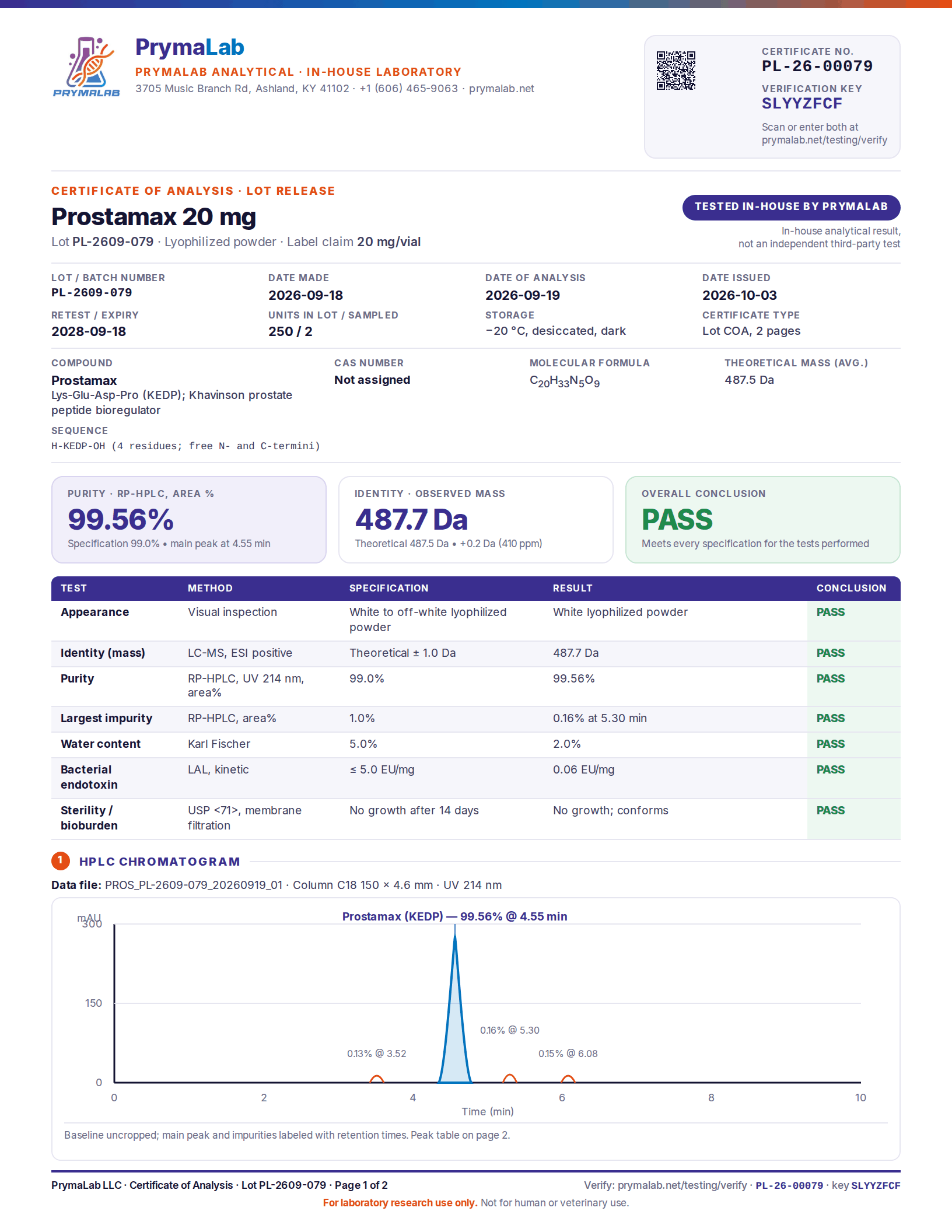
| Lot certificate | Results for the lot now shipping are in the certificate panel on this page |
| Safety data sheet | PL-SDS-132 |
Sequence and origin
The certificate gives Prostamax as H-Lys-Glu-Asp-Pro-OH: four residues with free ends, formula C20H33N5O9 and theoretical mass 487.5 Da, with no CAS number assigned. According to the Prostamax guide, the developers designed the sequence from the amino acid composition of Prostatilen, an extract of prostate tissue. Prostamax shares its first three residues with Vesugen (Lys-Glu-Asp) and differs from Testagen and Pancragen only at the fourth position, where it carries proline instead of glycine or tryptophan. A one-residue difference changes the mass, so the LC-MS identity result on the certificate distinguishes these compounds.
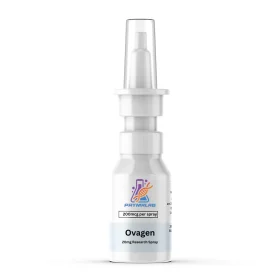
At 487.5 Da, 20 mg is about 41 µmol, slightly less once the water reported on the certificate is counted. Prostamax is also sold dissolved, as a Prostamax preloaded pen and a Prostamax nasal spray.
What the research covers
Where Prostamax fits in the programme
Khavinson’s group at the St Petersburg Institute of Bioregulation and Gerontology isolated small peptides from organs and tissues and then synthesised short analogues, di-, tri- and tetrapeptides, from single amino acids1. Prostamax is one of the tetrapeptides. Its experimental record in the references available here is a single abstract that names it; the other papers are reviews and mechanism studies from the same group.
The chromatin study
Khavinson, Lezhava and Malinin examined leukocytes from people aged 75 to 88 and compared Prostamax with Vilon, Epitalon, Livagen and Cortagen2. They measured ribosomal gene activity, the melting of common heterochromatin, polymorphism of structural heterochromatin on chromosomes 1, 9 and 16, and the variability of facultative heterochromatin2. Every peptide activated ribosomal genes and decondensed tightly packed chromatin, releasing genes that age-related condensation had repressed2. Prostamax was one of three peptides, with Epitalon and Livagen, that also decondensed the structural heterochromatin beside the centromere of chromosome 1; unlike those two, it did not change chromosome 92. The paper appeared in the Bulletin of Experimental Biology and Medicine, the English edition of a Russian journal, and its abstract gives no number of subjects. Nor does it say whether the cells were exposed to the peptides in culture, and it gives no effect sizes.
The proposed mechanism
The group’s explanation is that short peptides get into the nucleus and bind DNA in a sequence-dependent way. In 2011 Fedoreyeva and colleagues followed fluorescently labelled Epitalon, Pinealon and Testagen into the nuclei and nucleoli of HeLa cells, and found that unlabelled peptides changed the fluorescence of labelled DNA fragments to different extents depending on their sequence and on cytosine methylation3. Prostamax was not among the peptides tested in that work3. A 2021 systematic review by Khavinson and colleagues generalised these findings into a model in which peptides of two to seven residues interact with nucleosomes, histones and DNA and regulate DNA methylation4. The same review proposes that short peptides were among the earliest signalling molecules to regulate template-directed synthesis4. Organotypic culture work on rat prostate explants is summarised in the Prostamax guide; the original paper is not among the references on this page.
What is not established
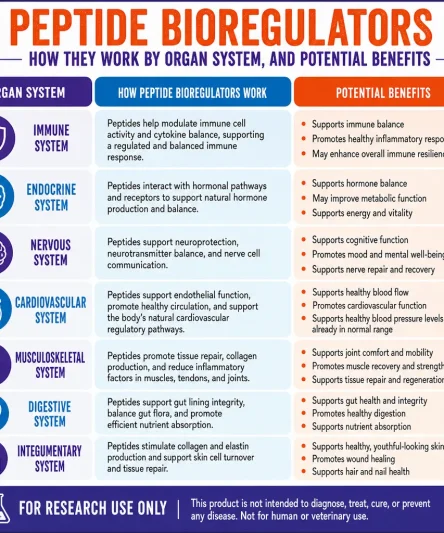
No reference here reports a study of Prostamax in prostate cells or in animals, or any clinical endpoint in people, and Khavinson is an author of every paper cited. The chromatin study measured nuclear structure in blood cells, not prostate tissue or any clinical endpoint2. The gene-regulation model remains the developers’ hypothesis. None of this work used PrymaLab material. The peptide bioregulators research overview sets Prostamax beside the other organ-assigned peptides.
How each lot is tested
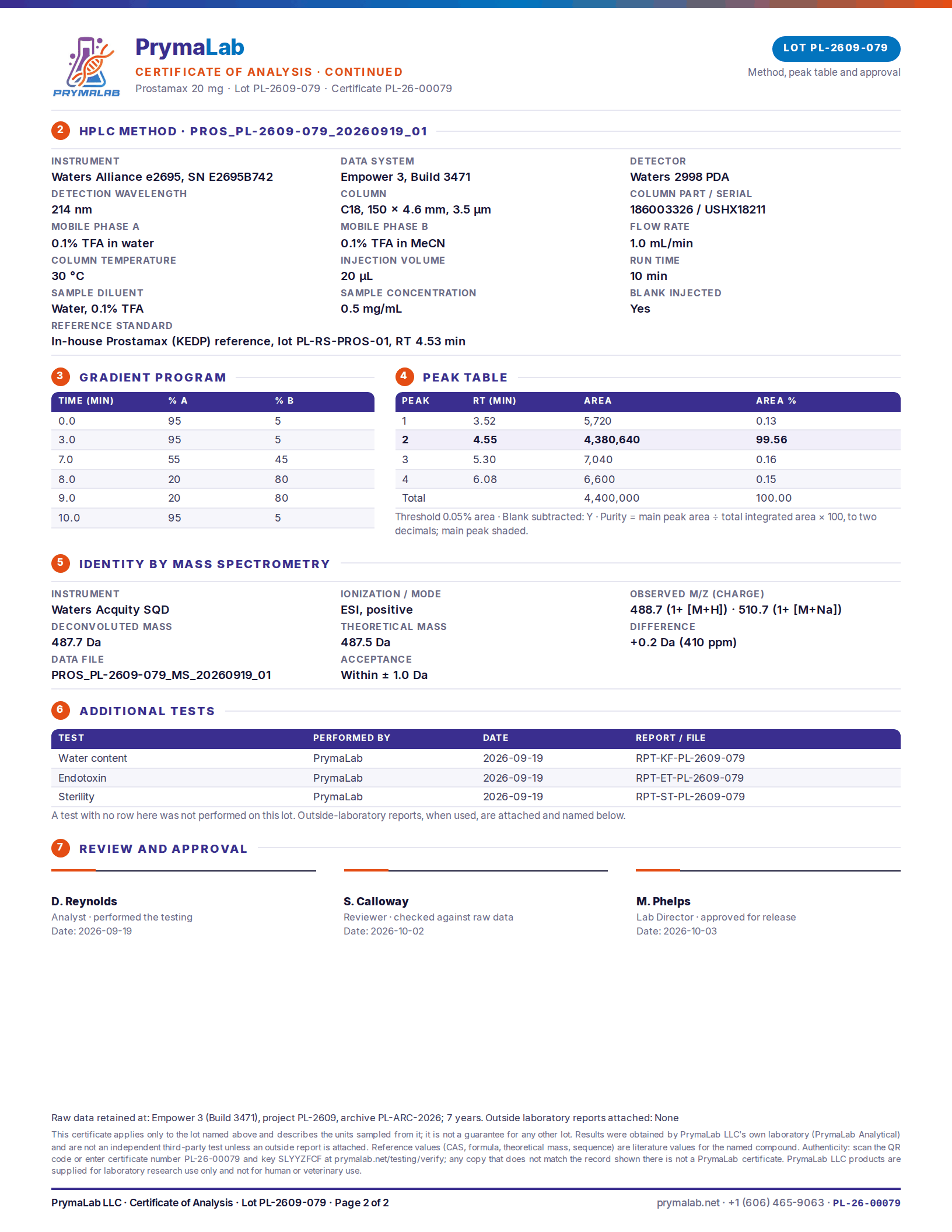
Every lot is tested in PrymaLab’s own laboratory in Ashland, Kentucky before release: RP-HPLC for purity, LC-MS for identity, Karl Fischer titration for water, LAL for endotoxin and USP <71> for sterility. The results for the lot now shipping are in the certificate panel on this page, and the certificate number, key and QR code can be checked on the verify page. These are in-house results from PrymaLab Analytical, not an independent test, and the lab is not accredited to ISO 17025. The third-party testing guarantee on this page still applies: if any independent laboratory finds the wrong compound, or less than the stated purity or amount, the order is refunded and the cost of the test is reimbursed.
Frequently asked questions
What does the Prostamax 20 mg vial contain?
20 mg of Prostamax, the tetrapeptide H-Lys-Glu-Asp-Pro-OH with free ends, as white freeze-dried powder in a sealed vial. The theoretical mass is 487.5 Da, and the lot certificate gives purity by RP-HPLC, identity by LC-MS, water, endotoxin and sterility results for the lot now shipping.
Why is Prostamax linked to the prostate?
Because its developers designed it from the amino acid composition of Prostatilen, a prostate extract, according to the Prostamax guide. The studies cited on this page did not test it in prostate tissue; the one experimental paper examined chromatin in leukocytes from older people.
How does Prostamax differ from Vesugen and Testagen?
All three begin with Lys-Glu-Asp. Vesugen stops there as a tripeptide, Testagen adds glycine and Prostamax adds proline. Each has its own mass, so the LC-MS identity result on the certificate distinguishes them.
How should the vial be stored?
Sealed at −20 °C, desiccated and protected from light. Before opening, let the vial come to room temperature to avoid condensation on the powder. A solution made from it should be held at 2 to 8 °C in the dark and used within a period your laboratory has established.
How do I confirm the certificate for my vial?
Check that the lot number on your vial matches the one in the certificate panel on this page. Certificates for earlier lots are on the testing results page, and the verify page confirms a certificate by its number and key.
Can Prostamax be used in people or animals?
No. Prostamax is sold for laboratory research only, is not approved by the FDA or any other authority for human or veterinary use, and must not be given to people or animals.
References
- Anisimov VN, Khavinson VKh. Peptide bioregulation of aging: results and prospects. Biogerontology. 2010;11(2):139-49. DOI · PubMed
- Khavinson VKh, Lezhava TA, Malinin VV. Effects of short peptides on lymphocyte chromatin in senile subjects. Bull Exp Biol Med. 2004;137(1):78-81. DOI · PubMed
- Fedoreyeva LI, Kireev II, Khavinson VKh, et al. Penetration of short fluorescence-labeled peptides into the nucleus in HeLa cells and in vitro specific interaction of the peptides with deoxyribooligonucleotides and DNA. Biochemistry (Mosc). 2011;76(11):1210-9. DOI · PubMed
- Khavinson VK, Popovich IG, Linkova NS, et al. Peptide Regulation of Gene Expression: A Systematic Review. Molecules. 2021;26(22). DOI · PubMed
Research use only
For laboratory research use only. Prostamax Peptide 20mg is not a drug, food, cosmetic or dietary supplement, is not approved by the FDA or any comparable authority for human or veterinary use, and must not be given to people or animals. It is sold to qualified researchers and institutions, and the buyer is responsible for lawful handling and disposal.






6 reviews for Prostamax Peptide 20mg