
-
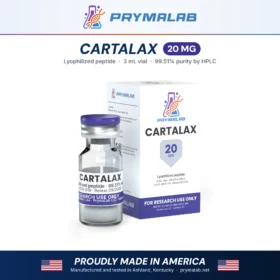
Cartalax 20mg Peptide
$54.99 or subscribe for $45.99/mo This product has multiple variants. The options may be chosen on the product page -

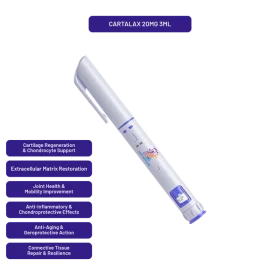
Preloaded Autoinjector | Cartalax | 3ml Pen | 20mg
$79.99 or subscribe for $67.99/mo This product has multiple variants. The options may be chosen on the product page
2 compounds · one is the other plus a proline
This is the smallest range on the site and the cleanest comparison in the whole bioregulator programme. Cartalax is Ala-Glu-Asp. Cortagen is Ala-Glu-Asp-Pro. One residue separates them, they are assigned to different tissues, and both are stocked here, which makes this the shortest route to testing whether the tissue-assignment claim survives contact with an assay.
Specification Table
| Property | Value |
|---|---|
| Listings in this range | 2 |
| Compounds | Cartalax and Cortagen |
| Mass span | 333.3 to 430.4 g/mol |
| Cartalax | Ala-Glu-Asp, 333.3 g/mol, 20mg lyophilised vial |
| Cortagen | Ala-Glu-Asp-Pro, 430.4 g/mol, 20mg metered nasal spray |
| Relationship | Cortagen is Cartalax with a terminal proline added |
| Shared opening | Ala-Glu-Asp, the same three residues in both |
| Storage | 2-8°C, protected from light. Do not freeze |
| Page type | Category hub, not a product page |
| Schema page type | CollectionPage |
| Meta robots | index, follow |
| Regulatory status | No approved human formulation for either compound |
What Does the Terminal Proline Change?
Proline is the only proteinogenic amino acid whose side chain loops back and bonds to its own backbone nitrogen. That ring restricts rotation at the peptide bond in front of it, so a terminal proline makes the C-terminus stiffer than any other residue would.
The practical consequence is enzymatic. Most carboxypeptidases work by fitting the terminal residue into a pocket and cleaving behind it, and a constrained proline fits that pocket poorly. Cortagen should therefore survive longer in the presence of serum peptidases than Cartalax does, purely as a matter of shape.
That is a testable prediction rather than a marketing claim, and it is the kind of thing a side-by-side stability run answers in an afternoon.
What Cartalax Peptide Dosage Figures Appear in Published Work?
Published figures for the Khavinson tripeptides cluster in the low milligram range per course rather than per administration, and the primary literature reports them in animal models rather than controlled human trials. Any figure quoted as a human dose for Cartalax is an extrapolation, and it is worth treating it as one.
For laboratory work the number that matters more is molar rather than mass. At 333.3 g/mol Cartalax delivers roughly 1.5 times the molar quantity per milligram that a 489 dalton tetrapeptide does, so matching two compounds by weight rather than by moles builds a systematic error into the comparison before the assay starts.
Why Is the Format Split Across These Two?
Cartalax ships as a lyophilised 20mg vial. Cortagen ships as a metered nasal spray at 20mg. Both sit far below the rough 1,000 dalton ceiling where nasal transport falls away, so the format split here reflects stocking rather than chemistry.
The vial gives control over concentration and the longer shelf life that dry powder brings. The spray fixes concentration at manufacture and starts the solution-state clock on the fill date. The wider peptide nasal spray range covers that trade in more detail, and the rest of the family sits under peptide bioregulators.
Frequently Asked Questions
What is Cartalax peptide?
Cartalax is a synthetic tripeptide with the sequence Ala-Glu-Asp and a molecular mass of roughly 333.3 g/mol. It is assigned to cartilage and connective tissue in the Khavinson bioregulator programme and is supplied here as a 20mg lyophilised vial.
What is the difference between Cartalax and Cortagen?
Cortagen is Cartalax with a proline added at the C-terminus. Cartalax is Ala-Glu-Asp at 333.3 g/mol and Cortagen is Ala-Glu-Asp-Pro at 430.4 g/mol. The added proline stiffens the terminus and should slow enzymatic cleavage.
What Cartalax peptide dosage is published?
Published figures come from animal work and are reported per course rather than per administration. No controlled human dosing study establishes a figure, so any human dose quoted online is an extrapolation from preclinical data.
Does Cartalax need reconstitution?
Yes. It ships as lyophilised powder in a 20mg vial and requires a suitable diluent before use. Cortagen arrives in solution as a metered spray and does not.
Is Cartalax the same as the sublingual musculoskeletal preparation?
Not necessarily. Sublingual and lingual preparations sold under similar names are frequently blends or extracts rather than the defined Ala-Glu-Asp tripeptide. The certificate should name one sequence and one mass, and if it does not, the product is something else.
Are these approved for human use?
No. Neither compound holds an approved human formulation in the United States. Both are supplied for laboratory research only.
Compliance Statement
Both products in this range are supplied for laboratory research use only. Neither is a drug, a supplement or a food, neither is intended for human or veterinary consumption, and neither may be used for diagnostic or therapeutic purposes. No compound listed here holds an approved human formulation. Purchasers are responsible for handling these materials in an appropriate research setting and in accordance with the regulations that apply to them.
All 2 products in the Musculoskeletal & Connective Tissue Bioregulators range
Every listing states its quantity, concentration and format and carries a batch certificate of analysis. Products are supplied for laboratory research only.