Description
PrymaLab · Research use only
Epitalon 50mg
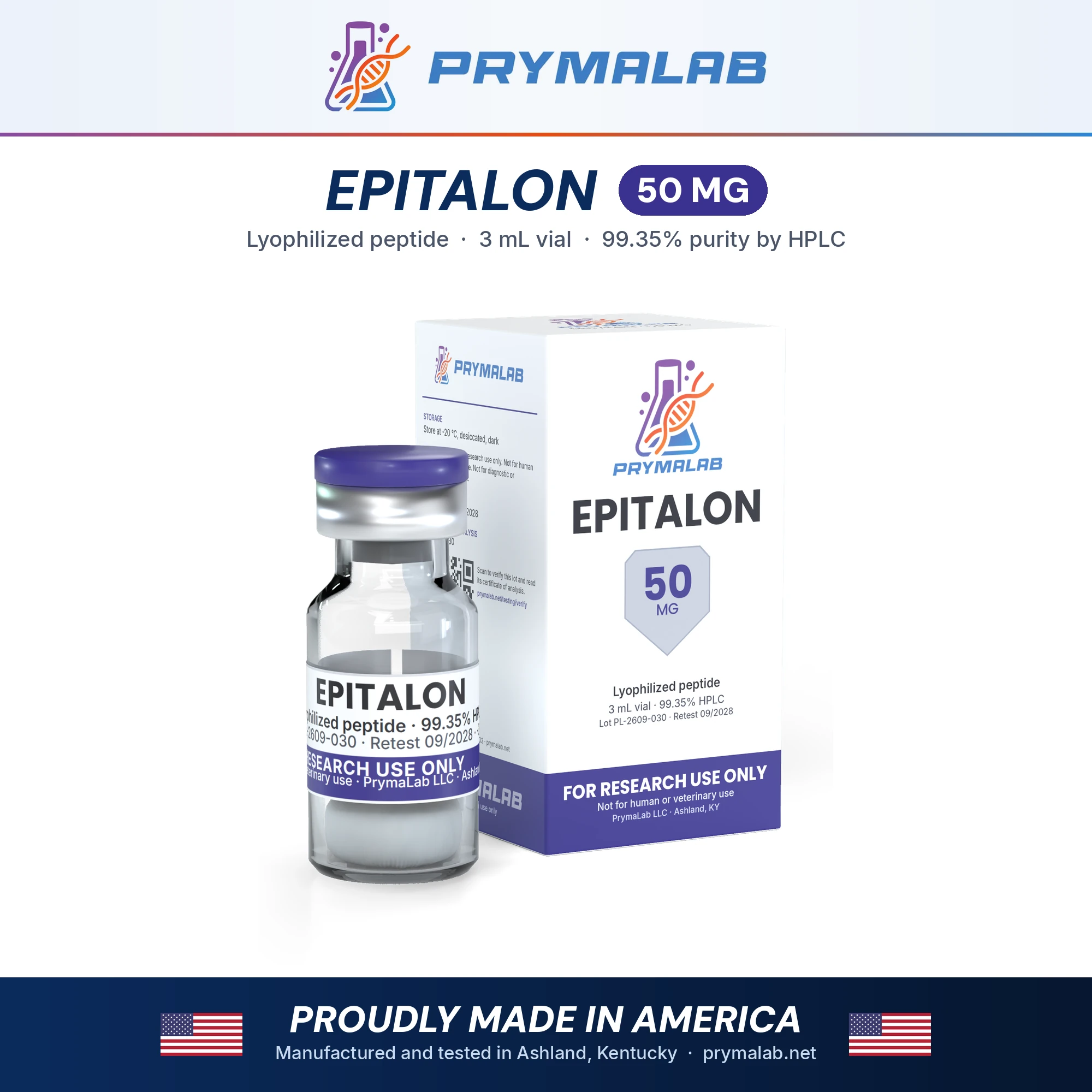
Synthetic Ala-Glu-Asp-Gly tetrapeptide, 50 mg of freeze-dried powder in one vial
Epitalon, also spelled Epithalon, is the synthetic tetrapeptide Ala-Glu-Asp-Gly (AEDG), designed by Vladimir Khavinson’s group in St Petersburg from the amino-acid composition of epithalamin, a bovine pineal extract. This listing is the 50 mg vial of freeze-dried powder, the larger of the two fills. Research on the peptide covers telomerase in cultured human cells, lifespan and tumour incidence in rodents, and melatonin, and nearly all of it comes from the developers’ own collaboration.
Specifications
| Property | Value |
|---|---|
| Compound | Epitalon Epithalon; Ala-Glu-Asp-Gly (AEDG); Khavinson pineal peptide bioregulator |
| CAS number | 307297-39-8 |
| Molecular formula | C14H22N4O9 |
| Theoretical mass | 390.4 Da |
| Sequence / structure | H-AEDG-OH (4 residues; free N- and C-termini) |
| Label claim | 50 mg/vial |
| Form | Lyophilized (freeze-dried) powder or cake in a sealed glass vial with a rubber stopper and aluminium crimp cap |
| Storage, sealed | −20 °C, desiccated, dark |
| Purity specification | 99.0% or higher by RP-HPLC |
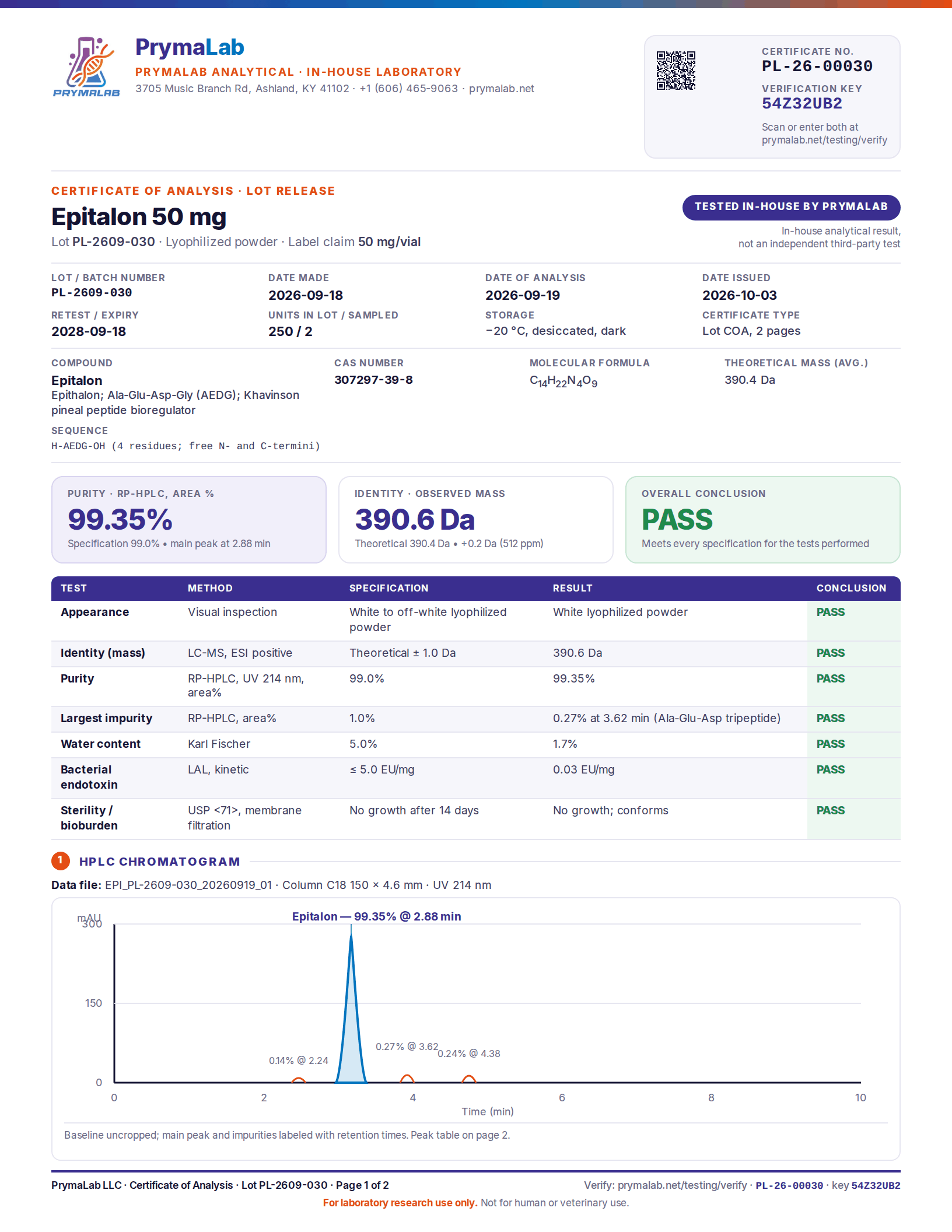
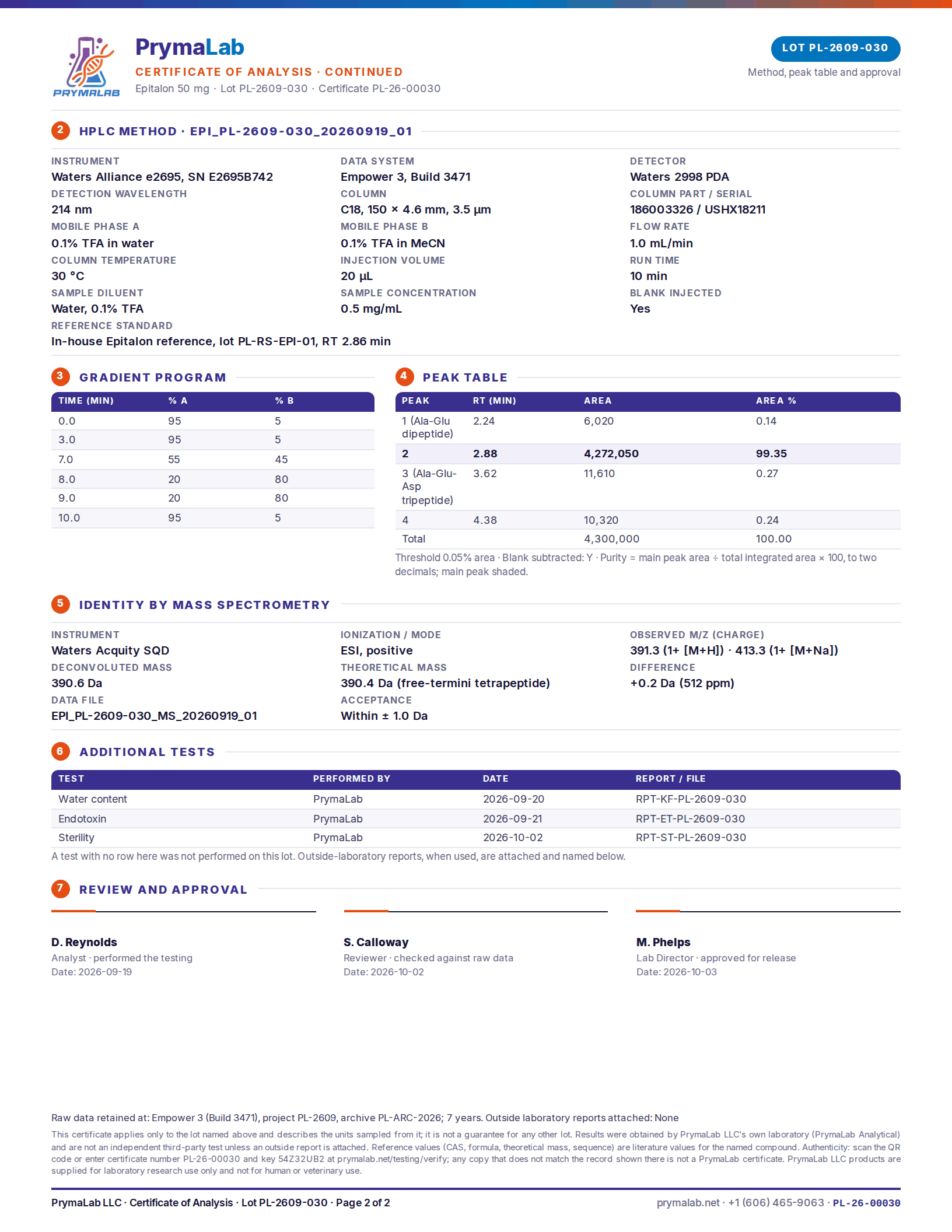
| Lot certificate | Results for the lot now shipping are in the certificate panel on this page |
| Safety data sheet | PL-SDS-049 |
Fills in this range
Epitalon is sold in 2 fills. The compound and the testing are the same in every fill; only the amount in the vial changes.
| Fill | Listing |
|---|---|
| 10 mg | Epitalon 10mg |
| 50 mg | Epitalon 50mg (this page) |
What is in the vial
The lot certificate gives the sequence as H-AEDG-OH: alanine, glutamate, aspartate and glycine, with a free amino terminus and a free carboxyl terminus. The formula is C14H22N4O9 and the theoretical mass 390.4 Da, which makes Epitalon one of the smallest peptides in the catalogue. Two of its four residues are acidic and none is basic. At that mass, 50 mg is about 128 µmol of peptide; the real figure sits a little lower because the powder also holds the residual water the certificate reports.
The name causes two common mix-ups. Epithalamin is the pineal extract the sequence was modelled on, not this peptide, and Pinealon is a different tripeptide (Glu-Asp-Arg) from the same programme. The LC-MS identity result on the certificate is the quickest check that the vial holds AEDG. The same compound is sold in a smaller Epitalon 10 mg vial and, already in solution, as an Epitalon preloaded pen.
What the research covers
What it is and what has been proposed
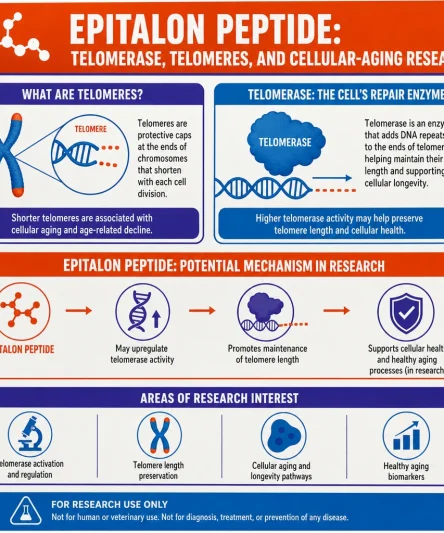
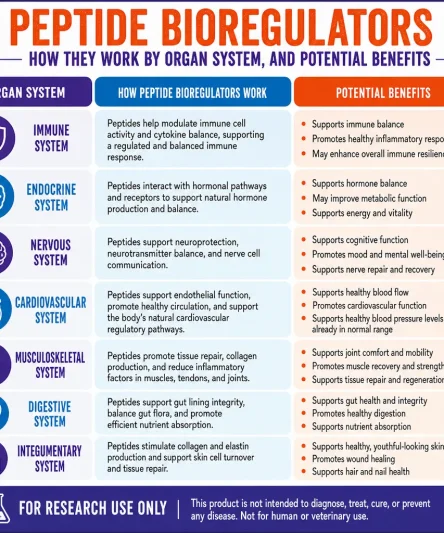
Epitalon was synthesised to match the amino-acid composition of epithalamin, a bovine pineal gland extract, and was later reported to occur in a pineal polypeptide preparation itself1. A 2025 review by Araj and colleagues gathered about 25 years of cell, animal and computer-modelling work and listed the effects reported for it: an influence on melatonin synthesis, changes in interleukin-2 mRNA, altered mitogenic activity of mouse thymocytes, and higher activity of several enzymes, among them acetylcholinesterase, butyrylcholinesterase and telomerase1. The same review said it remains uncertain whether these are the peptide’s only mechanisms, and that physical, chemical and structural studies of Epitalon are still few1. The developers’ wider idea, that short peptides act by regulating gene activity, is set out in Khavinson and Malinin’s 2005 monograph on genome peptide regulation2. It remains their hypothesis rather than an established mechanism.
Telomerase in cultured cells
The claim most often attached to Epitalon comes from a three-page 2003 report by Khavinson, Bondarev and Butyugov in the Bulletin of Experimental Biology and Medicine, the English edition of a Russian journal. Adding the peptide to cultures of telomerase-negative human fetal fibroblasts was followed by expression of the telomerase catalytic subunit, telomerase enzyme activity and telomere elongation3. The authors suggested the telomerase gene had been reactivated and wrote that the result pointed to longer life for the cell population and the organism3. The experiment measured cultured cells and nothing more.
Lifespan and tumour studies in rodents
The mouse study came from Vladimir Anisimov’s laboratory with Khavinson as co-author. In female Swiss-derived SHR mice, 54 per group and followed until natural death, Epitalon did not change food consumption, body weight or mean lifespan4. It slowed the age-related switching-off of oestrous function, reduced chromosome aberrations in bone marrow cells by 17.1%, and extended the lifespan of the last 10% of survivors by 13.3% and maximum lifespan by 12.3%4. Total spontaneous tumour incidence was unchanged, although leukaemia developed six times less often than in controls4. In a rat study by Vinogradova and colleagues, males were kept under standard, constant or natural northern light. Mean lifespan barely moved; the population ageing rate was normalised under natural and constant light, and spontaneous tumours, chiefly testicular Leydig cell tumours and leukaemias, were inhibited under every lighting regime5. A review by Anisimov and Khavinson put the gain in mean lifespan for their peptide preparations as a group at 20 to 40% in rodents6. That is a class-wide figure, and the two Epitalon studies above did not show a clear change in the mean.
What is not established
The same review described clinical use of the group’s peptide preparations over 6 to 12 years6, but the long-term human reports in this programme mostly concern epithalamin, the extract, and none of them is a randomised, blinded trial of Epitalon. Almost every primary study cited here comes from the developers’ own collaboration, several in Russian journals or their English translations, and group sizes are modest. Telomerase activation in cells, longer survival in rodents and direct gene regulation each rest mainly on the developers’ own papers. The Epitalon guide covers the monkey and melatonin studies and the later attempt by an outside laboratory to repeat the cell-culture result. None of these papers tested PrymaLab material.
How each lot is tested
Every lot is tested in PrymaLab’s own laboratory in Ashland, Kentucky before release: RP-HPLC for purity, LC-MS for identity, Karl Fischer titration for water, LAL for endotoxin and USP <71> for sterility. The results for the lot now shipping are in the certificate panel on this page, and the certificate number, key and QR code can be checked on the verify page. These are in-house results from PrymaLab Analytical, not an independent test, and the lab is not accredited to ISO 17025. The third-party testing guarantee on this page still applies: if any independent laboratory finds the wrong compound, or less than the stated purity or amount, the order is refunded and the cost of the test is reimbursed.
Frequently asked questions
Is Epitalon the same as Epithalon or epithalamin?
Epitalon and Epithalon are two spellings of the same synthetic tetrapeptide, Ala-Glu-Asp-Gly. Epithalamin is something else: a polypeptide extract of bovine pineal glands whose amino-acid make-up the tetrapeptide was designed from. Much of the long-term human literature in this field concerns the extract rather than this peptide.
How do the 10 mg and 50 mg vials differ?
Only in the amount of peptide. Both hold the same freeze-dried H-AEDG-OH, and each fill is made and tested as its own lot with its own certificate. In molar terms the 50 mg vial holds about 128 µmol and the 10 mg vial about 25.6 µmol, both slightly less once water content is allowed for.
How do I check the certificate for the vial I received?
Read the lot number printed on the vial and match it to the certificate. The panel on this page shows the lot now shipping; its LC-MS identity result should sit close to the theoretical 390.4 Da. The verify page confirms any certificate from its number and key.
How should the vial be stored?
Sealed, at −20 °C, desiccated and away from light, as the certificate states. Let the vial reach room temperature before opening so moisture does not condense on the powder. Once in solution, keep it at 2 to 8 °C, protected from light, for no longer than your laboratory has established.
Does Epitalon lengthen telomeres?
A 2003 report from the developers found telomerase activity and telomere elongation in cultured human fetal fibroblasts. That is a cell-culture finding. None of the studies cited here measured telomeres in animals or people, and the two rodent studies reported no clear change in mean lifespan.
Can Epitalon be used in people or animals?
No. It is sold only for laboratory research, has no approval from the FDA or any other authority for human or veterinary use, and must not be given to people or animals. Nothing on this page describes a clinical use.
References
- Araj SK, Brzezik J, Mądra-Gackowska K, et al. Overview of Epitalon-Highly Bioactive Pineal Tetrapeptide with Promising Properties. Int J Mol Sci. 2025;26(6). DOI · PubMed
- Khavinson V, Malinin V. Gerontological Aspects of Genome Peptide Regulation. . 2005. DOI
- Khavinson VKh, Bondarev IE, Butyugov AA. Epithalon peptide induces telomerase activity and telomere elongation in human somatic cells. Bull Exp Biol Med. 2003;135(6):590-2. DOI · PubMed
- Anisimov VN, Khavinson VKh, Popovich IG, et al. Effect of Epitalon on biomarkers of aging, life span and spontaneous tumor incidence in female Swiss-derived SHR mice. Biogerontology. 2003;4(4):193-202. DOI · PubMed
- Vinogradova IA, Bukalev AV, Zabezhinski MA, et al. Geroprotective effect of ala-glu-asp-gly peptide in male rats exposed to different illumination regimens. Bull Exp Biol Med. 2008;145(4):472-7. DOI · PubMed
- Anisimov VN, Khavinson VKh. Peptide bioregulation of aging: results and prospects. Biogerontology. 2010;11(2):139-49. DOI · PubMed
Research use only
For laboratory research use only. Epitalon 50mg is not a drug, food, cosmetic or dietary supplement, is not approved by the FDA or any comparable authority for human or veterinary use, and must not be given to people or animals. It is sold to qualified researchers and institutions, and the buyer is responsible for lawful handling and disposal.
Other formats of Epitalon
Epitalon is also stocked as Epitalon 10mg Nasal Spray. Each listing states its own quantity and concentration, and the pen and vial comparison explains what changes between formats.








2 reviews for Epitalon 50mg