
Description
PrymaLab · Research use only
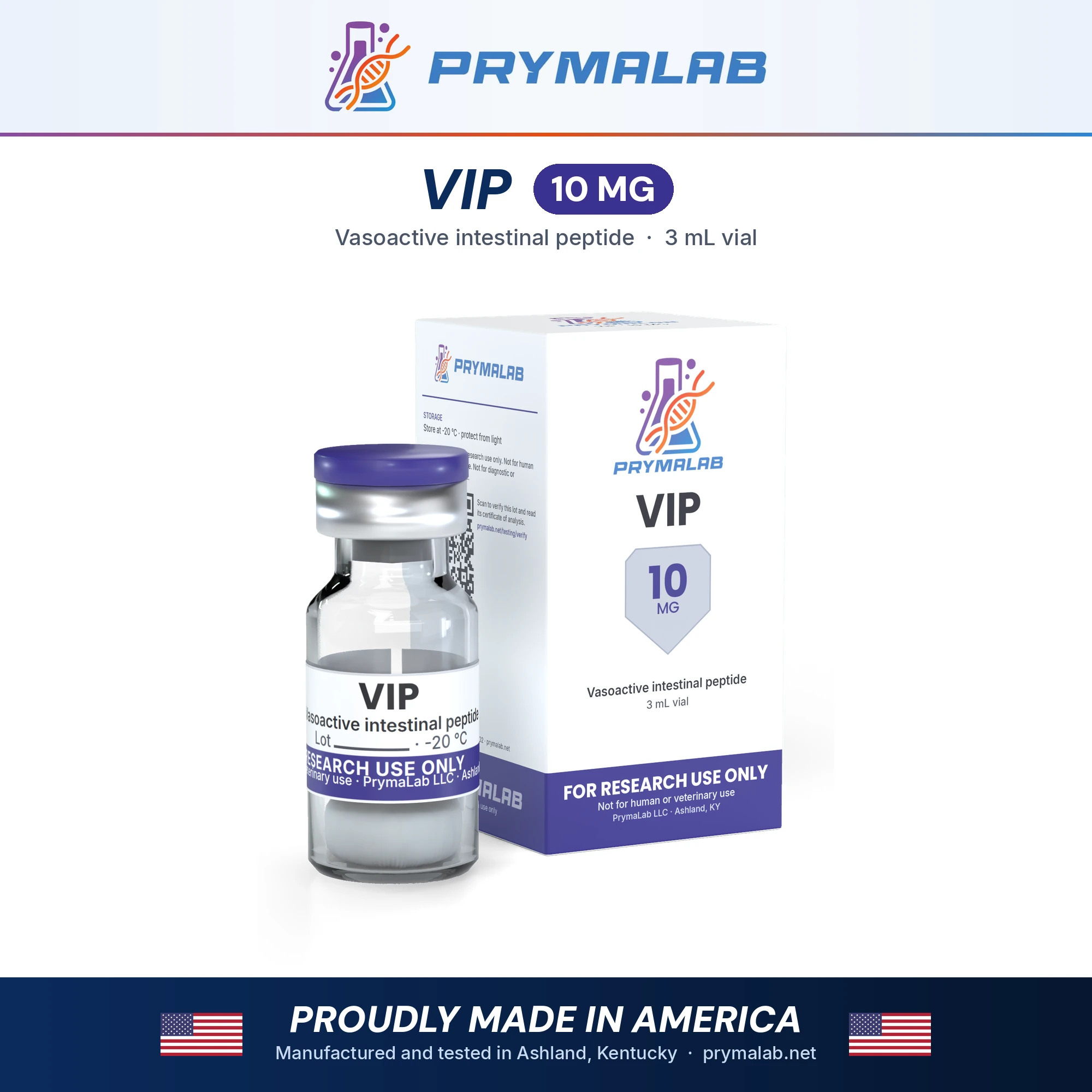
VIP5 10MG (Vasoactive Intestinal Peptide)
Vasoactive intestinal peptide (1-28) amide, 10 mg of freeze-dried powder per vial
Vasoactive intestinal peptide (VIP), sold here under the catalogue name VIP5, is a 28-residue neuropeptide of the secretin and glucagon family that signals mainly through the VPAC1 and VPAC2 receptors. This listing is the 10 mg vial of freeze-dried powder, the main fill; a 5 mg vial and a preloaded pen are also sold. Research on VIP covers its receptor pharmacology, its overlap with the related peptide PACAP, and its roles in the nervous and immune systems.
Specifications
| Property | Value |
|---|---|
| Compound | Vasoactive intestinal peptide (1-28) amide; aviptadil |
| CAS number | 40077-57-4 |
| Molecular formula | C147H238N44O42S |
| Label claim | 10 mg per vial |
| Form | Lyophilized (freeze-dried) powder or cake in a sealed glass vial with a rubber stopper and aluminium crimp cap |
| Safety data sheet | PL-SDS-184 |
Fills in this range
VIP is sold in 2 fills. The compound and the testing are the same in every fill; only the amount in the vial changes.
| Fill | Listing |
|---|---|
| 5 mg | VIP5 5MG (Vasoactive Intestinal Peptide) |
| 10 mg | VIP5 10MG (Vasoactive Intestinal Peptide) (this page) |
Identity of the material
The safety data sheet names the compound as vasoactive intestinal peptide (1-28) amide, the C-terminally amidated 28-residue form that is also called aviptadil, with CAS number 40077-57-4 and formula C147H238N44O42S. Those are the identifiers to quote when recording or citing the material. The vial holds the peptide alone as a freeze-dried powder or cake, sealed under a rubber stopper and crimp cap, and one safety data sheet covers both the 5 mg and 10 mg fills.
Aviptadil is also the name of a drug product built on synthetic VIP; this vial is research material and not that product. The same peptide is sold in solution as the VIP5 preloaded pen at 5 mg/mL, for work that does not call for reconstitution.
What the research covers
Discovery and family
VIP was first described in 1970 by Said and Mutt, who purified it from hog small intestine; their peptide had 28 amino acid residues and a wide spread of actions, from vasodilation and hypotension to increased cardiac output, respiratory stimulation and hyperglycaemia1. Later work placed it in a superfamily of structurally related peptide hormones together with PACAP, glucagon, the glucagon-like peptides, secretin, GIP and GHRH2. VIP and PACAP share 68% identity at the amino acid level3. Despite its name, VIP is widely distributed in the central and peripheral nervous systems and is released by both neurons and immune cells4.
Three receptors, two ligands
VIP and PACAP act through three class B G protein-coupled receptors2. PAC1 is selective for PACAP, while VPAC1 and VPAC2 respond to both peptides with high affinity2. All three preferentially stimulate adenylate cyclase and raise intracellular cAMP, although signalling through calcium and phospholipase D has also been reported3. Pinning an effect to one receptor has been hard: Dickson and Finlayson pointed to a shortage of selective, available non-peptide ligands as something that has held the field back at both basic and clinical levels3. Structural work has focused on VPAC1. Couvineau and Laburthe reviewed mutagenesis, photoaffinity labelling, NMR and molecular modelling studies showing that VIP is recognised by the receptor’s N-terminal ectodomain, which folds as a ‘Sushi’ domain5.
Functions by model
The IUPHAR subcommittee’s review summarised central roles in circadian rhythms, learning and memory, anxiety and responses to stress and brain injury, and noted genetic studies linking the VPAC2 receptor to susceptibility to schizophrenia2. In the periphery it listed control of immunity and inflammation, pancreatic insulin secretion and catecholamine release from the adrenal medulla, and a co-transmitter role in autonomic and sensory neurons2. Delgado and Ganea’s review of the immune literature described VIP receptors on many cell types, immune cells among them, and covered VIP’s part in inflammatory and autoimmune disorders4. The methods behind these findings were cell-based functional assays, transgenic animals and rodent disease models, with circadian control and pulmonary hypertension among the processes and conditions studied3.
What is not established
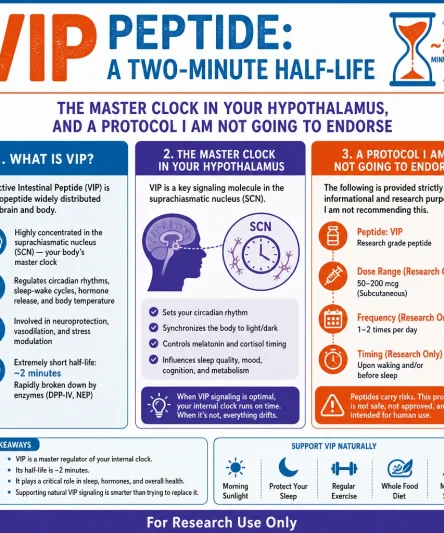
The papers cited here are reviews of receptor pharmacology, knockout and transgenic animals and rodent models, not reports of controlled trials3. Couvineau and Laburthe wrote that VIP appears to have beneficial effects in neurodegenerative and inflammatory diseases and looked ahead to new molecules designed from receptor structures, which places clinical use in the future5. Because VPAC1 and VPAC2 also respond to PACAP with high affinity2, an effect produced by adding VIP to a tissue does not by itself show which receptor, or which native peptide, normally carries it. None of these studies used PrymaLab material. The VIP peptide research guide covers VIP’s short half-life, its role in the suprachiasmatic nucleus and the aviptadil trials in more detail.
How each lot is tested
Every lot is tested in PrymaLab’s own laboratory in Ashland, Kentucky before release: RP-HPLC for purity, LC-MS for identity, Karl Fischer titration for water, LAL for endotoxin and USP <71> for sterility. Published certificates are listed on the results page and can be checked by number and key on the verify page. These are in-house results from PrymaLab Analytical, not an independent test, and the lab is not accredited to ISO 17025. The third-party testing guarantee on this page still applies: if any independent laboratory finds the wrong compound, or less than the stated purity or amount, the order is refunded and the cost of the test is reimbursed.
Frequently asked questions
What does the name VIP5 mean?
VIP5 is PrymaLab's catalogue name for vasoactive intestinal peptide. The safety data sheet identifies the material as VIP (1-28) amide, CAS 40077-57-4, the amidated 28-residue form. The 5 is part of the product name and does not mark a different peptide or a fragment.
How do the 5 mg and 10 mg vials differ?
Only in fill. Both contain the same freeze-dried peptide and share one safety data sheet. Each fill is produced as its own lot, so check the lot number on your vial against the certificate for that lot.
How should the vials be stored?
Keep sealed vials at −20 °C, dry and protected from light, and let a vial warm to room temperature before opening it. Reconstituted solution goes at 2 to 8 °C away from light, for no longer than the period your laboratory has validated.
Where do I find the certificate for my vial?
Look up the lot number printed on the vial on the testing results page, where published certificates are listed, then confirm the certificate by its number and key on the verify page.
Is this the drug aviptadil?
No. Aviptadil is synthetic VIP developed as a drug product and studied mainly in acute respiratory distress syndrome; it has no US marketing approval. This vial is research material with the same peptide identity, not that product.
Is VIP5 for human use?
No. It is sold for laboratory research only and must not be given to people or animals. No regulatory authority has approved it for human or veterinary use.
References
- Said SI, Mutt V. Polypeptide with broad biological activity: isolation from small intestine. Science. 1970;169(3951):1217-8. DOI · PubMed
- Harmar AJ, Fahrenkrug J, Gozes I, et al. Pharmacology and functions of receptors for vasoactive intestinal peptide and pituitary adenylate cyclase-activating polypeptide: IUPHAR review 1. Br J Pharmacol. 2012;166(1):4-17. DOI · PubMed
- Dickson L, Finlayson K. VPAC and PAC receptors: From ligands to function. Pharmacol Ther. 2009;121(3):294-316. DOI · PubMed
- Delgado M, Ganea D. Vasoactive intestinal peptide: a neuropeptide with pleiotropic immune functions. Amino Acids. 2013;45(1):25-39. DOI · PubMed
- Couvineau A, Laburthe M. VPAC receptors: structure, molecular pharmacology and interaction with accessory proteins. Br J Pharmacol. 2012;166(1):42-50. DOI · PubMed
Research use only
For laboratory research use only. VIP5 10MG (Vasoactive Intestinal Peptide) is not a drug, food, cosmetic or dietary supplement, is not approved by the FDA or any comparable authority for human or veterinary use, and must not be given to people or animals. It is sold to qualified researchers and institutions, and the buyer is responsible for lawful handling and disposal.
Other formats of VIP5
VIP5 is also stocked as VIP 10mg Nasal Spray. Each listing states its own quantity and concentration, and the pen and vial comparison explains what changes between formats.








Reviews
There are no reviews yet.