Description
PrymaLab · Research Use Only
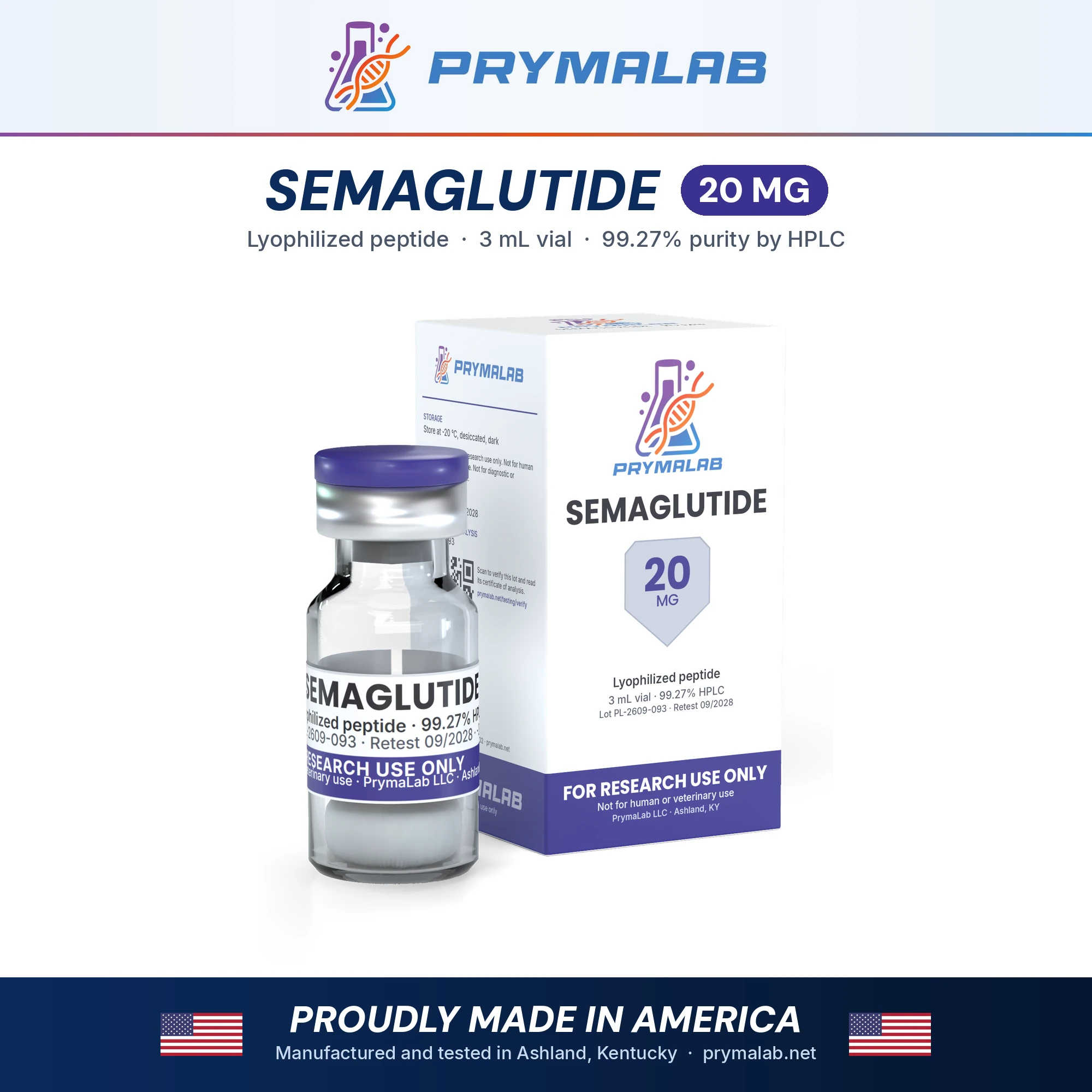
Semaglutide 20mg
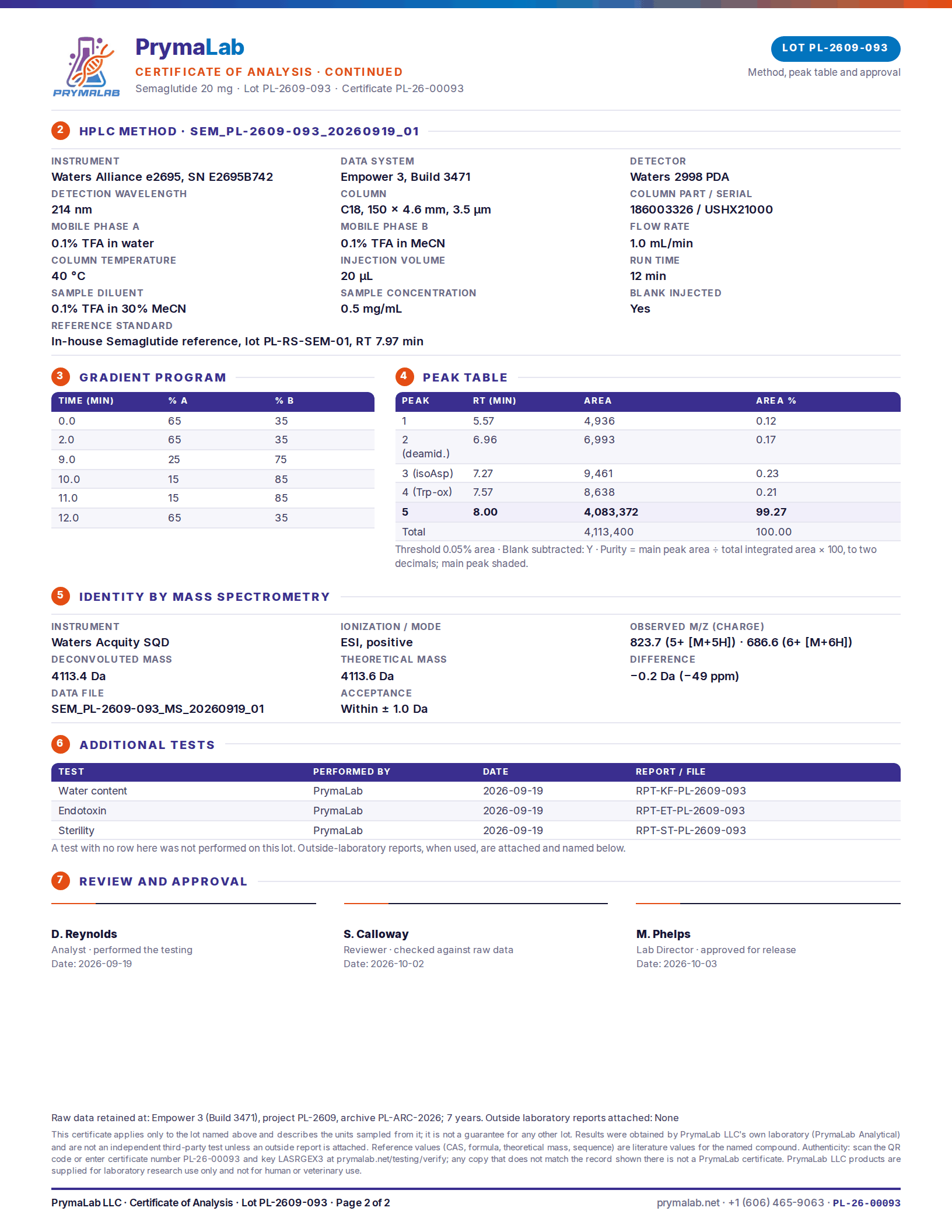
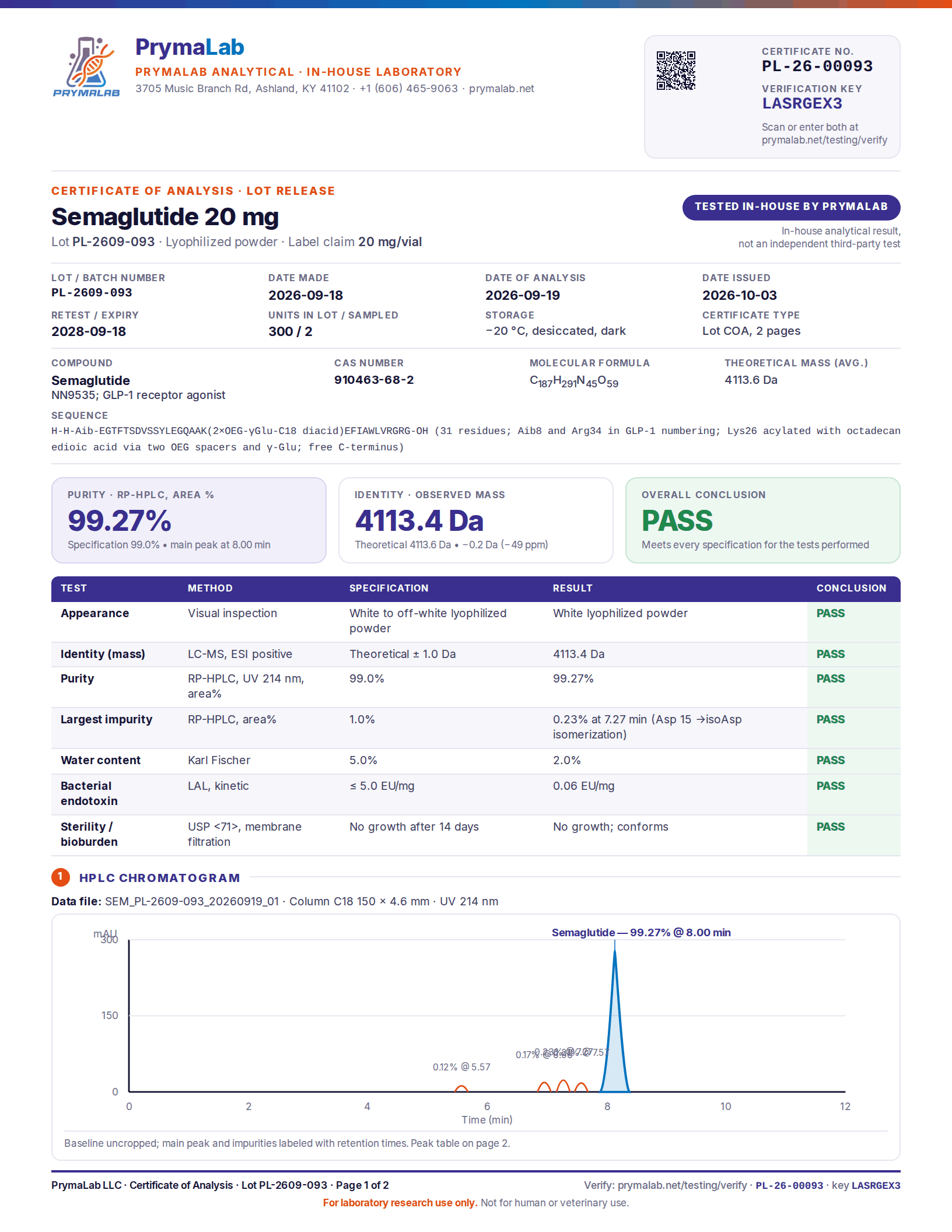
Around 4.9 micromoles · Chromatographic purity is not evidence that it still binds
A semaglutide 20mg certificate will say something like 99 percent by HPLC. That number counts how much absorbance sits under the main peak relative to everything else on the trace. It is a statement about chromatographic behaviour, and it is not evidence that the peptide in the vial still binds the receptor it was made for.
Specification Table
| Property | Value |
|---|---|
| Product format | Lyophilised powder, single vial |
| Peptide content | 20 mg |
| Molar content | Approximately 4.9 µmol at roughly 4,114 g/mol |
| CAS | 910463-68-2 |
| Backbone | GLP-1 analogue, 31 residues |
| Position 8 | Aib substituted for alanine, blocking DPP-4 cleavage |
| Acylation | C18 fatty diacid on a glutamate and two PEG spacers, at lysine 26 |
| What purity measures | Absorbance under the main chromatographic peak, relative to the rest |
| What purity does not measure | Folding, receptor binding, or any functional property |
| Assay that would | Receptor binding or a cAMP functional readout, not supplied in this market |
| Solubility | Soluble in bacteriostatic and sterile water |
| Storage, lyophilised | -20°C, sealed, dark and dry |
| Storage, reconstituted | 2-8°C, protected from light |
| Regulatory status | No approved human or veterinary formulation is supplied here |
What Does a Semaglutide 20mg Purity Number Measure?
A semaglutide 20mg purity figure is absorbance under a peak divided by total absorbance, expressed as a percentage.
A reverse phase column separates by hydrophobicity. A detector, usually ultraviolet at around 214 nanometres where the amide bond absorbs, records what comes off and when. Integrate the main peak, integrate everything else, take the ratio.
That is the whole measurement. It is a good one, and it catches a great deal: truncated sequences, deletion products, most oxidation, and anything else that shifts hydrophobicity enough to move a retention time.
What it cannot catch is anything that changes function without changing hydrophobicity, and there are such things.
A misfolded population of the same molecule co-elutes with the correctly folded one, because it is the same molecule. Chromatography sees composition. It does not see conformation.
What Would Actually Measure Potency?
A receptor binding assay or a functional readout, and neither comes with a semaglutide 20mg research vial.
Binding is the simpler of the two. You compete the material against a labelled reference ligand at the GLP-1 receptor and report an affinity constant. Published values for semaglutide are in the low nanomolar region, per the Novo Nordisk chemistry work cited below.
The functional version measures what happens downstream. GLP-1 receptor activation raises cyclic AMP, so a cell line expressing the receptor plus a cAMP readout gives an EC50.
Either one would tell you the material in your vial does what the material in the paper did. I have never seen either on a research certificate.
The reason is cost and equipment rather than concealment. A binding assay needs cells, a reference ligand and a plate reader, and it consumes material. Running it per lot would change the price of everything in this catalogue.
That is a defensible commercial decision and it still leaves a gap that buyers should know exists rather than assume away.
How Big Is the Gap in Practice?
Smaller than this section makes it sound, and I want to be straight about that.
Semaglutide is a synthetic linear peptide of 31 residues with no disulfide bonds. There is no tertiary structure here to lose in the way a protein loses one. In solution it adopts a partly helical conformation and it does so spontaneously.
So the misfolding failure mode that makes potency assays essential for antibodies and for larger proteins is much less of a concern here.
Where it does bite is aggregation. Acylated peptides self-associate, and an aggregated population may or may not resolve on a reverse phase column depending on whether it survives the injection.
Size exclusion chromatography catches that, and it is a row you should insist on for any acylated peptide at this fill size or above.
So the practical answer is: ask for size exclusion, read the purity number as what it is, and accept that potency is inferred rather than measured on research material.
One more observation belongs here, because it cuts the other way. Purity figures in this market cluster suspiciously. Almost every certificate reads 98 or 99 percent, across suppliers, across compounds, across price points.
A number that never varies is not measuring much. Whether that reflects genuinely good synthesis or a reporting convention, I cannot tell from outside, and neither can you.
Which is another reason to ask for the method rather than the number, and to ask what the last five lots read.
A supplier whose purity figures show real variation is measuring something. One whose figures never move is either extraordinary or rounding.
Why Does This Land on the 20mg Page?
Because a semaglutide 20mg purchase is roughly where buying stops being exploratory.
The 5mg fill here is written around using semaglutide as a comparator, with the compound as a reference point rather than the subject of the work. At that size a buyer is spending little and testing a hypothesis about something else.
At 20 milligrams somebody has committed. The material is going into a run of experiments whose results will be attributed to this compound, and the difference between what the certificate proves and what it implies starts to have consequences.
It is the same certificate at every fill. The stakes attached to reading it correctly are not the same.
What Should You Ask a Supplier?
Four things before a semaglutide 20mg order, and the answers are more informative than the numbers.
The chromatographic method, meaning column chemistry, gradient and detection wavelength. A supplier who can answer has run it.
Whether a size exclusion result is available for the lot, and the aggregate percentage if so.
Net peptide content, plus whether the purity figure was calculated on peptide or on total solid.
Whether any functional or binding data exists for the material, from any source. The answer will usually be no, and a supplier who says no plainly is worth more than one who implies yes.
A fifth question, which I have started asking and which sorts suppliers quickly: how many lots of this compound have they shipped, and can they show a purity figure from an older one.
Consistency across lots is the property that matters for anyone running work over months, and a single certificate cannot show it. Two certificates from different dates can.
Nobody is obliged to answer. The ones who do are telling you something about how they keep records.
What Should the Certificate Show?
Net peptide content, with the determination named.
The full 31 residue sequence, with the acylation position and the Aib substitution at position 8 both stated.
Observed mass by spectrometry, checked against what the sequence calculates to.
Purity by chromatography, with column, gradient and detection wavelength given rather than implied.
Aggregate content by size exclusion, which is the row that does the most work on an acylated peptide.
Salt form, with lot number and manufacturing date alongside.
What Does a Purity Number Miss Specifically?
Four things, ordered by how likely each is to matter on a semaglutide 20mg lot.
Aggregates, if they do not survive the injection or if they elute in the void and get excluded from the integration. Size exclusion is the answer and it is a separate assay.
Counterion and water, which are mass but not peptide. A purity figure calculated on total solid rather than on peptide inherits both, and the difference is the net peptide content correction that runs five to fifteen percent.
Stereochemical impurities. A D-amino acid at any position gives a molecule of identical mass and very similar hydrophobicity, and a standard reverse phase gradient will not separate it. Chiral analysis catches it and nobody runs chiral analysis on research peptides.
Anything co-eluting for ordinary reasons. Two structurally different impurities can share a retention time, and a single wavelength detector cannot tell.
None of these is exotic and none is a reason to distrust the number. They are reasons to know what the number is a number about.
How Should the Vial Be Handled?
As an acylated peptide with a solution clock running from the first drop of diluent.
Bring it to room temperature sealed. Then diluent down the wall, and rotate gently. Shaking foams it and foam is air-water interface, which is where surface active peptides denature.
Aliquot into single-use volumes immediately, then refrigerate. A 20 milligram fill makes enough solution that the temptation to keep drawing from one tube is real, and every draw means a warming and a fresh headspace.
Do not freeze the solution.
Low-binding consumables from the first dilution. The C18 diacid and the PEG spacers make this molecule adsorb, and losses at nanomolar working concentrations are not small.
Published Literature
Full citations for the work named above, each confirmed against the publisher record. The binding and functional data referenced are from the published characterisation of the molecule, not from any lot supplied here.
- Lau J, Bloch P, Schaffer L, Pettersson I, Spetzler J, Kofoed J, et al. Journal of Medicinal Chemistry. 2015;58(18):7370-7380. DOI: 10.1021/acs.jmedchem.5b00726
- Willard FS, Douros JD, Gabe MB, Showalter AD, Wainscott DB, Suter TM, et al. JCI Insight. 2020;5(17):e140532. DOI: 10.1172/jci.insight.140532
- Manning MC, Chou DK, Murphy BM, Payne RW, Katayama DS. Pharmaceutical Research. 2010;27(4):544-575. DOI: 10.1007/s11095-009-0045-6
Frequently Asked Questions
What is a semaglutide 20mg vial?
A lyophilised research vial holding 20 milligrams of semaglutide, about 4.9 micromoles at roughly 4,114 g/mol. It is supplied for laboratory research use only and is not for human or animal consumption.
Does 99 percent purity mean the peptide works?
No. Chromatographic purity is absorbance under the main peak divided by the total. It measures composition, not function. Anything that changes activity without changing hydrophobicity co-elutes with the intended compound and is counted as pure.
What is a potency assay?
A measurement of what the molecule does rather than what it is. For semaglutide that means either competitive binding against a labelled ligand at the GLP-1 receptor, reported as an affinity constant, or a functional readout such as cyclic AMP accumulation reported as an EC50.
Why is no potency result on the certificate?
Cost and equipment. A binding assay needs a receptor-expressing cell line, a reference ligand and a plate reader, and it consumes material for every lot. Running it per lot would change the price of research peptides substantially.
How worried should I be about misfolding?
Less than for a protein. Semaglutide is a 31 residue linear peptide with no disulfide bonds and no tertiary structure to lose. It adopts a partly helical conformation spontaneously in solution. On an acylated peptide the more realistic concern is aggregation.
What catches aggregation?
Size exclusion chromatography, which separates by hydrodynamic size rather than hydrophobicity. It is the certificate row worth insisting on for any acylated peptide, and it is frequently absent.
How many micromoles are in a semaglutide 20mg vial?
About 4.9, taking the molecular weight as roughly 4,114 g/mol. Reconstituted into 2 millilitres that is a 2.4 millimolar stock, which is far above any published in vitro working concentration.
What should a semaglutide 20mg certificate of analysis show?
Net peptide content with the method, the 31 residue sequence with the Aib position 8 substitution and the acylation site, observed mass against calculated, chromatographic purity with column and gradient, aggregate content by size exclusion, salt form and lot details.
What should I ask a supplier before buying?
The chromatographic method in detail, whether size exclusion data exists for the lot, whether the purity figure is calculated on peptide or total solid, and whether any binding or functional data exists for the material from any source.
Does the Aib substitution affect the analysis?
It affects mass confirmation. Aib is a non-standard residue, so the calculated mass has to account for it and any automated sequence tool that assumes the twenty standard amino acids will get the arithmetic wrong. The 10mg page in this catalogue covers that in detail.
How should a semaglutide 20mg vial be handled?
Room temperature before opening, diluent down the wall, gentle rotation rather than shaking. Aliquot into single-use volumes and refrigerate at 2 to 8 degrees. Do not freeze the solution. Use low-binding consumables from the first dilution.
Is this product for human use?
No. It is research material for laboratory use. It is not a drug, food, cosmetic or dietary product, the FDA has not evaluated it, and it must not be given to any person or animal.
Compliance Statement
Semaglutide 20mg is supplied exclusively for laboratory research use. It is not a drug, food, cosmetic or dietary product of any kind. It has not been evaluated by the FDA or any comparable authority, and no approved human or veterinary formulation is supplied here. It is not intended to diagnose, treat, cure or prevent any disease, and it must not be given to humans or animals. Purchase is restricted to qualified researchers and institutions.


19 reviews for Semaglutide 20mg