For laboratory and research use only. Not for human consumption. PrymaLab sells to qualified researchers and licensed laboratories only.
15% FALL DISCOUNT APPLIED AUTOMATICALLY AT CHECKOUTFree USA shipping over $100Free worldwide shipping over $200
Sign in 0

Gonadorelin 2mg

$14.99 or subscribe for $12.75/mo

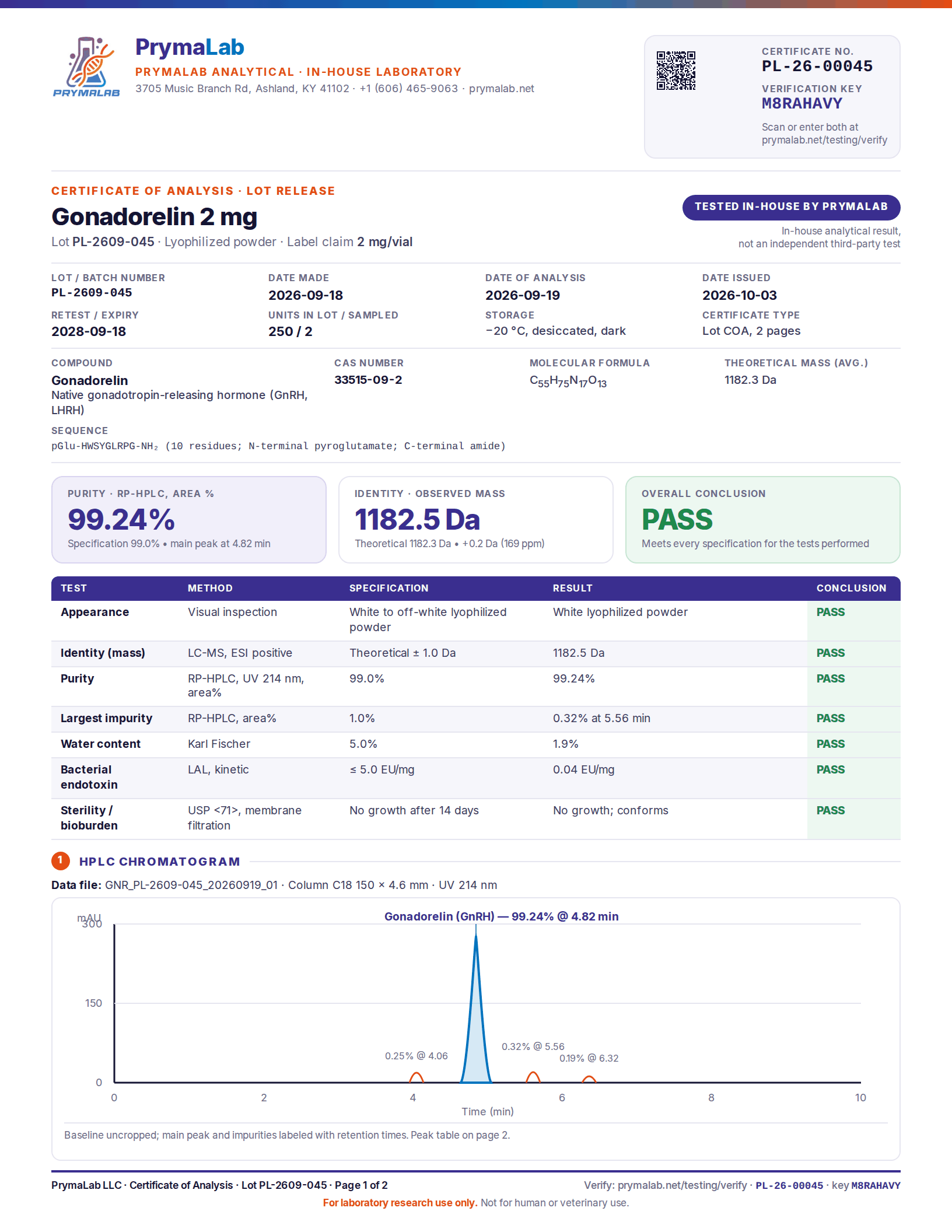
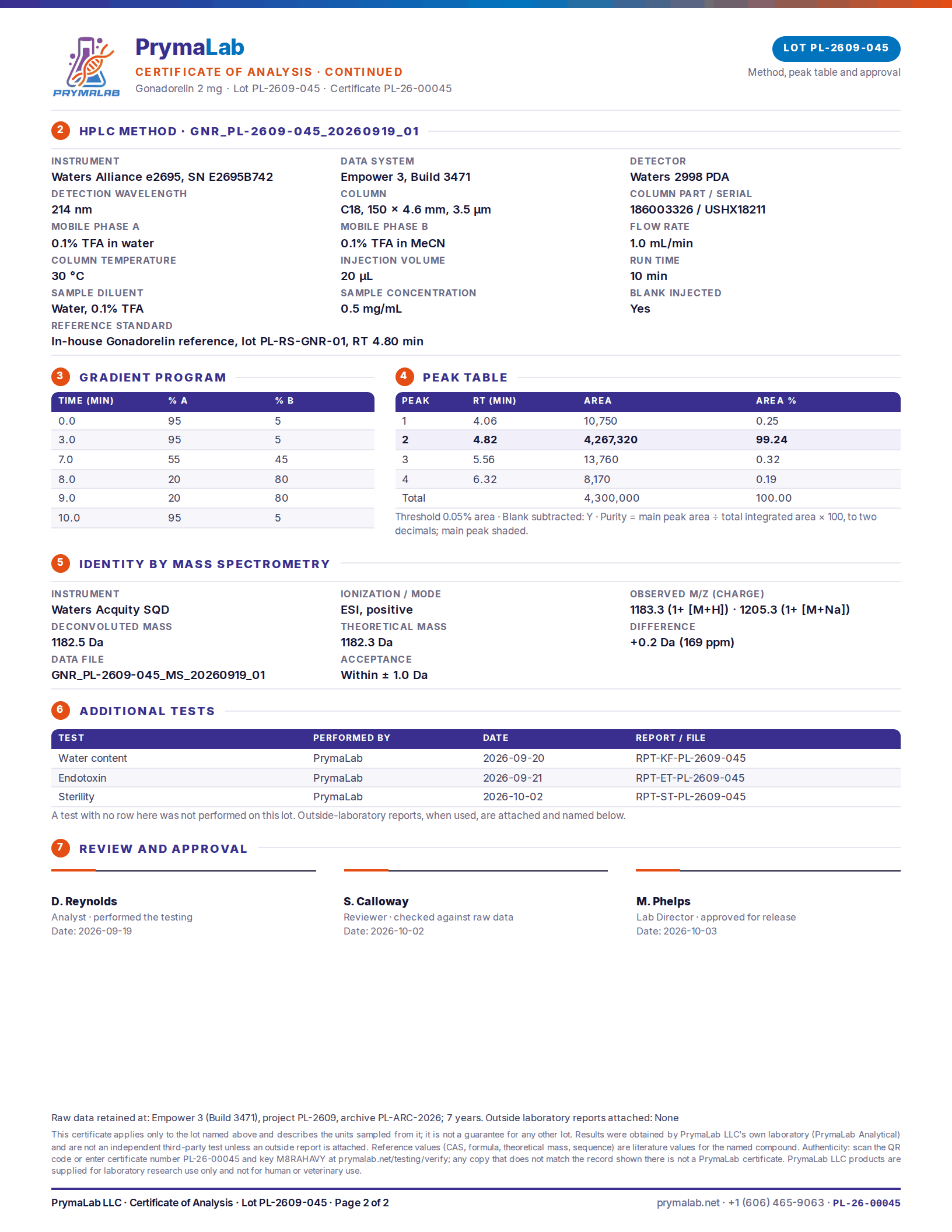
Lot PL-2609-045 tested in our lab: 99.24% purity by HPLC Certificate PL-26-00045, analysed Sep 19, 2026 · LC-MS identity, endotoxin and sterility on the certificate · details and COA images
Third-party testing guarantee. Have this product tested by any independent laboratory. If the result does not come back as the compound named on the label, at the purity and amount stated, we refund your order in full and reimburse the cost of the test. Email the lab report and your order number to michael@prymalab.net.
Safety data sheet PL-SDS-074 GHS: Danger · H361, H372, H334, H317, H332 · Read the SDS · PDF

Reagent details

Compound
Gonadorelin 2mg
CAS number
33515-09-2
Molecular weight
1182.3 Da
Formula
C55H75N17O13
Purity
99.24% by RP-HPLC, per lot
Storage
−20 °C, desiccated, dark
Certificate of analysis
Certificate PL-26-00045

Not a drug, food or cosmetic. Not for human consumption. This product has not been evaluated by the Food and Drug Administration and is not intended to diagnose, treat, cure or prevent any disease.

Visa, Mastercard, Discover up to $1,000 per order (charged in MXN; your bank may add a foreign-transaction fee). Pay by Bank, Zelle, Cash App or crypto: 10% off.

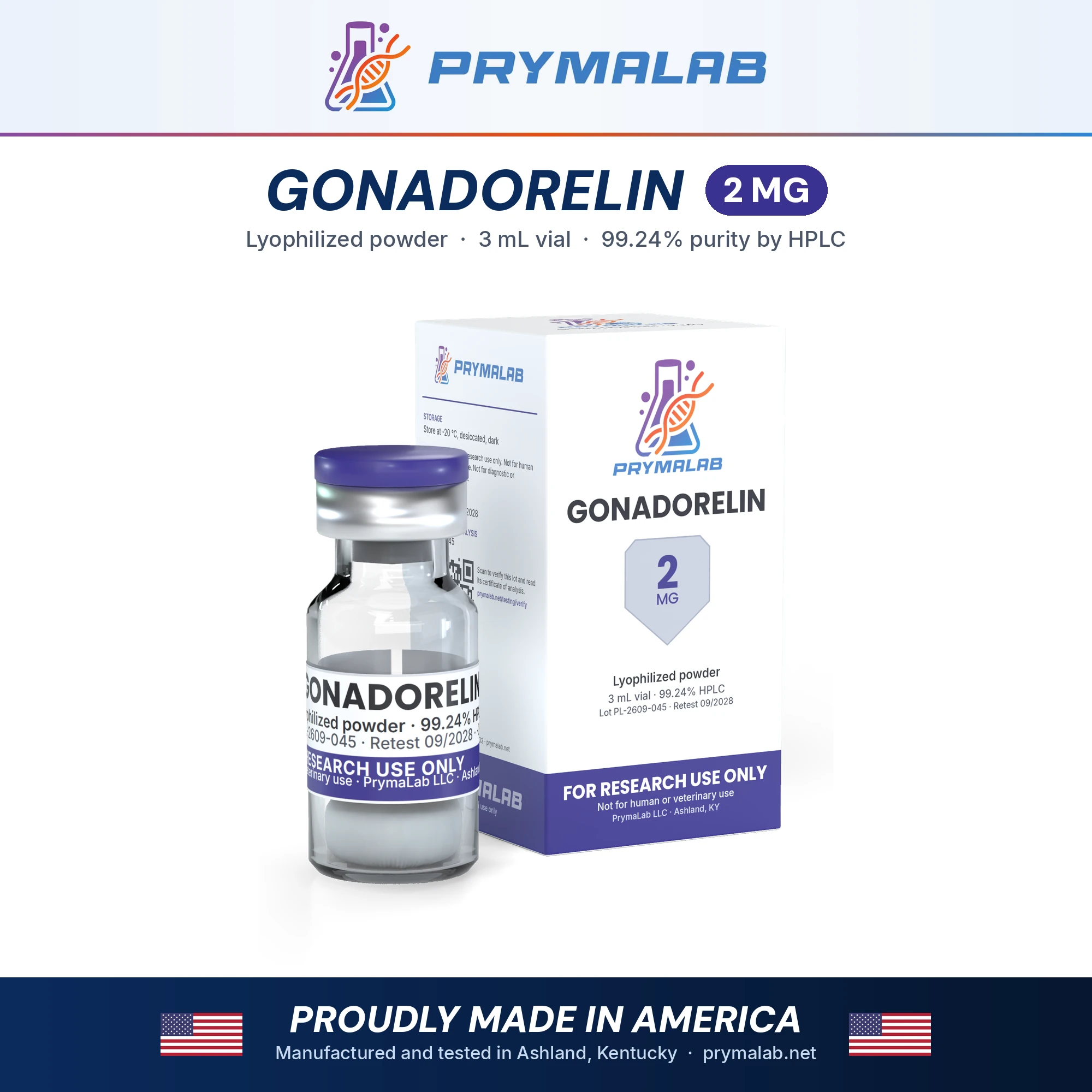
Gonadorelin 2 mg: synthetic gonadotropin-releasing hormone with the native ten-residue sequence, freeze-dried in a sealed vial. Every lot is tested in PrymaLab’s own laboratory and ships with a lot certificate. For laboratory research use only.

Description

PrymaLab · Research use only

Gonadorelin 2mg

Synthetic native GnRH, the ten-residue hypothalamic peptide, 2 mg freeze-dried

Gonadorelin is synthetic gonadotropin-releasing hormone (GnRH, also known as LHRH): the ten-residue peptide through which the hypothalamus controls release of LH and FSH from the pituitary. This vial contains 2 mg as a white freeze-dried powder, with the native sequence, an N-terminal pyroglutamate and a C-terminal amide. Research on GnRH covers its pituitary receptor and how that receptor signals, and a classic primate study showing that the pattern of exposure decides whether the pituitary responds.

Specifications

Gonadorelin 2mg at a glance
Property Value
Compound Gonadorelin Native gonadotropin-releasing hormone (GnRH, LHRH)
CAS number 33515-09-2
Molecular formula C55H75N17O13
Theoretical mass 1182.3 Da
Sequence / structure pGlu-HWSYGLRPG-NH₂ (10 residues; N-terminal pyroglutamate; C-terminal amide)
Label claim 2 mg/vial
Form Lyophilized (freeze-dried) powder or cake in a sealed glass vial with a rubber stopper and aluminium crimp cap
Storage, sealed −20 °C, desiccated, dark
Purity specification 99.0% or higher by RP-HPLC
Lot certificate Results for the lot now shipping are in the certificate panel on this page
Safety data sheet PL-SDS-074

The native sequence, unmodified

The certificate gives the sequence as pGlu-HWSYGLRPG-NH2: ten residues, starting with pyroglutamic acid and ending in glycinamide, formula C55H75N17O13, theoretical mass 1182.3 Da. That is the hormone itself, made by synthesis rather than by neurons, with no substituted residue and no altered terminus. GnRH agonists such as triptorelin, described in the triptorelin guide, are modified versions of this sequence. The structure was first proposed in 1971 by Matsuo and colleagues, working from the porcine hormone1.

With the mass stated, molar amounts are simple arithmetic: 2 mg of a 1182.3 Da peptide is about 1.7 µmol. The true figure is slightly lower, because the powder also holds the residual water the certificate reports. The same peptide is sold in solution as a gonadorelin nasal spray.

What the research covers

The receptor and its signalling

GnRH is an old and widely varied signal. Millar and colleagues counted 23 structural variants of GnRH across protochordates and vertebrates, and in many vertebrates three GnRH forms paired with three receptors, each with its own distribution and functions2. In humans, hypothalamic GnRH controls gonadotropin secretion through the pituitary type I GnRH receptor, which acts mainly by activating the G protein Gq2. Detailed studies have identified residues in both the hormone and the receptor that are involved in binding, in activating the receptor and in passing the signal into the cell2. Coupling to other G proteins, and possibly signalling that does not need G proteins at all, has also been described, and the review suggested that variations in ligand structure may steer which intracellular pathway is selected2. A second form, GnRH II, is conserved in all higher vertebrates including humans and is found outside the hypothalamus2.

The same review placed this work in a clinical context. GnRH and its analogues are used extensively for hormone-dependent diseases and in assisted reproduction, and Millar’s group described their potential as contraceptives in men and women2.

Pulsed and continuous exposure

The best known experiment on GnRH is about timing rather than amount. Belchetz and colleagues worked with rhesus monkeys whose hypothalamic lesions had abolished gonadotropin release by the pituitary3. A constant infusion of synthetic GnRH failed to restore sustained gonadotropin secretion. Intermittent delivery, timed to the physiological rhythm of gonadotropin release in these monkeys, did restore it, and the authors attributed the difference to the pattern of delivery rather than the amount of hormone reaching the pituitary3. When monkeys whose secretion had been restored this way were switched to continuous GnRH, the processes responsible for gonadotropin release could become desensitized, or down-regulated3.

For GnRH, then, the pattern of exposure is part of the experiment: the same synthetic hormone restored pituitary output in one arrangement and failed to in the other3.

What is not established

The evidence cited on this page is receptor biology, the original sequence work and one primate study from 1978. None of it tested PrymaLab material, and none of it says how long synthetic gonadorelin stays intact in a given solution. The older human literature, including gonadorelin’s history as a diagnostic agent, and its comparison with hCG, which acts on a different receptor in a different organ, are set out in the gonadorelin guide.

How each lot is tested

Every lot is tested in PrymaLab’s own laboratory in Ashland, Kentucky before release: RP-HPLC for purity, LC-MS for identity, Karl Fischer titration for water, LAL for endotoxin and USP <71> for sterility. The results for the lot now shipping are in the certificate panel on this page, and the certificate number, key and QR code can be checked on the verify page. These are in-house results from PrymaLab Analytical, not an independent test, and the lab is not accredited to ISO 17025. The third-party testing guarantee on this page still applies: if any independent laboratory finds the wrong compound, or less than the stated purity or amount, the order is refunded and the cost of the test is reimbursed.

Frequently asked questions

Is gonadorelin the same as natural GnRH?

Yes. It has the native ten-residue sequence, with pyroglutamate at the N-terminus and an amide at the C-terminus, and a theoretical mass of 1182.3 Da. The LC-MS identity result on the certificate is the figure to compare with that mass.

How does the 2 mg vial differ from the nasal spray?

The vial holds 2 mg of dry peptide that is stored at −20 °C and dissolved only when a study needs it. The spray holds 10 mg already in bacteriostatic water with benzyl alcohol, kept at 2 to 8 °C and never frozen. The peptide is the same in both.

How should the vial be stored?

Sealed at −20 °C, dry and dark, as the certificate specifies. Let the vial reach room temperature before opening so moisture does not condense on the powder. A solution goes to 2 to 8 °C, away from light, for a period your laboratory has validated.

Why does the pattern of exposure matter in GnRH research?

Because the pituitary responds to the rhythm of the signal as well as its size. In a 1978 primate study, intermittent GnRH restored gonadotropin secretion that continuous exposure could not, and switching to continuous delivery could desensitize the response.

Can gonadorelin be used in people or animals?

No. This vial is a laboratory research chemical. It is not approved for human or veterinary use and must not be given to people or animals; nothing on this page describes such use.

References

  1. Matsuo H, Baba Y, Nair RM, et al. Structure of the porcine LH- and FSH-releasing hormone. I. The proposed amino acid sequence. Biochem Biophys Res Commun. 1971;43(6):1334-9. DOI · PubMed
  2. Millar RP, Lu ZL, Pawson AJ, et al. Gonadotropin-releasing hormone receptors. Endocr Rev. 2004;25(2):235-75. DOI · PubMed
  3. Belchetz PE, Plant TM, Nakai Y, et al. Hypophysial responses to continuous and intermittent delivery of hypopthalamic gonadotropin-releasing hormone. Science. 1978;202(4368):631-3. DOI · PubMed

Research use only

For laboratory research use only. Gonadorelin 2mg is not a drug, food, cosmetic or dietary supplement, is not approved by the FDA or any comparable authority for human or veterinary use, and must not be given to people or animals. It is sold to qualified researchers and institutions, and the buyer is responsible for lawful handling and disposal.
Additional information

Weight 0.1 lbs
Dimensions N/A

Lot PL-2609-045 · Certificate of Analysis PL-26-00045

Every lot is tested in our own laboratory before it ships. These are the reference facts for this compound and the results for the lot currently shipping. Open the certificate page to verify it by QR code or number.

CompoundGonadorelin
Native gonadotropin-releasing hormone (GnRH, LHRH)
CAS number33515-09-2
Molecular formulaC55H75N17O13
Theoretical mass1182.3 Da
Sequence / structurepGlu-HWSYGLRPG-NH₂ (10 residues; N-terminal pyroglutamate; C-terminal amide)
AppearanceWhite lyophilized powder
Storage−20 °C, desiccated, dark
Label claim2 mg/vial
Lot numberPL-2609-045
Certificate numberPL-26-00045
Date of analysis2026-09-19 (retest 2028-09-18)
Purity (RP-HPLC)99.24%
Identity (LC-MS)1182.5 Da
Water content (KF)1.9%
Endotoxin (LAL)0.04 EU/mg
SterilityNo growth; conforms
ConclusionPASS
Tested byPrymaLab Analytical (PrymaLab's own laboratory, Ashland, KY). In-house result, not an independent third-party test.
Third-party testing guarantee. Have this product tested by any independent laboratory. If the result does not come back as the compound named on the label, at the purity and amount stated, we refund your order in full and reimburse the cost of the test. Email the lab report and your order number to michael@prymalab.net.
Certificate of analysis for lot PL-2609-045, page 1
Certificate page 1: results
Certificate of analysis for lot PL-2609-045, page 2
Certificate page 2: method and approval

Safety data sheet PL-SDS-074 · Gonadorelin

GHS safety data sheet for this product (lyophilized powder, vial), revision 1.0 of October 3, 2026. Read all 16 sections or download the PDF to keep with the material.

Danger
  • H361 Suspected of damaging fertility or the unborn child.
  • H372 Causes damage to organs (reproductive organs) through prolonged or repeated exposure.
  • H334 May cause allergy or asthma symptoms or breathing difficulties if inhaled.
  • H317 May cause an allergic skin reaction.
  • H332 Harmful if inhaled.
CompositionGonadorelin (CAS 33515-09-2) · ≥ 95% (dry basis, as supplied), 2 mg per vial
ClassificationReproductive toxicity (Category 2); Specific target organ toxicity, repeated exposure (Category 1); Respiratory sensitisation (Category 1); Skin sensitisation (Category 1); Acute toxicity, inhalation (Category 4)
Physical stateSolid. White to off-white lyophilized powder.
Storage−20 °C (sealed vial), desiccated and protected from light; 2–8 °C acceptable for short periods
HandlingOpen vials only in a clean area. Avoid generating or inhaling dust; weigh or reconstitute inside a ventilated enclosure when the full contents are handled as a dry powder. Reconstitute by adding diluent slowly to the vial wall; do not shake. Wash hands after handling.
First aidEyes: Rinse cautiously with water for several minutes. Remove contact lenses if present and easy to do; continue rinsing. If eye irritation persists, get medical advice. Skin: Take off contaminated clothing and wash it before reuse. Wash the skin with plenty of soap and water. If a rash develops, get medical advice: the material may cause an allergic skin reaction. Ingestion: Rinse mouth. Do not induce vomiting. Call a POISON CENTER or doctor if you feel unwell.
DisposalChemical waste through a licensed contractor; do not pour down the drain.
TransportNot regulated as a dangerous good (DOT / IATA / IMDG).

For laboratory research use only. Not for human or veterinary use.

Reviews

There are no reviews yet.

Only logged in customers who have purchased this product may leave a review.

Peptide Research Articles

Gonadorelin research library featured image: the native GnRH decapeptide pGlu-His-Trp-Ser-Tyr-Gly-Leu-Arg-Pro-Gly-NH2, a half-life measured in minutes, and the 1978 pulsatile experiment

Gonadorelin (GnRH) Peptide: Pulsatile Physiology, a Half-Life Measured in Minutes, and the hCG Switch Nobody Explains Properly

Gonadorelin is synthetic GnRH, the ten-amino-acid signal the hypothalamus sends to the pituitary, and its effect depends on timing more than amount: hourly pulses switch the axis on, continuous exposure switches it off. This reference covers the 1978 experiment that proved it, the half-life, the 2021 pump study, the March 2020 end of compounded hCG that made gonadorelin a clinic staple, and the October 2023 FDA 503B listing.

Triptorelin research library featured image: one amino acid swap turns a two-minute GnRH pulse into a drug that holds testosterone at castrate levels for six months; the approved uses, the trial numbers and the single-dose myth

Triptorelin: The GnRH Agonist That Switches the Axis Off, the Approved Uses, and the Steroid-Recovery Myth

Triptorelin is native GnRH with one D-amino acid swapped in, and that swap turns a two-minute pulse into a drug that holds testosterone at castrate levels for months: a surge for days, then shutdown within 2 to 4 weeks. It is FDA-approved for advanced prostate cancer and central precocious puberty, a European standard as Decapeptyl, and an IVF tool that nearly abolishes ovarian hyperstimulation. The research-market belief that one small dose restarts a steroid-suppressed axis rests on a single 2010 case report; this reference sets out the pharmacology that explains both the case and why repeating the dose does the opposite.

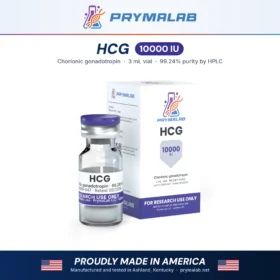
HCG peptide human chorionic gonadotropin guide for testosterone support fertility treatment and TRT dosage protocols

HCG Peptide: What It Is, How It Works and the Research

HCG is a two-subunit glycoprotein hormone that acts on the LH receptor. This guide covers its structure, how international units are assigned, regular and hyperglycosylated hCG, and what the published research measured.

24-hour support icon
24/7 Online support

support@prymalab.net info@prymalab.net

Quality guarantee badge icon
7-day returns

7-day returns on unopened, sealed products, plus our third-party testing guarantee.

Shipping truck icon
Free US shipping

Free USA shipping over $100 and free worldwide shipping over $200.

RealReviews.io Rate your experience with PrymaLab
For laboratory and research use only. Not for human consumption. PrymaLab sells to qualified researchers and licensed laboratories only. Not a drug, food or cosmetic. Not for human consumption. This product has not been evaluated by the Food and Drug Administration and is not intended to diagnose, treat, cure or prevent any disease.