Description
PrymaLab · Research use only
Ipamorelin 10mg
Aib-His-D-2-Nal-D-Phe-Lys-NH2, the selective GHS-R1a pentapeptide, in a 10 mg vial
Ipamorelin is a synthetic pentapeptide, Aib-His-D-2-Nal-D-Phe-Lys-NH₂, that releases growth hormone through the growth hormone secretagogue receptor, the same receptor the stomach hormone ghrelin activates. This listing is the 10 mg vial of freeze-dried powder, the main fill; a 5 mg vial and a nasal spray are also sold. Research on ipamorelin has centred on its potency and its selectivity for growth hormone in rat and pig studies, and on the receptor it acts through.
Specifications
| Property | Value |
|---|---|
| Compound | Ipamorelin NNC 26-0161; selective growth hormone secretagogue pentapeptide |
| CAS number | 170851-70-4 |
| Molecular formula | C38H49N9O5 |
| Theoretical mass | 711.9 Da |
| Sequence / structure | H-Aib-H-[D-2-Nal]-[D-Phe]-K-NH₂ (5 residues; C-terminal amide) |
| Label claim | 10 mg/vial |
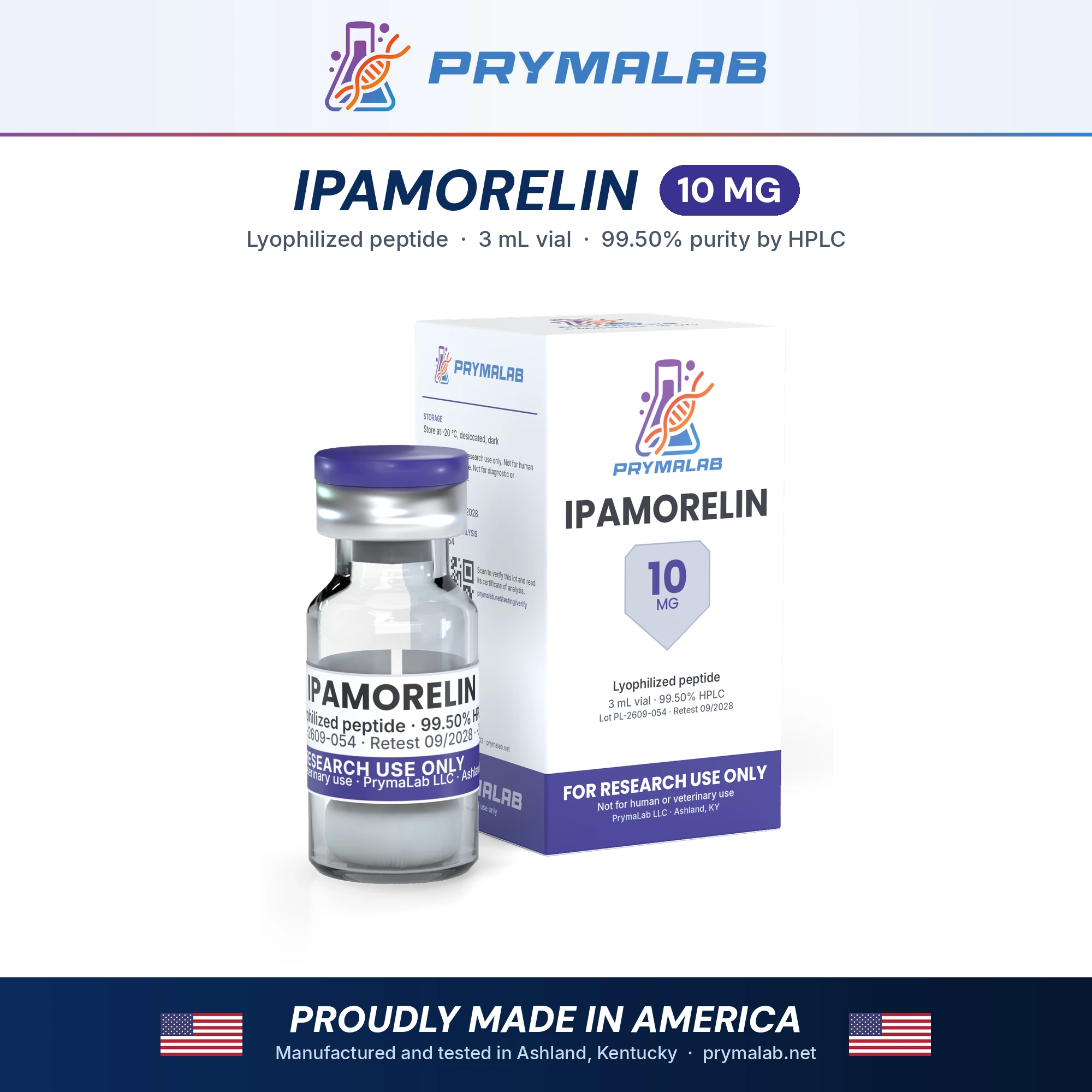
| Form | Lyophilized (freeze-dried) powder or cake in a sealed glass vial with a rubber stopper and aluminium crimp cap |
| Storage, sealed | −20 °C, desiccated, dark |
| Purity specification | 99.0% or higher by RP-HPLC |
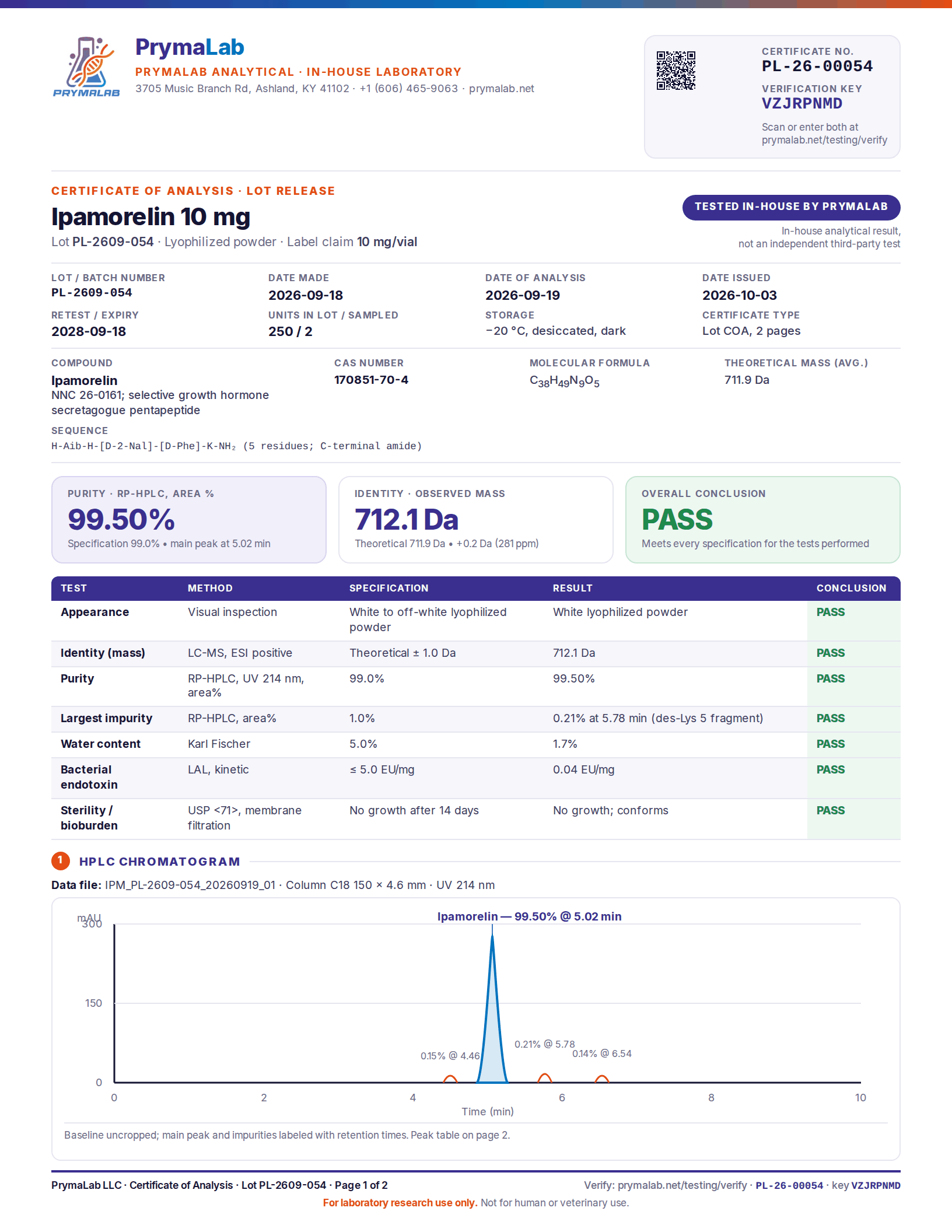
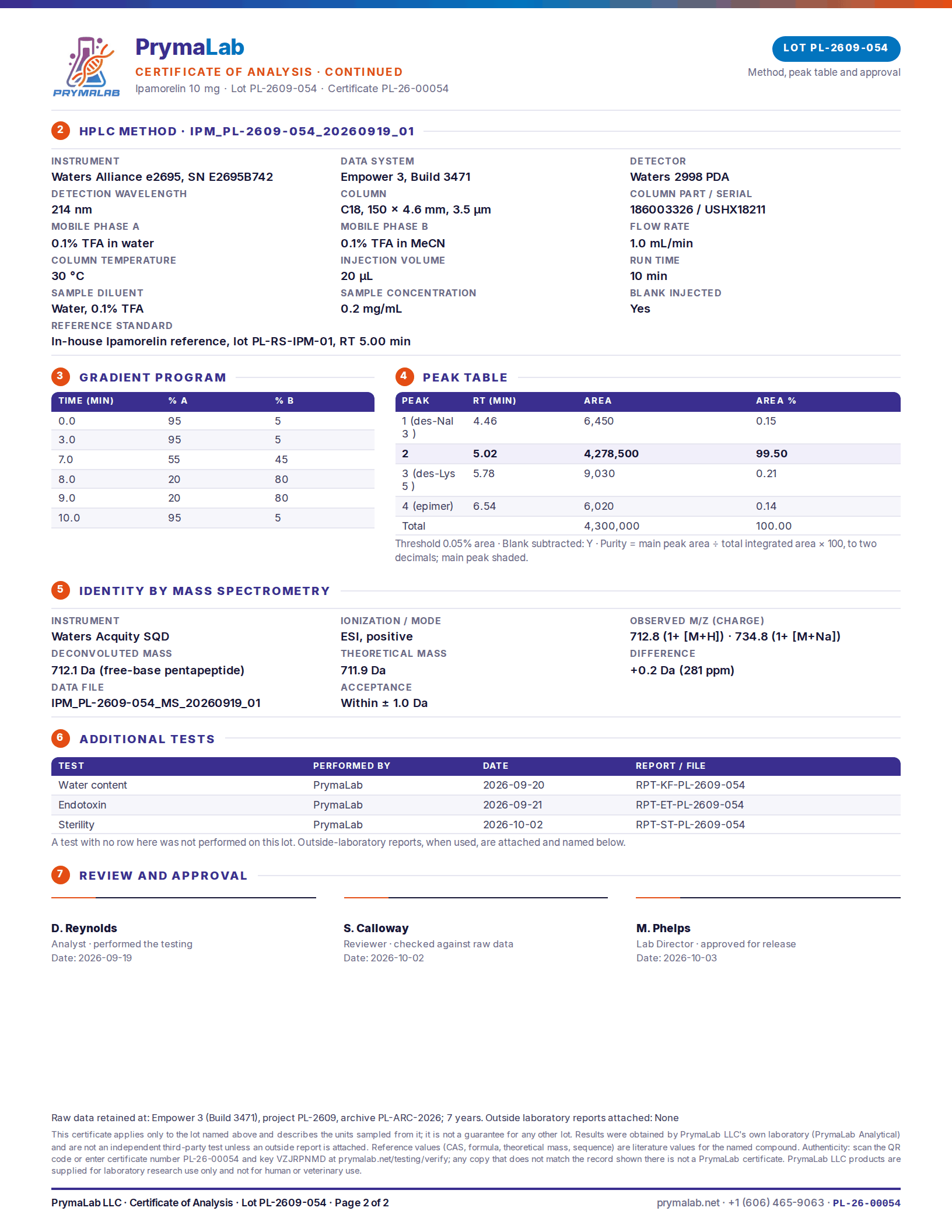
| Lot certificate | Results for the lot now shipping are in the certificate panel on this page |
| Safety data sheet | PL-SDS-090 |
Fills in this range
Ipamorelin is sold in 2 fills. The compound and the testing are the same in every fill; only the amount in the vial changes.
| Fill | Listing |
|---|---|
| 5 mg | Ipamorelin 5mg |
| 10 mg | Ipamorelin 10mg (this page) |
Handling notes
Ipamorelin’s safety data sheet carries three hazard statements: skin irritation category 2 (H315), serious eye irritation category 2A (H319) and specific target organ toxicity after single exposure, category 3 (H335, may cause respiratory irritation). The sheet asks for the sealed vial to be stored locked up at −20 °C, dry and dark, and brought to room temperature before opening so moisture does not condense on the powder. Reconstituted solutions are kept at 2 to 8 °C, protected from light.
Because the molecule is small, one vial holds a large molar amount: at the certificate’s theoretical mass of 711.9 Da, 10 mg is about 14 µmol. Commercially synthesised peptides almost always contain some trifluoroacetate left over from manufacture1. The certificate reports water content but not counter-ion content, so the moles of peptide in the vial sit somewhat below that figure.
What the research covers
Where ipamorelin came from
Raun and colleagues introduced ipamorelin in 1998 as the product of a large chemistry programme, picked from a series of compounds that lack the central Ala-Trp dipeptide of growth hormone-releasing peptide-12. In primary rat pituitary cells it released growth hormone with potency and efficacy close to GHRP-6: an EC50 of 1.3 nmol/l and a maximum of 85% of the GHRP-6 response2. Experiments with GHRP and GHRH antagonists showed that, like GHRP-6, it acts through a GHRP-type receptor and not the GHRH receptor2. Its potency and efficacy were again close to GHRP-6 in anaesthetised rats and conscious swine, while GHRP-2 was more potent in swine but reached a lower maximum2.
The selectivity finding
The claim in the paper’s title rests on hormone measurements in swine. None of the secretagogues tested changed FSH, LH, prolactin or TSH2. GHRP-6 and GHRP-2 both raised ACTH and cortisol, but ipamorelin did not raise either above the levels seen after GHRH, even at amounts more than 200 times its ED50 for growth hormone release2. On that basis the authors described it as the first GHRP-receptor agonist with a selectivity for growth hormone similar to that of GHRH, measured against those named hormones in one species2.
The receptor
Ipamorelin’s target was found before its natural ligand. In 1996 Howard and colleagues cloned a G protein-coupled receptor from the pituitary and hypothalamus of pigs and humans, showed that the synthetic secretagogues act on it, and proposed that they were mimicking a hormone not yet discovered3. Kojima’s group isolated that hormone from rat stomach in 1999: ghrelin, a 28-residue peptide that needs an n-octanoyl group on serine 3 to be active4. Their result meant pituitary growth hormone release is governed by ghrelin as well as by hypothalamic GHRH4. In transfected cells the receptor also signals strongly with nothing bound to it, and ghrelin acts through it on appetite as well as on growth hormone5.
Work beyond the pituitary
One rat study looked at muscle and bone. Andersen and colleagues gave 8-month-old female rats the glucocorticoid methylprednisolone, ipamorelin, or both for three months6. Compared with the glucocorticoid alone, the combination increased the maximum tetanic tension of the calf muscles and raised the periosteal bone formation rate fourfold6.
What is not established
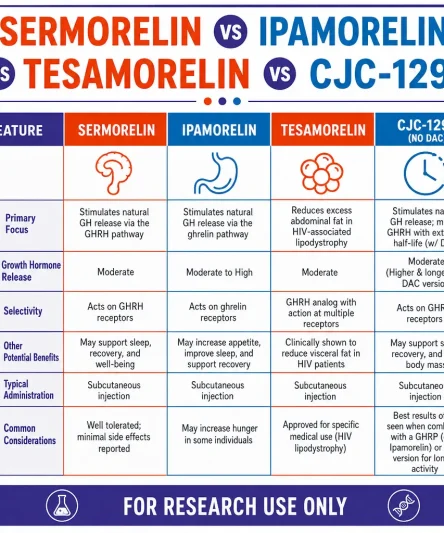
None of the studies cited here was carried out in people, and the selectivity data come from one paper in swine. The muscle and bone finding is a single rat study of glucocorticoid-induced loss. Ghrelin itself stimulates appetite5, but the abstracts cited here do not report whether ipamorelin does. None of the work used PrymaLab material. How ipamorelin compares with the GHRH analogues is set out in sermorelin vs ipamorelin vs tesamorelin.
How each lot is tested
Every lot is tested in PrymaLab’s own laboratory in Ashland, Kentucky before release: RP-HPLC for purity, LC-MS for identity, Karl Fischer titration for water, LAL for endotoxin and USP <71> for sterility. The results for the lot now shipping are in the certificate panel on this page, and the certificate number, key and QR code can be checked on the verify page. These are in-house results from PrymaLab Analytical, not an independent test, and the lab is not accredited to ISO 17025. The third-party testing guarantee on this page still applies: if any independent laboratory finds the wrong compound, or less than the stated purity or amount, the order is refunded and the cost of the test is reimbursed.
Frequently asked questions
How do the 10 mg and 5 mg vials differ?
Only in the amount of peptide: about 14 µmol in the 10 mg vial and 7.0 µmol in the 5 mg vial, from the 711.9 Da theoretical mass. Each fill is made as its own lot with its own certificate. With the same volume of diluent the 10 mg vial gives twice the concentration.
How does the nasal spray differ from the vials?
The spray holds the same pentapeptide already dissolved in bacteriostatic water, 10 mg per bottle, and is kept at 2 to 8 °C without freezing. The vials hold dry powder stored at −20 °C, so the laboratory chooses the solvent and concentration.
Is ipamorelin a GHRH analogue like sermorelin?
No. Sermorelin and the other GHRH analogues act on the GHRH receptor. Ipamorelin acts on the growth hormone secretagogue receptor, the receptor for ghrelin, which is a separate route to growth hormone release from the same pituitary cells.
How do I check the certificate for the vial I received?
Find the lot number on the vial label and match it to the certificate. The panel on this page shows the lot now shipping, and the verify page confirms any certificate from its number and key.
What does the published research show, and what does it leave open?
Cell, rat and pig studies showed growth hormone release through the GHRP receptor without the ACTH and cortisol rise seen with GHRP-6 and GHRP-2. The papers cited here include no human data, and none of them used this product.
Can this product be used in people or animals?
No. It is sold for laboratory research only, is not approved by the FDA or any other authority for human or veterinary use, and must not be given to people or animals.
References
- Andrushchenko VV, Vogel HJ, Prenner EJ. Optimization of the hydrochloric acid concentration used for trifluoroacetate removal from synthetic peptides. J Pept Sci. 2007;13(1):37-43. DOI · PubMed
- Raun K, Hansen BS, Johansen NL, et al. Ipamorelin, the first selective growth hormone secretagogue. Eur J Endocrinol. 1998;139(5):552-61. DOI · PubMed
- Howard AD, Feighner SD, Cully DF, et al. A receptor in pituitary and hypothalamus that functions in growth hormone release. Science. 1996;273(5277):974-7. DOI · PubMed
- Kojima M, Hosoda H, Date Y, et al. Ghrelin is a growth-hormone-releasing acylated peptide from stomach. Nature. 1999;402(6762):656-60. DOI · PubMed
- Holst B, Cygankiewicz A, Jensen TH, et al. High constitutive signaling of the ghrelin receptor–identification of a potent inverse agonist. Mol Endocrinol. 2003;17(11):2201-10. DOI · PubMed
- Andersen NB, Malmlöf K, Johansen PB, et al. The growth hormone secretagogue ipamorelin counteracts glucocorticoid-induced decrease in bone formation of adult rats. Growth Horm IGF Res. 2001;11(5):266-72. DOI · PubMed
Research use only
For laboratory research use only. Ipamorelin 10mg is not a drug, food, cosmetic or dietary supplement, is not approved by the FDA or any comparable authority for human or veterinary use, and must not be given to people or animals. It is sold to qualified researchers and institutions, and the buyer is responsible for lawful handling and disposal.
Other formats of Ipamorelin
Ipamorelin is also stocked as Ipamorelin 10mg Nasal Spray, CJC-1295 (no DAC), Ipamorelin 10mg (Blend), CJC-1295 (No DAC) + Ipamorelin 15mg preloaded 3ml pen, CJC-1295 (NO DAC) 5MG and CJC-1295 (NO DAC) 10MG. Each listing states its own quantity and concentration, and the pen and vial comparison explains what changes between formats.







Reviews
There are no reviews yet.