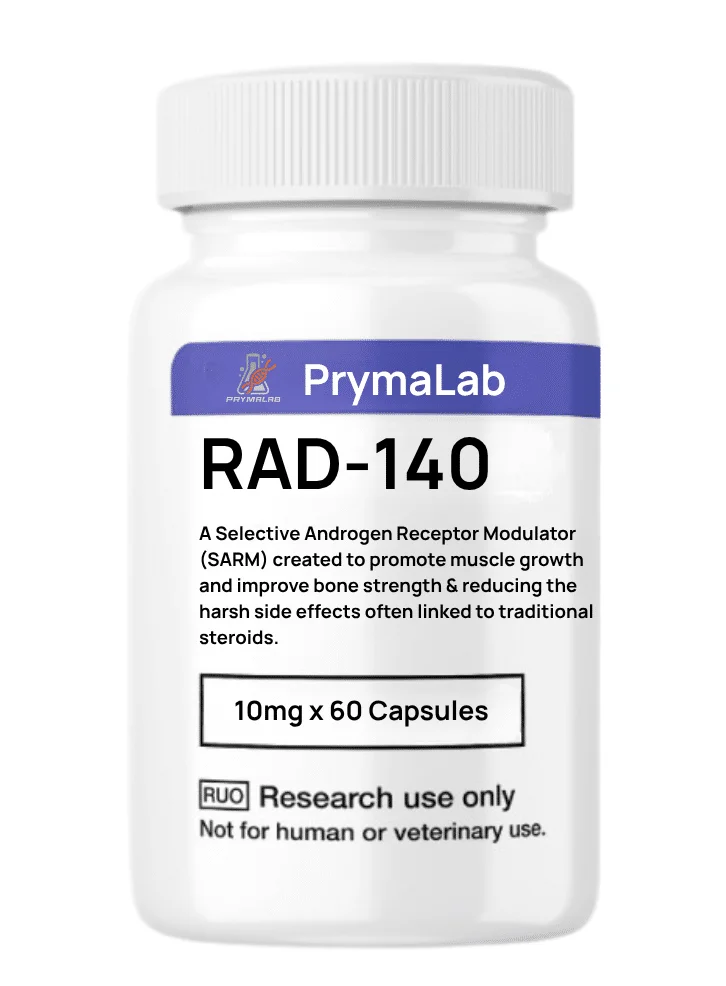
Description
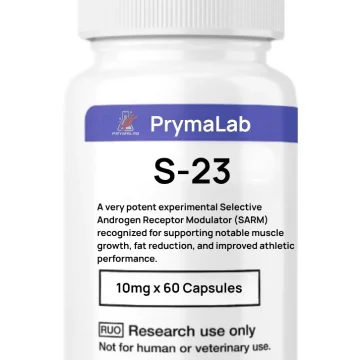
PrymaLab · Research Use Only
RAD-140 (Testolone)
Non-steroidal AR ligand · CAS 1182367-47-0 · 393.83 Da
RAD-140 Testolone is a non-steroidal synthetic small molecule characterised in the published literature as a selective androgen receptor modulator and androgen receptor ligand, CAS 1182367-47-0, molecular formula C20H16ClN5O2, molecular weight 393.83. It was first described by researchers at Radius Health in 2011.
Specification Table
| Property | Value |
|---|---|
| Compound | RAD-140 |
| Alternative designation | Testolone |
| Compound class | Non-steroidal synthetic small molecule. Not a peptide, not a steroid |
| CAS number | 1182367-47-0 |
| Molecular formula | C20H16ClN5O2 |
| Molecular weight | 393.83 g/mol |
| Molecular target | Androgen receptor (AR, NR3C4) |
| Receptor superfamily | Nuclear receptor, steroid receptor subfamily |
| Structural class | Contains a chlorinated aryl ring, a nitrile, and an oxadiazole heteroshift |
| Structural relationship to steroids | None. No steroid nucleus present |
| First described | Miller and colleagues, 2011 |
| Originating organisation | Radius Health |
| Aromatisation | Not a substrate for aromatase, having no steroid nucleus |
| Appearance | Solid, typically white to off-white |
| Purity | Per lot-specific certificate of analysis |
| Solubility | Soluble in DMSO. Poorly soluble in water |
| Storage, solid | -20°C, protected from light and moisture |
| Storage, DMSO stock | -20°C or below, protected from moisture |
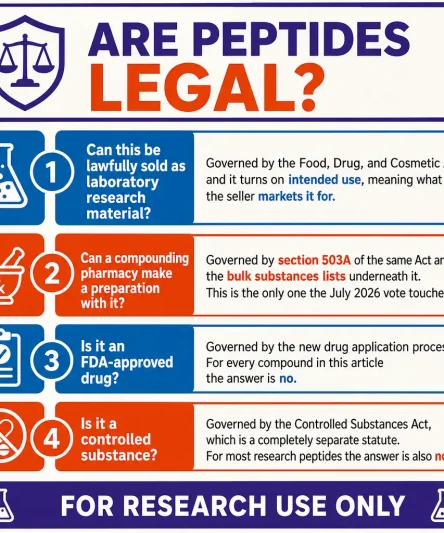
| Regulatory status | No approved human or veterinary formulation in any jurisdiction |
What Does Non-Steroidal Mean Structurally?
The term appears constantly in descriptions of RAD-140 Testolone and its class and is usually left undefined, which obscures a genuinely important structural point.
A steroid is built on a specific fused ring system: three six-membered rings and one five-membered ring sharing edges, the cyclopentanoperhydrophenanthrene nucleus. Testosterone, cortisol, cholesterol and oestradiol all share it, differing in the substituents attached.
RAD-140 contains no part of that system. Its structure comprises a chlorinated aromatic ring, a nitrile group, and an oxadiazole heteroshift, connected through linkers. Chemically it belongs to a different world entirely.
The practical consequence is that enzymes acting on the steroid nucleus have nothing to act on. Aromatase converts the A-ring of androgens to a phenol, producing oestrogens, and a molecule with no A-ring is not a substrate. Steroid 5-alpha reductase likewise has no target.
What is preserved is the ability to occupy the androgen receptor ligand-binding pocket. That pocket accommodates a range of shapes, and non-steroidal chemistry that fits it has been pursued precisely because it decouples receptor binding from steroid metabolism.
How Does Tissue-Selective Modulation Work in Principle?
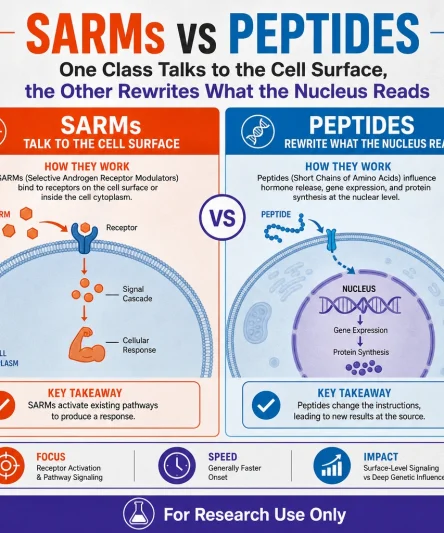
The concept underlying this SARM compound class is worth explaining properly, because it is frequently described as though selectivity were a property of the molecule alone.
A nuclear receptor bound to a ligand adopts a conformation, and that conformation determines which coregulator proteins can dock. Different ligands stabilise slightly different conformations, presenting different coregulator surfaces.
Coregulator expression differs between tissues. A given cell type contains a particular complement of coactivators and corepressors, so the same receptor bound to the same ligand can assemble a transcriptionally active complex in one tissue and an inactive one in another.
Selectivity therefore emerges from the interaction between ligand-induced conformation and tissue-specific coregulator availability. It is not a property the molecule carries independently of context, which is why selectivity established in one tissue pair does not automatically extend to another.
The same principle underlies selective oestrogen receptor modulators, where tamoxifen behaves as an antagonist in some tissues and an agonist in others. That precedent is the intellectual origin of the approach applied to the androgen receptor.
What Did the Original Characterisation Report?
Miller and colleagues published the discovery paper in ACS Medicinal Chemistry Letters in 2011, and reading it directly is more informative than reading descriptions of it.
The paper reports the medicinal chemistry campaign that produced the compound, including the structure-activity relationships across the series and the binding affinity of the selected candidate at the androgen receptor.
Characterisation included cell-based transactivation assays measuring receptor-dependent reporter output, and comparison against reference androgens to establish relative behaviour at the receptor.
In vivo work in the paper used rodent models with tissue-level endpoints to evaluate anabolic effects, which is the standard preclinical characterisation for a compound of this class. Those endpoints are measurements in animals, not statements about humans.
No approved human or veterinary formulation of RAD-140 exists in any jurisdiction. Clinical investigation of the compound has been reported in registry records, and that is a separate matter from approval.
What Should RAD-140 Testolone Research Control For?
RAD-140 Testolone work has well-established control requirements, and several are specific to the androgen receptor.
A reference androgen arm is necessary for any comparative claim. Dihydrotestosterone is the conventional choice for receptor-level work, since it binds with high affinity and is not itself a substrate for further reduction.
An antagonist arm establishes receptor dependence. If a compound acts through the androgen receptor, a competitive antagonist such as bicalutamide or enzalutamide should attenuate the effect, and failure to do so points elsewhere.
Receptor knockdown or knockout provides the genetic version of the same test and is stronger. An effect persisting in cells lacking the receptor is not receptor-mediated.
Coregulator context should be reported rather than assumed. Since selectivity depends on the coregulator complement of the specific cell type used, a finding obtained in one cell line constrains conclusions about others less than it may appear to.
A matched DMSO vehicle control across all conditions is required given the solubility profile.
What Does Receptor Binding Data Actually Establish?
Binding affinity is the most-quoted number for compounds of this class and among the least informative in isolation, which is worth unpacking.
A binding constant states how tightly a ligand associates with a receptor under the assay conditions used. It says nothing about what the receptor does once occupied, and nuclear receptors are the clearest case where occupancy and consequence diverge.
A full agonist, a partial agonist and an antagonist can all bind with comparable affinity, and what distinguishes them is the conformation each stabilises and therefore which coregulators assemble, which requires a functional assay to determine.
Transactivation assays provide that functional readout, measuring reporter gene output from a receptor response element, and they establish whether occupancy produces transcriptional activity and how much relative to a reference ligand.
Even a transactivation figure is context-bound, since the coregulator complement of the reporter cell line shapes the answer, and a compound reading as a partial agonist in one line can read differently in another with a different coregulator profile.
The defensible way to report a compound of this class is affinity plus functional output plus the cell system used. Any one of those three alone invites overinterpretation, and affinity alone invites it most.
Why Does Coregulator Context Deserve Explicit Reporting?
The selectivity concept described above has a practical corollary that is routinely left implicit in published work.
If tissue selectivity emerges from coregulator availability, then the cell system used is part of the finding rather than a background detail. Two laboratories using different cell lines are measuring different systems even when they use identical compound and identical concentration.
Common reporter lines differ substantially in their coactivator and corepressor profiles. A line derived from one tissue carries that tissue coregulator complement, which is precisely the variable the selectivity concept says matters.
The reporting practice that follows is to state the cell line, its tissue of origin, and where known the relevant coregulator expression, rather than treating the line as an inert testing vessel.
Where a conclusion about selectivity is drawn, it should be drawn from at least two systems with different coregulator profiles, since a single system cannot demonstrate a differential by definition.
This is not an exotic requirement. It follows directly from the mechanism the field itself proposes, and applying it inconsistently is what makes selectivity claims in this area harder to compare than they should be.
What Should Be Documented for RAD-140 Testolone Work?
Small-molecule nuclear receptor work has a short list of fields that separate a reproducible method from an unreproducible one.
Lot number and stated purity, with the analytical method named. A purity figure with no method attached carries less information than it appears to.
Stock concentration in dimethyl sulfoxide, the date the stock was made, and the number of freeze-thaw events. A stock that has been thawed repeatedly may have taken up water and may have precipitated material that never redissolved.
Final vehicle concentration in each condition, matched across all arms including untreated controls. This is the field most often omitted and the one most likely to explain a discrepancy between laboratories using RAD-140 Testolone.
Cell line, its tissue of origin, and passage number, for the coregulator reasons set out above.
Handling and Storage in Laboratory Practice
RAD-140 Testolone is handled as a small molecule, with DMSO stocks and the precautions that implies.
Prepare a concentrated stock in anhydrous DMSO and aliquot into tightly sealed tubes stored at -20°C or below. DMSO absorbs atmospheric water readily and a wet stock may precipitate compound on freezing.
Bring aliquots fully to room temperature before opening, since condensation into cold DMSO is how most stocks become wet. Vortex and inspect visually for precipitate before use.
Dilute into aqueous medium slowly with mixing to limit local supersaturation and potential confounding side effects in the assay. Keep final DMSO concentration identical across every condition including vehicle controls, and below the threshold at which the solvent itself perturbs the assay.
Solid material belongs at -20°C, sealed against light and against moisture. Record lot, purity, DMSO stock concentration, preparation date and final vehicle concentration. Recording the vehicle concentration matters because it is the most common uncontrolled variable in small-molecule cell work.
One last consideration concerns purity claims from unverified suppliers. Compounds in this class are widely distributed through channels with no analytical accountability, and mislabelled or adulterated material is documented in the published literature.
Independent verification is therefore worth the cost. Mass spectrometry confirming 393.83 and chromatography establishing purity together take an afternoon and they establish that the material is what the label says.
Nuclear magnetic resonance adds structural confirmation where the question is whether a related compound has been substituted, which mass alone would not always reveal.
Published Literature
References verified against the publisher record. The androgen receptor literature is extensive and independent, though work on this specific compound is more limited.
- Miller CP, Shomali M, Lyttle CR, O’Dea LS, Herendeen H, Gallacher K, Paquin D, Compton DR, Sahoo B, Kerrigan SA, Burge MS, Nickels M, Green JL, Katzenellenbogen JA, Tchesnokov A, Hattersley G. ACS Medicinal Chemistry Letters. 2011;2(2):124-129.
- Narayanan R, Coss CC, Dalton JT. Molecular and Cellular Endocrinology. 2018;465:134-142.
- Bhasin S, Jasuja R. Current Opinion in Clinical Nutrition and Metabolic Care. 2009;12(3):232-240.
- Heinlein CA, Chang C. Endocrine Reviews. 2002;23(2):175-200.
- Gao W, Bohl CE, Dalton JT. Chemical Reviews. 2005;105(9):3352-3370.
Frequently Asked Questions
What is RAD-140 Testolone?
A non-steroidal synthetic small molecule characterised as an androgen receptor ligand, CAS 1182367-47-0, molecular formula C20H16ClN5O2, molecular weight 393.83. First described by researchers at Radius Health in 2011. Supplied strictly for laboratory research. Not for human or veterinary use.
What does non-steroidal mean structurally?
That the molecule contains no part of the fused four-ring steroid nucleus shared by testosterone, cortisol and cholesterol. RAD-140 is built from a chlorinated aromatic ring, a nitrile group and an oxadiazole heteroshift connected through linkers.
Why does the absence of a steroid nucleus matter?
Because enzymes acting on that nucleus have nothing to act on. Aromatase converts the A-ring of androgens to a phenol, and a molecule with no A-ring is not a substrate. Steroid 5-alpha reductase likewise has no target.
What is preserved despite the different chemistry?
The ability to occupy the androgen receptor ligand-binding pocket, which accommodates a range of molecular shapes. Non-steroidal chemistry fitting that pocket has been pursued precisely because it decouples receptor binding from steroid metabolism.
How does tissue-selective modulation work?
A ligand stabilises a particular receptor conformation, and that conformation determines which coregulator proteins can dock. Since coregulator expression differs between tissues, the same receptor with the same ligand can assemble an active complex in one tissue and an inactive one in another.
Is selectivity a property of the molecule?
Not on its own. It emerges from the interaction between ligand-induced conformation and tissue-specific coregulator availability, which is why selectivity established in one tissue pair does not automatically extend to another and should be verified rather than assumed.
Where does the concept come from?
From selective oestrogen receptor modulators, where tamoxifen behaves as an antagonist in some tissues and an agonist in others. That precedent is the intellectual origin of applying the same approach to the androgen receptor.
What did the 2011 paper report?
The medicinal chemistry campaign producing the compound, structure-activity relationships across the series, binding affinity at the androgen receptor, cell-based transactivation assays, and rodent work with tissue-level endpoints. Those endpoints are measurements in animals.
What controls establish receptor dependence?
An antagonist arm using bicalutamide or enzalutamide, where attenuation of the effect indicates receptor mediation. Receptor knockdown or knockout is the stronger genetic version. A reference androgen such as dihydrotestosterone is needed for any comparative claim.
What is the most common uncontrolled variable?
Final DMSO concentration. It should be identical across every condition including vehicle controls and kept below the threshold at which the solvent perturbs the assay, and it should be recorded rather than left implicit in the method.
Compliance Statement
RAD-140 is sold exclusively for laboratory research use. It is not a drug, food, or cosmetic product, and it is not a dietary product of any kind. It is not approved by the FDA or any comparable authority for human or veterinary use, it is a research chemical rather than a candidate for any other purpose, and clinical registry activity does not constitute approval in any jurisdiction. This product is not intended to diagnose, treat, cure, or prevent any disease. It must not be given to humans or animals. Purchase is restricted to qualified researchers and institutions operating within applicable laws. All handling is the responsibility of the purchasing laboratory.


19 reviews for RAD-140 (Testolone) 10mg Capsules