

Peptide Calculator for Weight Loss: Complete Peptide Dosage Guide [2026]
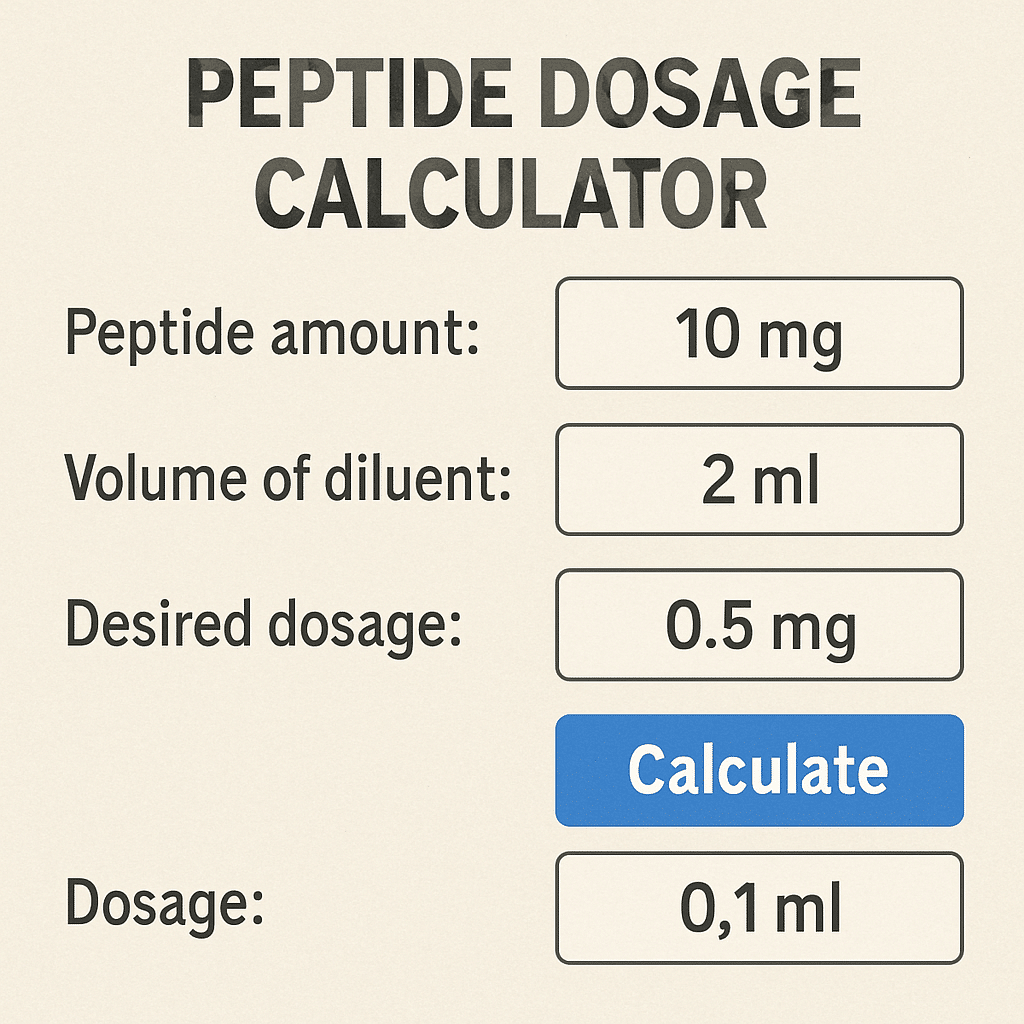
A peptide calculator is the single most useful tool any peptide user can have on their phone. It takes three inputs — vial strength, bacteriostatic water added, and target dose — and returns the exact number of units to draw into a U-100 insulin syringe. In this 2026 guide we walk through how every peptide dosage calculator works under the hood, show step-by-step reconstitution math, and give dialed-in examples for the most popular weight-loss peptides including tirzepatide, semaglutide, and retatrutide — so you can verify any calculator's output yourself and inject the right amount every single time.
Important: Peptide calculators are math tools, not medical advice. All peptide use should be directed by a licensed clinician. This article is educational and does not recommend, prescribe, or sell any peptide.
?? Quick Answer: How a Peptide Calculator Works
- Concentration (mg/mL) = peptide mass in vial (mg) ÷ bacteriostatic water added (mL)
- Volume per dose (mL) = target dose (mg) ÷ concentration (mg/mL)
- Units per dose = volume per dose (mL) × 100 (U-100 insulin syringe scale)
- Example: 10 mg tirzepatide vial + 2 mL BAC water = 5 mg/mL. A 2.5 mg dose = 0.5 mL = 50 units; similar math applies to a bpc-157 vial.
- Weight loss peptides covered: semaglutide, tirzepatide, retatrutide, cagrilintide, AOD-9604, mots-c, and cjc-1295.
- Reconstitution rule of thumb: 2 mL of BAC water is the most common choice for weight-loss peptide vials.
What Is a Peptide Calculator?
A peptide calculator — sometimes called a peptides calculator, peptide dose calculator, or peptide dosing calculator — is a conversion tool that answers one question: "Given my vial strength and the amount of bacteriostatic water I added, how many units do I draw on an insulin syringe to inject a specific dose?
The reason peptide calculators exist is that nearly all injectable research and compounded peptides come as lyophilized (freeze-dried) powder inside a sealed glass vial. Before you can inject them, they must be reconstituted — rehydrated — with sterile bacteriostatic water. How much water you add determines the final concentration, and the final concentration determines how many units (or milliliters) equal your target dose.
Manual math is straightforward but easy to get wrong, especially when you are half-asleep on a cold morning. A good calculator removes that risk.
What a Peptide Calculator Is Not
- Not a prescription tool. It does not decide which peptide you should use or how much.
- Not a safety check. It cannot verify peptide purity, sterility, or legality.
- Not a substitute for a clinician. For FDA-approved weight-loss medications like Wegovy, Ozempic, Mounjaro, and Zepbound, your prescriber sets the dose escalation.
Bottom line: A peptide calculator is a math converter. It ensures the dose your clinician (or protocol) recommends is the dose that actually goes into the syringe. Nothing more, nothing less.
How Does a Peptide Dosage Calculator Work?
Every peptide dosage calculator — whether it is the Jay Campbell peptide calculator, the Prime Peptides calculator, a mobile app, or a spreadsheet — performs the same three-step arithmetic.
Step 1: Calculate Concentration
After reconstitution, concentration is simply the total peptide mass divided by the total liquid volume:
Concentration (mg/mL) = Peptide in Vial (mg) ÷ Bacteriostatic Water Added (mL)
If you reconstitute a 10 mg vial with 2 mL of bacteriostatic water, your concentration is 5 mg/mL.
Step 2: Calculate Volume per Dose
Once you know the concentration, any dose can be converted to a volume:
Volume per Dose (mL) = Target Dose (mg) ÷ Concentration (mg/mL)
For a 2.5 mg dose at 5 mg/mL concentration: 2.5 ÷ 5 = 0.5 mL.
Step 3: Convert Volume to Insulin Syringe Units
Peptide injections are done with U-100 insulin syringes, where 100 units = 1 mL. The conversion is:
Units = Volume (mL) × 100
0.5 mL × 100 = 50 units — that is the line on the syringe barrel you fill to.
Working Example: 10 mg Tirzepatide Vial
| Step | Calculation | Result |
|---|---|---|
| Reconstitute | 10 mg peptide + 2 mL BAC water | 5 mg/mL concentration |
| Dose 2.5 mg | 2.5 mg ÷ 5 mg/mL | 0.5 mL = 50 units |
| Dose 5 mg | 5 mg ÷ 5 mg/mL | 1.0 mL = 100 units |
| Dose 7.5 mg | 7.5 mg ÷ 5 mg/mL | 1.5 mL = 150 units |
| Dose 10 mg | 10 mg ÷ 5 mg/mL | 2.0 mL = 200 units |
Every legitimate peptide calculator dosage tool runs exactly this math. Knowing how it works means you can sanity-check any calculator's output.
Peptide Reconstitution Calculator: Step by Step
A peptide reconstitution calculator — also searched as reconstitute peptides calculator, peptide reconstitution calculator mg, or peptide mixing calculator — is simply a peptide dosage calculator with an emphasis on the reconstitution step. The core decision is: how much bacteriostatic water do I add?
Choosing Your Reconstitution Volume
There is no universally "correct" water volume. The amount you add is a tradeoff between dosing precision and syringe draw size:
- More water ? more dilute ? easier to draw small doses accurately. For micro-doses under 500 mcg, such as a 100 mcg injection, adding 3–5 mL of BAC water gives you larger, easier-to-read units on the syringe.
- Less water ? more concentrated ? larger doses fit in one injection. For larger doses (10+ mg), adding only 1 mL means you do not exceed the 100-unit syringe capacity.
- Standard default: 2 mL. For virtually every weight-loss peptide (tirzepatide, semaglutide, retatrutide), 2 mL of BAC water into a 5–15 mg vial produces clean, easy-to-read units across the typical dose range.
Common Reconstitution Scenarios
| Vial Strength | BAC Water | Concentration | Units per 1 mg |
|---|---|---|---|
| 5 mg | 1 mL | 5 mg/mL | 20 units |
| 5 mg | 2 mL | 2.5 mg/mL | 40 units |
| 10 mg | 1 mL | 10 mg/mL | 10 units |
| 10 mg | 2 mL | 5 mg/mL | 20 units |
| 10 mg | 3 mL | 3.33 mg/mL | 30 units |
| 15 mg | 2 mL | 7.5 mg/mL | 13.3 units |
| 15 mg | 3 mL | 5 mg/mL | 20 units |
Physical Reconstitution Procedure
- Allow vials to reach room temperature (about 10–15 minutes out of the fridge).
- Clean the rubber stopper of both the peptide vial and the bacteriostatic water vial with an alcohol swab.
- Draw the chosen volume of bacteriostatic water into a 3 mL syringe.
- Inject the water slowly against the inner glass wall of the peptide vial — do not shoot it directly onto the peptide powder.
- Gently swirl until the peptide powder fully dissolves. Do not shake. Peptides are protein structures; vigorous agitation can denature them.
- Inspect the peptide solution: the final peptide solution should be crystal clear and colorless. Cloudiness or particles means discard.
- Label the vial with the date, concentration, and peptide name.
- Refrigerate at 2–8 °C (36–46 °F). Use within 28–30 days.
Critical rule: Use only bacteriostatic water (which contains 0.9% benzyl alcohol as a preservative) for reconstitution — not sterile water and not tap water. Bacteriostatic water is what allows multi-dose use for up to 28 days without microbial contamination.
Peptide Dilution Calculator
A peptide dilution calculator handles the reverse case: you already have a reconstituted peptide solution and want to further dilute it (for micro-dosing or research-scale doses). The math is identical — divide your desired final concentration by the starting concentration to find the dilution ratio, then mix that ratio of starting solution to additional bacteriostatic water in a fresh sterile vial.
?? Interactive Peptide Calculator
Use the calculator below to convert your peptide dose into insulin syringe units. Enter your vial strength, the amount of bacteriostatic water you added, and your target dose — the calculator returns your concentration, injection volume, and syringe units in real time.
Concentration: 5 mg/mL
Volume per dose: 0.5 mL
Draw to: 50 units on a U-100 insulin syringe
Always verify your calculation against a second source — a second calculator, a trusted peptide dosing chart, or your clinician — before injecting.
Peptide Calculator for Tirzepatide
Tirzepatide — sold under the brand names Mounjaro (type 2 diabetes) and Zepbound (chronic weight management) — is a dual GLP-1/GIP receptor agonist that produced an average 20.9% body-weight reduction at the 15 mg dose in the SURMOUNT-1 Phase 3 trial. Compounded tirzepatide is frequently dispensed in 5 mg, 10 mg, or 15 mg lyophilized vials, and a peptide calculator for tirzepatide (sometimes searched as tirzepatide peptide calculator) handles the dose-to-units conversion.
Standard Tirzepatide Dose Escalation
The FDA-approved titration schedule starts low and increases every four weeks to minimize nausea:
- Weeks 1–4: 2.5 mg once weekly (starter, not therapeutic)
- Weeks 5–8: 5 mg once weekly
- Weeks 9–12: 7.5 mg once weekly
- Weeks 13–16: 10 mg once weekly
- Weeks 17–20: 12.5 mg once weekly
- Weeks 21+: 15 mg once weekly (maximum approved dose)
Tirzepatide Units by Vial Size (2 mL BAC Water Reconstitution)
| Vial | Concentration | 2.5 mg | 5 mg | 7.5 mg | 10 mg | 12.5 mg | 15 mg |
|---|---|---|---|---|---|---|---|
| 5 mg + 2 mL | 2.5 mg/mL | 100 units | — (full vial) | — | — | — | — |
| 10 mg + 2 mL | 5 mg/mL | 50 units | 100 units | 150 units* | 200 units* | — | — |
| 15 mg + 2 mL | 7.5 mg/mL | 33 units | 67 units | 100 units | 133 units* | 167 units* | 200 units* |
| 15 mg + 3 mL | 5 mg/mL | 50 units | 100 units | 150 units* | 200 units* | 250 units* | 300 units* |
*Doses exceeding 100 units on a single U-100 syringe will require two separate injections using a 1 mL syringe or a 3 mL syringe calibrated in mL rather than units.
Pro tip: For most users on tirzepatide, a 10 mg vial reconstituted with 2 mL of bacteriostatic water is the sweet spot: it gives clean 50 / 100 / 150 / 200 unit marks for the 2.5, 5, 7.5, and 10 mg doses with no mental math required at injection time.
Peptide Calculator for Semaglutide
Semaglutide — sold as Ozempic and Rybelsus (type 2 diabetes) and Wegovy (chronic weight management) — is the most-prescribed GLP-1 receptor agonist in history, with the STEP-1 Phase 3 trial showing an average 14.9% body-weight reduction at 2.4 mg weekly. Compounded semaglutide vials typically come in 2 mg, 5 mg, or 10 mg strengths, and a peptide calculator for semaglutide (or semaglutide peptide calculator) converts the weekly dose into insulin syringe units.
Standard Semaglutide Dose Escalation (Wegovy Protocol)
- Weeks 1–4: 0.25 mg once weekly
- Weeks 5–8: 0.5 mg once weekly
- Weeks 9–12: 1.0 mg once weekly
- Weeks 13–16: 1.7 mg once weekly
- Weeks 17+: 2.4 mg once weekly (maintenance)
Semaglutide Units by Vial Size (2 mL BAC Water Reconstitution)
| Vial | Concentration | 0.25 mg | 0.5 mg | 1.0 mg | 1.7 mg | 2.4 mg |
|---|---|---|---|---|---|---|
| 2 mg + 2 mL | 1 mg/mL | 25 units | 50 units | 100 units | — (split) | — (split) |
| 5 mg + 2 mL | 2.5 mg/mL | 10 units | 20 units | 40 units | 68 units | 96 units |
| 10 mg + 2 mL | 5 mg/mL | 5 units | 10 units | 20 units | 34 units | 48 units |
| 10 mg + 3 mL | 3.33 mg/mL | 7.5 units | 15 units | 30 units | 51 units | 72 units |
Common pitfall: For the 0.25 mg starter dose, a 10 mg vial reconstituted with 2 mL of water produces an injection of just 5 units — which is hard to read accurately on an insulin syringe. Either use a smaller vial (2 mg) or add more bacteriostatic water (3–5 mL) to produce larger, easier-to-read unit values.
Popular Weight Loss Peptides & Their Calculator Doses
Beyond tirzepatide and semaglutide, several other peptide weight loss calculator use cases are common in 2026. Here is how the math pans out for the most frequently searched weight-loss peptides.
Retatrutide (Triple Agonist — GLP-1/GIP/Glucagon)
Retatrutide is in Phase 3 trials for obesity. The TRIUMPH-1 Phase 2 trial showed up to 24.2% body-weight reduction at 12 mg weekly over 48 weeks — the highest reduction ever reported in a GLP-class drug.
- Typical titration: 2 mg ? 4 mg ? 8 mg ? 12 mg weekly
- 10 mg vial + 2 mL BAC water (5 mg/mL): 2 mg = 40 units, 4 mg = 80 units, 8 mg = 160 units*, 12 mg = 240 units*
Cagrilintide (Amylin Analog)
Cagrilintide is often stacked with semaglutide (the "CagriSema" combination) and on its own has produced up to 10.8% body-weight reduction at 2.4 mg weekly.
- Typical titration: 0.3 mg ? 0.6 mg ? 1.2 mg ? 2.4 mg weekly
- 5 mg vial + 2 mL BAC water (2.5 mg/mL): 0.3 mg = 12 units, 0.6 mg = 24 units, 1.2 mg = 48 units, 2.4 mg = 96 units
AOD-9604 (Lipolytic Peptide)
AOD-9604 is a modified fragment of human growth hormone marketed for fat loss. Clinical evidence is weaker than GLP-1 peptides.
- Typical dose: 250–500 mcg daily subcutaneous
- 5 mg vial + 2 mL BAC water (2.5 mg/mL = 2,500 mcg/mL): 250 mcg = 10 units, 500 mcg = 20 units
Tesofensine (Oral — no reconstitution)
Tesofensine is an oral small molecule, not an injectable peptide. It does not require a peptide calculator — dosing is in milligram oral tablet form (0.25–1 mg daily).
Dosing principle: The peptide calculator mg for weight loss — regardless of which peptide — follows the exact same three-step formula in every case. Learn it once and you can dose any injectable peptide on the market.
Peptide Dosing Chart: mg to Units Quick Reference
This universal peptide dosing chart (also searched as peptide dose chart or peptide calculator mg) lets you convert dose to units at a glance for the most common reconstitution setups. Pin it, screenshot it, or keep it beside your peptide storage.
Concentration: 5 mg/mL (e.g., 10 mg vial + 2 mL BAC water)
| Dose (mg) | Volume (mL) | Units (U-100) |
|---|---|---|
| 0.5 | 0.10 | 10 |
| 1.0 | 0.20 | 20 |
| 2.5 | 0.50 | 50 |
| 5.0 | 1.00 | 100 |
| 7.5 | 1.50 | 150* |
| 10.0 | 2.00 | 200* |
Concentration: 2.5 mg/mL (e.g., 5 mg vial + 2 mL BAC water)
| Dose (mg) | Volume (mL) | Units (U-100) |
|---|---|---|
| 0.25 | 0.10 | 10 |
| 0.50 | 0.20 | 20 |
| 1.00 | 0.40 | 40 |
| 1.70 | 0.68 | 68 |
| 2.40 | 0.96 | 96 |
Concentration: 1 mg/mL (e.g., 2 mg vial + 2 mL BAC water)
| Dose (mg) | Volume (mL) | Units (U-100) |
|---|---|---|
| 0.10 | 0.10 | 10 |
| 0.25 | 0.25 | 25 |
| 0.50 | 0.50 | 50 |
| 1.00 | 1.00 | 100 |
*Values exceeding 100 units require multiple injections on a standard U-100 insulin syringe or a 1 mL / 3 mL syringe calibrated in mL.
Peptide Mixing & Reconstitution Guide
A peptide mixing calculator and a peptide mixing chart exist because dosing errors almost always trace back to one of a few predictable mistakes at the reconstitution stage. This section is the visual checklist for doing it right.
Supplies Checklist
- Lyophilized peptide vial (stored per label — usually 2–8 °C refrigerated or room temperature)
- Bacteriostatic water (NOT sterile water, NOT saline — must contain benzyl alcohol as preservative)
- U-100 insulin syringes (29–31 gauge, ½" needle) — one per injection
- A 3 mL syringe with 21–23 gauge needle for drawing bacteriostatic water into the peptide vial
- Alcohol prep pads (70% isopropyl alcohol)
- Sharps disposal container
- Cool, dark storage (refrigerator at 2–8 °C after reconstitution)
Visual Mixing Chart
| If you have… | And you add… | Your concentration is… | Ideal for… |
|---|---|---|---|
| 2 mg vial | 1 mL BAC water | 2 mg/mL | Small doses (0.25–1 mg) |
| 2 mg vial | 2 mL BAC water | 1 mg/mL | Very small doses (0.1–0.5 mg) |
| 5 mg vial | 1 mL BAC water | 5 mg/mL | Mid-range doses (1–5 mg) |
| 5 mg vial | 2 mL BAC water | 2.5 mg/mL | Small-to-mid doses (0.5–2.5 mg) |
| 10 mg vial | 2 mL BAC water | 5 mg/mL | GLP-1 weight loss (2.5–10 mg) |
| 10 mg vial | 3 mL BAC water | 3.33 mg/mL | Lower-dose titration periods |
| 15 mg vial | 2 mL BAC water | 7.5 mg/mL | High-dose tirzepatide (10–15 mg) |
Risk List: The Six Most Common Mixing Errors
- Using sterile water or saline instead of bacteriostatic water. Sterile water has no preservative — a multi-dose vial will become a microbial culture within days.
- Shaking the vial. Peptides are delicate protein structures. Vigorous shaking can denature them and reduce potency. Always gently swirl.
- Injecting water directly onto the lyophilized powder pellet. Shoot the water against the glass wall so it drizzles down, preserving peptide integrity.
- Not labeling the reconstituted vial. Without the date and concentration on the label, dosing errors and expired-vial use become inevitable.
- Reading the syringe wrong. U-100 insulin syringes have different calibrations than tuberculin or 1 mL syringes. Verify the scale before drawing.
- Using an expired reconstituted vial. Bacteriostatic water provides about 28 days of protection. After that, discard — even if solution looks clear.
Best Peptide Calculator Apps & Tools 2026
You do not need a fancy app — a clean spreadsheet or a calculator widget (like the one embedded above) does everything required. That said, several tools are popular within the peptide community for their reliability and extra features.
Widely Used Peptide Calculators
- Jay Campbell peptide calculator. A long-standing community reference. Good for quick cross-checking of doses on desktop.
- Prime Peptides calculator (also known as the Prime Peptide calculator). A clean web tool with vial-size presets for popular weight-loss peptides.
- Peptide Calculator app (iOS / Android). Multiple free peptide calculator app options are available on the App Store and Google Play. Reviews vary; always sanity-check any app output against manual math at least once before trusting it blindly.
- Prymalab printable peptide dosing chart. A PDF reference covering the eight most common reconstitution combinations — useful for users who prefer paper over screens.
- Your own spreadsheet. A two-cell formula in Google Sheets or Excel replicates every peptide dosage calculator on the market:
=dose_mg/(vial_mg/water_ml)*100gives you units directly.
What to Look For in a Good Peptide Calculator Tool
- Clear input fields for vial strength (mg), vial quantity, reconstitution volume (mL), and target dose (mg or mcg)
- Output in both mL and U-100 insulin syringe units
- Ability to switch between mg and mcg for small-dose peptides like IGF-1 LR3, ipamorelin, ghk-cu, mots-c, epithalon, and AOD-9604
- A sanity-check warning if units exceed 100 (the cap on a single insulin syringe)
- Preserves your last calculation or allows saving presets for peptides you dose repeatedly, such as selank or semax.
Verification rule: No matter which peptide calculator you prefer, always calculate any new dose twice on two different tools before your first injection on a new vial. A typo, a wrong decimal, or a misread label causes more real-world dosing errors than faulty math.
Safety, Storage & Common Peptide Calculator Errors
A peptide calculator solves the arithmetic. It does not solve the harder problems of peptide quality, clinical appropriateness, and safe injection practice. This section covers the safety layer that every calculator assumes but does not enforce.
Storage Rules After Reconstitution
- Refrigerate at 2–8 °C (36–46 °F) within two hours of mixing.
- Protect from light — keep in the original box or a dark container.
- Use within 28–30 days of reconstitution. Bacteriostatic water's preservative effect fades after this window.
- Do not freeze reconstituted vials — freeze/thaw cycles can precipitate the peptide.
- Discard if cloudy, discolored, or past-dated. When in doubt, throw it out — a $50 vial is not worth an infection or lost dose integrity.
Common Calculator and Dosing Errors
- Mixing up micrograms (mcg) and milligrams (mg). 1 mg = 1,000 mcg. A calculator set to mg when you meant mcg will deliver a 1,000-fold overdose.
- Wrong reconstitution volume assumed. If you reconstitute with 3 mL but your calculator is set to 2 mL, your real dose will be 33% lower than intended.
- Reading units as mL. Some syringes show both. 100 units looks like 1 mL — but on a tuberculin syringe, the 100 mark means 1 mL too. Confirm which scale you are reading.
- Ignoring the dead space in the needle. Roughly 0.03 mL of fluid stays in the needle/hub after injection. On very small doses this can matter.
- Not accounting for vial over-fill. Manufacturers often add 5–10% excess peptide. This rarely matters for weight-loss dosing but can matter for research precision.
- Using an old vial past 28 days. Even if math is perfect, degraded peptide delivers a sub-therapeutic dose.
When to Call a Clinician, Not a Calculator
- Severe nausea, vomiting, or dehydration on GLP-1 peptides
- Persistent upper-abdominal pain (possible pancreatitis)
- Rapid heart rate, fainting, or severe hypoglycemia
- Injection site that becomes red, hot, swollen, or pus-filled
- Any allergic-type reaction — rash, hives, throat tightness, swelling
The honest truth: The safest weight-loss peptide protocol is one prescribed and monitored by a licensed physician using FDA-approved medications like Wegovy, Zepbound, Ozempic, and Mounjaro. Compounded peptides can be less expensive, but the quality, sterility, and regulatory oversight are not equivalent. A peptide calculator cannot protect you from a bad vial.
?? Key Takeaways
- A peptide calculator is a three-step math tool: (1) concentration = mg ÷ mL, (2) volume = dose ÷ concentration, (3) units = volume × 100.
- Every peptide dosage calculator uses the same formula. Brand, app, and spreadsheet all converge on the same numbers.
- 2 mL of bacteriostatic water is the most common reconstitution volume for weight-loss peptides and gives clean syringe units in most cases.
- Tirzepatide dosing example: 10 mg vial + 2 mL BAC water = 5 mg/mL. 2.5 mg starter = 50 units, 5 mg = 100 units, 10 mg = 200 units (split across two injections).
- Semaglutide dosing example: 5 mg vial + 2 mL BAC water = 2.5 mg/mL. 0.25 mg starter = 10 units, 1 mg = 40 units, 2.4 mg maintenance = 96 units.
- Use only U-100 insulin syringes and only bacteriostatic water (never sterile water or saline).
- Refrigerate reconstituted vials at 2–8 °C and discard after 28–30 days.
- Verify every new dose twice on two tools before your first injection — typos, not faulty math, cause most real-world errors.
- A calculator is not a clinician. FDA-approved prescriptions and medical supervision are the safer path for weight-loss peptide therapy.
?? Medical Disclaimer
This article is strictly educational. It does not constitute medical advice, diagnosis, or treatment, and it does not recommend, endorse, or sell any peptide, compounded medication, or research chemical. Injectable peptides — including compounded semaglutide, tirzepatide, retatrutide, cagrilintide, tesamorelin, AOD-9604, and similar products — carry real risks of nausea, vomiting, dehydration, pancreatitis, gallbladder disease, thyroid C-cell changes, and hypoglycemia. FDA-approved versions (Wegovy, Zepbound, Ozempic, Mounjaro, Rybelsus) should be used only under the supervision of a licensed healthcare provider. Dosing tables and examples in this article are illustrative math, not prescriptions. Consult a qualified physician before starting, adjusting, or stopping any peptide therapy. Prymalab and the author accept no responsibility for self-directed use of unapproved peptide products.
Frequently Asked Questions
What is a peptide calculator?
A peptide calculator is a tool that converts a desired dose (in milligrams or micrograms) into the correct injection volume (in units or milliliters) based on the vial strength and the amount of bacteriostatic water used for reconstitution. It replaces manual arithmetic and reduces dosing errors at the point of injection.
How does a peptide dosage calculator work?
Every peptide dosage calculator runs three steps: (1) divide the vial strength (mg) by the bacteriostatic water volume (mL) to get concentration; (2) divide the target dose by the concentration to get injection volume; (3) multiply that volume by 100 to convert to U-100 insulin syringe units. The formula never changes, regardless of which peptide you are dosing.
What does a peptide reconstitution calculator do?
A peptide reconstitution calculator helps you decide how many milliliters of bacteriostatic water to add to a lyophilized peptide vial, then calculates the exact units to draw for each subsequent dose. More water produces a more dilute solution (easier to dose small amounts accurately); less water produces a concentrated solution (better for large doses).
How do you calculate tirzepatide dosage from a vial?
For a 10 mg tirzepatide vial reconstituted with 2 mL of bacteriostatic water, the concentration is 5 mg/mL. A 2.5 mg starting dose equals 0.5 mL, or 50 units on a U-100 insulin syringe. A 5 mg dose equals 1 mL (100 units); a 7.5 mg dose equals 150 units; a 10 mg dose equals 200 units (which requires two injections on a standard 100-unit insulin syringe).
How do you calculate semaglutide dosage from a compounded vial?
For a 5 mg semaglutide vial reconstituted with 2 mL of bacteriostatic water, the concentration is 2.5 mg/mL. A 0.25 mg starter dose equals 0.1 mL, or 10 units. A 0.5 mg dose equals 20 units; a 1 mg dose equals 40 units; a 1.7 mg dose equals 68 units; a 2.4 mg maximum maintenance dose equals 96 units.
What syringe do I use for peptide injections?
A U-100 insulin syringe with a 29–31 gauge, half-inch needle is the standard for subcutaneous peptide injections. U-100 means 100 units equals 1 mL — which is the scale every reputable peptide calculator uses. For doses that exceed 100 units, either split into two injections or use a 1 mL or 3 mL syringe calibrated in mL.
How much bacteriostatic water should I use to reconstitute a peptide?
The volume is flexible and chosen for dosing convenience. For weight-loss peptides, 2 mL of bacteriostatic water is the most common choice. More water (3–5 mL) dilutes the peptide, making small doses easier to draw accurately; less water (1 mL) produces a concentrated solution that fits larger doses into a single insulin syringe.
What is the best peptide for weight loss?
The most clinically validated weight-loss peptides are tirzepatide (Mounjaro, Zepbound) with ~20.9% average body-weight reduction at 15 mg, and semaglutide (Ozempic, Wegovy) with ~14.9% at 2.4 mg in Phase 3 trials. Retatrutide is in Phase 3 with Phase 2 data showing up to 24.2% reduction at 12 mg weekly. FDA-approved versions prescribed by a physician are the recommended path.
Can I use a peptide calculator app on my phone?
Yes. Several free peptide calculator apps exist on iOS and Android, and well-known web tools include the Jay Campbell peptide calculator and the Prime Peptides calculator. A simple Google Sheets formula works equally well. Whichever tool you use, verify any new calculation twice before your first injection from a new vial.
Is it safe to use a peptide calculator without medical supervision?
A peptide calculator is a math tool — it cannot assess whether a peptide is appropriate for you, verify its purity, or catch dangerous drug interactions. For weight-loss peptides specifically, FDA-approved prescriptions with physician oversight are the safer option. Research peptides and compounded vials fall outside the FDA approval framework and carry real risk.
What happens if I calculate the wrong peptide dose?
Under-dosing typically produces weak or absent effects. Over-dosing GLP-1 peptides like semaglutide or tirzepatide can cause severe nausea, vomiting, dehydration, and in rare cases pancreatitis, gallbladder disease, or hypoglycemia. Always recalculate every new dose on two different tools and consult a clinician before escalating beyond the labeled maximum.
How do I store peptides after reconstitution?
Reconstituted peptides should be stored in the refrigerator at 2–8 °C (36–46 °F), protected from light, and used within 28–30 days. Do not freeze — freeze/thaw cycles can precipitate the peptide. Discard any vial that becomes cloudy, discolored, or past the 30-day mark, even if it looks visually fine.

Ready to Dose Smarter?
Explore Prymalab's evidence-based peptide and weight-loss guides — dose charts, protocol comparisons, and plain-English mechanism explanations built from the latest clinical research.
Explore Prymalab GuidesReferences
- Jastreboff, A. M., Aronne, L. J., Ahmad, N. N., et al. (2022). Tirzepatide once weekly for the treatment of obesity (SURMOUNT-1). New England Journal of Medicine, 387(3), 205–216. View the SURMOUNT-1 tirzepatide obesity trial on PubMed
- Wilding, J. P. H., Batterham, R. L., Calanna, S., et al. (2021). Once-weekly semaglutide in adults with overweight or obesity (STEP-1). New England Journal of Medicine, 384(11), 989–1002. View the STEP-1 semaglutide obesity trial on PubMed
- Jastreboff, A. M., Kaplan, L. M., Frías, J. P., et al. (2023). Triple-hormone-receptor agonist retatrutide for obesity — a Phase 2 trial. New England Journal of Medicine, 389(6), 514–526. View the retatrutide Phase 2 obesity trial on PubMed
- Frias, J. P., Deenadayalan, S., Erichsen, L., et al. (2023). Efficacy and safety of co-administered once-weekly cagrilintide 2.4 mg with once-weekly semaglutide 2.4 mg in type 2 diabetes. The Lancet, 402(10403), 720–730. View the cagrilintide plus semaglutide study on PubMed
- U.S. Food and Drug Administration. (2023). Zepbound (tirzepatide) injection prescribing information. FDA Drug Approvals Database. Read the FDA prescribing information for Zepbound
- U.S. Food and Drug Administration. (2021). Wegovy (semaglutide) injection prescribing information. FDA Drug Approvals Database. Read the FDA prescribing information for Wegovy
- Nauck, M. A., & Meier, J. J. (2019). Management of endocrine disease: Are all GLP-1 agonists equal in the treatment of type 2 diabetes? European Journal of Endocrinology, 181(6), R211–R234. View the GLP-1 receptor agonist review on PubMed
- Sorli, C., Harashima, S. I., Tsoukas, G. M., et al. (2017). Efficacy and safety of once-weekly semaglutide monotherapy versus placebo in patients with type 2 diabetes (SUSTAIN 1). The Lancet Diabetes & Endocrinology, 5(4), 251–260. View the SUSTAIN 1 semaglutide trial on PubMed
- Heber, D., Ingles, S., Ashley, J. M., et al. (1996). Clinical detection of sarcopenic obesity by bioelectrical impedance analysis. American Journal of Clinical Nutrition, 64(3 Suppl), 472S–477S. View the sarcopenic obesity body-composition study on PubMed
- U.S. Pharmacopeia. (2023). General Chapter <797> Pharmaceutical Compounding — Sterile Preparations. USP. Read USP General Chapter <797> on sterile compounding
- American Diabetes Association. (2024). Standards of Care in Diabetes — Pharmacologic Approaches to Glycemic Treatment. Diabetes Care, 47(Suppl 1), S158–S178. View the 2024 ADA Standards of Care supplement in Diabetes Care
- Hauser, A. S., Attwood, M. M., Rask-Andersen, M., Schiöth, H. B., & Gloriam, D. E. (2017). Trends in GPCR drug discovery: new agents, targets and indications. Nature Reviews Drug Discovery, 16(12), 829–842. View the GPCR drug discovery review on PubMed