Description
PrymaLab · Research use only
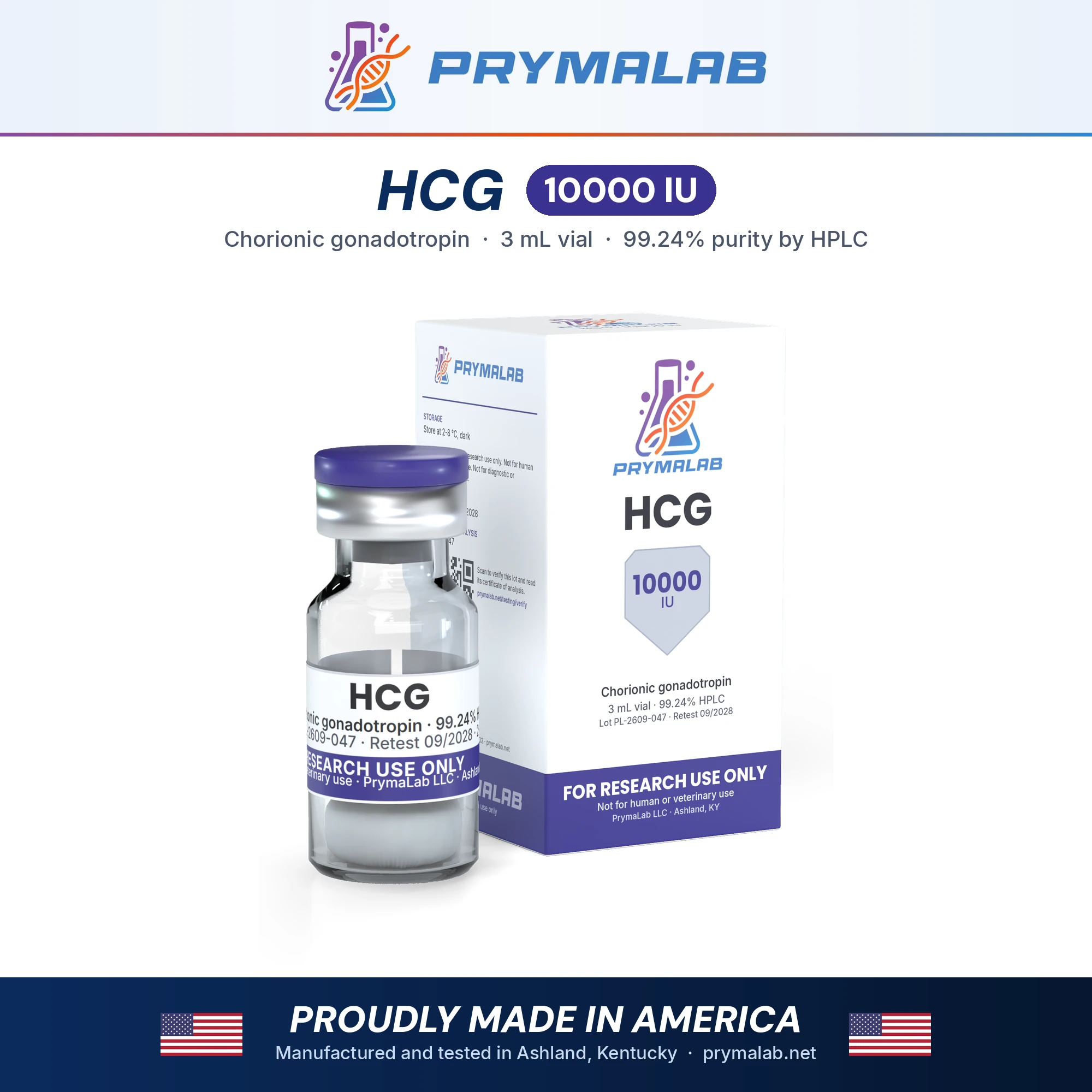
HCG 10000iu
Urinary human chorionic gonadotropin, 10,000 IU assigned by bioassay, freeze-dried
Human chorionic gonadotropin (hCG) is a glycoprotein hormone made by the placenta, built from an alpha and a beta subunit with 237 amino acids between them and about 30% of its mass as carbohydrate. This listing is the 10,000 IU vial of urinary hCG, supplied as a white freeze-dried cake; a 5,000 IU fill is also sold. Published work on hCG covers its subunit structure and glycosylation, the several forms it takes in pregnancy and in trophoblastic tumors, and the reference standards used to measure it.
Specifications
| Property | Value |
|---|---|
| Compound | HCG Human chorionic gonadotropin (urinary); potency assigned in IU by bioassay |
| CAS number | 9002-61-3 |
| Molecular formula | Not applicable (glycoprotein) |
| Theoretical mass | About 36–38 kDa glycoform average; 25.7 kDa protein core (about 30% carbohydrate) |
| Sequence / structure | Non-covalent heterodimer, 237 residues in total: common glycoprotein-hormone α-subunit (92 aa) paired with the hCG β-subunit (145 aa, including the 24-residue C-terminal peptide); 11 disulfides; N- and O-glycosylated. |
| Label claim | 10,000 IU/vial (≈ 1 mg glycoprotein, standardized by bioassay) |
| Form | Lyophilized (freeze-dried) powder or cake in a sealed glass vial with a rubber stopper and aluminium crimp cap |
| Storage, sealed | 2–8 °C, dark |
| Purity specification | 99.0% or higher by RP-HPLC |
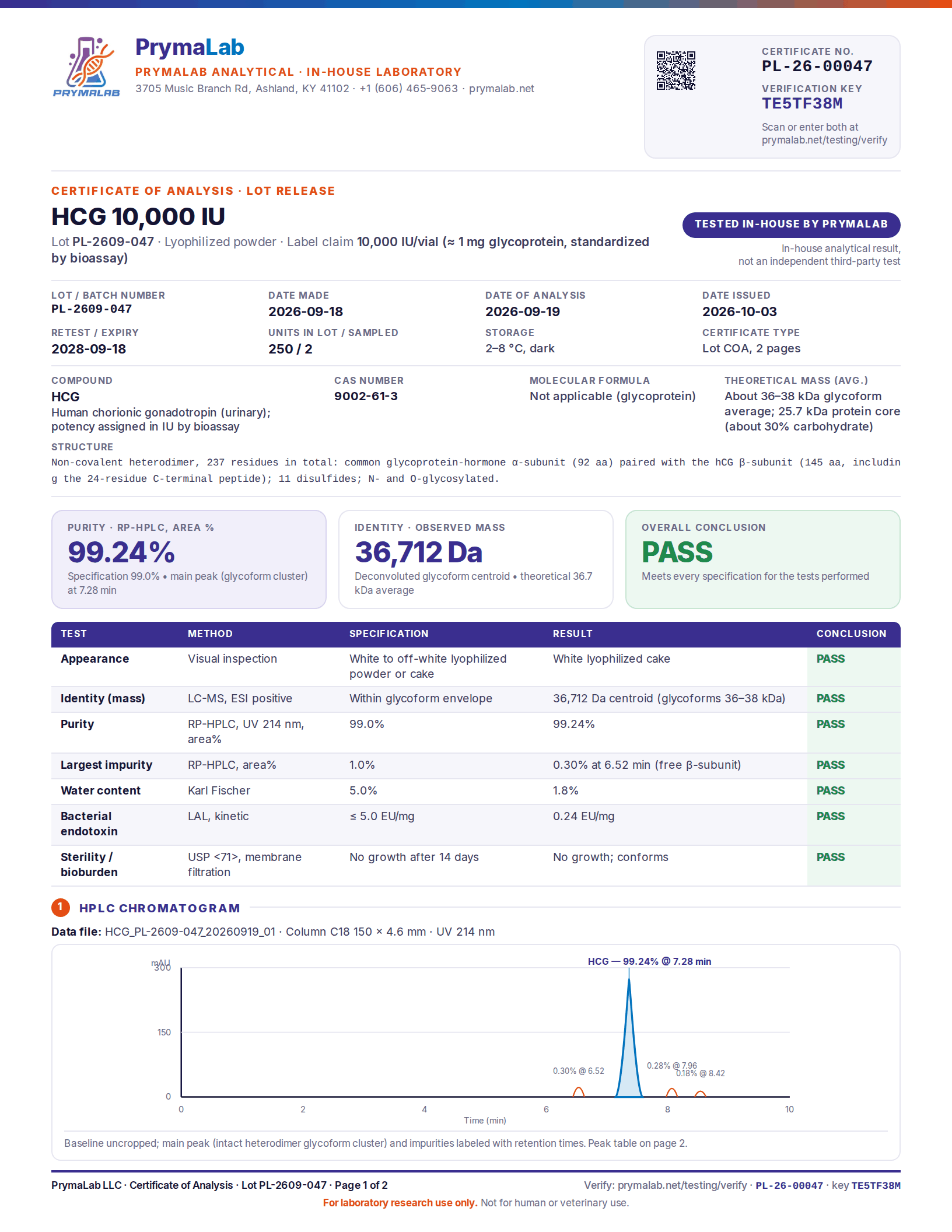
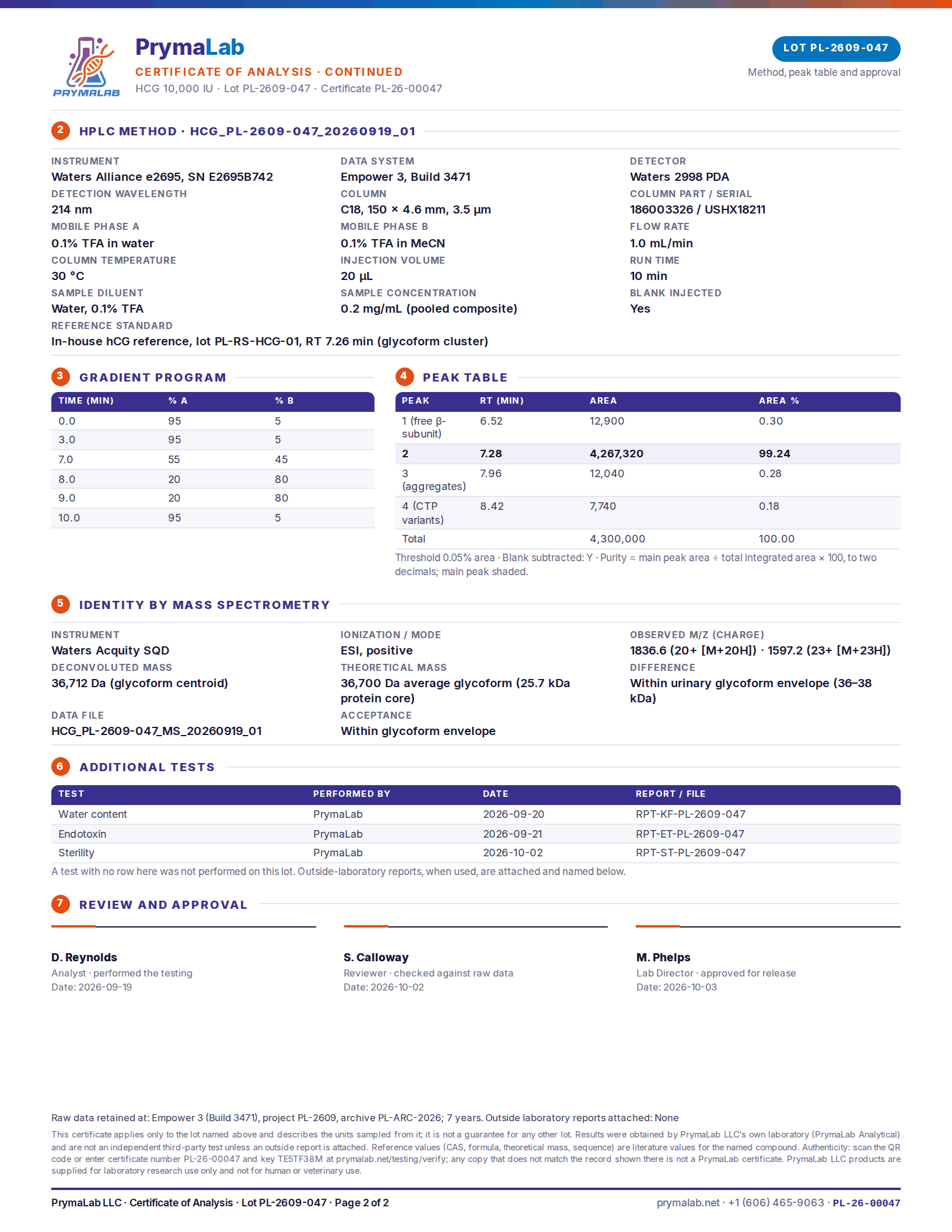
| Lot certificate | Results for the lot now shipping are in the certificate panel on this page |
| Safety data sheet | PL-SDS-077 |
Fills in this range
HCG is sold in 2 fills. The compound and the testing are the same in every fill; only the amount in the vial changes.
| Fill | Listing |
|---|---|
| 5000 IU | HCG 5000iu |
| 10000 IU | HCG 10000iu (this page) |
What 10,000 IU measures
An international unit is a measure of biological activity relative to a reference preparation, not a quantity of substance. The certificate puts this fill at roughly 1 mg of glycoprotein, standardized by bioassay, and the HCG 5,000 IU vial at roughly half that. Even the mass of one molecule is a spread rather than a single number: LC-MS gives a centroid of 36,712 Da across glycoforms of 36 to 38 kDa, built on a protein core of 25.7 kDa.
The loose link between units and weight comes from how units are assigned. When the WHO set up its International Standard for FSH, a closely related glycoprotein hormone, 27 laboratories in 13 countries assayed it by several methods1. The in vivo bioassays agreed within and between laboratories at about 80 IU per ampoule, in vitro bioassays and receptor assays agreed at about 31, and 19 immunoassay systems returned anything from 5 to 311. The unitage was set from the in vivo bioassay, the method judged to identify and define the hormone best1.
Handling notes
Most short synthetic peptides in the catalogue are kept at −20 °C. hCG is a protein, and the certificate gives 2 to 8 °C, in the dark, for the sealed vial. Let the vial reach room temperature before opening so that moisture does not condense on the cake. A solution is kept at 2 to 8 °C, protected from light, for a period your laboratory has established.
The safety data sheet classifies hCG as a reproductive toxicant in category 1A (H360Fd) and as causing organ damage through prolonged or repeated exposure (H372). It is stored locked up and handled with the precautions the sheet sets out. General guidance on keeping proteins and peptides is in peptide storage and stability.
What the research covers
Two subunits and their sugars
hCG is one of the glycoprotein hormones. Its alpha subunit is identical to the alpha subunit of the pituitary hormones LH, FSH and TSH, carries two N-glycosylation sites and is encoded by a single gene, CGA2. Beta subunits differ from one hormone to the next and give each its receptor and biological specificity; the hCG beta subunit has two N-glycosylation and four O-glycosylation sites and is encoded by a cluster of genes, CGB2. The two subunits are joined non-covalently3. The certificate puts numbers on the same molecule: a 92-residue alpha chain, a 145-residue beta chain that ends in a 24-residue C-terminal peptide, and 11 disulfide bonds.
One name for several forms
In structure hCG resembles LH, but Cole’s 2009 review described it as a set of hormonal and non-endocrine agents where LH is a single molecule: regular hCG, hyperglycosylated hCG and the free beta-subunit of the hyperglycosylated form3. Regular hCG had been known for 88 years as a promoter of progesterone production by the corpus luteum, a function that accounts for only about three weeks of its output across a pregnancy3. Cole summarized later work giving it roles in trophoblast differentiation and in fetal nutrition, through angiogenesis of the spiral arteries in the myometrium3. The two main forms come from different cells. Fused villous syncytiotrophoblast makes regular hCG, while invasive extravillous cytotrophoblast makes the hyperglycosylated variant, which acts back on those same cells to start and control invasion at implantation and, in invasive hydatidiform mole and choriocarcinoma, malignant growth3. In those cells it also inhibits apoptosis3.
Fournier and colleagues approached the hormone from the placental side. They called hCG the first hormonal message from the placenta to the mother, detectable in maternal blood two days after implantation, acting like an LH agonist on the corpus luteum and also involved in quiescence of the myometrium and local immune tolerance2. Levels in maternal blood peak at around 8 to 10 weeks of gestation, and the glycosylation of the hormone shifts with the stage of pregnancy, the cell producing it and disease2.
Reference materials for measurement
With so many related forms in circulation, measuring hCG consistently has needed purpose-made standards. Birken and colleagues reported in 2003 that the standards then used for hCG and its alpha and beta subunits contained substantial amounts of contaminating variants and other impurities4. For an IFCC working group they prepared new reagents for intact hCG, the free subunits, nicked hCG and nicked beta subunit (with cuts in the beta backbone between residues 44 and 45 or 47 and 48), and the beta-core fragment, in which residues 6 to 40 and 55 to 92 of the beta chain are held together by disulfide bridges4. Each preparation was characterized by amino acid and sequence analysis, carbohydrate composition and electrophoresis, and its concentration was set by amino acid analysis4.
What these papers do not show
The literature cited here is about hCG as the body makes it and about how laboratories standardize its measurement. None of the abstracts compares a urinary preparation with the forms that circulate in pregnancy, and none of the work used PrymaLab material. The certificate gives purity and a centroid mass for the intact hormone; it does not resolve regular, hyperglycosylated, nicked or free-subunit forms, so their share in a given lot is not reported. The hCG guide covers more of the literature.
How each lot is tested
Every lot is tested in PrymaLab’s own laboratory in Ashland, Kentucky before release: RP-HPLC for purity, LC-MS for identity, Karl Fischer titration for water, LAL for endotoxin and USP <71> for sterility. The results for the lot now shipping are in the certificate panel on this page, and the certificate number, key and QR code can be checked on the verify page. These are in-house results from PrymaLab Analytical, not an independent test, and the lab is not accredited to ISO 17025. The third-party testing guarantee on this page still applies: if any independent laboratory finds the wrong compound, or less than the stated purity or amount, the order is refunded and the cost of the test is reimbursed.
Frequently asked questions
Why is hCG sold in IU rather than milligrams?
Because its potency is defined by biological activity measured against a reference preparation. The certificate gives this 10,000 IU fill as roughly 1 mg of glycoprotein, but the conversion is approximate: the unit is fixed by bioassay, and different assay methods can give quite different figures for the same material.
How do the 10,000 IU and 5,000 IU vials differ?
Only in the amount of hormone. Both contain the same urinary hCG as a freeze-dried cake, with the label claim standardized by bioassay. Each fill is made and tested as its own lot, so each carries its own lot number and certificate.
How do I check the certificate for the vial I received?
Find the lot number printed on the vial and match it to a certificate. The panel on this page shows the lot currently shipping, earlier lots are listed on the testing results page, and the verify page confirms any certificate from its number and key.
What does the research on hCG actually cover?
Mostly the biology of pregnancy and the chemistry of the hormone: its subunits and glycosylation, the regular and hyperglycosylated forms and the cells that make each, and the reference reagents used to standardize hCG measurements. None of the papers cited reports work with this product.
Can this product be used in people or animals?
No. This vial is a research material and is not approved for human or veterinary use by the FDA or any other regulator. It must not be given to people or animals, and nothing on this page describes a clinical use.
References
- Storring PL, Gaines Das RE. The International Standard for Pituitary FSH: collaborative study of the Standard and of four other purified human FSH preparations of differing molecular composition by bioassays, receptor assays and different immunoassay systems. J Endocrinol. 1989;123(2):275-93. DOI · PubMed
- Fournier T, Guibourdenche J, Evain-Brion D. Review: hCGs: different sources of production, different glycoforms and functions. Placenta. 2015;36 Suppl 1:S60-5. DOI · PubMed
- Cole LA. New discoveries on the biology and detection of human chorionic gonadotropin. Reprod Biol Endocrinol. 2009;7:8. DOI · PubMed
- Birken S, Berger P, Bidart JM, et al. Preparation and characterization of new WHO reference reagents for human chorionic gonadotropin and metabolites. Clin Chem. 2003;49(1):144-54. DOI · PubMed
Research use only
For laboratory research use only. HCG 10000iu is not a drug, food, cosmetic or dietary supplement, is not approved by the FDA or any comparable authority for human or veterinary use, and must not be given to people or animals. It is sold to qualified researchers and institutions, and the buyer is responsible for lawful handling and disposal.
Other formats of HCG
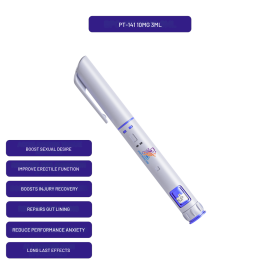
HCG is also stocked as hMG (Menotropins) 150IU preloaded 3ml pen and HMG 75IU. Each listing states its own quantity and concentration, and the pen and vial comparison explains what changes between formats.








Reviews
There are no reviews yet.