Description
PrymaLab · Research Use Only
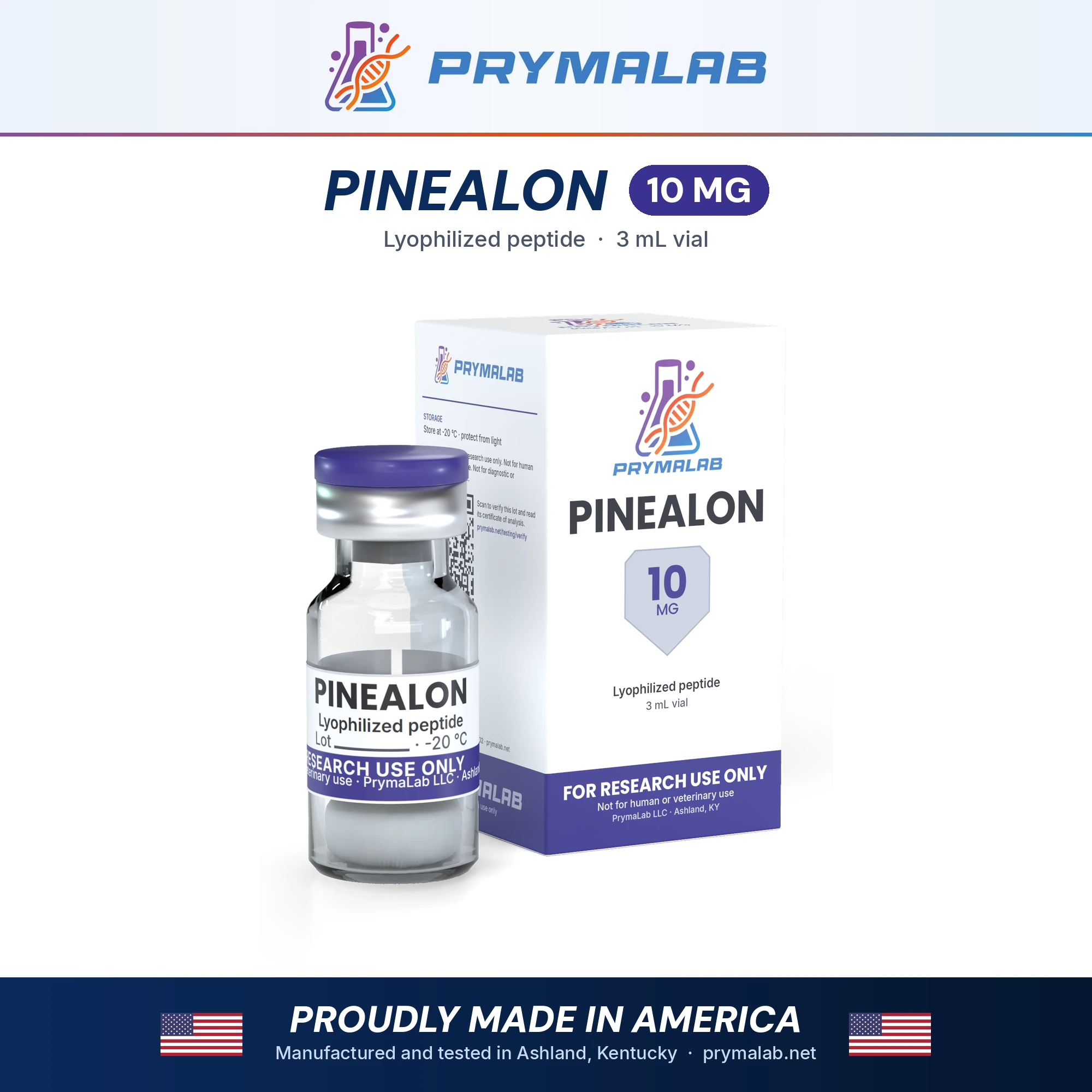
Pinealon 10mg
Glu-Asp-Arg tripeptide · 10mg lab research supply
Pinealon 10mg is the mid-size lyophilized vial of the tripeptide Glu-Asp-Arg. The chemistry is identical to the 5mg vial. What changes is the arithmetic, because doubling the mass in one container halves the number of weighing operations and therefore halves the accumulated weighing error across a study.
Specification Table
| Property | Value |
|---|---|
| Compound | Pinealon |
| Sequence designation | EDR |
| Amino acid sequence | Glutamate-Aspartate-Arginine |
| Sequence provenance | Secondary sources, converging. Not traced to a single primary citation. Confirm against the lot certificate before relying on it for calculation |
| Residue count | 3 |
| Molecular weight, calculated | 418.4 g/mol, computed from standard residue masses plus water rather than quoted from a paper |
| Vial mass, nominal | 10 mg lyophilized |
| Balance requirement | Four-place analytical balance minimum for subdivision |
| Truncation relationship | Identical to Cardiogen (Ala-Glu-Asp-Arg) minus alanine |
| Net charge at neutral pH | Near neutral, one basic and two acidic residues |
| Chromophore | None. Concentration cannot be determined by 280 nm absorbance |
| Oxidation-prone residues | None |
| Compound class | Short peptide bioregulator, cytogen subclass |
| Source tissue of the parent fraction | Pineal gland and central nervous tissue |
| Originating programme | St Petersburg Institute of Bioregulation and Gerontology |
| Proposed mechanism in the literature | Sequence-specific interaction with DNA, modulating tissue-associated gene expression |
| Mechanism status | Hypothesis. Not independently established outside the originating programme |
| Receptor | None identified |
| Appearance | White lyophilized powder |
| Purity | Per lot-specific certificate of analysis |
| Solubility | Water soluble |
| Storage, lyophilized | 2-8°C or -20°C, protected from light and moisture |
| Regulatory status | No approved human or veterinary formulation in any jurisdiction |
Why Does Vial Size Change the Error Budget?
Choosing between a 5mg and a 10mg vial looks like a purchasing decision. It is a measurement decision, and the arithmetic is worth setting out because almost nobody does it.
An analytical balance carries a fixed absolute uncertainty. On a four-place instrument in a room with ordinary air currents, roughly plus or minus 0.2 milligrams is realistic rather than the 0.1 quoted on the specification sheet.
That absolute figure does not shrink when the sample does, so weighing out 2 milligrams with a 0.2 milligram uncertainty carries ten percent error. Weighing 10 milligrams with the same instrument carries two percent.
The consequence for a study is that every subdivision step adds error, and a smaller vial forces more of them. A Pinealon 10mg vial dissolved once in a single container and then aliquoted by volume moves the measurement from the balance to the pipette, which is the more accurate of the two by a wide margin.
Volumetric transfer at microlitre scale on a calibrated pipette runs to roughly one percent. Gravimetric transfer of low-milligram powder does not come close.
The practical rule that falls out of this is to weigh once at the largest mass the experiment allows, dissolve to a known volume, then work volumetrically from that stock for everything downstream.
That rule is why the mid-size vial exists, and it is a better reason than cost per milligram.
Anyone running more than two or three experiments on this compound will subdivide either way. The only question is whether the subdivision happens on a balance or in a pipette.
What Should a Pinealon Certificate of Analysis Contain?
A certificate is only as useful as the fields it carries, and a surprising number of documents circulating in this market omit the field that matters most.
Measured mass by mass spectrometry, stated against roughly 418.4. That figure is calculated from standard residue masses plus water rather than quoted from a paper, and it should be reproduced by the instrument to within the method tolerance.
Purity by reversed-phase chromatography, with the gradient and detection wavelength stated. Since this compound has no chromophore, detection is at 214 nanometres on the amide bond rather than at 280, and a certificate quoting 280 nanometre detection has a problem worth asking about.
Sequence stated explicitly as Glu-Asp-Arg. Trade names carry no chemical information and four compounds in this family differ from each other by one residue.
Counterion identity with net peptide content as a percentage. This is the field most often missing, and its absence is the single largest source of concentration error in peptide work.
Water content by Karl Fischer where available. Lyophilized material is hygroscopic and residual water counts toward the mass on the balance while contributing nothing to the peptide.
A statement of the truncation check described below, or at minimum a chromatogram from which it can be read.
Absent all of that, what a buyer holds is a label rather than a certificate, and the distinction matters more at 10mg than at 5mg because the material is committed to more experiments.
What Truncation Check Applies to This Compound?
Mapping the sequences across this family surfaces a specific analytical hazard for Pinealon, and it is one a purity figure alone will not catch.
Cardiogen is Ala-Glu-Asp-Arg. Remove the alanine and Glu-Asp-Arg is what remains, which is exactly this compound.
Solid-phase synthesis builds a chain from the carboxy terminus backwards, so alanine is the last residue added to Cardiogen. A failed final coupling on a Cardiogen batch delivers Pinealon.
That direction is the benign one for a Pinealon buyer. The concerning direction is a supplier who runs both compounds on shared equipment, where carryover moves material the other way.
The masses differ by roughly 71 daltons, which is the residue mass of alanine. That gap is comfortably resolved by any mass spectrometer worth using, so the check is trivial once someone thinks to run it.
Chromatographically the two separate readily, since adding a hydrophobic alanine shifts retention. A well-run reversed-phase method will show them as distinct peaks.
The question to put to a supplier is therefore narrow and answerable. Does the chromatogram show anything at the Cardiogen retention time, and does the mass spectrum show a species near 489.5.
A Pinealon 10mg supplier who cannot answer that has not thought about their own product family, which tells a buyer something useful independent of this particular compound.
How Does the Arginine Change Handling?
One residue distinguishes this compound from a dipeptide, and that residue drives most of its physical behaviour.
Arginine carries a guanidinium group with a pKa near 12.5, which means it stays positively charged across every buffer condition a laboratory realistically uses.
Against two acidic residues that produces a near-neutral net charge at physiological pH, and near-neutral peptides are the ones most prone to adsorbing onto glass and polypropylene.
The consequence is that a dilute working solution can lose measurable material to the container wall before it reaches the assay. At low micromolar concentrations that loss is not a rounding error.
Low-binding consumables address this at modest cost. So does carrier protein in the diluent where the assay tolerates it, and so does preparing working dilutions immediately before use rather than the day before.
The guanidinium group also makes this compound more soluble than the purely acidic members of the family, which is a genuine convenience during reconstitution.
None of this applies to the lyophilized powder, which is stable and undemanding. The handling question arises only once the compound is in solution.
Log the lot, measured mass to two decimal places, counterion, net peptide content, diluent, volume, final concentration, container type and date. Adsorption losses are invisible unless the container is part of the record.
The Pinealon 10mg nasal spray removes the container question at the point of use, since the concentration is fixed at manufacture and the solution never passes through a second vessel.
How Does Pinealon 10mg Differ From the 5mg Vial?
Nothing chemically. Pinealon 10mg and the 5mg vial hold the same powder, and saying so plainly is more useful than manufacturing a difference that does not exist.
Same sequence, same calculated mass, same lyophilization, same storage requirement, same certificate fields. A buyer choosing between them is choosing quantity and nothing else.
Against Pinealon 10mg, the 5mg vial suits a single pilot experiment or a first characterisation run where the material may never be used again.
Pinealon 10mg suits a study with a defined arm structure, where one weighing operation followed by volumetric subdivision is both more accurate and less work than repeated small weighings.
The 20mg vial suits multi-month work where lot consistency across the whole study matters more than anything else, since a single lot removes an entire variable.
That is the honest account of where Pinealon 10mg sits in the range. Vial size is a logistics decision with a measurement consequence, not a quality difference.
Where a supplier implies otherwise, that implication is worth examining, because the powder in all three containers comes off the same synthesis.
What does differ between suppliers is the certificate, and that is where scrutiny belongs regardless of which vial size ends up on the bench.
What Research Endpoints Are on Record for Pinealon?
The published record for Pinealon is among the better-documented in this family, which is a low bar worth stating explicitly.
The originating programme published aged-rodent and cell-culture observations, assessed histologically and read out through markers of tissue-associated gene expression.
Family-wide cell-culture work reports chromatin decondensation, advanced in support of the DNA-binding hypothesis rather than of any neural claim specifically.
The mechanism remains a hypothesis. No receptor has been identified, no binding constant is on record, and no independent Western group has reproduced the central molecular claim.
Parenteral rodent figures occupy the microgram per kilogram band. Alongside them sits a Russian clinical record built on short courses at tens to low hundreds of micrograms rather than open-ended exposure.
No well-powered independent Western clinical trial exists for this compound or for any other in the range.
Settled chemistry, a modest research record, an unresolved mechanism. Those three things are separate and a defensible statement about this compound keeps them separate.
That separation is also what makes the compound worth working on, since the open questions are answerable with ordinary equipment at low material cost.
Published Literature
References verified against the publisher record. This literature originates almost entirely from one research programme.
- Khavinson VK, Malinin VV. Gerontological Aspects of Genome Peptide Regulation. Karger, Basel; 2005.
- Khavinson VK. Neuroendocrinology Letters. 2002;23(Suppl 3):11-144.
- Anisimov VN, Khavinson VK. Critical Reviews in Oncology/Hematology. 2010;74(1):46-66.
- Fedoreyeva LI, Kireev II, Khavinson VK, Vanyushin BF. Biochemistry (Moscow). 2011;76(11):1210-1219.
- Khavinson VK, Solovyov AY, Zhilinsky DV, Shataeva LK, Bandaletova TY. Bulletin of Experimental Biology and Medicine. 2012;153(4):500-505.
Frequently Asked Questions
What is Pinealon 10mg?
Pinealon 10mg is the mid-size lyophilized vial of the tripeptide Glu-Asp-Arg, assigned to pineal gland and central nervous tissue in the Khavinson bioregulator range. Supplied for laboratory research only. No jurisdiction has approved it for any purpose.
How does it differ from the 5mg vial?
Only in quantity. Pinealon 10mg carries the same sequence, the same calculated mass near 418.4, same lyophilization, same storage requirement and same certificate fields. Vial size is a logistics decision rather than a quality difference.
Why does vial size affect accuracy?
Because balance uncertainty is absolute rather than proportional. Weighing 2 milligrams with a 0.2 milligram uncertainty carries ten percent error while weighing 10 milligrams with the same instrument carries two percent.
What is the practical rule?
Weigh once at the largest mass the experiment allows, dissolve to a known volume, then work volumetrically from that stock. Pipette transfer runs near one percent where low-milligram gravimetric transfer does not come close.
What should a certificate of analysis contain?
Measured mass against roughly 418.4, purity with gradient and detection wavelength stated, the explicit sequence Glu-Asp-Arg, counterion identity with net peptide content, and water content by Karl Fischer where available.
Why does detection wavelength matter here?
Because this compound has no chromophore. Detection runs at 214 nanometres on the amide bond, so a certificate quoting 280 nanometre detection has a problem worth asking about before the material is used.
Which field is most often missing?
Net peptide content with counterion identity. Its absence is the single largest source of concentration error in peptide work, and it matters more at 10mg because the material is committed to more experiments.
What truncation check applies?
Cardiogen is Ala-Glu-Asp-Arg, so removing its alanine gives this compound. Since synthesis builds backwards from the carboxy terminus, a failed final coupling on a Cardiogen batch delivers Pinealon.
How is that checked?
The masses differ by roughly 71 daltons, the residue mass of alanine, which any mass spectrometer resolves easily. Ask whether the chromatogram shows anything near the Cardiogen retention time or a species near 489.5.
How does the arginine affect handling?
Its guanidinium group stays charged across all realistic buffer conditions, giving a near-neutral net charge against two acidic residues. Near-neutral peptides are the ones that adsorb to glass and to polypropylene, which is why low-binding consumables are worth their modest extra cost on this compound.
Does adsorption affect the powder?
No. Lyophilized material is stable and undemanding at 2 to 8 degrees Celsius or below. The handling question arises only in solution, and only at the dilute concentrations typical of working stocks.
Compliance Statement
Pinealon is sold exclusively for laboratory research use. It is not a drug, food, or cosmetic product, and it is not a dietary product of any kind. It is not approved by the FDA or any comparable authority for human or veterinary use, its proposed mechanism has not been independently established, and amounts cited are figures from published studies in the species those studies used. This product is not intended to diagnose, treat, cure, or prevent any disease. It must not be given to humans or animals. Purchase is restricted to qualified researchers and institutions operating within applicable laws. All handling is the responsibility of the purchasing laboratory.
Other formats of Pinealon
Pinealon is also stocked as Pinealon 6mg preloaded 3ml pen, Pinealon 5mg and Pinealon 20mg. Each listing states its own quantity and concentration, and the pen and vial comparison explains what changes between formats.









18 reviews for Pinealon 10mg