Description
PrymaLab · Research use only
Ovagen Peptide 20mg
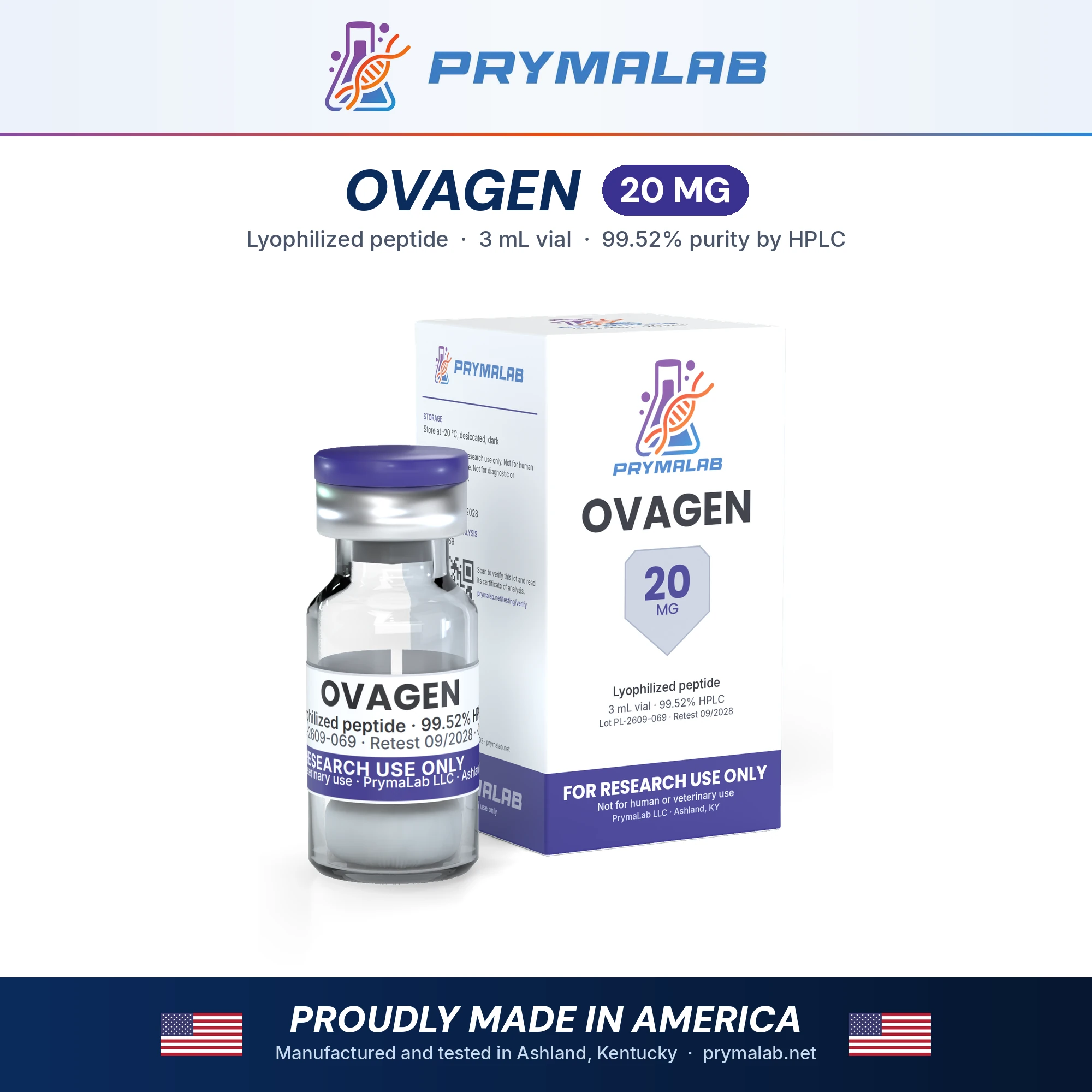
Glu-Asp-Leu (EDL), the Khavinson tripeptide, freeze-dried in a 20 mg vial
Ovagen is the synthetic tripeptide Glu-Asp-Leu (EDL), one of the short peptides from Vladimir Khavinson’s bioregulator programme in St Petersburg, where it is also coded T-35. This listing is a 20 mg vial of freeze-dried Ovagen with free N- and C-termini and a theoretical mass of 375.4 Da. The published work on EDL is small and comes almost entirely from that one group: culture studies of kidney cells, plus a broader body of papers proposing that short peptides act on DNA and gene expression.
Specifications
| Property | Value |
|---|---|
| Compound | Ovagen Glu-Asp-Leu (EDL); Khavinson peptide bioregulator |
| CAS number | Not assigned |
| Molecular formula | C15H25N3O8 |
| Theoretical mass | 375.4 Da |
| Sequence / structure | H-EDL-OH (3 residues; free N- and C-termini) |
| Label claim | 20 mg/vial |
| Form | Lyophilized (freeze-dried) powder or cake in a sealed glass vial with a rubber stopper and aluminium crimp cap |
| Storage, sealed | −20 °C, desiccated, dark |
| Purity specification | 99.0% or higher by RP-HPLC |
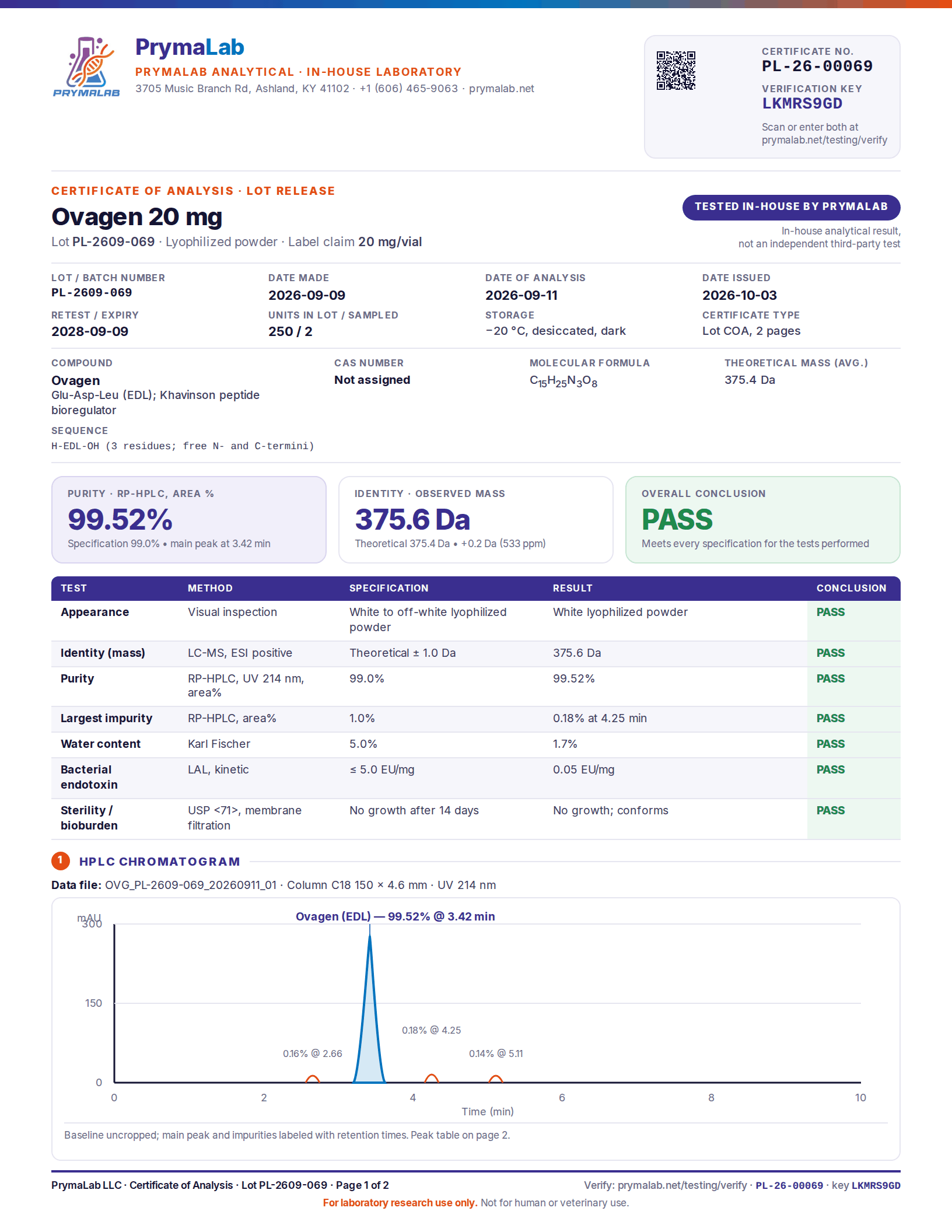
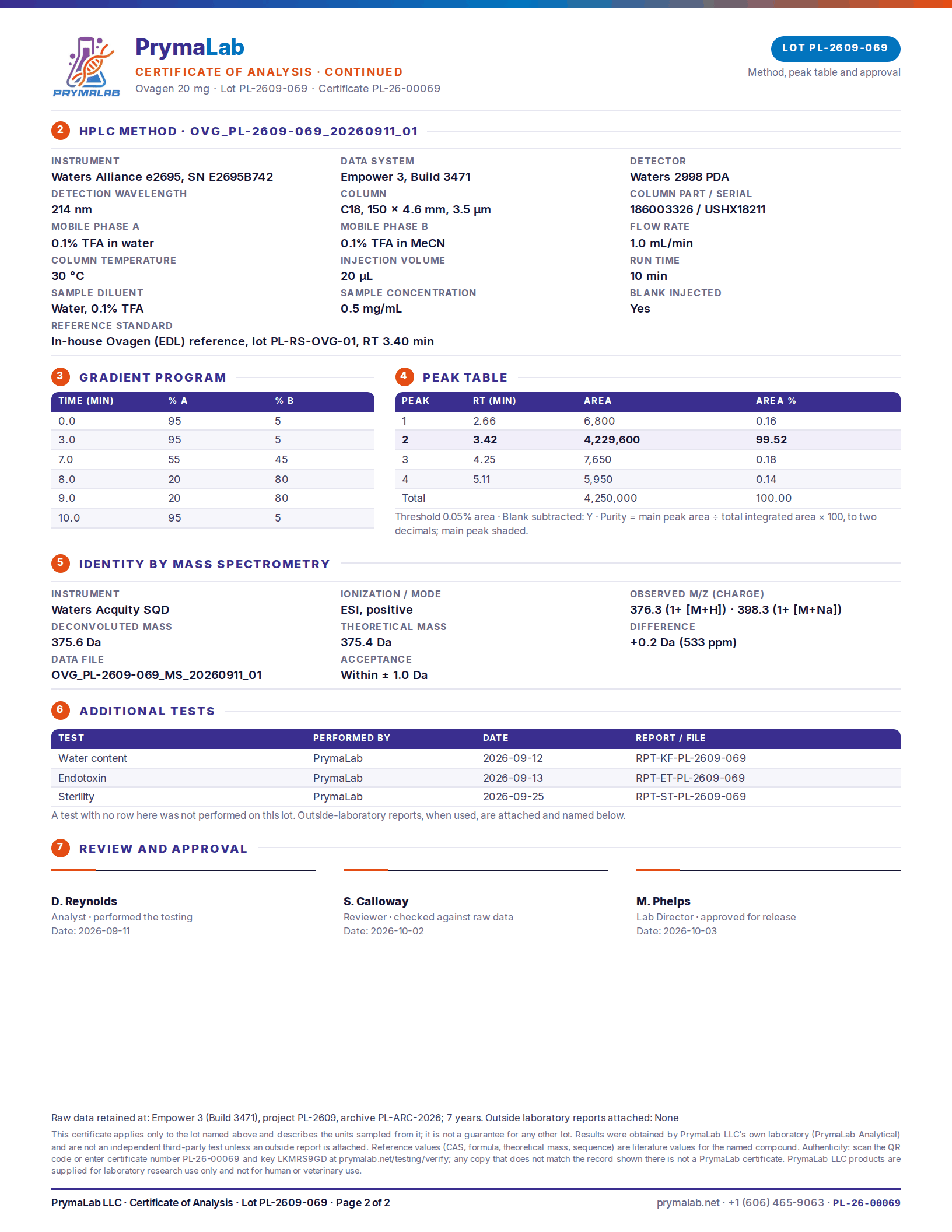
| Lot certificate | Results for the lot now shipping are in the certificate panel on this page |
| Safety data sheet | PL-SDS-118 |
Ovagen, EDL and the other Ovagen
The vial holds H-EDL-OH: glutamic acid, aspartic acid and leucine with free ends, formula C15H25N3O8. Its theoretical mass of 375.4 Da is the figure to compare with the LC-MS identity result on the lot certificate. In molar terms 20 mg is about 53 µmol, a little less in practice because the powder also holds the residual water the certificate reports. The chain is bronchogen without its first residue, since Fedoreyeva and colleagues give bronchogen as Ala-Glu-Asp-Leu1.
The name causes trouble in literature searches. In the late 1980s Ovagen was also the trade name of a preparation from Immuno-Chemical Products in Auckland, used for superovulation in goats and compared with Folltropin in a 1989 study2. That product has nothing to do with the tripeptide, so any paper found under the name needs checking for which Ovagen it means.
Counterion and cell-culture work
The lot certificate reports purity, identity, water, endotoxin and sterility. It does not state a salt form, and that matters more than usual here because every published EDL experiment is a cell or tissue culture. Peptides purified by reversed-phase HPLC are often recovered as trifluoroacetate salts, and Cornish and colleagues found that trifluoroacetate at 10-8 to 10-7 M reduced cell numbers and thymidine incorporation in fetal rat osteoblast cultures, with similar effects in chondrocytes and mouse calvariae3. Comparing salts of the same peptides, they saw the trifluoroacetate forms mask a proliferative effect or produce a false antiproliferative one, and they advised converting peptides used above 10-9 M to a hydrochloride or equivalent salt before testing3. Laboratories running EDL in culture may want to confirm or exchange the counterion before attributing an effect to the peptide.
What the research covers
What Ovagen is
Ovagen belongs to a set of short synthetic peptides developed by Khavinson’s group. In a 2010 review, Anisimov and Khavinson described how the group isolated small peptides from different organs and tissues and then synthesised di-, tri- and tetrapeptide analogues from amino acids4. In the group’s culture papers the tripeptide Glu-Asp-Leu carries the code T-355. The proposed mechanism is the one the group applies to all of its short peptides: chains of two to seven residues enter the nucleus and nucleolus, interact with histones and DNA, and change gene expression and DNA methylation6. Direct evidence for nuclear entry comes from Fedoreyeva and colleagues, who saw fluorescently labelled short peptides in the cytoplasm, nucleus and nucleolus of HeLa cells and found that different peptides quenched labelled DNA fragments to different degrees1. EDL is not named among the peptides in that abstract.
Kidney cell and tissue cultures
The studies that test EDL directly used kidney material. Khavinson, Lin’kova and colleagues followed primary kidney cell cultures as they aged in vitro and compared a polypeptide complex isolated from calf kidney with two synthetic tripeptides, T-31 (AED) and T-35 (EDL)7. They measured markers of cell renewal (Ki-67 and p53), of extracellular matrix remodelling (the gelatinase MMP-14) and of immune response (IL-8). The kidney complex and T-31 activated cell renewal, while the abstract names MMP-14 as the target of T-357.
A year later Chalisova and colleagues worked with organotypic kidney tissue cultures from young and old rats5. Both short peptides stimulated proliferation and reduced apoptosis of the kidney cells, though less than the calf kidney complex did, and the authors framed the results as a basis for further work on the complex rather than on the tripeptides5. Both papers appeared in Bulletin of Experimental Biology and Medicine, the English edition of a Russian journal, and both abstracts report the direction of each effect without effect sizes.
What is not established
Ovagen is widely sold as a liver peptide, yet none of the abstracts behind this page measured liver cells, liver tissue or liver function. The Livagen guide’s comparison with Ovagen looks at where that label comes from. These references contain no study in living animals and no human data, and every EDL paper cited here shares authors with Khavinson’s group. The 2021 review describes short peptides as a class6; it does not show that EDL binds any particular gene or promoter.
The Ovagen Peptide Guide covers the literature in more depth.
How each lot is tested
Every lot is tested in PrymaLab’s own laboratory in Ashland, Kentucky before release: RP-HPLC for purity, LC-MS for identity, Karl Fischer titration for water, LAL for endotoxin and USP <71> for sterility. The results for the lot now shipping are in the certificate panel on this page, and the certificate number, key and QR code can be checked on the verify page. These are in-house results from PrymaLab Analytical, not an independent test, and the lab is not accredited to ISO 17025. The third-party testing guarantee on this page still applies: if any independent laboratory finds the wrong compound, or less than the stated purity or amount, the order is refunded and the cost of the test is reimbursed.
Frequently asked questions
Is this Ovagen the same as the Ovagen in goat reproduction studies?
No. Those studies used a veterinary preparation sold under the same name in New Zealand in the late 1980s. This vial holds the synthetic tripeptide Glu-Asp-Leu from the Khavinson series, which shares nothing with that product except the name.
How much Ovagen is in the vial in molar terms?
About 53 µmol, from 20 mg divided by the theoretical mass of 375.4 Da. The true figure is slightly lower, because the powder also contains the residual water reported on the certificate and whatever counterion is present.
How do I check the certificate for the vial I received?
Read the lot number printed on the vial and match it to a certificate. The certificate panel on this page covers the lot now shipping, earlier lots are listed on the testing results page, and the verify page checks a certificate from its number and key.
How should the vial be stored?
Sealed, at −20 °C, dry and protected from light. Allow the vial to come to room temperature before opening so moisture does not condense on the powder. A reconstituted solution belongs at 2 to 8 °C, away from light, for no longer than your laboratory's own established period.
What does the research on EDL actually show?
A few cell and tissue-culture studies from Khavinson's group, all on kidney cells, report changes in proliferation, apoptosis and MMP-14. None of the references here studied liver tissue, animals or people, and every paper shares authors with that one group.
Can Ovagen be used in people or animals?
No. It is a research chemical sold for laboratory use only. It is not approved by the FDA or any other regulator for human or veterinary use and must not be given to people or animals.
References
- Fedoreyeva LI, Kireev II, Khavinson VKh, et al. Penetration of short fluorescence-labeled peptides into the nucleus in HeLa cells and in vitro specific interaction of the peptides with deoxyribooligonucleotides and DNA. Biochemistry (Mosc). 2011;76(11):1210-9. DOI · PubMed
- McNatty KP, Hudson NL, Ball K, et al. Superovulation and embryo recovery in goats treated with Ovagen and Folltropin. N Z Vet J. 1989;37(1):27-9. DOI · PubMed
- Cornish J, Callon KE, Lin CQ, et al. Trifluoroacetate, a contaminant in purified proteins, inhibits proliferation of osteoblasts and chondrocytes. Am J Physiol. 1999;277(5):E779-83. DOI · PubMed
- Anisimov VN, Khavinson VKh. Peptide bioregulation of aging: results and prospects. Biogerontology. 2010;11(2):139-49. DOI · PubMed
- Chalisova NI, Lin'kova NS, Nichik TE, et al. Peptide Regulation of Cells Renewal Processes in Kidney Tissue Cultures from Young and Old Animals. Bull Exp Biol Med. 2015;159(1):124-7. DOI · PubMed
- Khavinson VK, Popovich IG, Linkova NS, et al. Peptide Regulation of Gene Expression: A Systematic Review. Molecules. 2021;26(22). DOI · PubMed
- Khavinson VKh, Lin'kova NS, Polyakova VO, et al. Peptides regulate expression of signaling molecules in kidney cell cultures during in vitro aging. Bull Exp Biol Med. 2014;157(2):261-4. DOI · PubMed
Research use only
For laboratory research use only. Ovagen Peptide 20mg is not a drug, food, cosmetic or dietary supplement, is not approved by the FDA or any comparable authority for human or veterinary use, and must not be given to people or animals. It is sold to qualified researchers and institutions, and the buyer is responsible for lawful handling and disposal.
Other formats of Ovagen
Ovagen is also stocked as Ovagen 20mg Nasal Spray and Ovagen 6mg preloaded 3ml pen. Each listing states its own quantity and concentration, and the pen and vial comparison explains what changes between formats.







1 review for Ovagen Peptide 20mg