
Description
PrymaLab · Research use only
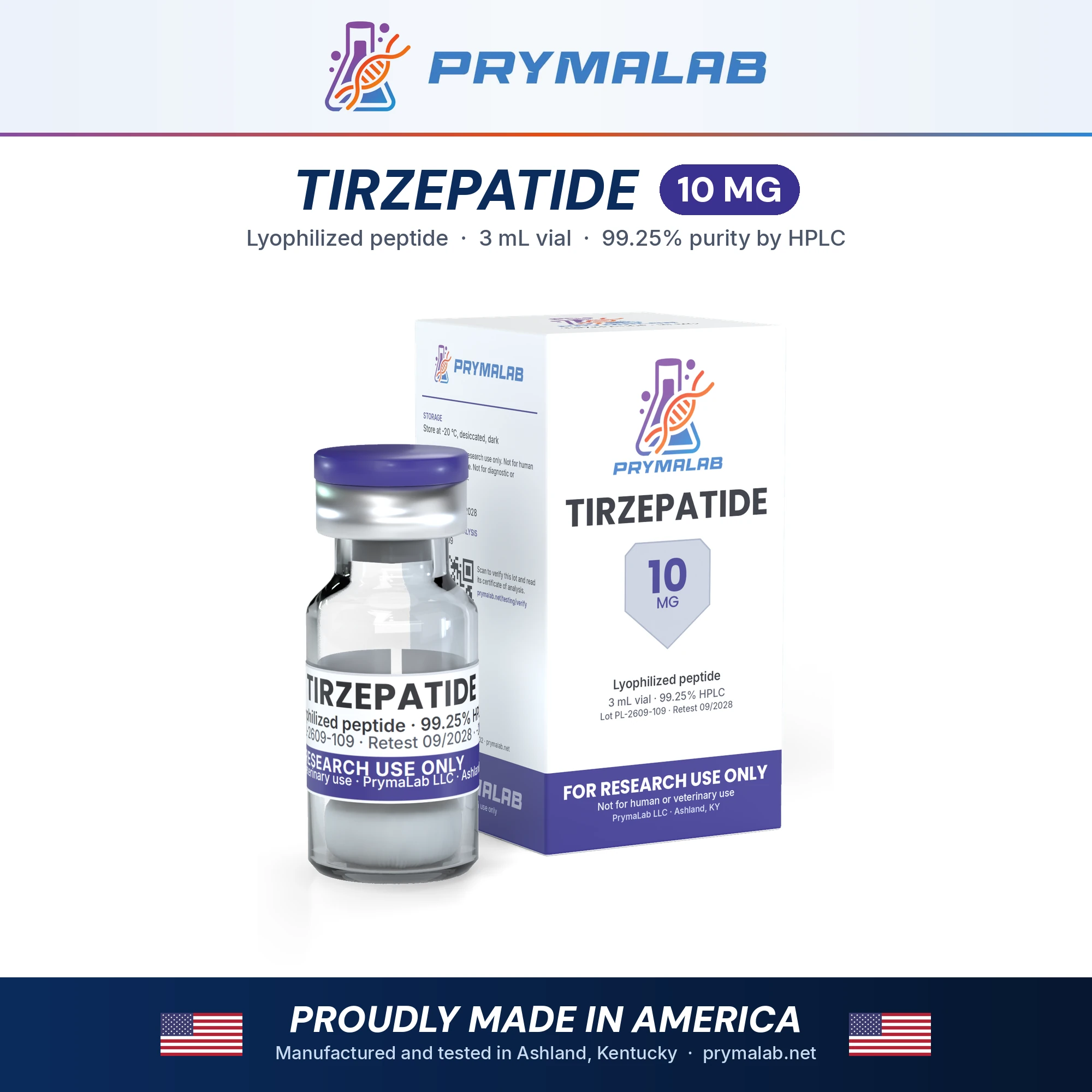
Tirzepatide 10mg
Dual GIP and GLP-1 receptor agonist, 39 residues, 10 mg of freeze-dried powder
Tirzepatide, development code LY3298176, is a synthetic 39-residue peptide that activates two incretin receptors, the GIP receptor and the GLP-1 receptor, and carries a C20 fatty diacid on lysine 20. This listing is the 10 mg vial of white freeze-dried powder and the main page for a range of ten fills, from 5 mg to 100 mg. The literature on it covers how unequally it engages the two receptors, the structural reasons for that, and phase 3 trials in type 2 diabetes.
Specifications
| Property | Value |
|---|---|
| Compound | Tirzepatide LY3298176; GIP/GLP-1 receptor dual agonist |
| CAS number | 2023788-19-2 |
| Molecular formula | C225H348N48O68 |
| Theoretical mass | 4813.5 Da |
| Sequence / structure | H-Y-Aib-EGTFTSDYSI-Aib-LDKIAQK(2×AEEA-γGlu-C20 diacid)AFVQWLIAGGPSSGAPPPS-NH₂ (39 residues; Aib2 and Aib13; Lys20 acylated with eicosanedioic acid via γ-Glu and two AEEA spacers; C-terminal amide) |
| Label claim | 10 mg/vial |
| Form | Lyophilized (freeze-dried) powder or cake in a sealed glass vial with a rubber stopper and aluminium crimp cap |
| Storage, sealed | −20 °C, desiccated, dark |
| Purity specification | 99.0% or higher by RP-HPLC |
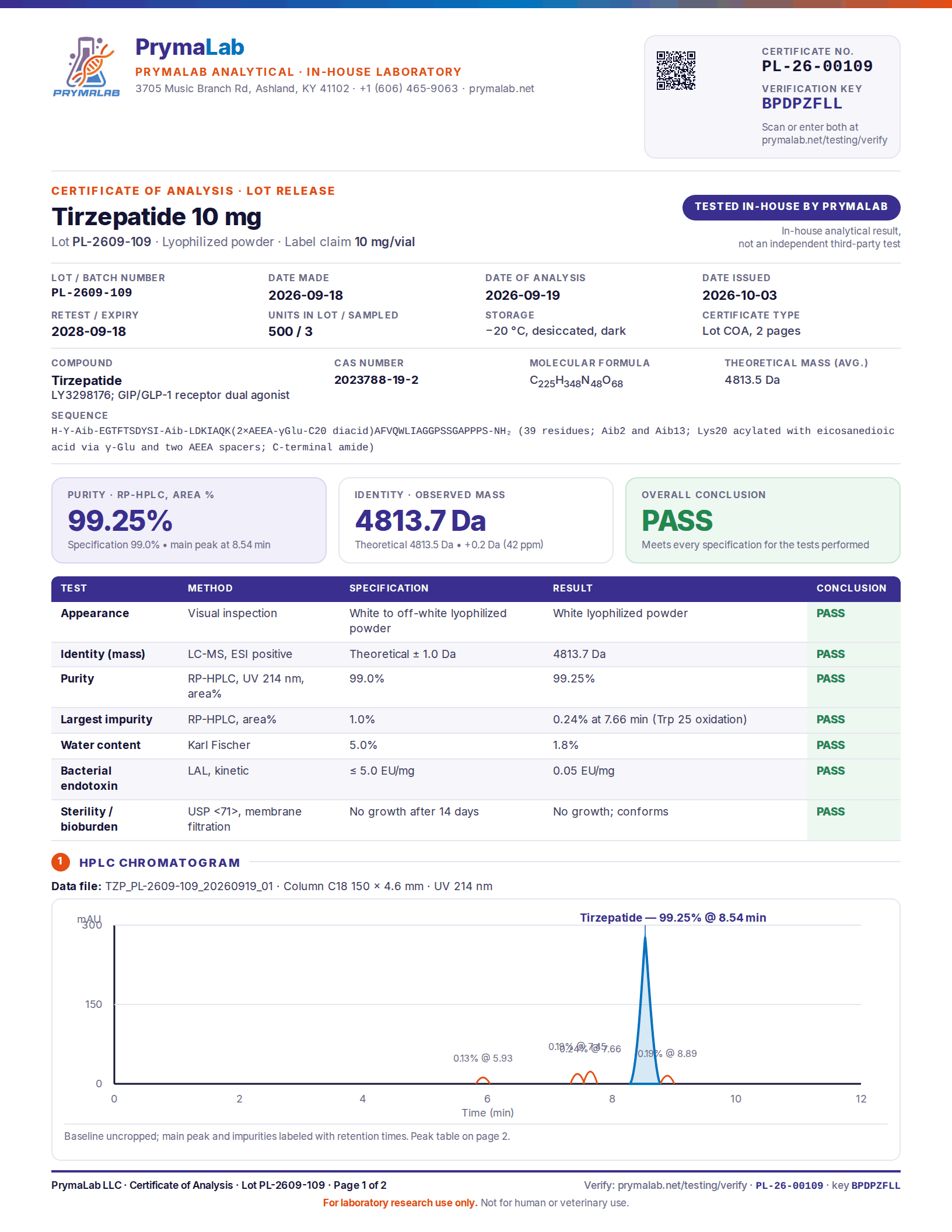
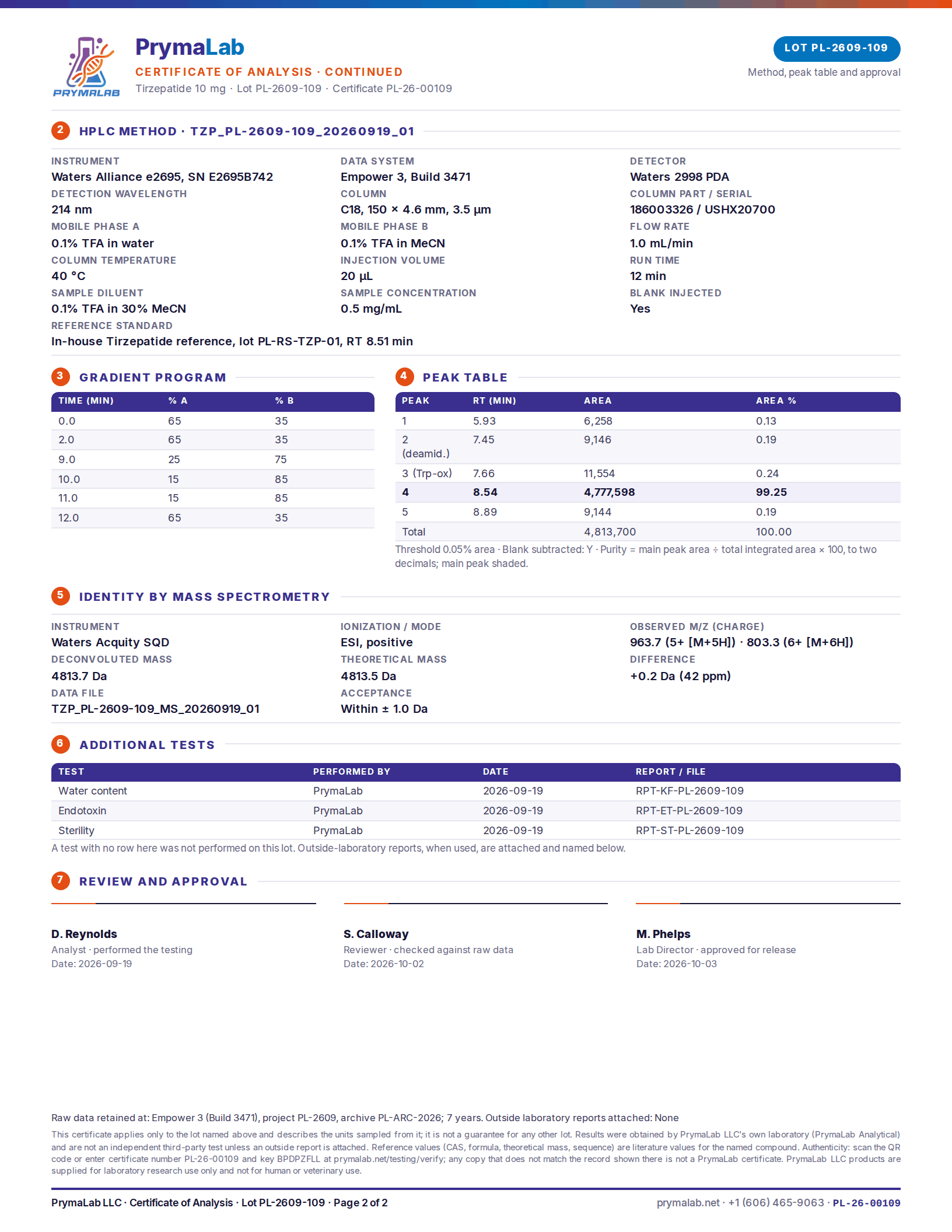
| Lot certificate | Results for the lot now shipping are in the certificate panel on this page |
| Safety data sheet | PL-SDS-173 |
Fills in this range
Tirzepatide is sold in 10 fills. The compound and the testing are the same in every fill; only the amount in the vial changes.
| Fill | Listing |
|---|---|
| 5 mg | Tirzepatide 5mg |
| 10 mg | Tirzepatide 10mg (this page) |
| 15 mg | Tirzepatide 15mg |
| 20 mg | Tirzepatide 20mg |
| 30 mg | Tirzepatide 30mg |
| 40 mg | Tirzepatide 40mg |
| 50 mg | Tirzepatide 50mg |
| 60 mg | Tirzepatide 60mg |
| 80 mg | Tirzepatide 80mg |
| 100 mg | Tirzepatide 100mg |
What the certificate says about the molecule
The lot certificate gives the structure in full. The chain has 39 residues, two of them aminoisobutyric acid (Aib) at positions 2 and 13. Lysine 20 carries eicosanedioic acid, a 20-carbon diacid, joined through a γ-glutamic acid and two AEEA spacers, and the C-terminus is an amide. That adds up to C225H348N48O68 and a theoretical mass of 4813.5 Da, the figure to set beside the LC-MS identity result in the certificate panel; a chain missing the side chain or a residue would read lighter. By the same mass, 10 mg is about 2.08 µmol, slightly less once the residual water reported on the certificate is allowed for.
Handling notes
The safety data sheet for tirzepatide powder, PL-SDS-173, classifies the peptide as Carc. 2 (H351, suspected of causing cancer) and Repr. 2 (H361, suspected of damaging fertility or the unborn child), and asks for it to be stored locked up. Keep the sealed vial at −20 °C, dry and dark, and let it reach room temperature before opening so that moisture does not condense on the powder. A reconstituted solution belongs at 2 to 8 °C, protected from light, for no longer than the period your laboratory has established. More general advice is in peptide storage and stability.
What the research covers
Two receptors, engaged unequally
Tirzepatide is an agonist at the glucose-dependent insulinotropic polypeptide receptor (GIPR) and the glucagon-like peptide-1 receptor (GLP-1R), the two incretin receptors involved in regulating carbohydrate metabolism1. When Willard and colleagues described its pharmacology in 2020, it was in development for type 2 diabetes, obesity and nonalcoholic steatohepatitis2. Their paper set out a method for calculating how much of each receptor the drug occupies at clinically effective exposure, and the result was greater engagement of the GIP receptor than of the GLP-1 receptor2. The authors called this an imbalanced mechanism2. The label “dual agonist” names the two receptors, then, but says nothing about the proportion.
Biased signalling at the GLP-1 receptor
In Willard’s signalling studies, tirzepatide reproduced the actions of native GIP at the GIP receptor, but at the GLP-1 receptor it favoured cAMP generation over β-arrestin recruitment and was weaker than GLP-1 at driving the receptor’s internalisation2. Experiments in primary islets added a functional result: β-arrestin1 limited the insulin response to GLP-1 but not the response to GIP or tirzepatide, which the authors read as a sign that the bias increases insulin secretion2.
Sun and colleagues approached the same contrast through structure. Using cryogenic electron microscopy and molecular dynamics simulations, they found that tirzepatide closely resembles native GIP in how it activates the GIP receptor, while its activation of the GLP-1 receptor differs markedly from GLP-1’s and produces less agonist-induced desensitisation1. The study showed how far the fatty acid modification, together with the amino acid sequence, determines the mode of action of a multireceptor agonist1. On this vial’s certificate, that modification is the C20 diacid attached to lysine 20.
Phase 3 trial data
The human evidence cited on this page is a single trial, SURPASS-2, published by Frías and colleagues in 20213. This open-label, 40-week phase 3 study randomised 1,879 people with type 2 diabetes in equal numbers to one of three tirzepatide arms or to semaglutide, a selective GLP-1 receptor agonist3. Mean glycated haemoglobin (HbA1c) at baseline was 8.28%3. The primary endpoint was the change in HbA1c from baseline to week 403. HbA1c fell by an estimated 2.01 to 2.30 percentage points across the tirzepatide arms and by 1.86 points with semaglutide, and each tirzepatide arm was noninferior and superior to the comparator on that endpoint3. The trial used clinical drug supply under medical supervision, and its results are not a property of research material.
What is not established
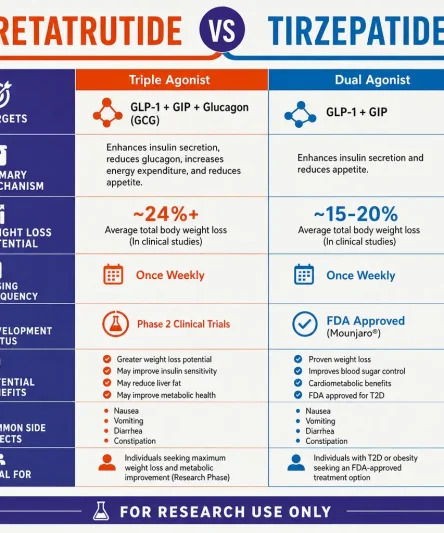
The occupancy figures in Willard’s paper are calculations from pharmacological data, not measurements in people, and the authors offered the GIP-leaning imbalance and the GLP-1 receptor bias as a possible explanation of the clinical profile rather than a demonstrated one2. These papers do not settle how much each receptor contributes to what the trials measured; that question is discussed in the retatrutide vs tirzepatide article. SURPASS-2 was open label, compared tirzepatide with one drug and enrolled only people with type 2 diabetes3. No study cited here used PrymaLab material.
How each lot is tested
Every lot is tested in PrymaLab’s own laboratory in Ashland, Kentucky before release: RP-HPLC for purity, LC-MS for identity, Karl Fischer titration for water, LAL for endotoxin and USP <71> for sterility. The results for the lot now shipping are in the certificate panel on this page, and the certificate number, key and QR code can be checked on the verify page. These are in-house results from PrymaLab Analytical, not an independent test, and the lab is not accredited to ISO 17025. The third-party testing guarantee on this page still applies: if any independent laboratory finds the wrong compound, or less than the stated purity or amount, the order is refunded and the cost of the test is reimbursed.
Frequently asked questions
What is in the 10 mg vial?
Ten milligrams of tirzepatide as white freeze-dried powder in a glass vial sealed with a rubber stopper and aluminium crimp cap: about 2.08 µmol of the acylated 39-residue peptide.
How do the ten fills differ from one another?
Only in the amount of peptide, from 5 mg to 100 mg. The compound, the purity specification and the set of tests are the same throughout, and each fill is made and tested as its own lot with its own certificate. With equal diluent volumes, a larger fill gives a proportionally higher concentration.
How do I check the certificate for the vial I received?
Read the lot number on the vial label and find the certificate that carries it. The panel on this page shows the lot now shipping, earlier lots are listed on the testing results page, and the verify page confirms any certificate from its number and key.
How should the vial be stored, sealed and after reconstitution?
Sealed, at −20 °C, dry and protected from light. Allow it to reach room temperature before opening so condensation does not form on the powder. A reconstituted solution goes at 2 to 8 °C in the dark and should be used within a period your own laboratory has set.
What does the published research show, and what does it not?
Cell, islet and structural studies show tirzepatide engaging the GIP receptor more than the GLP-1 receptor and signalling with a bias at the latter. A phase 3 trial in type 2 diabetes measured HbA1c against semaglutide. None of the work used this product, and the share each receptor contributes is unresolved.
Can this tirzepatide be used in people or animals?
No. Tirzepatide is the active ingredient of prescription medicines in some countries, but this vial is laboratory research material, not a medicine. It is not approved for human or veterinary use and must not be given to people or animals.
References
- Sun B, Willard FS, Feng D, et al. Structural determinants of dual incretin receptor agonism by tirzepatide. Proc Natl Acad Sci U S A. 2022;119(13):e2116506119. DOI · PubMed
- Willard FS, Douros JD, Gabe MB, et al. Tirzepatide is an imbalanced and biased dual GIP and GLP-1 receptor agonist. JCI Insight. 2020;5(17). DOI · PubMed
- Frías JP, Davies MJ, Rosenstock J, et al. Tirzepatide versus Semaglutide Once Weekly in Patients with Type 2 Diabetes. N Engl J Med. 2021;385(6):503-515. DOI · PubMed
Research use only
For laboratory research use only. Tirzepatide 10mg is not a drug, food, cosmetic or dietary supplement, is not approved by the FDA or any comparable authority for human or veterinary use, and must not be given to people or animals. It is sold to qualified researchers and institutions, and the buyer is responsible for lawful handling and disposal.








1 review for Tirzepatide 10mg