
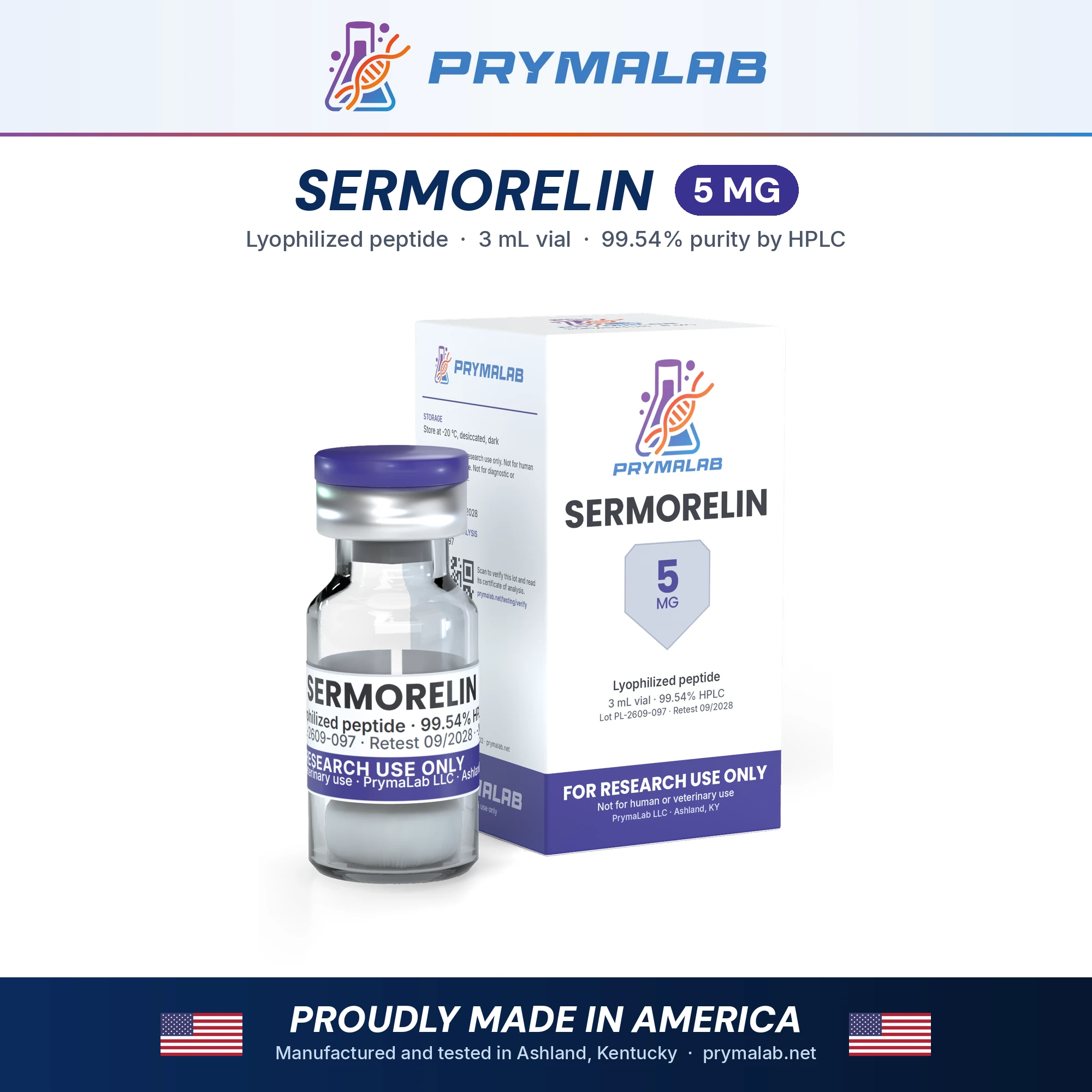
Description
PrymaLab · Research Use Only
Sermorelin 5mg
On this sequence, fill size is a stability decision
Almost every fill-size argument in this catalogue ends in a trade-off. Buy small and pay in reconstitution error, buy large and pay on the stability clock. Sermorelin 5mg is the case where that balance tips, because the compound degrades faster than most of what sits next to it.
Specification Table
| Property | Value |
|---|---|
| Compound | Sermorelin |
| Relationship to the native hormone | Residues 1 to 29 of growth hormone releasing hormone, C-terminally amidated |
| Residue count | Twenty-nine |
| Molecular weight | Approximately 3,357.9 for the free base |
| CAS, free base | 86168-78-7 |
| CAS, acetate salt | 114466-38-5 |
| Declared content | 5 milligrams |
| Approximate molar content | Around 1.5 micromoles |
| Sibling fill in this catalogue | 10 milligrams |
| Chemically labile sites | Three, at aspartate 3, asparagine 8 and methionine 27 |
| Asparagine 8 route | Deamidation through a succinimide intermediate above pH 5 |
| Products of that route | Aspartate 8 and iso-aspartate 8. Both are different molecules |
| Methionine 27 route | Oxidation to the sulfoxide, adding sixteen daltons |
| Why an analogue exists | Mod GRF 1-29 substitutes position 8 specifically to slow deamidation |
| Storage | Sealed at minus 20°C, dark and dry |
Why Does a Sermorelin 5mg Vial Suit This Compound?
Because the compound in a sermorelin 5mg vial has more ways to go wrong than most of the catalogue, and every one of them runs faster in solution.
The 10mg page in this catalogue covers what degrades and by what mechanism, and that is the place to read the chemistry.
The short version is three labile sites in twenty-nine residues: an aspartate at position 3, an asparagine at position 8 and a methionine at position 27.
The asparagine is the interesting one. Above pH 5 it deamidates through a cyclic succinimide, which then opens to give either aspartate or iso-aspartate at that position.
Both products are different molecules. The iso form has a backbone rerouted through the side chain.
There is a well-known analogue, Mod GRF 1-29, whose whole reason for existing is to substitute that position and slow the reaction down. When somebody builds a modified version of a peptide to fix one residue, that residue is a real problem.
So the purchasing consequence is unusually clean. A smaller vial is less material sitting in a freezer waiting to be used, and a smaller reconstituted volume is less peptide sitting in solution waiting to deamidate.
On most articles buying small costs you something. Here it mostly does not.
What Is the Cost of Buying Small?
Buying a sermorelin 5mg vial costs the usual thing, and it is smaller than what you get back on this compound.
Fixed reconstitution errors are a larger share of a 5 milligram fill than a 10: diluent measurement, syringe retention, material left on the glass.
Call that a couple of percent on a careful reconstitution.
Set that against a deamidation reaction that proceeds over days to weeks in solution at neutral pH and warmer, and the arithmetic is not close.
A stock held two weeks longer than necessary loses more to chemistry than a careful reconstitution loses to mechanics.
The second cost is lot count. Two 5 milligram vials to cover what one 10 would have covered means two lots in a dataset.
That is the only objection I would take seriously here. If a study genuinely needs 10 milligrams and will use it inside a couple of weeks, buy the 10.
If it needs 10 milligrams over four months, buy two fives and open the second one when you get to it.
How Should a Prepared Stock Be Held?
A sermorelin 5mg stock should be cold, dark, near neutral pH, and held for as short a time as the work allows.
Neutral is the compromise rather than the optimum. Deamidation runs by direct hydrolysis below pH 2 and through the succinimide above pH 5, so neither extreme is safe and the middle is the least bad.
Aliquot on first reconstitution so a working stock is opened once rather than repeatedly.
Freeze the aliquots. On this sequence the freeze-thaw cost is smaller than holding solution at 4 degrees for weeks. That is not true of every peptide.
Keep it dark for the methionine, which oxidises under ordinary conditions and adds sixteen daltons when it does.
If a stock has been sitting, the honest position is that you do not know what fraction is still the intended molecule, because deamidation produces species of identical mass to within one dalton and a routine chromatogram may not resolve them.
That is the argument for preparing fresh rather than for testing more, since testing for this properly is harder than making it again.
What Should the Certificate Show?
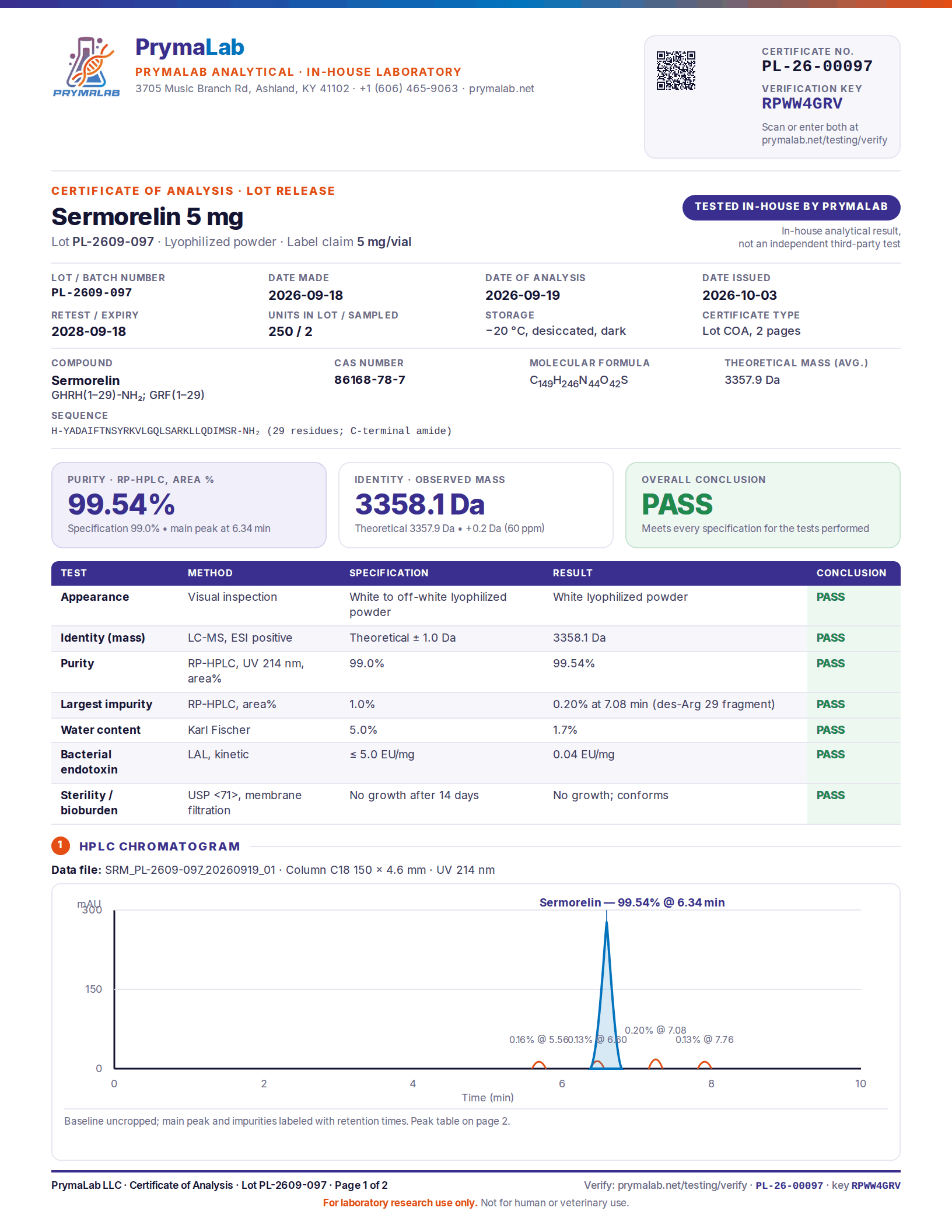
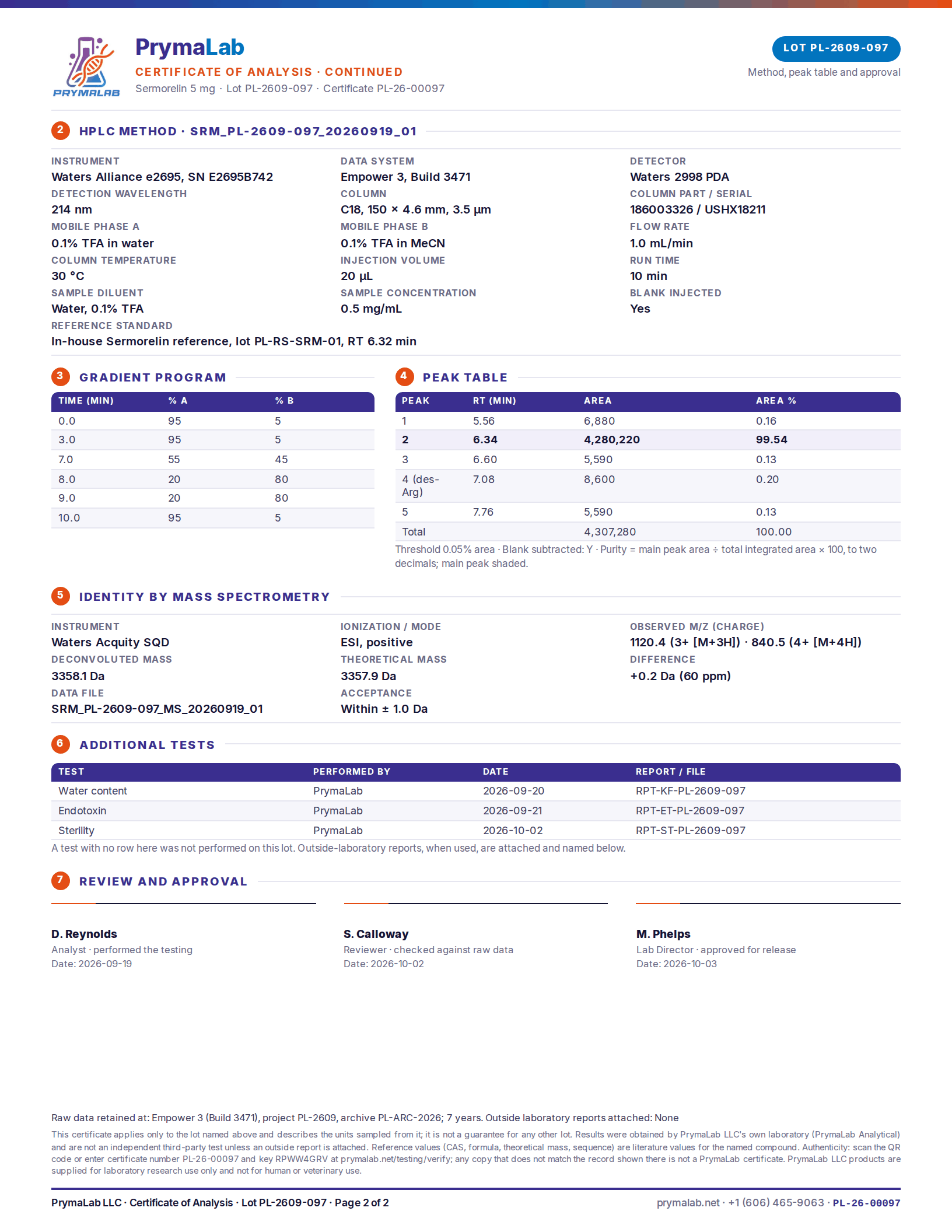
On a sermorelin 5mg certificate, the full twenty-nine residue sequence with the C-terminal amide stated.
Observed mass against the calculated 3,357.9 for the free base. Salt form named separately.
Which CAS the document refers to, since the free base and the acetate carry different registrations.
Purity by chromatography with the method named, and ideally a note on whether the gradient separates the deamidated species.
Net peptide content.
Absence of a sixteen dalton adduct at manufacture.
Lot number and manufacturing date.
The deamidation note is the one that separates a useful certificate from a template. Aspartate and iso-aspartate at position 8 differ from the parent by one dalton, and a method that cannot resolve them will report a preparation as pure whether it is or not.
How Fast Does It Actually Degrade?
A sermorelin 5mg stock degrades faster than a stable peptide would and slower than the framing above might suggest, and I want to be careful about that because overstating it is as unhelpful as ignoring it.
Deamidation at an asparagine is a reaction with a half-life measured in days to weeks depending on the neighbouring residue, the pH and the temperature.
At 4 degrees and neutral pH it is slow. At room temperature and slightly basic it is considerably faster.
The published rate constants for asparagine deamidation vary widely by sequence context, and the sequence context here is not one I can quote a number for.
So the honest position is directional rather than quantitative: this reaction happens on a timescale a laboratory will encounter, unlike some degradation routes that only matter over years.
What that supports is a practical rule rather than a calculation. Prepare fresh where the work allows it, keep stocks cold and near neutral, and do not carry a solution across months.
It does not support a specific shelf life, and any supplier quoting one for a solution of this peptide should be asked what data it came from.
How Does This Compare With the Modified Analogue?
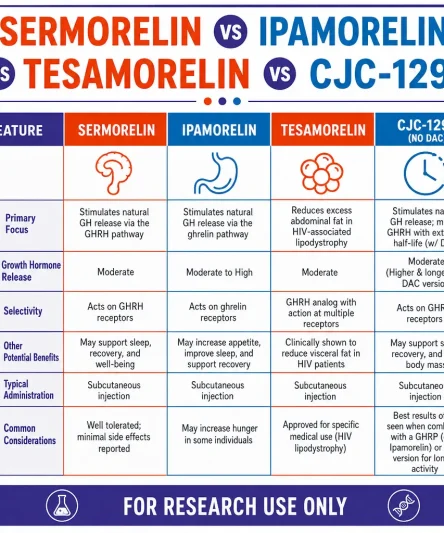
Mod GRF 1-29 has the same backbone as sermorelin 5mg with four substitutions, one of which replaces the asparagine at position 8 specifically to slow deamidation.
That comparison is the clearest evidence available that the position 8 problem is real, because somebody spent effort on fixing it.
The trade is the usual one for a modified analogue. The substitutions buy stability and they change the molecule, so results generated with one are not automatically transferable to the other.
A study asking about the native fragment needs sermorelin. A study wanting a more stable tool that engages the same receptor has a different option, and should say which it used.
This catalogue sells both, and the confusion between them in supplier listings is considerable. The two get described interchangeably and they are not interchangeable.
The single field that settles it is the sequence, as usual.
What Should the Record Show?
The reconstitution date, and then the date of every measurement made from that solution.
On a stable peptide those two fields are administrative. Here they are the exposure history, because the interval between them is how long the deamidation reaction had.
Lot, salt form and net peptide content as usual.
The buffer and its pH, since the reaction rate depends on both and a solution held at pH 7.4 behaves differently from one at 6.
Storage temperature of the stock itself, which is a different field from the storage temperature of the sealed vial.
Six fields, and the two date fields are the ones that make a result reproducible by somebody who did not watch you make it.
How Should the Vial Be Handled?
Keep a sermorelin 5mg vial sealed at minus 20 degrees Celsius, dark and dry. The solid state is where all three degradation routes are slowest.
Bring the vial to ambient temperature before opening, since a 5 milligram cake is small and cold glass collects water.
Run diluent down the wall and let the cake dissolve without agitation.
Choose a diluent volume against the concentration you need rather than a round number.
Rinse the vial with a second small volume. On a small fill the residue on the glass is a larger share of the total.
Aliquot immediately, freeze the aliquots, and thaw one at a time.
Low-binding tubes and tips from the first dilution onward.
Record lot, salt form, net peptide content, diluent, pH, the reconstitution date and the date of every subsequent use.
The dates are the part that matters here. On a compound with a deamidation clock, the interval between reconstitution and measurement is a variable, and it is the one nobody writes down.
A last point on why this page argues the opposite of most fill pages. Nearly everywhere else in this catalogue, buying small costs you accuracy and buying large costs you time.
Here the time cost is steep enough that it swamps the accuracy cost, so the trade collapses and the small fill simply wins for most work.
That happens because of one asparagine. It is a good illustration of how a single residue can drive a purchasing decision that looks purely commercial.
If somebody asked me to name the residue in this catalogue with the largest effect on how an article should be bought, it would be this one, and the runner-up is not close.
Published Literature
Selected references on the parent hormone, on the receptor and on the degradation chemistry of peptides in solution. The 10mg page carries the same list.
- Guillemin R, Brazeau P, Bohlen P, Esch F, Ling N, Wehrenberg WB. Science. 1982;218(4572):585-587. DOI: 10.1126/science.6812220
- Prakash A, Goa KL. BioDrugs. 1999;12(2):139-157. DOI: 10.2165/00063030-199912020-00007
- Veldhuis JD, Roemmich JN, Richmond EJ, Rogol AD, Lovejoy JC, Sheffield-Moore M, et al. Endocrine Reviews. 2005;26(1):114-146. DOI: 10.1210/er.2003-0038
- Manning MC, Chou DK, Murphy BM, Payne RW, Katayama DS. Pharmaceutical Research. 2010;27(4):544-575. DOI: 10.1007/s11095-009-0045-6
Frequently Asked Questions
Why does fill size matter more on this compound?
Because it has three chemically labile sites in twenty-nine residues, and all three run faster in solution than in a lyophilised solid.
Where are those sites?
Aspartate 3, asparagine 8 and methionine 27.
What happens at asparagine 8?
Above pH 5 it deamidates through a cyclic succinimide, which opens to give aspartate or iso-aspartate at that position. Both are different molecules from the parent.
Is there evidence that matters?
Mod GRF 1-29 exists partly to substitute that position and slow the reaction. Somebody building a modified peptide to fix one residue tells you the residue is a problem.
So the smaller fill is better?
On this compound, mostly yes. Less material waiting to be used, and a smaller reconstituted volume waiting to deamidate.
What does buying small cost?
A couple of percent to fixed reconstitution errors on a careful preparation, which is small against a reaction that proceeds over days to weeks in solution.
Is there a real objection?
Lot count. Two 5 milligram vials means two lots in a dataset. If a study needs 10 milligrams and will use it inside a couple of weeks, buy the 10.
What pH should a stock be held at?
Near neutral, as a compromise. Deamidation runs by direct hydrolysis below pH 2 and through the succinimide above pH 5, so the middle is the least bad.
Should aliquots be frozen?
Yes. On this sequence the freeze-thaw cost is smaller than holding solution at 4 degrees for weeks, which is not true of every peptide.
Can deamidation be detected easily?
Not reliably. The products differ from the parent by about one dalton and a routine gradient may not separate them, so a preparation can report as pure either way.
What does that mean practically?
Prepare fresh rather than test more. Testing for it properly is harder than simply making the solution again.
Which certificate field is most useful?
A note on whether the chromatographic method separates the deamidated species. Without it, a purity figure does not speak to the question this compound raises.
Compliance Statement
Sermorelin is sold exclusively for laboratory research use. It is not a drug, food, or cosmetic product, and it is not a dietary product of any kind. It is not approved by the FDA or any comparable authority for human or veterinary use, the sequence carries three chemically labile sites and deamidation at position eight produces species differing from the parent by about one dalton that a routine chromatographic method may not resolve, a prepared solution therefore cannot be assumed to retain its nominal composition over time, vial mass includes counterion and residual water and is not equivalent to peptide mass, and no compound in this range is offered for any human or veterinary purpose. This product is not intended to diagnose, treat, cure, or prevent any disease. It must not be given to humans or animals. Purchase is restricted to qualified researchers and institutions operating within applicable laws. All handling is the responsibility of the purchasing laboratory.
Other formats of Sermorelin
Sermorelin is also stocked as Sermorelin 6mg preloaded 3ml pen and Sermorelin 10mg. Each listing states its own quantity and concentration, and the pen and vial comparison explains what changes between formats.










20 reviews for Sermorelin 5mg