Description
PrymaLab · Research Use Only
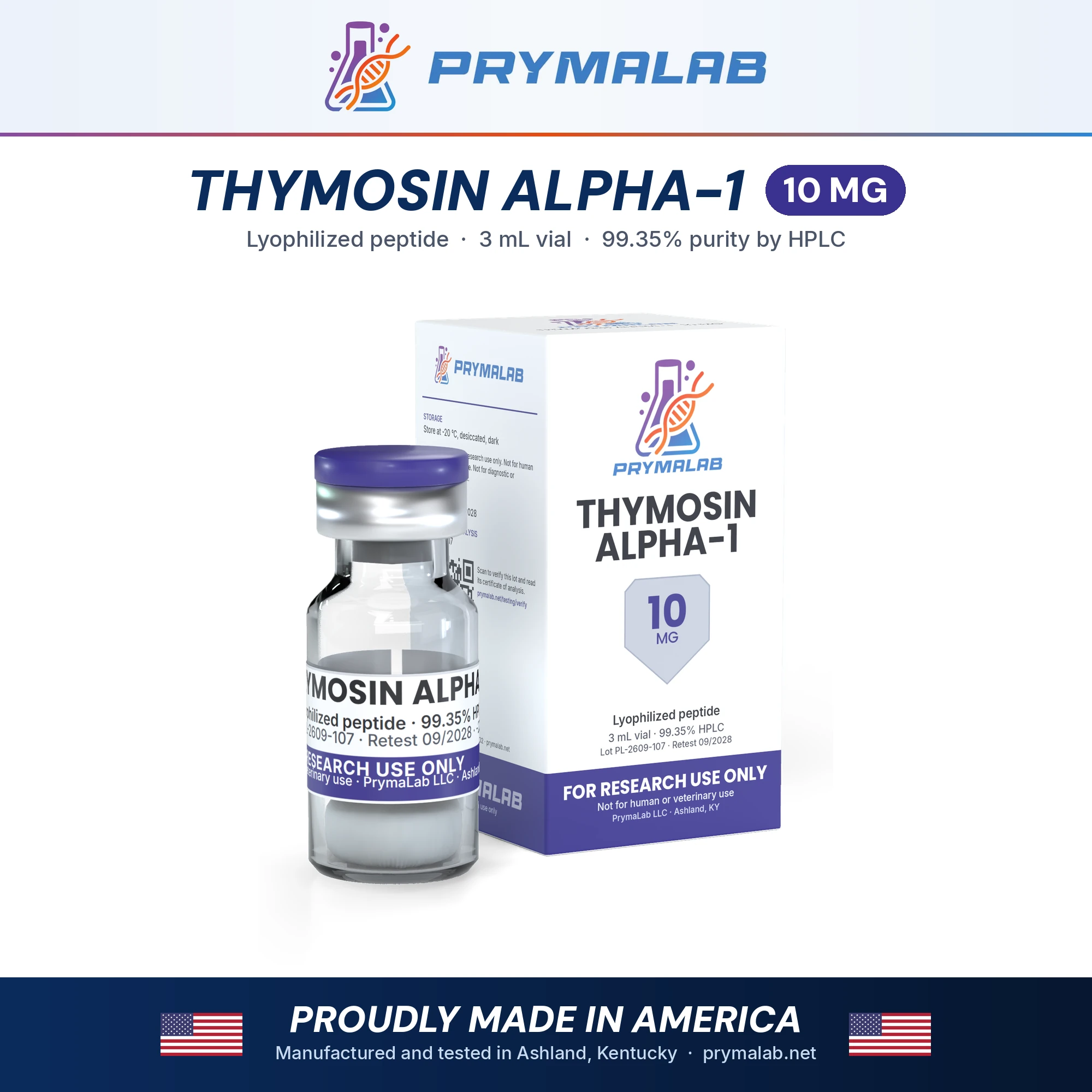
Thymosin Alpha-1 10mg
Approved in dozens of countries · and not in this one
Thymosin alpha-1 sits in an unusual regulatory position. It holds marketing approval in dozens of countries under the name thymalfasin and holds none in the United States, which means the evidence base and the legal status point in different directions.
Specification Table
| Property | Value |
|---|---|
| Compound | Thymosin alpha-1 |
| International nonproprietary name | Thymalfasin |
| Residue count | 28 |
| Amino terminus | Acetylated |
| Molecular weight, calculated | Approximately 3,108 g/mol for the acetylated free base |
| CAS | 62304-98-7 |
| Origin of the sequence | Residues 2 to 29 of prothymosin alpha, a larger intracellular protein |
| Composition note | Highly acidic. Several glutamates and aspartates, no aromatic residue |
| Consequence of that | Absorbance at 280 nanometres is not a usable quantification route |
| Cysteine residues | None |
| Regulatory status | Approved and marketed in dozens of countries as thymalfasin |
| Status in the United States | No marketing approval |
| Relationship to that product | Material supplied here is not the approved product and is not manufactured to pharmaceutical standards |
| Appearance | White lyophilized powder |
| Storage, lyophilized | 2-8°C short term, -20°C for extended storage, protected from light and moisture |
What Does the Regulatory Split Mean?
A compound approved in one place and not another is common. A compound approved in dozens of places and not in the largest pharmaceutical market is less common, and it produces a specific evidentiary situation.
Approval anywhere requires a regulator to examine manufacturing, stability and clinical data and conclude the package supports the claim.
That has happened repeatedly for thymosin alpha-1 across a wide set of jurisdictions, which means a substantial dossier exists and has been reviewed by people whose job is to find its weaknesses.
The absence of a United States approval is not evidence that the dossier failed there. A sponsor has to file before a regulator can decline, and filing is a commercial decision as much as a scientific one.
What can be said accurately is that no United States regulator has completed a review, and that the compound is therefore not an approved article in that market.
For a researcher the useful consequence is about literature quality rather than legality.
Compounds that reach approval anywhere generate trial data conducted to regulatory standard, which is a considerably better foundation than the animal-model literature behind most of this catalogue.
That literature is readable and it used approved formulations manufactured under pharmaceutical controls.
Material supplied here is research-grade and is not that product. Trial figures therefore describe an article nobody has shown equivalent to any particular research lot.
Read the trials, then verify the vial. The certificate closes the gap.
Where Does the Thymosin Alpha-1 Sequence Come From?
This peptide is not an independent gene product, which is a fact that shapes how the literature about it should be read.
It corresponds to residues 2 to 29 of prothymosin alpha, a larger and abundant intracellular protein found across tissues rather than only in the thymus.
The name is therefore a historical artefact. The peptide was isolated from thymic extract and named for that source, and the parent protein turned out to be far more widely distributed.
Whether the 28-residue peptide exists as a distinct species in vivo, or arises during extraction from the larger protein, is a question the literature has argued over for decades.
That is worth knowing because it changes what a result means. A study adding synthetic thymosin alpha-1 to a system is adding a defined peptide whose natural counterpart may or may not circulate as such.
The synthetic article is well defined regardless. It is 28 residues with a stated sequence and an acetylated amino terminus, and it can be verified directly.
The acetylation is part of the definition rather than an optional extra. The natural amino terminus of the parent protein is acetylated, and the peptide inherits that.
A preparation lacking the acetyl group is 42 daltons lighter and carries a positive charge the acetylated form does not, which on a highly acidic 28-mer is a meaningful change to the charge state.
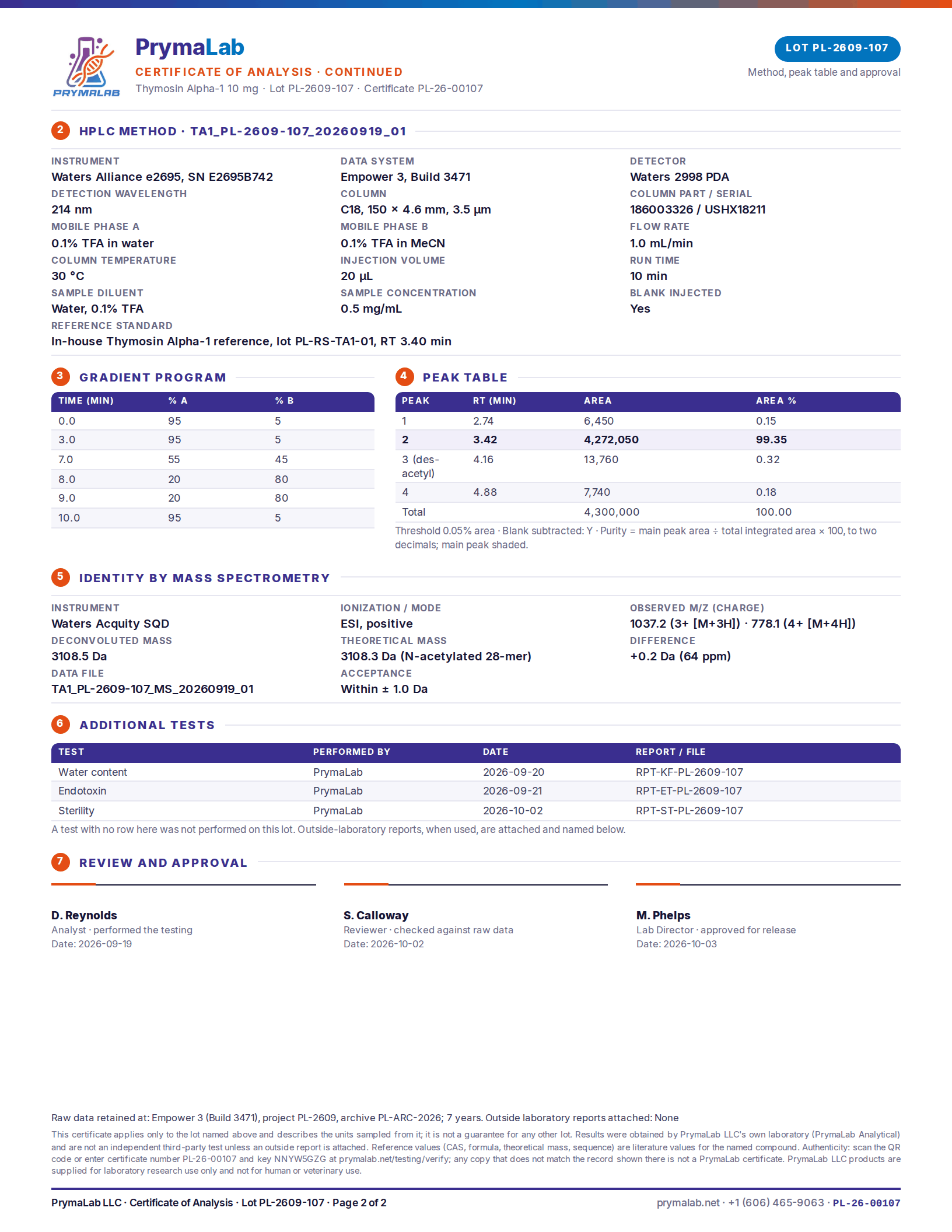
So the certificate should state acetylation explicitly, and a mass of roughly 3,066 rather than 3,108 indicates the unmodified peptide.
Why Is Quantification Awkward Here?
This sequence contains no tryptophan, no tyrosine and no phenylalanine, which removes the convenient measurement.
Ultraviolet absorbance at 280 nanometres depends on aromatic side chains, so on this peptide it reads close to nothing regardless of how much material is present.
The alternative is 214 nanometres, which reads the peptide bond and works on any sequence, at the cost of requiring a matrix that does not itself absorb in that region.
The composition creates a second complication that is specific rather than general.
Thymosin alpha-1 is strongly acidic. It carries a substantial number of glutamate and aspartate residues, which means it holds a large negative charge at neutral pH.
A peptide that acidic is usually supplied as a sodium or ammonium salt rather than the trifluoroacetate form that dominates the rest of this catalogue, because the basic sites trifluoroacetate would pair with are largely absent.
That inverts the usual counterion assumption. A supplier stating trifluoroacetate on a strongly acidic peptide has either performed an unusual purification or copied a template.
Net peptide content still applies and the arithmetic behind it is different, so the figure should come from the certificate rather than from a rule of thumb learned on basic peptides.
Solubility follows the same chemistry. It dissolves readily in neutral aqueous buffer and can be sluggish in mildly acidic diluent, which is the opposite of what most of this catalogue does.
A short note on what that means in practice for a first lot.
Running one amino acid analysis on a new supplier establishes both the composition and an independent concentration figure, and it settles the counterion question at the same time.
It costs a day and it is the only measurement that does all three, which makes it better value on this peptide than on most.
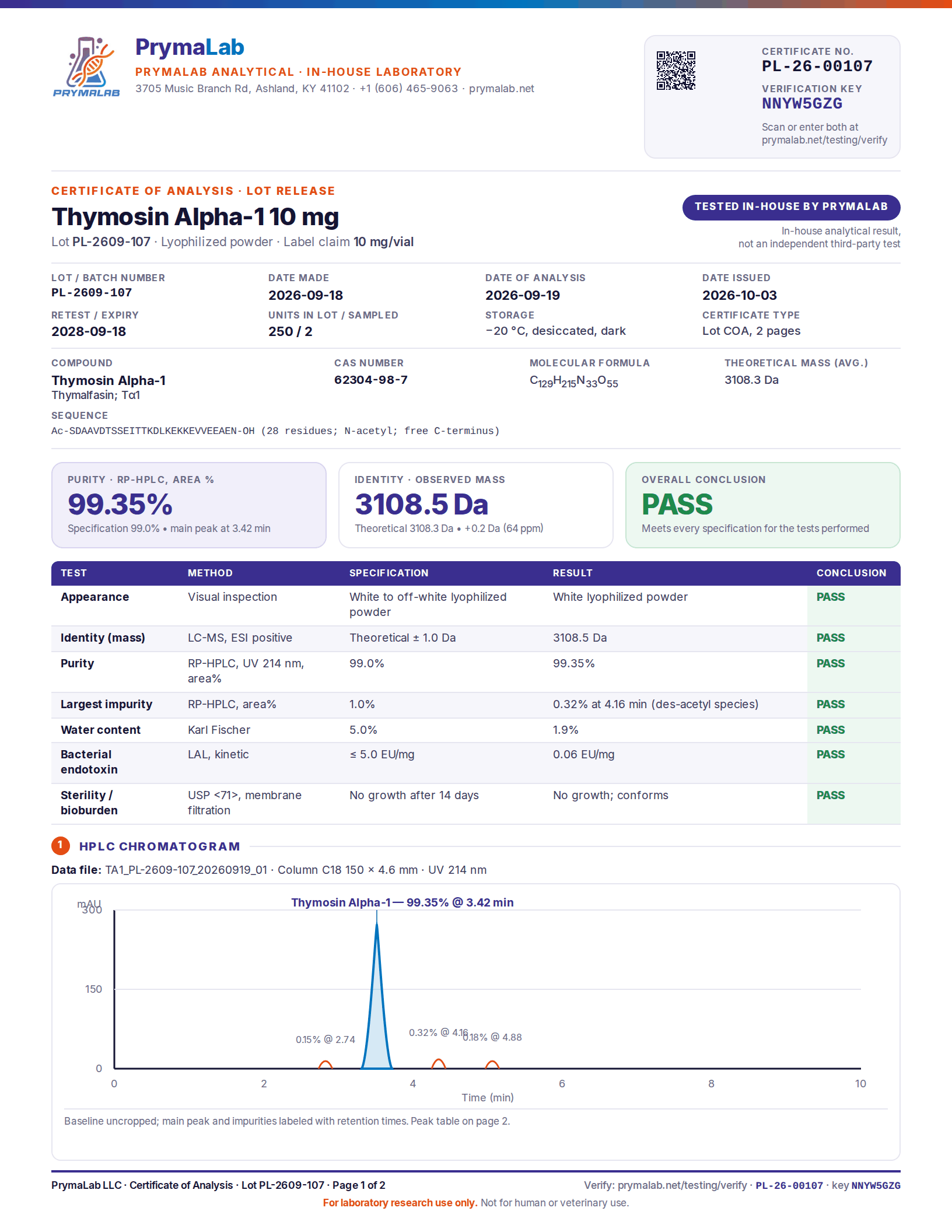
What Should the Certificate Show?
Six fields, and two of them exist because of the acetylation and the acidity.
The sequence written out, since 28 residues is long enough for a substitution to hide behind a name and short enough to print.
Whether the amino terminus is acetylated, stated explicitly. Roughly 3,108 daltons is the acetylated peptide and roughly 3,066 is not.
Observed mass against calculated mass with the instrument resolution stated, because at 28 residues a single deletion is three to four percent and nominal resolution can miss it.
Purity by reverse-phase HPLC at 214 nanometres with the chromatogram supplied. A 280 nanometre figure here measures the buffer rather than the peptide, whatever the number attached to it says.
Counterion identity, which on an acidic peptide should be a cation rather than trifluoroacetate, together with net peptide content.
Lot number and synthesis date, tying the preceding figures to the material that ships.
A certificate naming the compound as thymalfasin alongside the research designation is a small signal that the supplier knows the compound has an approved identity elsewhere.
What Is Known About the Mechanism?
The mechanistic account for this peptide is more specific than for most compounds in this catalogue, and it is worth stating at the level the evidence supports.
Published work identifies Toll-like receptor signalling as a route through which the peptide acts, with reported engagement of the receptors that recognise microbial nucleic acid and cell wall components.
That places it upstream of immune activation rather than acting directly on any single effector population.
Downstream reports describe effects on dendritic cell maturation and on the balance of T cell responses, which is consistent with an upstream position.
The reason this matters experimentally is that an upstream mechanism produces different assay requirements from a direct one.
A compound acting through pattern recognition receptors will produce readouts that depend heavily on what else is in the system.
Serum components, endotoxin contamination and the activation state of the cells at the start of the experiment all become variables rather than background.
Endotoxin deserves particular attention here, because it engages one of the same receptor families. A contaminated preparation can produce a result that looks like the compound working.
That makes an endotoxin figure on the certificate more useful for this peptide than for most, and a heat-inactivated control arm worth building into any cell-based design.
The published record is considerably better than the catalogue average and it is still a record of specific experiments in specific systems.
How Should the Vial Be Handled?
Handling is straightforward and the diluent choice deserves more thought than usual.
Sealed lyophilized powder holds at 2 to 8 degrees Celsius for short periods and at minus 20 for extended storage, protected from light and moisture.
Bring the vial to ambient temperature before opening. The powder is hygroscopic and an acidic peptide takes up water as readily as any other.
Reconstitute in a neutral buffer rather than plain acidified water where the assay permits it, since the acidic composition favours solution at neutral pH.
Add diluent down the wall and swirl. Twenty-eight residues is long enough for interface aggregation to matter and short enough that gentle handling is sufficient.
Aliquot on first reconstitution. There is no cysteine and no methionine here, so chemical degradation is slower than for many peptides, and freeze-thaw damage is physical and cumulative regardless.
Use low-binding consumables at working dilutions. An acidic peptide adsorbs differently from a basic one and it still adsorbs.
Record lot, acetylation status as taken from the certificate, counterion, net peptide content, diluent composition and date.
Acetylation status belongs in that list because two vials labelled identically can differ by that one group, and nothing downstream will reveal it.
Published Literature
Selected references on the isolation of this peptide, on its parent protein and on its clinical evaluation.
- Low TL, Thurman GB, McAdoo M, McClure J, Rossio JL, Naylor PH, et al. Journal of Biological Chemistry. 1979;254(3):981-986. PMID: 762108
- Goldstein AL, Goldstein AL. Expert Opinion on Biological Therapy. 2009;9(5):593-608. DOI: 10.1517/14712590902911412
- Romani L, Bistoni F, Gaziano R, Bozza S, Montagnoli C, Perruccio K, et al. Blood. 2004;103(11):4232-4239. DOI: 10.1182/blood-2003-11-4036
- Camerini R, Garaci E. Expert Opinion on Biological Therapy. 2015;15(sup1):S117-S127. DOI: 10.1517/14712598.2015.1033393
Frequently Asked Questions
What is thymosin alpha-1?
A 28-residue peptide with an acetylated amino terminus, calculated at approximately 3,108 daltons, corresponding to residues 2 to 29 of the larger protein prothymosin alpha.
What is thymalfasin?
The international nonproprietary name for the same compound. It is the designation used where the compound holds marketing approval.
Where is it approved?
In dozens of countries. It holds no marketing approval in the United States, which is an unusual asymmetry for a compound with that breadth of clearance elsewhere.
Does the absence of a US approval mean it failed there?
No. A sponsor has to file before a regulator can decline, and filing is a commercial decision as much as a scientific one. What can be said is that no US review has been completed.
What does approval elsewhere give a researcher?
Trial data conducted to regulatory standard, which is a better foundation than the animal-model literature behind most compounds in this catalogue. Those trials used approved formulations rather than research material.
Is this the approved product?
No. Material supplied here is research-grade under research-use-only terms and is not manufactured to pharmaceutical standards, so trial figures describe an article not shown equivalent to any research lot.
Where does the sequence come from?
Residues 2 to 29 of prothymosin alpha, an abundant intracellular protein found across tissues rather than only in the thymus. The name is a historical artefact of the original extraction source.
Does the peptide exist naturally as such?
That has been argued over for decades. Whether it circulates as a distinct species or arises during extraction from the larger protein remains unsettled in the published record.
Why does the acetyl group matter?
It is part of the definition. A preparation lacking it is 42 daltons lighter and carries a positive charge the acetylated form does not, which on a strongly acidic peptide is a meaningful change.
Why is 280 nanometre detection unusable?
The sequence contains no tryptophan, tyrosine or phenylalanine, so there is no aromatic side chain to absorb. A 214 nanometre measurement reads the peptide bond and works instead.
What counterion should it carry?
A cation such as sodium or ammonium rather than trifluoroacetate. The peptide is strongly acidic, so the basic sites trifluoroacetate would pair with are largely absent.
How should it be reconstituted?
In a neutral buffer rather than acidified water where the assay permits it, since the acidic composition favours solution at neutral pH. Add diluent down the wall and swirl rather than shake.
Compliance Statement
Thymosin alpha-1 is sold exclusively for laboratory research use. It is not a drug, food, or cosmetic product, and it is not a dietary product of any kind. It is not approved by the FDA or any comparable authority for human or veterinary use, it holds marketing approval in dozens of countries under the name thymalfasin and holds none in the United States, material supplied here is not any approved product and is not manufactured to pharmaceutical standards, published trial data was generated using approved formulations rather than research-grade material, and no compound in this range is offered for any human or veterinary purpose. This product is not intended to diagnose, treat, cure, or prevent any disease. It must not be given to humans or animals. Purchase is restricted to qualified researchers and institutions operating within applicable laws. All handling is the responsibility of the purchasing laboratory.
Other formats of Thymosin Alpha-1
Thymosin Alpha-1 is also stocked as Thymosin Alpha-1 5mg. Each listing states its own quantity and concentration, and the pen and vial comparison explains what changes between formats.


19 reviews for Thymosin Alpha-1 10mg