Description
PrymaLab · Research use only
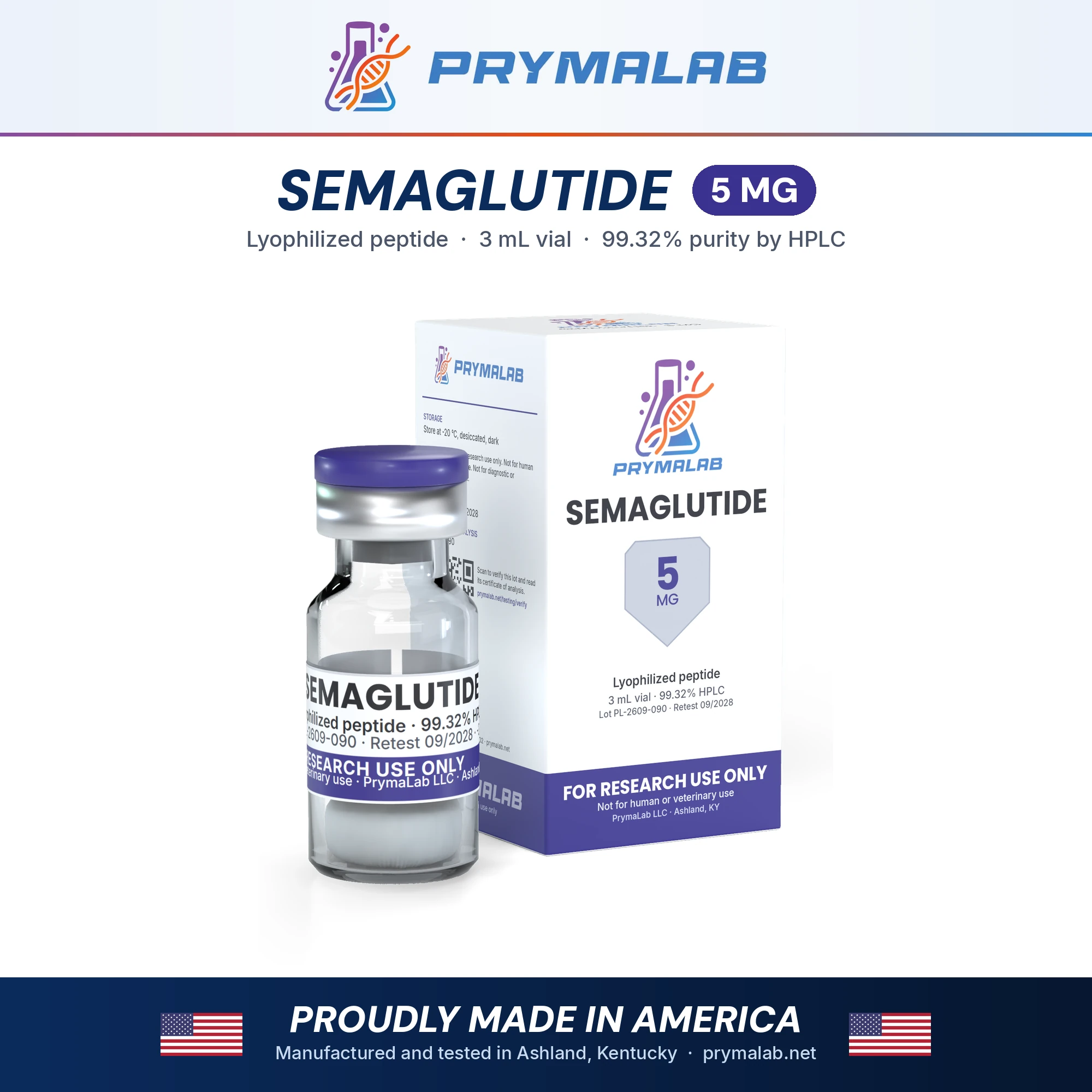
Semaglutide 5mg
Acylated GLP-1 receptor agonist, 31 residues, freeze-dried in a 5 mg vial
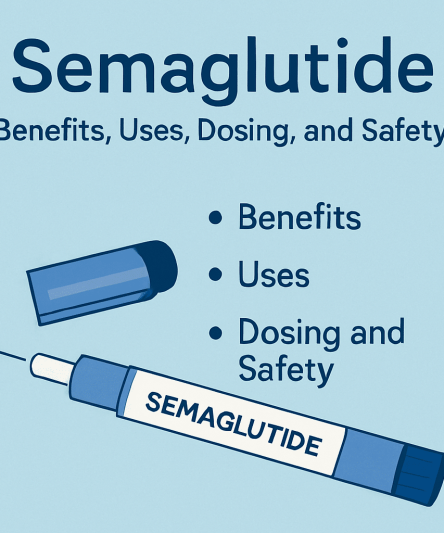
Semaglutide is a synthetic analogue of glucagon-like peptide-1 (GLP-1): 31 amino acids with two substitutions and a C18 fatty diacid chain on lysine 26 that binds serum albumin. This listing is the 5 mg vial of freeze-dried powder, the main page for the five semaglutide fills PrymaLab sells. Published work on semaglutide runs from the medicinal chemistry behind its design to receptor pharmacology and large clinical trials in type 2 diabetes and obesity.
Specifications
| Property | Value |
|---|---|
| Compound | Semaglutide NN9535; GLP-1 receptor agonist |
| CAS number | 910463-68-2 |
| Molecular formula | C187H291N45O59 |
| Theoretical mass | 4113.6 Da |
| Sequence / structure | H-H-Aib-EGTFTSDVSSYLEGQAAK(2×OEG-γGlu-C18 diacid)EFIAWLVRGRG-OH (31 residues; Aib8 and Arg34 in GLP-1 numbering; Lys26 acylated with octadecanedioic acid via two OEG spacers and γ-Glu; free C-terminus) |
| Label claim | 5 mg/vial |
| Form | Lyophilized (freeze-dried) powder or cake in a sealed glass vial with a rubber stopper and aluminium crimp cap |
| Storage, sealed | −20 °C, desiccated, dark |
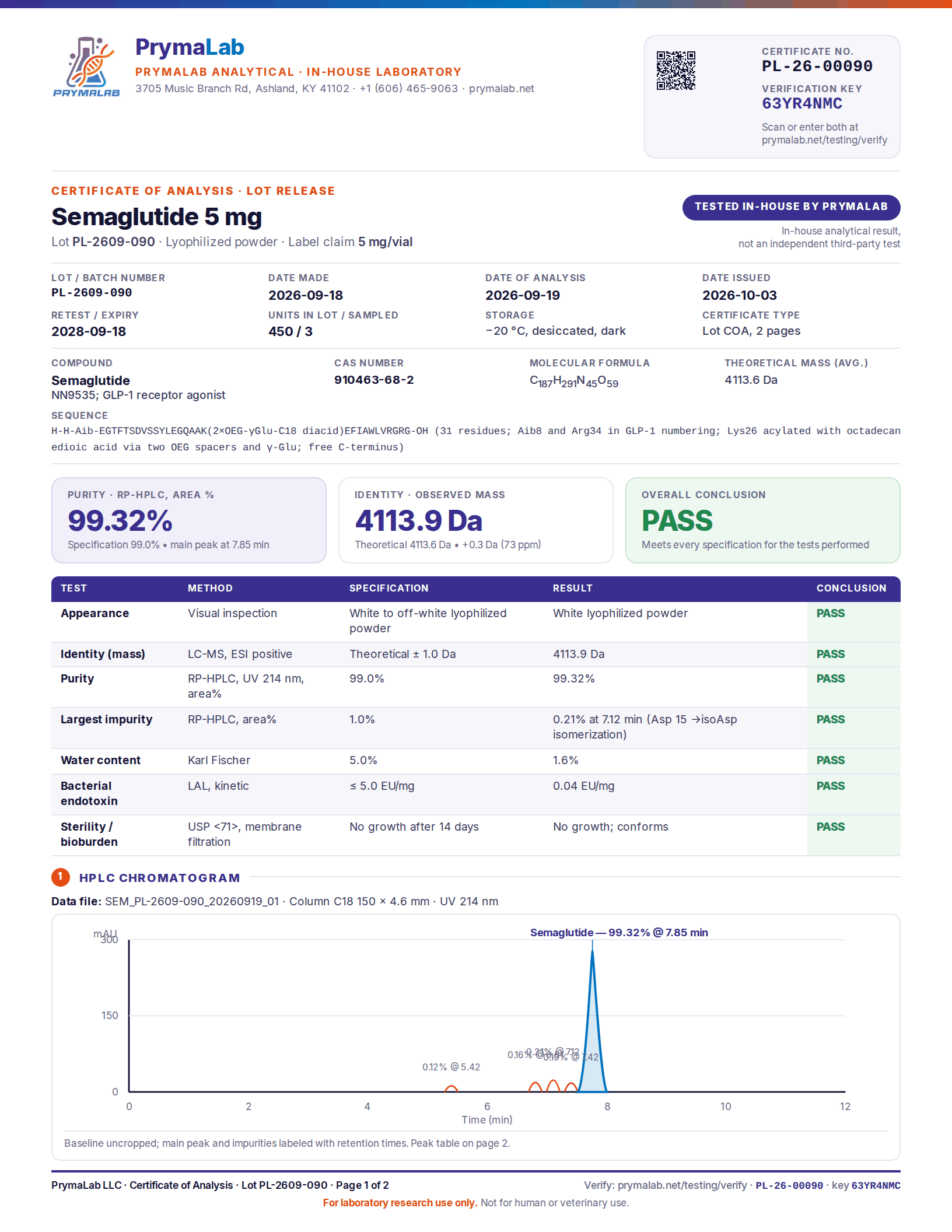
| Purity specification | 99.0% or higher by RP-HPLC |
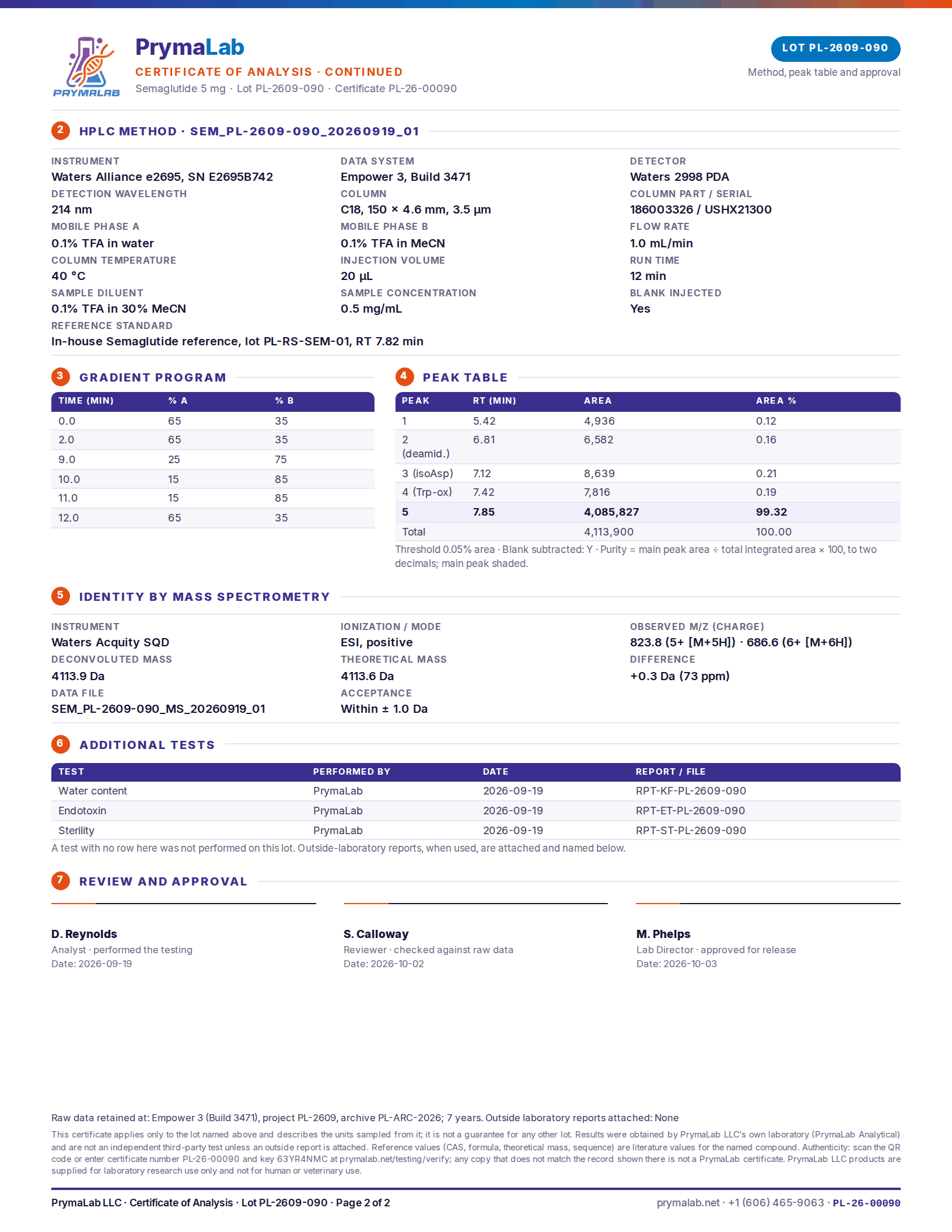
| Lot certificate | Results for the lot now shipping are in the certificate panel on this page |
| Safety data sheet | PL-SDS-146 |
Fills in this range
Semaglutide is sold in 5 fills. The compound and the testing are the same in every fill; only the amount in the vial changes.
| Fill | Listing |
|---|---|
| 5 mg | Semaglutide 5mg (this page) |
| 10 mg | Semaglutide 10mg |
| 15 mg | Semaglutide 15mg |
| 20 mg | Semaglutide 20mg |
| 30 mg | Semaglutide 30mg |
Reading the structure on the certificate
The certificate writes semaglutide as H-H-Aib-EGTFTSDVSSYLEGQAAK(2×OEG-γGlu-C18 diacid)EFIAWLVRGRG-OH. The first H- is the free N-terminus, so the chain starts with histidine, and the residues follow GLP-1 numbering: Aib sits at position 8, which puts the histidine at 7 and the end of the 31-residue chain at 37. Lau and colleagues described two substitutions relative to human GLP-1, Aib (alpha-aminoisobutyric acid) at 8 and arginine at 34, with lysine 26 derivatised1. Because position 34 is arginine, lysine 26 is the only lysine in the sequence, and it carries the whole side chain: a γ-glutamic acid, two OEG spacers and octadecanedioic acid, an 18-carbon diacid. The C-terminus is a free acid.
That side chain is why the theoretical mass, 4113.6 Da, sits well above what the amino acids alone would add up to, and the LC-MS identity result on the certificate is the figure to hold against it. The same mass converts the fill to moles: 5 mg is about 1.2 µmol, slightly less in practice because the powder also contains the residual water the certificate reports.
Hazard classification and storage
Semaglutide carries a hazard classification. Its safety data sheet lists it as Carc. 2 (H351, suspected of causing cancer) and Repr. 2 (H361, suspected of damaging fertility or the unborn child), and asks for the container to be kept tightly closed, labelled and locked up, out of reach of unauthorised persons. Store the sealed vial at −20 °C, desiccated and away from light, and let it warm to room temperature before opening so that moisture does not condense on the powder. Reconstituted solution goes to 2 to 8 °C, protected from light, for a period your laboratory has set. General practice for keeping peptides is covered in peptide storage and stability.
What the research covers
Designed around albumin binding
Semaglutide grew out of liraglutide, an acylated GLP-1 analogue that binds serum albumin and was already approved for diabetes and obesity1. In the 2015 discovery paper, Lau and colleagues aimed for a longer-acting successor by raising albumin affinity and making the peptide fully stable against metabolic degradation1. They found that the fatty acid and the chemistry linking it to the peptide decided three things at once: albumin affinity, GLP-1 receptor potency and how long exposure lasted1.
The chosen compound gave up some receptor binding to get there. Its affinity for the GLP-1 receptor was 0.38 ± 0.06 nM, a threefold drop from liraglutide, while albumin affinity rose1. Given intravenously to mini-pigs, it had a plasma half-life of 46.1 hours1. Semaglutide was in phase 3 testing when the paper appeared1, and it is now approved as a prescription medicine in a number of markets. The vial sold here is a research chemical, not one of those approved products.
Signalling at the GLP-1 receptor
Activation of the GLP-1 receptor can be read out in more than one way. Willard and colleagues followed it through cAMP generation, β-arrestin recruitment and receptor internalisation, and found that tirzepatide favoured cAMP over β-arrestin and internalised the receptor less than native GLP-1 did2. In primary islets, β-arrestin1 limited the insulin response to GLP-12. The abstract makes these comparisons against native GLP-1 and reports no semaglutide data2.
Semaglutide as a comparator
Newer incretin drugs have been tested head to head against semaglutide. SURPASS-2 was an open-label, 40-week phase 3 trial that randomly assigned 1,879 adults with type 2 diabetes in equal numbers to three tirzepatide arms or to semaglutide3. At baseline the mean glycated haemoglobin was 8.28%, the mean age 56.6 years and the mean weight 93.7 kg3. Its primary endpoint was the change in glycated haemoglobin from baseline to week 403. Each tirzepatide arm was noninferior and superior to the semaglutide arm, with estimated differences of 0.15 to 0.45 percentage points3. The semaglutide trial programmes in diabetes, obesity and cardiovascular outcomes are described in the semaglutide guide; their primary papers are not in this page’s reference list.
What is not established
The receptor affinity and half-life figures come from the discovery paper’s own assays and from mini-pigs1, and the clinical paper cited here uses semaglutide as the comparator rather than the subject. SURPASS-2 was also open-label, so participants and investigators knew which drug each arm received3. No paper on this page measured how long semaglutide stays intact after a freeze-dried vial is dissolved. Reviews of protein stability handle chemical and physical degradation as separate problems and discuss stabilisation in solution and in the dried state4, but they give no figure for this peptide. None of the studies used PrymaLab material.
How each lot is tested
Every lot is tested in PrymaLab’s own laboratory in Ashland, Kentucky before release: RP-HPLC for purity, LC-MS for identity, Karl Fischer titration for water, LAL for endotoxin and USP <71> for sterility. The results for the lot now shipping are in the certificate panel on this page, and the certificate number, key and QR code can be checked on the verify page. These are in-house results from PrymaLab Analytical, not an independent test, and the lab is not accredited to ISO 17025. The third-party testing guarantee on this page still applies: if any independent laboratory finds the wrong compound, or less than the stated purity or amount, the order is refunded and the cost of the test is reimbursed.
Frequently asked questions
What is in the 5 mg vial?
Five milligrams of semaglutide as white freeze-dried powder: the 31-residue GLP-1 analogue with Aib at position 8, arginine at 34 and the C18 diacid side chain on lysine 26. The safety data sheet lists semaglutide as the only component, and the theoretical mass is 4113.6 Da.
How do the five semaglutide fills differ?
Only in the amount of peptide: 5, 10, 15, 20 or 30 mg. Each fill is made and tested as a separate lot with its own certificate. With the same volume of diluent a larger fill gives a stronger solution, or more solution that has to be kept cold and used within its period.
How do I check the certificate for my vial?
Find the lot number printed on the vial and match it to the certificate. The panel on this page shows the lot now shipping, and the verify page confirms a certificate from its number and key. The LC-MS identity result should sit close to the theoretical 4113.6 Da.
Why does the safety data sheet classify semaglutide as hazardous?
It lists semaglutide as suspected of causing cancer (Carc. 2, H351) and suspected of damaging fertility or the unborn child (Repr. 2, H361). Those classes are why the sheet asks for locked storage out of reach of unauthorised persons. Read the full sheet before opening a vial.
Can this vial be used in people or animals?
No. Semaglutide is approved as a prescription medicine in some markets, but this vial is not that product. It is a research chemical sold for laboratory use only, is not approved for human or veterinary use and must not be given to people or animals.
References
- Lau J, Bloch P, Schäffer L, et al. Discovery of the Once-Weekly Glucagon-Like Peptide-1 (GLP-1) Analogue Semaglutide. J Med Chem. 2015;58(18):7370-80. DOI · PubMed
- Willard FS, Douros JD, Gabe MB, et al. Tirzepatide is an imbalanced and biased dual GIP and GLP-1 receptor agonist. JCI Insight. 2020;5(17). DOI · PubMed
- Frías JP, Davies MJ, Rosenstock J, et al. Tirzepatide versus Semaglutide Once Weekly in Patients with Type 2 Diabetes. N Engl J Med. 2021;385(6):503-515. DOI · PubMed
- Manning MC, Chou DK, Murphy BM, et al. Stability of protein pharmaceuticals: an update. Pharm Res. 2010;27(4):544-75. DOI · PubMed
Research use only
For laboratory research use only. Semaglutide 5mg is not a drug, food, cosmetic or dietary supplement, is not approved by the FDA or any comparable authority for human or veterinary use, and must not be given to people or animals. It is sold to qualified researchers and institutions, and the buyer is responsible for lawful handling and disposal.
Other formats of Semaglutide
Semaglutide is also stocked as cagrilintide 2.5mg + semaglutide 2.5mg, Cagrilintide 5mg + Semaglutide 5mg, Cagrilintide 20mg preloaded 3ml pen and Cagrilintide 5mg. Each listing states its own quantity and concentration, and the pen and vial comparison explains what changes between formats.







Reviews
There are no reviews yet.