Description
PrymaLab · Research use only
Cortagen Peptide 20mg
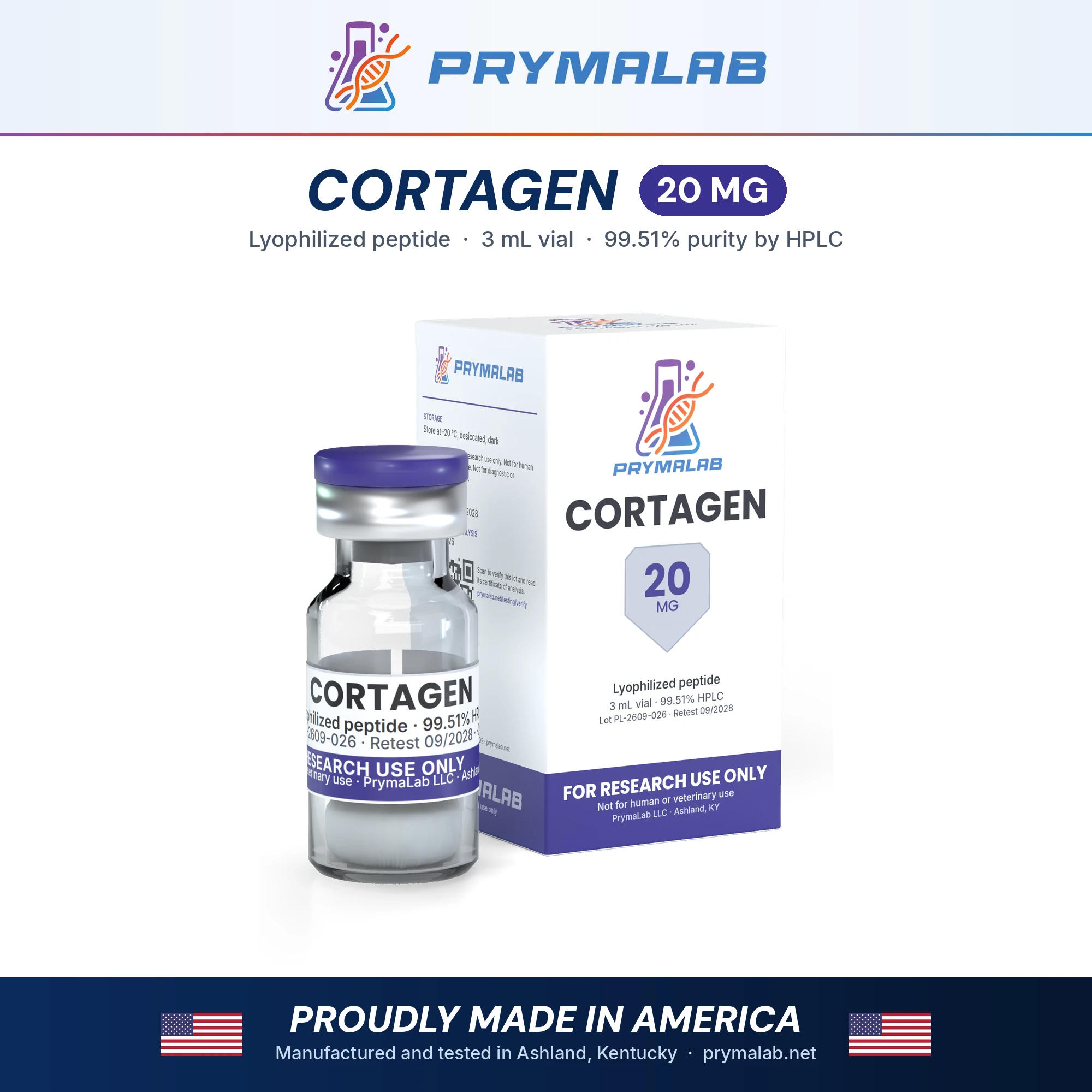
Synthetic Ala-Glu-Asp-Pro tetrapeptide, 20 mg of freeze-dried powder per vial
Cortagen is the synthetic tetrapeptide Ala-Glu-Asp-Pro (AEDP), one of the short peptides Vladimir Khavinson’s group in St Petersburg developed as tissue bioregulators and assigned to the cerebral cortex. This listing is a 20 mg vial of freeze-dried powder. Its small literature, mostly short reports in Russian journals, deals with peripheral nerve regeneration, oxidative stress markers in rats and chromatin in ageing cells.
Specifications
| Property | Value |
|---|---|
| Compound | Cortagen Ala-Glu-Asp-Pro (AEDP); Khavinson cerebral-cortex peptide bioregulator |
| CAS number | Not assigned |
| Molecular formula | C17H26N4O9 |
| Theoretical mass | 430.4 Da |
| Sequence / structure | H-AEDP-OH (4 residues; free N- and C-termini) |
| Label claim | 20 mg/vial |
| Form | Lyophilized (freeze-dried) powder or cake in a sealed glass vial with a rubber stopper and aluminium crimp cap |
| Storage, sealed | −20 °C, desiccated, dark |
| Purity specification | 99.0% or higher by RP-HPLC |
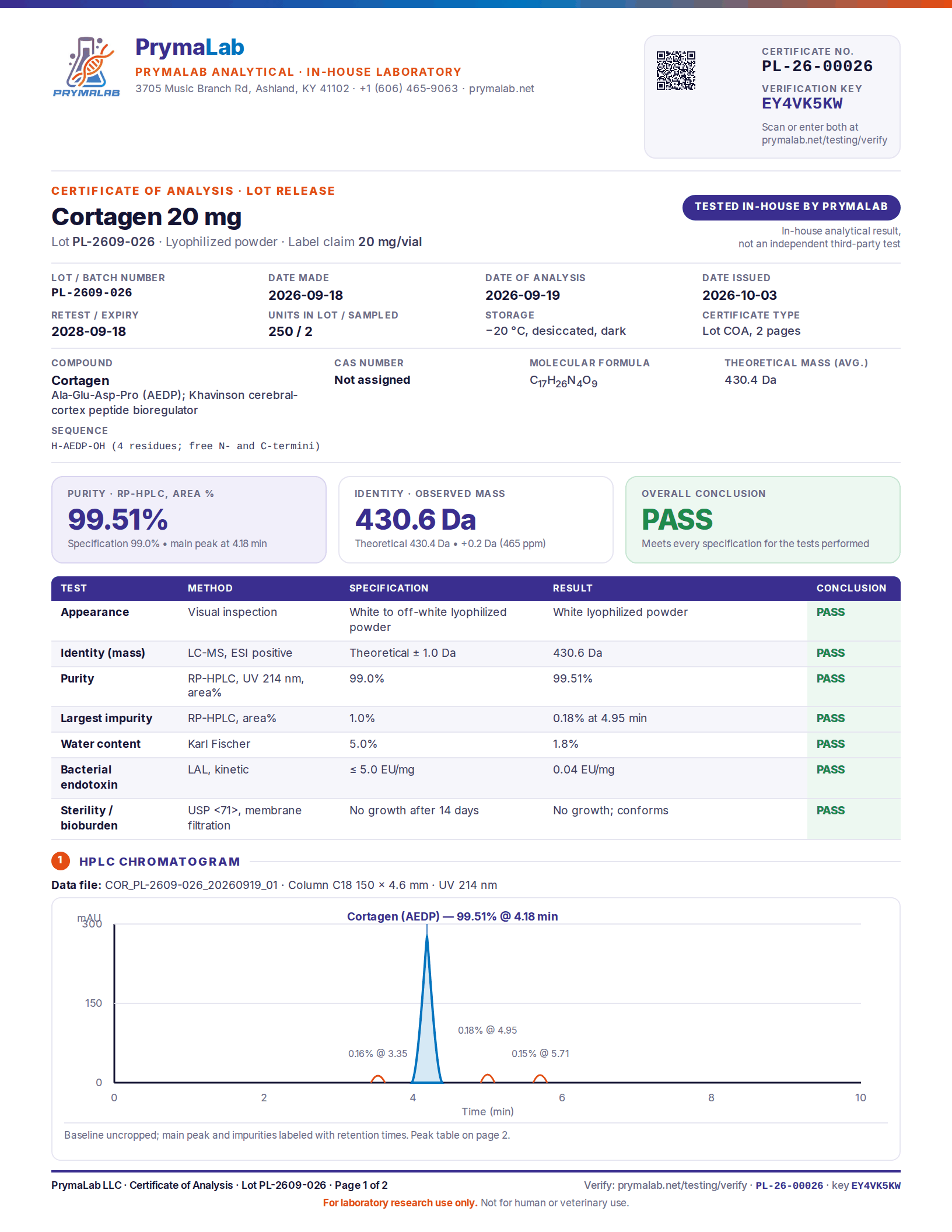
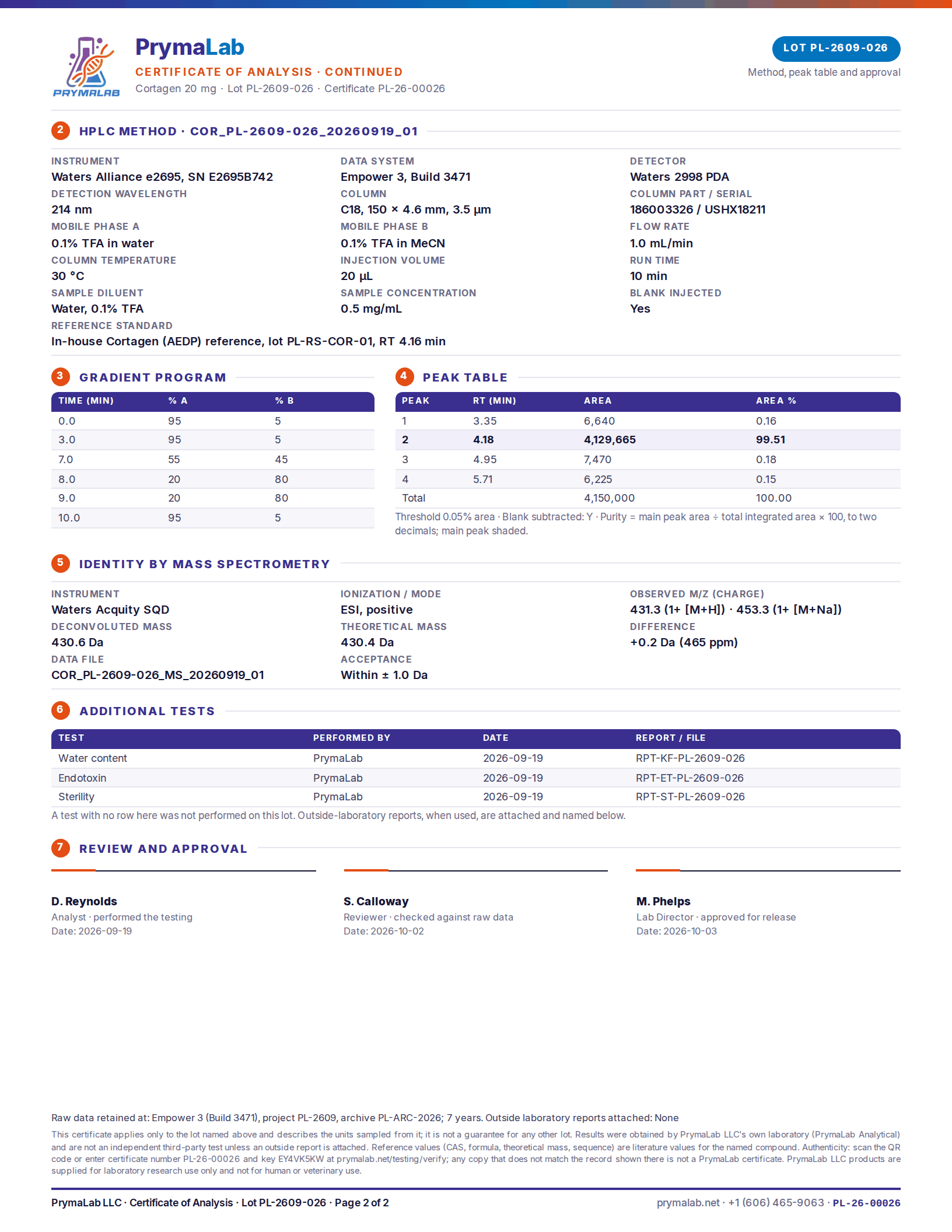
| Lot certificate | Results for the lot now shipping are in the certificate panel on this page |
| Safety data sheet | PL-SDS-043 |
What is in the vial
The lot certificate gives the sequence as H-AEDP-OH: alanine, glutamate, aspartate and proline with free termini, formula C17H26N4O9 and a theoretical mass of 430.4 Da. No CAS number has been assigned. At that mass the 20 mg fill is about 46 µmol of peptide, slightly less once the residual water reported on the certificate is allowed for.
The aspartate-proline bond is the chemically weak point. In dilute hydrochloric acid at 100 to 110 °C, Asp-Pro bonds were 8 to 20 times more labile than other peptide bonds involving aspartate1, a quirk sequencing chemists had already met as anomalous Asp-Pro cleavage in 19702. Those are harsh conditions, far from cold storage, and no study has measured the rate for cortagen; keeping the sealed vial at −20 °C, dry and dark, as the certificate states, sidesteps the question. The same peptide is sold in solution as a Cortagen preloaded pen and a Cortagen nasal spray.
What the research covers
What it is
A review by Anisimov and Khavinson describes how their group isolated small peptides from different organs and tissues and then synthesised di-, tri- and tetrapeptide analogues of them from amino acids3. Cortagen is one of those tetrapeptides, linked by its developers to the cerebral cortex; like Pinealon, its sequence was derived from the composition of a cattle cortex preparation, Cortexin.
Nerve regeneration reports
The earliest cortagen papers concern peripheral nerve. Turchaninova, Kolosova, Malinin and colleagues reported on the effect of the tetrapeptide on regeneration of the sciatic nerve in 20004, and Kolosova and colleagues followed in 2002 with a report on a delayed effect of cortagen on the restoration of injured nerve function5. Both are reports of two to three pages in English translations of Russian journals, and neither has an abstract in the reference set used here, so their models and results are not summarised on this page.
Oxidative stress and chromatin
In rats, epithalon and cortagen lowered the content of lipid peroxidation products and reduced oxidative modification of proteins, while antioxidant activity in serum and cerebral cortex was suppressed at the same time6. That is a pattern of lower oxidative damage without a rise in measured antioxidant defences, reported in a one-sentence abstract. Without group sizes or tissue values in that abstract, the strength of the result cannot be judged from the reference alone6. A 2015 paper by Lezhava and colleagues in the International Journal of Peptide Research and Therapeutics examined epigenetic regulation of “aged” heterochromatin by cortagen7; as with the nerve papers, only its title is available here.
What is borrowed from sibling peptides
Much of what is said about cortagen’s mechanism comes from work on its relatives. Fluorescein-labelled Epitalon, Pinealon and Testagen entered the nucleus of HeLa cells, and these short peptides bound DNA fragments in a sequence-dependent way8. The same paper reported that these peptides discriminated between DNA sequences and appeared to recognise cytosine methylation8. Cortagen was not among the peptides tested, so the nuclear-entry and DNA-binding claims made for it are an extrapolation from Epitalon, Pinealon and Testagen.
What is not established
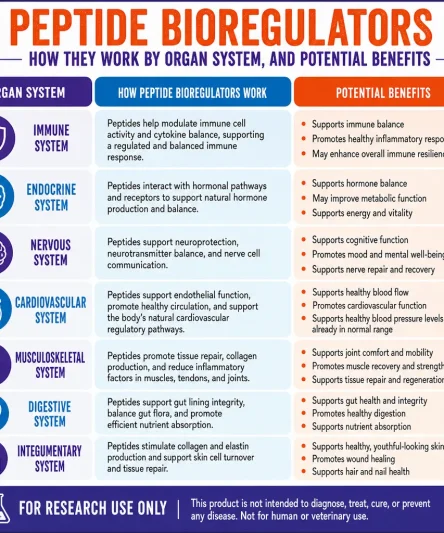
The cortagen record is small: a handful of short reports, most from the developers’ institute and its collaborators, several without an accessible abstract. The programme’s review reports longer lifespan and fewer tumours in rodents for “some peptide preparations” without naming cortagen in its abstract3, so lifespan claims cannot be carried over to this peptide. No controlled study in people has been published. Nothing here measured how the peptide is handled in the body, and no outside laboratory has repeated the nerve or oxidative stress findings. None of these papers used PrymaLab material. The peptide bioregulators overview places cortagen among the other Khavinson peptides.
How each lot is tested
Every lot is tested in PrymaLab’s own laboratory in Ashland, Kentucky before release: RP-HPLC for purity, LC-MS for identity, Karl Fischer titration for water, LAL for endotoxin and USP <71> for sterility. The results for the lot now shipping are in the certificate panel on this page, and the certificate number, key and QR code can be checked on the verify page. These are in-house results from PrymaLab Analytical, not an independent test, and the lab is not accredited to ISO 17025. The third-party testing guarantee on this page still applies: if any independent laboratory finds the wrong compound, or less than the stated purity or amount, the order is refunded and the cost of the test is reimbursed.
Frequently asked questions
What is Cortagen?
A synthetic tetrapeptide, Ala-Glu-Asp-Pro (AEDP), from Vladimir Khavinson's bioregulator programme, where it is assigned to the cerebral cortex. Its theoretical mass is 430.4 Da and it has no CAS number. It is a relative of Pinealon (Glu-Asp-Arg) and Epitalon (Ala-Glu-Asp-Gly), not a fragment or salt of either.
How do the vial, pen and spray differ?
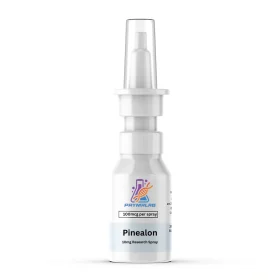
The vial holds 20 mg of freeze-dried peptide kept at −20 °C until the laboratory dissolves it. The pen holds 20 mg already in 3 mL of preserved solution, and the spray holds 20 mg in a metered bottle; both solutions are kept at 2 to 8 °C and never frozen.
How do I check the certificate for the vial I received?
Match the lot number on the vial to its certificate. The panel on this page shows the lot now shipping, with its RP-HPLC purity and an LC-MS mass that should sit close to 430.4 Da, and the verify page confirms any certificate by number and key.
How should the vial be stored?
Sealed at −20 °C, desiccated and dark. Let it warm to room temperature before opening so moisture does not settle on the powder. Solutions are kept at 2 to 8 °C, away from light, for a period your laboratory has established.
What does the research on cortagen actually show?
Two short Russian reports on sciatic nerve regeneration, a rat study of oxidative stress markers and a title-level paper on chromatin. The DNA-binding mechanism proposed for it was studied with sibling peptides. There are no controlled human studies, and none of the work used this product.
Is Cortagen for human use?
No. It is sold only for laboratory research, has no approval from the FDA or any other authority for human or veterinary use, and must not be given to people or animals.
References
- Marcus F. Preferential cleavage at aspartyl-prolyl peptide bonds in dilute acid. Int J Pept Protein Res. 1985;25(5):542-6. DOI · PubMed
- Piszkiewicz D, Landon M, Smith EL. Anomalous cleavage of aspartyl-proline peptide bonds during amino acid sequence determinations. Biochem Biophys Res Commun. 1970;40(5):1173-8. DOI · PubMed
- Anisimov VN, Khavinson VKh. Peptide bioregulation of aging: results and prospects. Biogerontology. 2010;11(2):139-49. DOI · PubMed
- Turchaninova LN, Kolosova LI, Malinin VV, et al. Effect of tetrapeptide cortagen on regeneration of sciatic nerve. Bulletin of Experimental Biology and Medicine. 2000;130(6):1172-1174. DOI
- Kolosova LI, Moiseeva AB, Turchaninova LN, et al. The delayed effect of cortagen on the restoration of injured nerve function. Dokl Biol Sci. 2002;384:183-4. DOI · PubMed
- Kozina LS. Effects of bioactive tetrapeptides on free-radical processes. Bull Exp Biol Med. 2007;143(6):744-6. DOI · PubMed
- Lezhava T, Monaselidze J, Jokhadze T, et al. Epigenetic Regulation of “Aged” Heterochromatin by Peptide Bioregulator Cortagen. International Journal of Peptide Research and Therapeutics. 2015;21(1):157-163. DOI
- Fedoreyeva LI, Kireev II, Khavinson VKh, et al. Penetration of short fluorescence-labeled peptides into the nucleus in HeLa cells and in vitro specific interaction of the peptides with deoxyribooligonucleotides and DNA. Biochemistry (Mosc). 2011;76(11):1210-9. DOI · PubMed
Research use only
For laboratory research use only. Cortagen Peptide 20mg is not a drug, food, cosmetic or dietary supplement, is not approved by the FDA or any comparable authority for human or veterinary use, and must not be given to people or animals. It is sold to qualified researchers and institutions, and the buyer is responsible for lawful handling and disposal.







Reviews
There are no reviews yet.