
Description
PrymaLab · Research use only
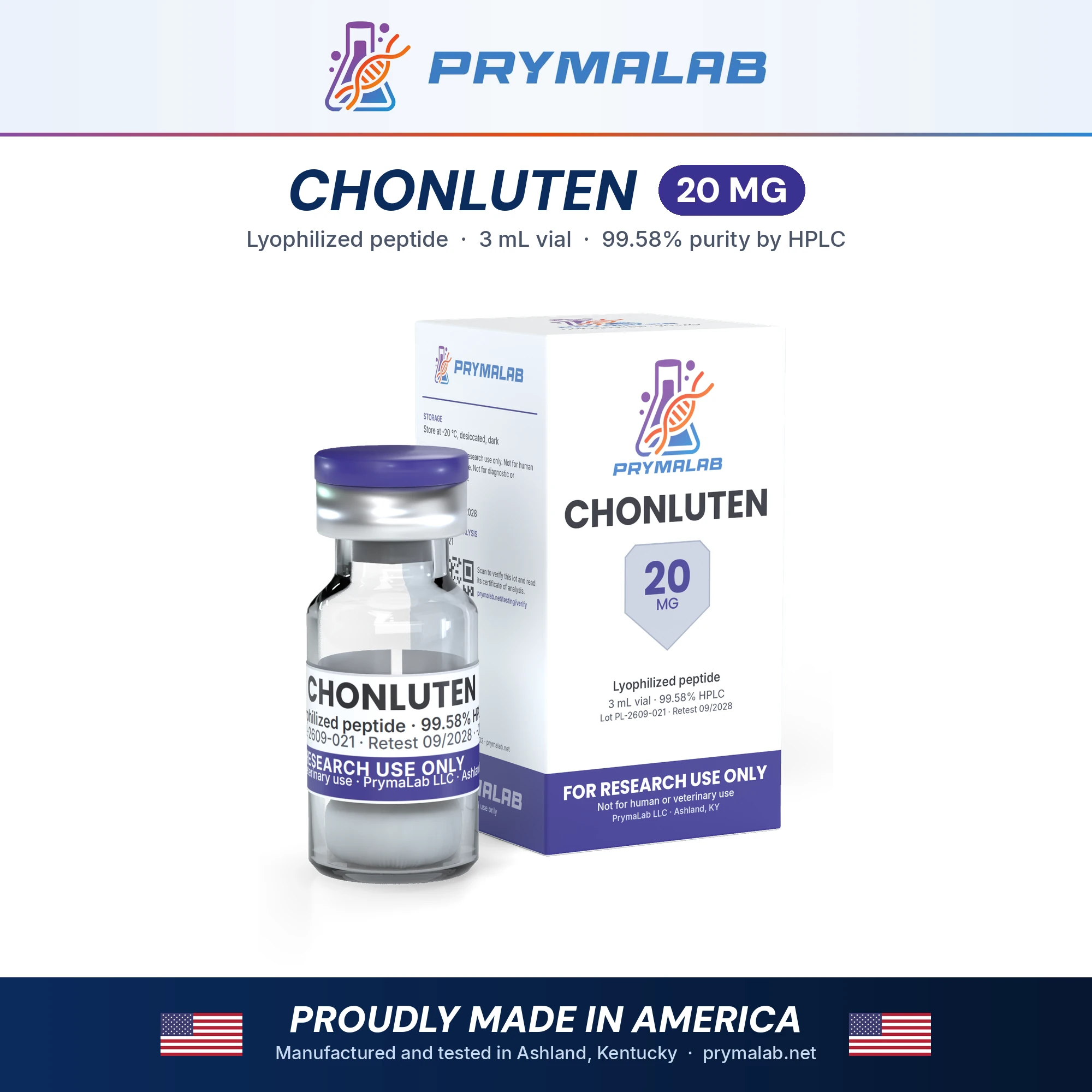
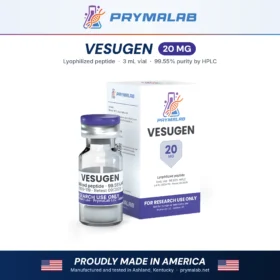
Chonluten Peptide 20mg
Glu-Asp-Gly (EDG), the Khavinson bronchial-mucosa tripeptide, in a 20 mg vial
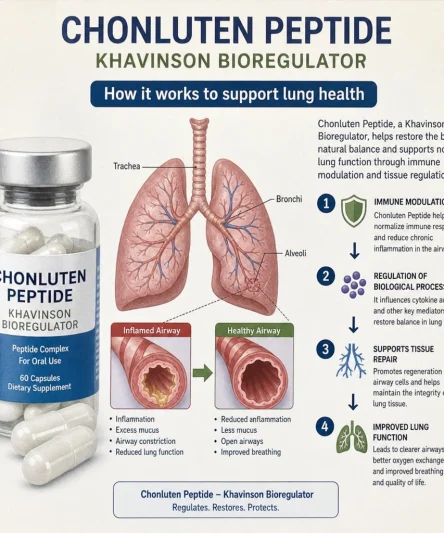
Chonluten is the synthetic tripeptide Glu-Asp-Gly (EDG), CAS 75007-24-8, assigned to the bronchial mucosa in Vladimir Khavinson’s series of short peptide bioregulators. This listing is a 20 mg vial of freeze-dried Chonluten with a theoretical mass of 319.3 Da. Its research record is short: a 2022 study of inflammatory signalling in a human monocyte cell line, a gene-expression paper on the peptide coded T-34, and the St Petersburg group’s general model of short peptides acting on DNA.
Specifications
| Property | Value |
|---|---|
| Compound | Chonluten Glu-Asp-Gly (EDG); Khavinson bronchial-mucosa peptide bioregulator |
| CAS number | 75007-24-8 |
| Molecular formula | C11H17N3O8 |
| Theoretical mass | 319.3 Da |
| Sequence / structure | H-EDG-OH (3 residues; free N- and C-termini) |
| Label claim | 20 mg/vial |
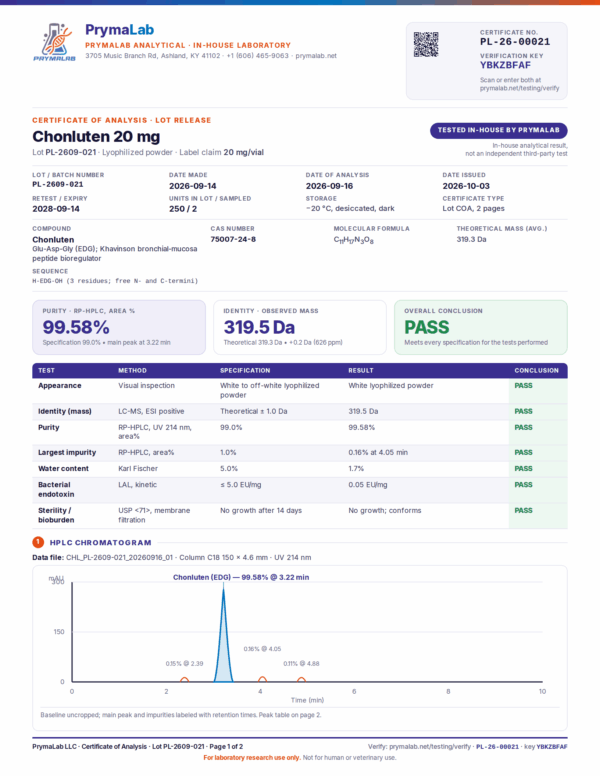
| Form | Lyophilized (freeze-dried) powder or cake in a sealed glass vial with a rubber stopper and aluminium crimp cap |
| Storage, sealed | −20 °C, desiccated, dark |
| Purity specification | 99.0% or higher by RP-HPLC |
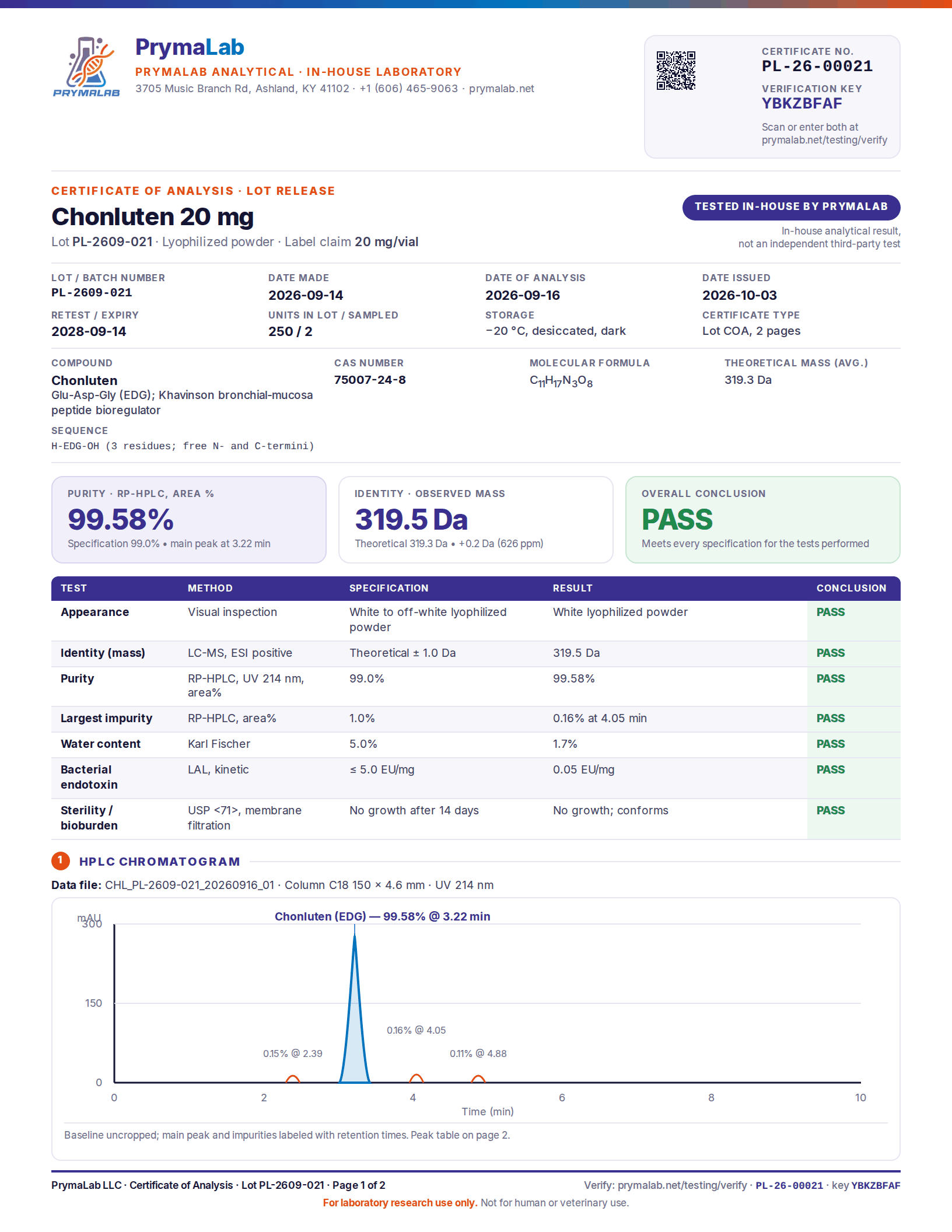
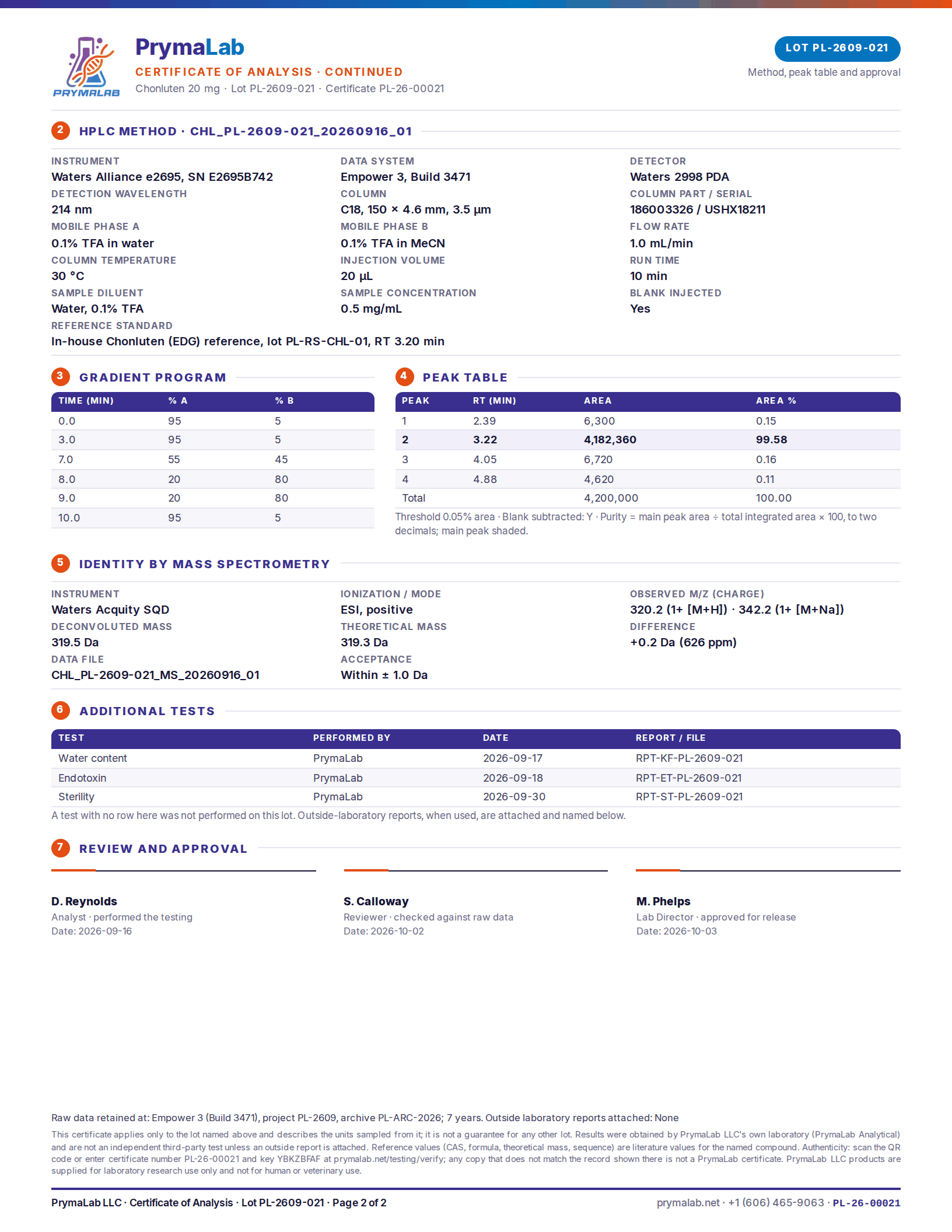
| Lot certificate | Results for the lot now shipping are in the certificate panel on this page |
| Safety data sheet | PL-SDS-036 |
Chonluten in the Khavinson series
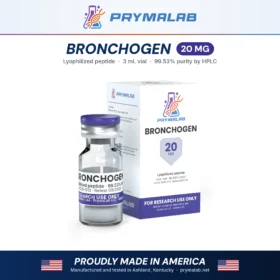
The vial holds H-EDG-OH: glutamic acid, aspartic acid and glycine with free ends, formula C11H17N3O8. Its theoretical mass of 319.3 Da is the value to read against the LC-MS identity result on the lot certificate. In molar terms 20 mg of Chonluten is about 63 µmol, a little less once the certificate’s water figure is allowed for. The sequence is Epitalon, Ala-Glu-Asp-Gly1, without its first residue. Chonluten is also distinct from Bronchogen, the tetrapeptide Ala-Glu-Asp-Leu that the series assigns to the airways as well1. The three peptides overlap in sequence but have separate literatures, and a finding for one is not a finding for the others.
Handling notes
Two features of this short sequence bear on how it behaves once dissolved. The Asp-Gly bond belongs to the Asp-Xaa linkages that can close into a cyclic succinimide and reopen as isoaspartate, one of the main routes of spontaneous damage to peptides and proteins under physiological conditions2. In a model hexapeptide containing Asp-Gly, Oliyai and Borchardt found that strong acid mainly cleaved the Asp-Gly bond, while at pH 4 and 5 isomerisation and cleavage ran side by side3. An N-terminal glutamic acid can also cyclise to pyroglutamic acid, which in antibody studies formed least at pH 6.2 and more at pH 4 and 84. All three studies describe reactions in aqueous solution. Isomerisation leaves the mass unchanged, so an LC-MS identity check alone would not reveal it.
What the research covers
What Chonluten is and the model behind it
Chonluten is one of the synthetic short peptides from Khavinson’s programme, whose peptides, according to the 2022 study described below, were first isolated from animal tissues and found to be organ specific5. The group’s 2021 systematic review sets out how it thinks such peptides work: chains of two to seven residues enter the nucleus and nucleolus, interact with nucleosomes, histones and single- and double-stranded DNA, and regulate gene expression and DNA methylation6. Fedoreyeva and colleagues supplied part of the evidence, showing labelled short peptides inside HeLa cell nuclei and sequence-dependent interactions with labelled DNA fragments1. Chonluten is not named among the peptides in that abstract.
A monocyte and macrophage cell line
The most detailed study is a 2022 paper by Avolio and colleagues, with Khavinson among the authors, which tested Epitalon, Vilon, Thymogen, Thymalin and Chonluten on the human monocytic cell line THP-15. All five increased tyrosine phosphorylation of mitogen-activated cytoplasmic kinases. Chonluten, described in the paper as derived from bronchial epithelial cells, inhibited TNF production by monocytes exposed to bacterial lipopolysaccharide, which the authors linked to a documented mechanism of TNF tolerance5. After the cells had been differentiated into macrophages, all five peptides inhibited LPS-stimulated expression of TNF and IL-65.
Gene expression in a gastric ulcer setting
The Chonluten guide identifies EDG with the code T-34. A 2012 paper by Khavinson, Lin’kova and colleagues described T-34 as regulating mRNA expression of genes for antioxidant and anti-inflammatory proteins in the context of gastric ulcer, and said it normalised the synthesis of those proteins7. The abstract gives no species, model details or numbers, and it concerns the stomach rather than the airways.
What is not established
No study among these references measured Chonluten in bronchial cells, lung tissue or a living animal, and there are no human data. The airway work in the same programme mostly used a different peptide: Khavinson, Tendler, Vanyushin and colleagues tested the tetrapeptide ADEL in human embryonic bronchial epithelial cultures and reported changes in proliferation markers and in genes for airway epithelial differentiation8. That result belongs to ADEL, not to Chonluten. The respiratory assignment of Chonluten rests on the programme’s tissue naming and on the THP-1 study, and most of the work shares authors with Khavinson’s group, much of it published in Bulletin of Experimental Biology and Medicine, the English edition of a Russian journal.
How each lot is tested
Every lot is tested in PrymaLab’s own laboratory in Ashland, Kentucky before release: RP-HPLC for purity, LC-MS for identity, Karl Fischer titration for water, LAL for endotoxin and USP <71> for sterility. The results for the lot now shipping are in the certificate panel on this page, and the certificate number, key and QR code can be checked on the verify page. These are in-house results from PrymaLab Analytical, not an independent test, and the lab is not accredited to ISO 17025. The third-party testing guarantee on this page still applies: if any independent laboratory finds the wrong compound, or less than the stated purity or amount, the order is refunded and the cost of the test is reimbursed.
Frequently asked questions
How is Chonluten related to Epitalon and Bronchogen?
Chonluten (Glu-Asp-Gly) is Epitalon (Ala-Glu-Asp-Gly) without the N-terminal alanine. Bronchogen is a separate tetrapeptide that the series also assigns to the airways. The three have different sequences and masses and their own small literatures, so findings for one do not carry over to the others.
How do I check the certificate for my vial?
Find the lot number on the vial label. The certificate panel on this page shows the lot currently shipping, the testing results page lists earlier lots, and the verify page confirms any certificate from its number and key.
How should Chonluten be stored before and after reconstitution?
Keep the sealed vial at −20 °C, dry and away from light, and let it warm to room temperature before opening. After reconstitution, hold the solution at 2 to 8 °C, protected from light, for a period your lab has set. The Asp-Gly bond is one reason not to keep solutions longer than needed.
What has Chonluten been shown to do?
In one human monocyte cell line it reduced TNF release after a bacterial challenge, and a gene-expression paper on T-34 concerned gastric ulcer. Nothing among the references here tested it in lung tissue, in animals or in people.
Is Chonluten for human or veterinary use?
No. Chonluten from PrymaLab is a research chemical for laboratory use only. It is not approved as a drug or supplement by the FDA or any other authority and must not be given to people or animals.
References
- Fedoreyeva LI, Kireev II, Khavinson VKh, et al. Penetration of short fluorescence-labeled peptides into the nucleus in HeLa cells and in vitro specific interaction of the peptides with deoxyribooligonucleotides and DNA. Biochemistry (Mosc). 2011;76(11):1210-9. DOI · PubMed
- Reissner KJ, Aswad DW. Deamidation and isoaspartate formation in proteins: unwanted alterations or surreptitious signals?. Cell Mol Life Sci. 2003;60(7):1281-95. DOI · PubMed
- Oliyai C, Borchardt RT. Chemical pathways of peptide degradation. IV. Pathways, kinetics, and mechanism of degradation of an aspartyl residue in a model hexapeptide. Pharm Res. 1993;10(1):95-102. DOI · PubMed
- Chelius D, Jing K, Lueras A, et al. Formation of pyroglutamic acid from N-terminal glutamic acid in immunoglobulin gamma antibodies. Anal Chem. 2006;78(7):2370-6. DOI · PubMed
- Avolio F, Martinotti S, Khavinson VK, et al. Peptides Regulating Proliferative Activity and Inflammatory Pathways in the Monocyte/Macrophage THP-1 Cell Line. Int J Mol Sci. 2022;23(7). DOI · PubMed
- Khavinson VK, Popovich IG, Linkova NS, et al. Peptide Regulation of Gene Expression: A Systematic Review. Molecules. 2021;26(22). DOI · PubMed
- Khavinson VKh, Lin'kova NS, Dudkov AV, et al. Peptidergic regulation of expression of genes encoding antioxidant and anti-inflammatory proteins. Bull Exp Biol Med. 2012;152(5):615-8. DOI · PubMed
- Khavinson VKh, Tendler SM, Vanyushin BF, et al. Peptide regulation of gene expression and protein synthesis in bronchial epithelium. Lung. 2014;192(5):781-91. DOI · PubMed
Research use only
For laboratory research use only. Chonluten Peptide 20mg is not a drug, food, cosmetic or dietary supplement, is not approved by the FDA or any comparable authority for human or veterinary use, and must not be given to people or animals. It is sold to qualified researchers and institutions, and the buyer is responsible for lawful handling and disposal.
Other formats of Chonluten
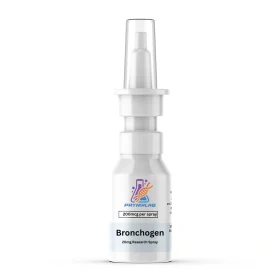
Chonluten is also stocked as Chonluten 20mg Nasal Spray and Chonluten 20mg preloaded 3ml pen. Each listing states its own quantity and concentration, and the pen and vial comparison explains what changes between formats.







4 reviews for Chonluten Peptide 20mg