
Description
PrymaLab · Research use only
Testagen Peptide 20mg
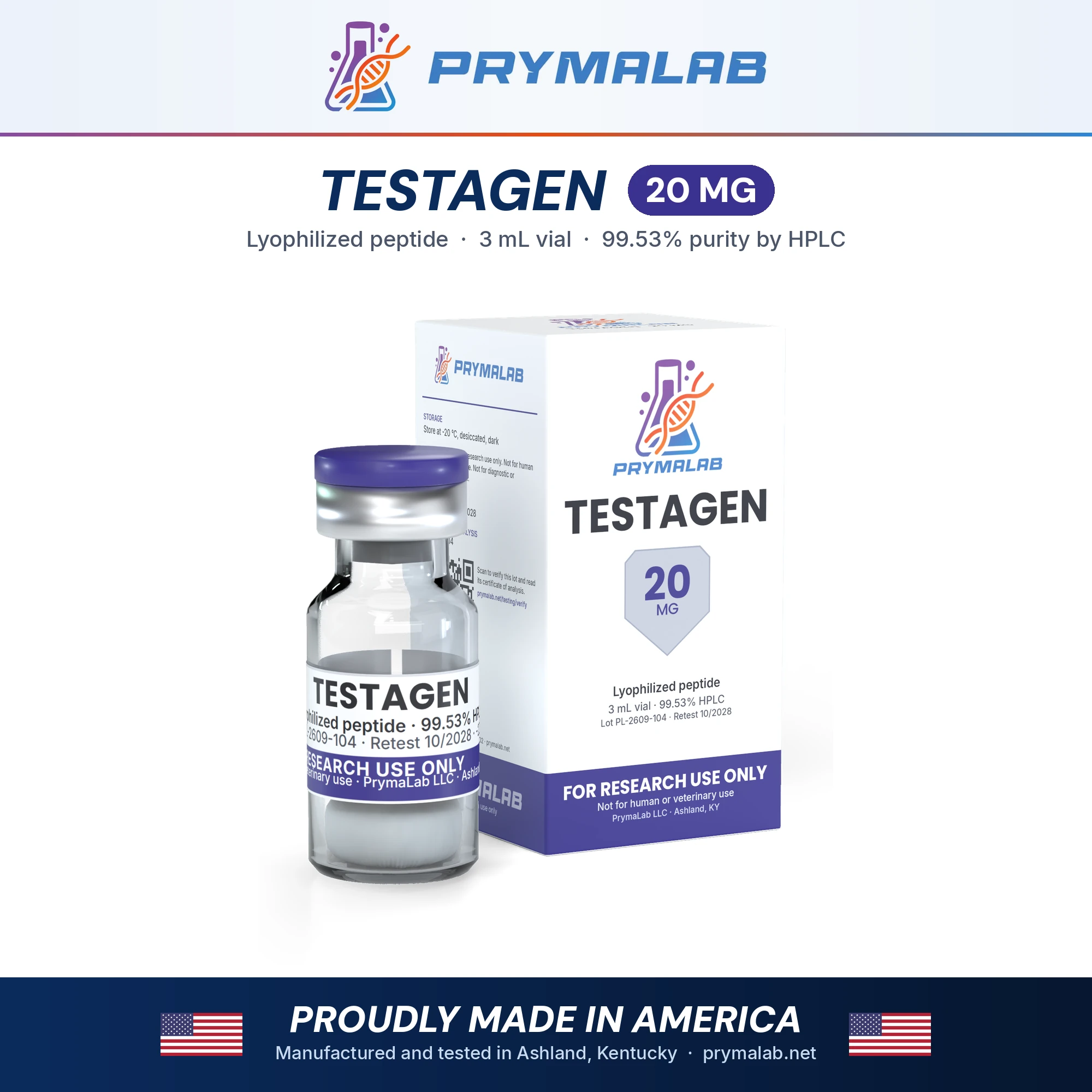
Lys-Glu-Asp-Gly (KEDG) tetrapeptide bioregulator, 20 mg freeze-dried per vial
Testagen is the tetrapeptide Lys-Glu-Asp-Gly (KEDG), a synthetic bioregulator from Vladimir Khavinson’s St Petersburg series that carries a testicular name. This listing is a 20 mg vial of freeze-dried Testagen with a lot certificate. The published work that names the KEDG sequence is small and does not match that name: pituitary and thyroid hormone studies in chickens and hens, a cell-uptake experiment in HeLa cells, and the group’s broader reviews of short peptides and gene regulation.
Specifications
| Property | Value |
|---|---|
| Compound | Testagen Lys-Glu-Asp-Gly (KEDG); Khavinson testicular peptide bioregulator |
| CAS number | Not assigned |
| Molecular formula | C17H29N5O9 |
| Theoretical mass | 447.4 Da |
| Sequence / structure | H-KEDG-OH (4 residues; free N- and C-termini) |
| Label claim | 20 mg/vial |
| Form | Lyophilized (freeze-dried) powder or cake in a sealed glass vial with a rubber stopper and aluminium crimp cap |
| Storage, sealed | −20 °C, desiccated, dark |
| Purity specification | 99.0% or higher by RP-HPLC |
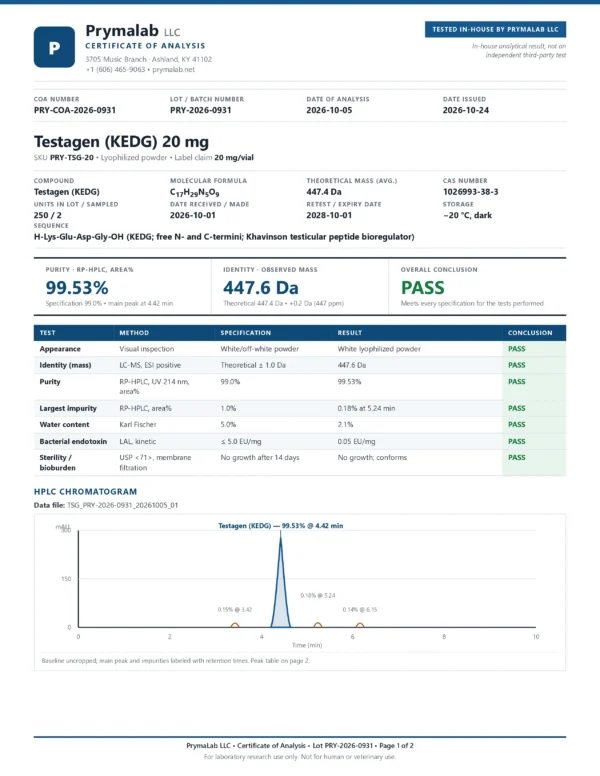
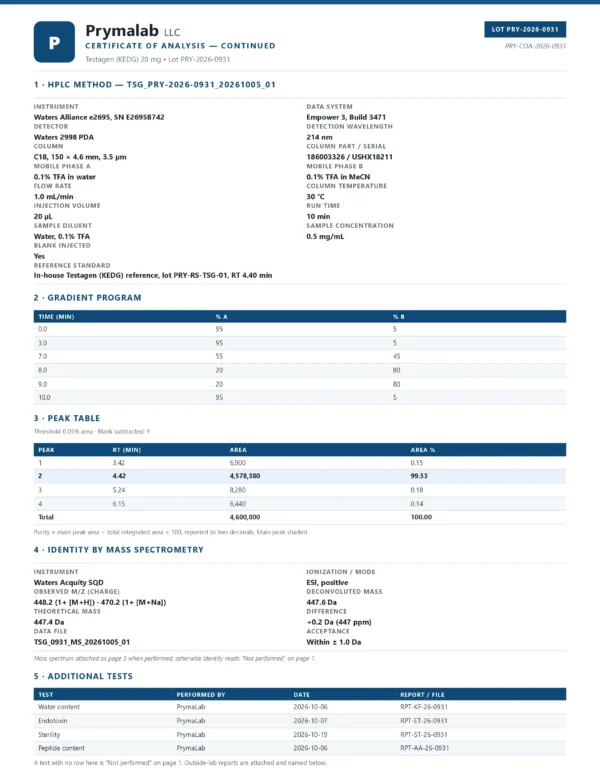
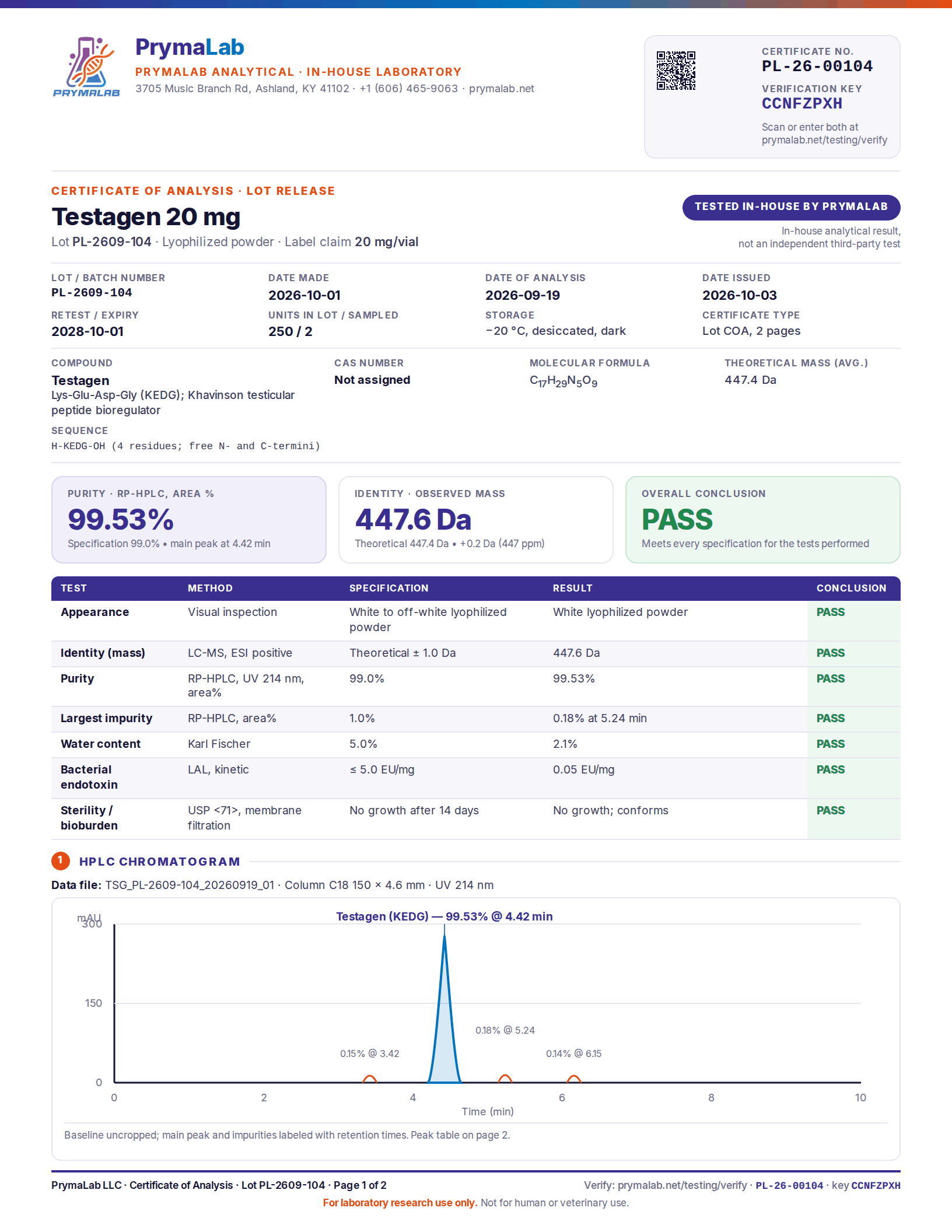
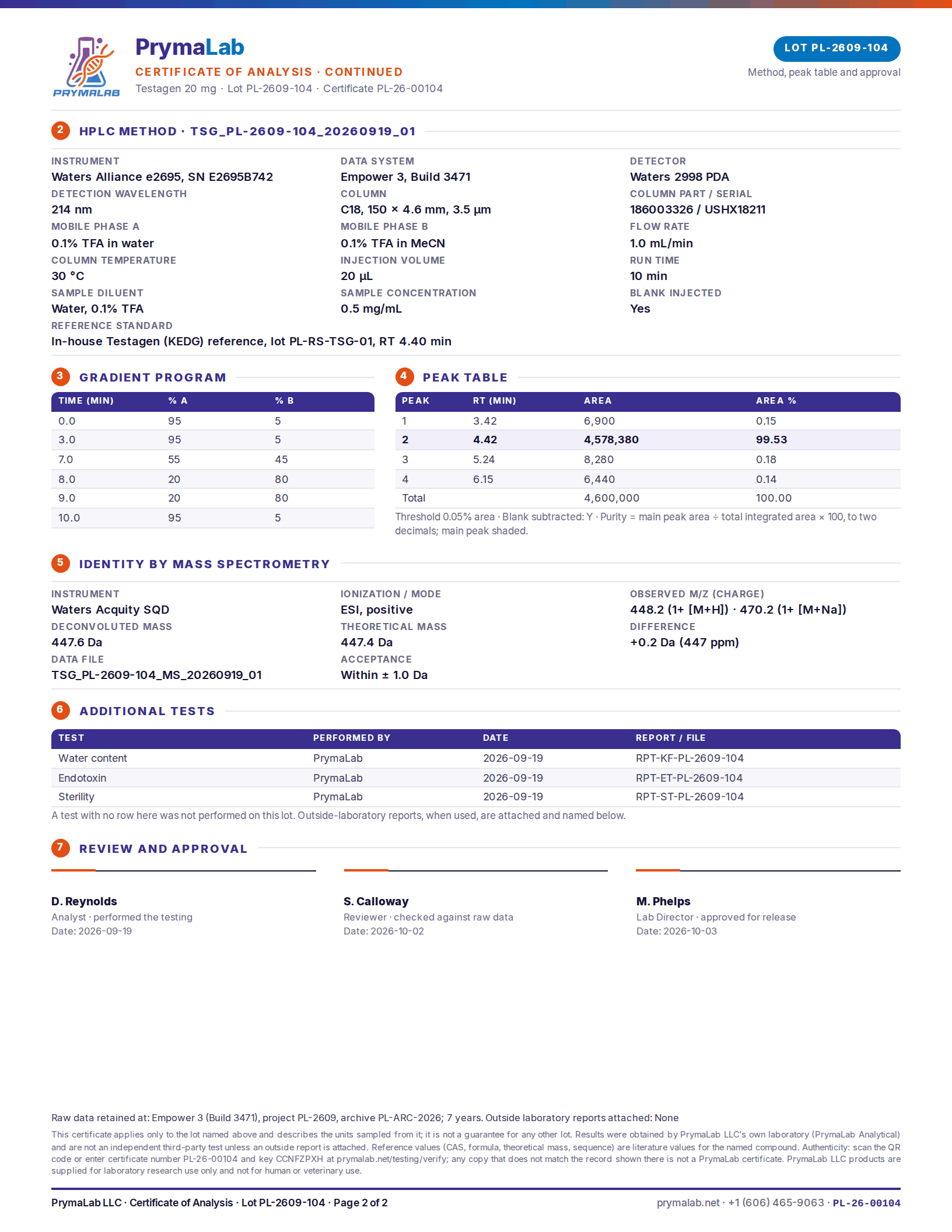
| Lot certificate | Results for the lot now shipping are in the certificate panel on this page |
| Safety data sheet | PL-SDS-165 |
Testagen, Epitalon and the Lys-Glu-Asp family
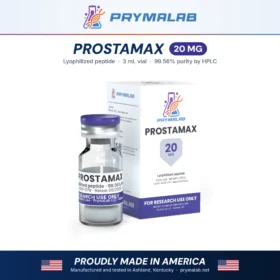
The certificate gives the sequence as H-Lys-Glu-Asp-Gly-OH: four residues with free ends, formula C17H29N5O9 and theoretical mass 447.4 Da, with no CAS number assigned. Two neighbours matter when reading the literature. Epitalon is Ala-Glu-Asp-Gly1, so the two tetrapeptides differ only in the first residue, and the bird studies tested them side by side2,3. Testagen also extends Vesugen’s Lys-Glu-Asp by one glycine, the same pattern that gives Prostamax its proline and Pancragen its tryptophan.
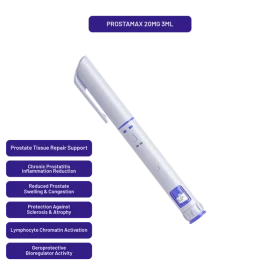
Twenty milligrams of a 447.4 Da peptide is about 45 µmol, a little less after the water content on the certificate. Testagen is also sold in solution as a Testagen preloaded pen and a Testagen nasal spray.
What the research covers
A testicular name, a pituitary origin
Testagen comes from the programme of Vladimir Khavinson’s group at the St Petersburg Institute of Bioregulation and Gerontology, which isolated small peptides from organs and tissues and synthesised di-, tri- and tetrapeptide analogues of them4. The papers on the sequence itself tell a different story from the name. Kuznik and colleagues described Lys-Glu-Asp-Gly as synthesised from the amino acid composition of pituitary cytomedins, and more precisely of extracts from the anterior pituitary lobe2,3. None of the references on this page studied the testis.
Bird studies of the thyroid axis
In a 2008 paper, chickens whose pituitary had been removed soon after hatching were given KEDG or Ala-Glu-Asp-Gly; afterwards, concentrations of thyrotropic hormone and thyroid hormones rose and the structure of the thyroid gland recovered2. A 2011 follow-up used chickens hypophysectomised at five days old and old hens, and reported that both peptides significantly reduced the hormonal disturbances and thyroid changes caused by the surgery3. The normalising effect on thyrotropic and thyroid hormones was weaker in the old hens than in the chickens3. Neither abstract gives group sizes or effect sizes, and both come from the same group. Both studies used birds; no mammalian study of KEDG appears among these references.
Entry into cells
Testagen was one of three fluorescently labelled peptides, with Epitalon and Pinealon, that Fedoreyeva and colleagues followed in HeLa cells in 2011; the label appeared in the cytoplasm, nucleus and nucleolus1. In the same study, unlabelled short peptides changed the fluorescence of labelled DNA fragments to different degrees depending on their sequence, which the authors read as sequence-specific binding that could even register cytosine methylation1. The preference for CNG-containing DNA was reported for Epitalon, Pinealon and Bronchogen, not for Testagen1. The group’s 2021 systematic review builds its model of gene regulation by peptides of two to seven residues on work of this kind, describing such peptides as able to recognise sequences in gene promoters and to regulate DNA methylation5. It goes as far as suggesting that short peptides were among the first signalling molecules in evolution5.
What is not established
The name implies an action on the testis, and testosterone claims are often attached to it, but no paper cited here measured testicular tissue, sex hormones or fertility after KEDG. The bird studies concern the pituitary and thyroid, the HeLa experiment shows that a labelled tetrapeptide can enter a cancer cell line, and the reviews state a hypothesis. The experimental papers appeared in Russian journals published in English translation, the Bulletin of Experimental Biology and Medicine and Biochemistry (Moscow), and the reviews are by Khavinson and his co-authors. None of this work used PrymaLab material. The Testagen guide and the peptide bioregulators research overview give the programme’s wider context.
How each lot is tested
Every lot is tested in PrymaLab’s own laboratory in Ashland, Kentucky before release: RP-HPLC for purity, LC-MS for identity, Karl Fischer titration for water, LAL for endotoxin and USP <71> for sterility. The results for the lot now shipping are in the certificate panel on this page, and the certificate number, key and QR code can be checked on the verify page. These are in-house results from PrymaLab Analytical, not an independent test, and the lab is not accredited to ISO 17025. The third-party testing guarantee on this page still applies: if any independent laboratory finds the wrong compound, or less than the stated purity or amount, the order is refunded and the cost of the test is reimbursed.
Frequently asked questions
What is in the Testagen 20 mg vial?
20 mg of Testagen, the tetrapeptide H-Lys-Glu-Asp-Gly-OH with free ends, as white freeze-dried powder. The theoretical mass is 447.4 Da. The lot certificate reports RP-HPLC purity, LC-MS identity, water content, endotoxin and sterility for the lot now shipping.
Does Testagen contain testosterone or act like a SARM?
No. Testagen is a four-residue peptide and contains no steroid, and it is not a selective androgen receptor modulator. The papers cited here did not measure testosterone or any other sex hormone after KEDG; the hormones studied were thyrotropic and thyroid hormones in birds.
How is Testagen related to Epitalon?
Both are tetrapeptides ending in Glu-Asp-Gly. Testagen starts with lysine (KEDG) and Epitalon with alanine (AEDG). The bird studies of pituitary and thyroid function tested the two side by side, and both were among the labelled peptides in the same HeLa cell uptake experiment.
How should the vial be stored?
Keep it sealed at −20 °C, desiccated and dark. Warm the vial to room temperature before opening so that moisture does not settle on the powder. Solutions made from it belong at 2 to 8 °C, protected from light, and should be used within your laboratory's established period.
How do I check the certificate for the vial I received?
Find the lot number printed on the vial and compare it with the certificate panel on this page, which shows the lot now shipping. Certificates for older lots are on the testing results page, and the verify page confirms any certificate by number and key.
Can Testagen be used in people or animals?
No. It is sold for laboratory research only. Testagen is not approved by the FDA or any comparable authority for human or veterinary use and must not be given to people or animals.
References
- Fedoreyeva LI, Kireev II, Khavinson VKh, et al. Penetration of short fluorescence-labeled peptides into the nucleus in HeLa cells and in vitro specific interaction of the peptides with deoxyribooligonucleotides and DNA. Biochemistry (Mosc). 2011;76(11):1210-9. DOI · PubMed
- Kuznik BI, Pateyuk AV, Rusaeva NS. Effect of tetrapeptides Lys-Glu-Asp-Gly and Ala-Glu-Asp-Gly on the structure and function of the thyroid gland in neonatally hypophysectomized chickens. Bull Exp Biol Med. 2008;145(1):104-7. DOI · PubMed
- Kuznik BI, Pateyuk AV, Rusaeva NS, et al. Effects of peptides Lys-Glu-Asp-Gly and Ala-Glu-Asp-Gly on hormonal activity and structure of the thyroid gland in hypophysectomized young chickens and old hens. Bull Exp Biol Med. 2011;150(4):495-9. DOI · PubMed
- Anisimov VN, Khavinson VKh. Peptide bioregulation of aging: results and prospects. Biogerontology. 2010;11(2):139-49. DOI · PubMed
- Khavinson VK, Popovich IG, Linkova NS, et al. Peptide Regulation of Gene Expression: A Systematic Review. Molecules. 2021;26(22). DOI · PubMed
Research use only
For laboratory research use only. Testagen Peptide 20mg is not a drug, food, cosmetic or dietary supplement, is not approved by the FDA or any comparable authority for human or veterinary use, and must not be given to people or animals. It is sold to qualified researchers and institutions, and the buyer is responsible for lawful handling and disposal.






2 reviews for Testagen Peptide 20mg