Description
PrymaLab · Research Use Only
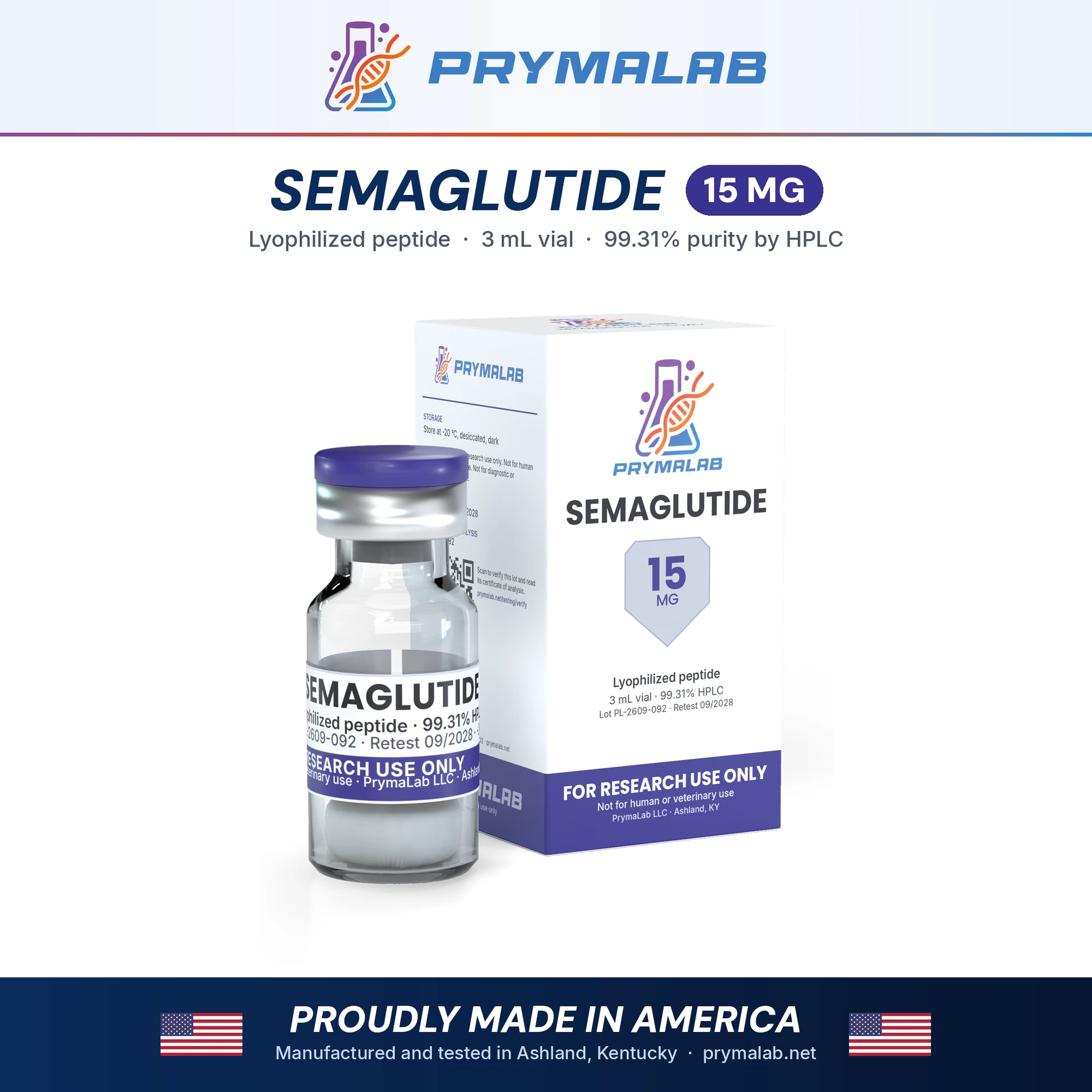
Semaglutide 15mg
About 3.6 micromoles · A sixth of the mass is not in the sequence
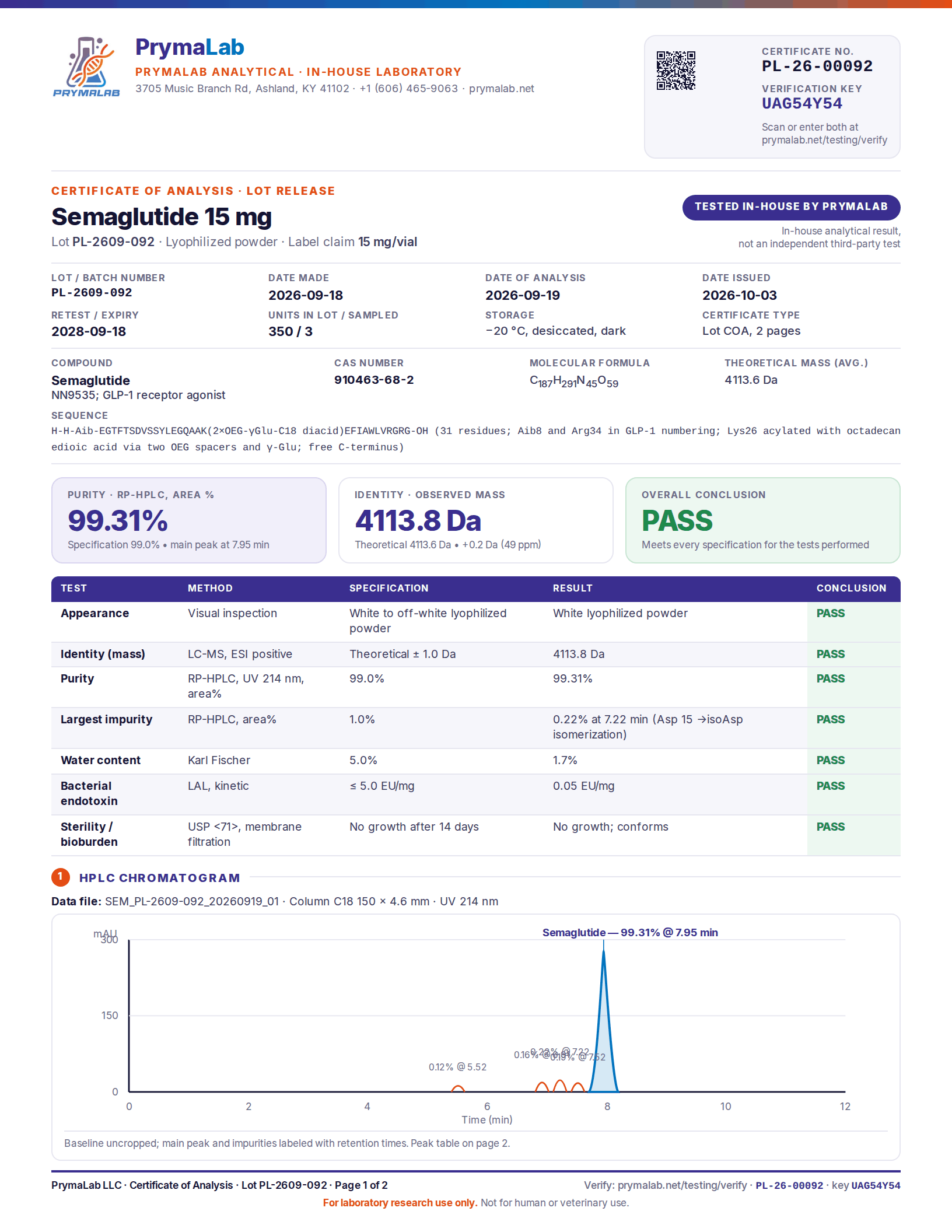
A semaglutide 15mg certificate will give you a 31 residue sequence and an observed mass around 4,114. Those two numbers do not reconcile from the sequence alone, because roughly 650 daltons of the molecule is a side chain built from things that are not amino acids: a gamma-linked glutamate, two ethylene glycol spacers and a C18 diacid.
Specification Table
| Property | Value |
|---|---|
| Product format | Lyophilised powder, single vial |
| Peptide content | 15 mg |
| Molar content | Approximately 3.6 µmol at roughly 4,114 g/mol |
| CAS | 910463-68-2 |
| Residue count quoted on certificates | 31 |
| Position 8 | Aib, an aminoisobutyric acid, substituted for alanine |
| Position 34 | Arginine, substituted for the native lysine |
| Acylation site | Lysine 26 |
| Side chain construction | Gamma-glutamate, then two 8-amino-3,6-dioxaoctanoic acid spacers, then a C18 diacid |
| Approximate side chain mass | Around 650 Da |
| Share of molecular weight in the side chain | Roughly 16 percent |
| Share described by the sequence line | Roughly 84 percent |
| Consequence | Mass calculated from the sequence alone is wrong by about 650 daltons |
| Storage, lyophilised | -20°C, sealed, dark and dry |
| Storage, reconstituted | 2-8°C, protected from light |
| Regulatory status | No approved human or veterinary formulation is supplied here |
Why Does the Sequence Not Account for the Mass?
Because four components of semaglutide 15mg are not amino acids, and sequence notation has no way to write them.
One letter code can express twenty standard residues. Three letter code can express a few more, including Aib at position 8, which is already a stretch of the convention.
What neither can express is a gamma-linked glutamate hanging off a lysine side chain, two ethylene glycol spacer units, or a fatty diacid on the end of that.
So a certificate writes the sequence it can write and then either names the modification in prose or leaves it implied by the compound name.
Add the four side chain pieces, subtract the waters lost in joining them, and you get somewhere around 650 daltons. On a molecule of 4,114 that is about one part in six.
The sequence line is therefore an accurate description of 84 percent of what is in the vial.
Does That Cause a Real Problem?
It causes one specific problem on a semaglutide 15mg certificate, of the kind found late.
Automated tools that calculate a peptide mass from a sequence will return roughly 3,465 rather than 4,114. Anybody checking a certificate that way concludes the observed mass is 650 daltons too high and starts asking the wrong questions.
The reverse also happens. A supplier who calculates from the sequence and reports that figure as the expected mass has published a number nobody can match.
Neither is a chemistry error. Both are notation errors, and they are avoidable by stating the full construct rather than the residue count.
The Aib substitution at position 8 has the same character on a smaller scale, and the 10mg page in this catalogue covers what that does to verification.
There is a version of this that catches people out in reverse. Somebody sees an observed mass of 4,114, looks up semaglutide, finds 4,114, and concludes the material is confirmed.
It is not. Nominal mass agreement confirms that something weighing 4,114 daltons is present, and there are other ways to arrive at that number than being semaglutide.
Sequence confirmation is what closes that gap, and on an acylated peptide it means fragmenting the molecule rather than weighing it whole.
What Should a Certificate Say Instead?
The residue sequence, and then the side chain described explicitly, on any semaglutide 15mg certificate.
Something of the form: 31 residue backbone with Aib at position 8 and arginine at 34, acylated at lysine 26 via gamma-Glu and two OEG spacers to a C18 diacid.
That sentence is unambiguous and it lets anybody reconcile the observed mass without guessing.
A calculated mass for the whole construct belongs next to it, so the observed figure has something to be compared against.
What does not belong is a bare residue count with a mass beside it and no explanation of the gap.
I would ask for the full construct in writing before ordering from a new supplier. It is a one-line request and the answer tells you whether the person on the other end understands what they are selling.
A worked example, since the argument is easier to see with numbers on it.
Take the observed mass of 4,114. Subtract the side chain at roughly 650 and you are near 3,465, which is what a sequence calculator returns for the backbone alone.
Neither figure is wrong. They describe different objects, and a certificate that gives one without saying which has handed the reader a puzzle.
Write both. Backbone, side chain, total. Three numbers on one line, and nobody has to reverse engineer anything from a residue count.
I have not seen a research certificate do this. There is no reason one could not.
The same three-number layout would help on tirzepatide, on cagrilintide, and on anything else here carrying an acyl chain. A formatting change, not an analytical one. Which is why it costs nothing and never happens.
What Does a Semaglutide 15mg Vial Give You?
A semaglutide 15mg vial is about 3.6 micromoles, the smallest of the useful fills in this range and still generous.
Reconstituted into 3.6 millilitres it is a 1 millimolar stock, which is a convenient round figure and a reason to pick that volume.
Published in vitro work runs orders of magnitude below that. The stock sits at the top of a long dilution series rather than anywhere near a working concentration.
The range here runs 5, 10, 15, 20 and 30 milligrams. Fifteen sits between the exploratory sizes and the committed ones.
It is the fill I would pick for a study that has finished piloting and has not yet scaled, which is a narrow window and a real one.
What Does the Side Chain Do at the Bench?
It makes the molecule surface active, which is the practical consequence of all that mass in a semaglutide 15mg vial.
A C18 diacid on two glycol spacers is a long hydrophobic tail on a flexible arm. In a biological setting it binds albumin. That is the design intent, and it is the reason the tail is there at all. In a tube it binds plastic and air-water interfaces, which is not.
So the handling advice on every acylated peptide page in this catalogue traces back to this side chain rather than to the peptide part.
Do not shake, because foam is air-water interface. Use low-binding consumables throughout, because that tail adsorbs to ordinary polypropylene at the concentrations this work runs at. Aliquot rather than drawing repeatedly, because every draw makes fresh interface.
None of that follows from the 31 residues. All of it follows from the 650 daltons that the sequence line does not mention.
What Should the Certificate Show?
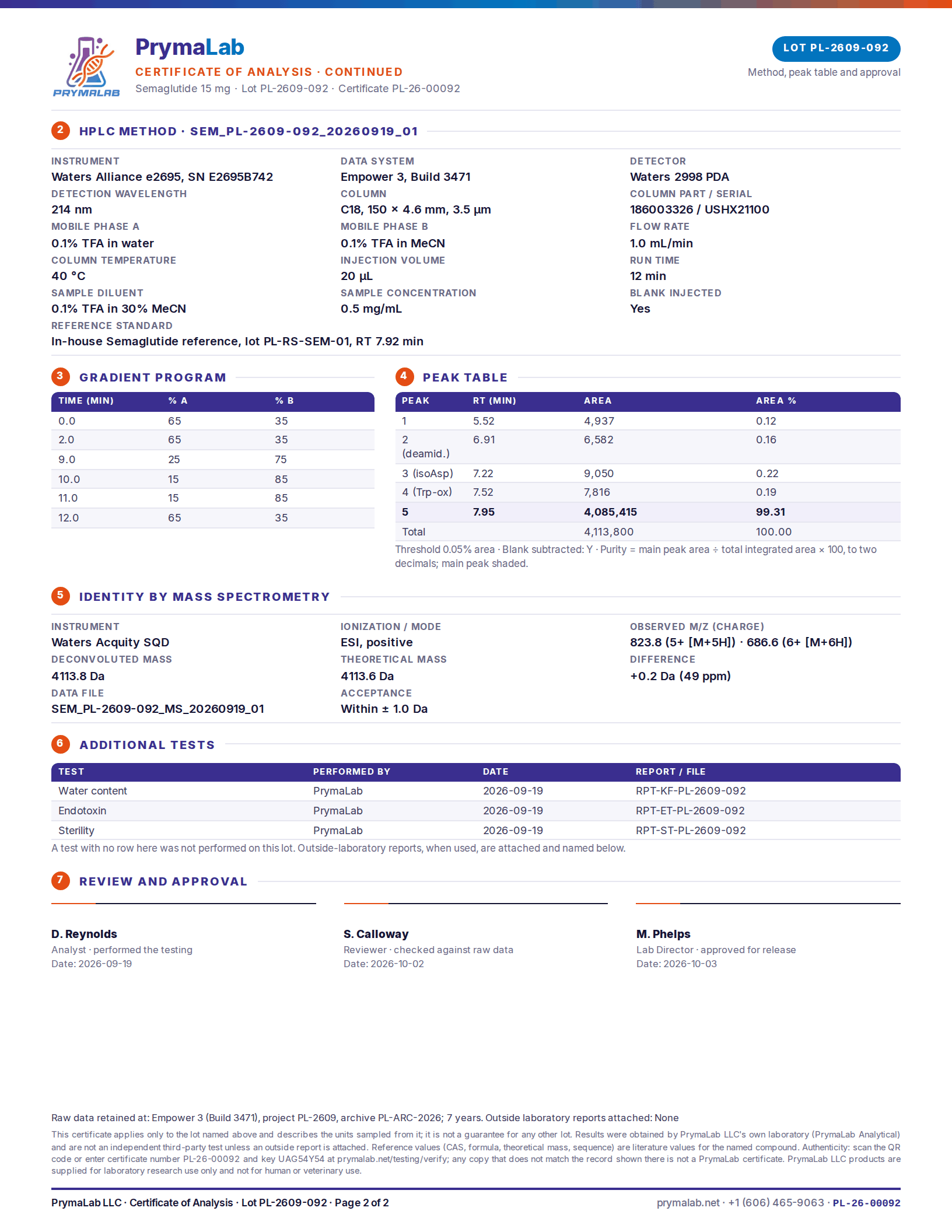
Net peptide content, with the determination named.
The 31 residue sequence, with Aib at position 8 and the substitution at position 34 both stated.
The full acylation construct, written out in words rather than implied by the compound name.
A calculated mass for the whole molecule. The observed mass beside it.
Chromatographic purity with column and gradient, and aggregate content by size exclusion.
Salt form, with the lot number and manufacturing date beside it.
Where Else Does This Notation Problem Appear?
On every acylated peptide here, not only on semaglutide 15mg, and on a few things that are not peptides at all.
Tirzepatide carries a C20 diacid on a linker at lysine 20, and the same arithmetic applies: the residue count does not account for the side chain.
Cagrilintide is an acylated amylin analogue with the same structural pattern.
GHK-Cu is a worse case, because the copper is a coordinated metal ion rather than a covalent addition and no sequence notation has ever tried to express one.
The rule that falls out is short. When a compound name contains an acylation, a chelate or a spacer, do not calculate mass from sequence.
That covers a surprising fraction of what modern peptide chemistry produces, and the certificates in this market have not caught up with it.
Is Any of This the Supplier’s Fault?
Partly.
The notation limitation is real and nobody invented it: there is genuinely no standard way to write a gamma-linked glutamate and two glycol spacers in one-letter code, and chemists have been working around that for decades.
What is avoidable is the silence.
A certificate that gives a residue count and a mass without reconciling them has left a gap the reader has to notice, work out, and resolve, and most readers will do none of those three because they have no reason to suspect a gap exists.
One sentence closes it.
So the fault is not in the chemistry or the convention. It is in choosing brevity on the one line where brevity costs the reader something.
That is a small complaint.
It is also the kind that separates a certificate written by somebody who understands the molecule from one produced by filling in a template, and on a purchase of this size that distinction is worth paying attention to.
How Should the Vial Be Handled?
Handle a semaglutide 15mg vial as an acylated peptide, which here means attending to the tail rather than the backbone.
Room temperature before opening, sealed.
Diluent down the wall and gentle rotation. Shaking produces foam and foam is where surface active molecules go to denature.
Aliquot immediately into single-use volumes, then hold those at 2 to 8 degrees rather than drawing repeatedly from one tube.
Never freeze it.
Low-binding consumables from the first dilution, because losses at the dilute end of a series are not small on a molecule with a C18 tail.
Published Literature
Full citations for the work named above, each confirmed against the publisher record. The design paper describes the side chain construction that this page is about, in more detail than any certificate will.
- Lau J, Bloch P, Schaffer L, Pettersson I, Spetzler J, Kofoed J, et al. Journal of Medicinal Chemistry. 2015;58(18):7370-7380. DOI: 10.1021/acs.jmedchem.5b00726
- Willard FS, Douros JD, Gabe MB, Showalter AD, Wainscott DB, Suter TM, et al. JCI Insight. 2020;5(17):e140532. DOI: 10.1172/jci.insight.140532
- Manning MC, Chou DK, Murphy BM, Payne RW, Katayama DS. Pharmaceutical Research. 2010;27(4):544-575. DOI: 10.1007/s11095-009-0045-6
Frequently Asked Questions
What is a semaglutide 15mg vial?
A lyophilised research vial holding 15 milligrams of semaglutide, about 3.6 micromoles at roughly 4,114 g/mol. Middle of five fill sizes here, supplied for laboratory research only.
Why does the sequence not account for the full mass?
Because about 650 daltons of the molecule is a side chain made of things sequence notation cannot write: a gamma-linked glutamate, two ethylene glycol spacer units and a C18 diacid. The 31 residue sequence describes roughly 84 percent of the molecular weight.
What goes wrong if I calculate mass from the sequence?
You get about 3,465 instead of 4,114 and conclude the observed mass is 650 daltons too high. It is a notation error rather than a chemistry error, and it is avoidable by writing out the full construct.
What is an OEG spacer?
An 8-amino-3,6-dioxaoctanoic acid unit, a short ethylene glycol linker. Semaglutide carries two, between the gamma-glutamate and the fatty diacid.
How should a certificate describe the acylation?
Explicitly: a 31 residue backbone with Aib at position 8 and arginine at 34, acylated at lysine 26 through a gamma-glutamate and two OEG spacers to a C18 diacid. A calculated mass for the whole construct should sit beside the observed one.
How many micromoles are in the vial?
About 3.6 at roughly 4,114 g/mol. Reconstituted into 3.6 millilitres that gives exactly 1 millimolar, which is the top of a long dilution series for nanomolar work.
Why is the side chain the source of the handling advice?
Because a C18 diacid on a flexible arm is a long hydrophobic tail. It binds albumin in biology. In a tube it binds plastic and air-water interfaces instead. The instructions about foam, low-binding tips and aliquoting all follow from that tail, not from the peptide backbone.
Where does 15mg sit in the range?
Third of five: 5, 10, 15, 20 and 30 milligrams. It suits a study that has finished piloting and has not yet scaled, which is a narrow window but a real one.
Does the Aib substitution cause the same problem?
A smaller version of it. Aib is not one of the twenty standard residues, so tools that assume the standard set get the backbone mass wrong too. The 10mg page in this catalogue covers what that does to verification.
What should a semaglutide 15mg certificate of analysis show?
Net peptide content with the method, the sequence with both substitutions named, the full acylation construct written out, calculated and observed mass, chromatographic purity with the method, aggregate content by size exclusion, salt form and lot details.
How should the vial be stored?
Powder sealed at minus 20 degrees Celsius, kept dark and dry. Reconstituted solution held at 2 to 8 degrees, out of the light, split into single-use aliquots. Do not freeze it.
Is this product for human use?
No. What is in the vial is laboratory research material. It is not a drug, a food, a cosmetic or a dietary product, the FDA has not evaluated it, and it must not go into a person or an animal.
Compliance Statement
Semaglutide 15mg is supplied exclusively for laboratory research use. It is not a drug, food, cosmetic or dietary product of any kind. It has not been evaluated by the FDA or any comparable authority, and no approved human or veterinary formulation is supplied here. It is not intended to diagnose, treat, cure or prevent any disease, and it must not be given to humans or animals. Purchase is restricted to qualified researchers and institutions.


18 reviews for Semaglutide 15mg