
-
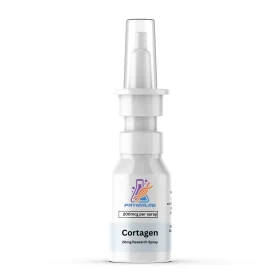
Cortagen 20mg Nasal Spray
$119.99 or subscribe for $101.99/mo This product has multiple variants. The options may be chosen on the product page -

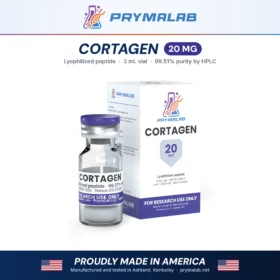
Cortagen Peptide 20mg
$39.99 or subscribe for $33.99/mo This product has multiple variants. The options may be chosen on the product page -
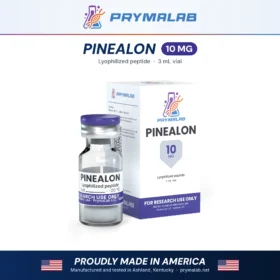
Pinealon 10mg
$39.99 or subscribe for $33.99/mo This product has multiple variants. The options may be chosen on the product page -
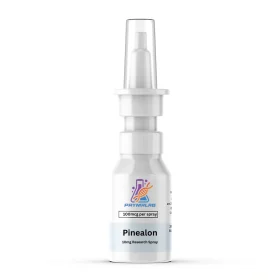
Pinealon 10mg Nasal Spray
$59.99 or subscribe for $50.99/mo This product has multiple variants. The options may be chosen on the product page -
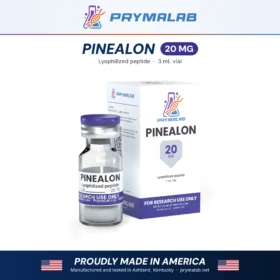
Pinealon 20mg
$59.99 or subscribe for $50.99/mo This product has multiple variants. The options may be chosen on the product page -
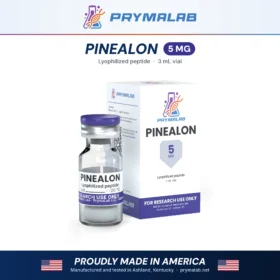
Pinealon 5mg
$24.99 or subscribe for $20.99/mo This product has multiple variants. The options may be chosen on the product page -
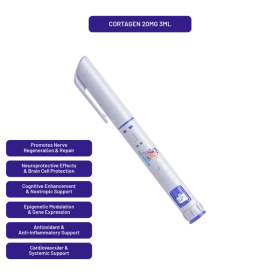
Preloaded Autoinjector | Cortagen | 3ml Pen | 20mg
$69.99 or subscribe for $59.49/mo This product has multiple variants. The options may be chosen on the product page -
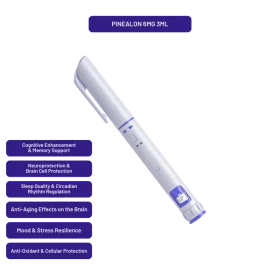
Preloaded Autoinjector | Pinealon | 3ml Pen | 6mg
$59.99 or subscribe for $49.99/mo This product has multiple variants. The options may be chosen on the product page
Two to four residues · the one place the size argument helps
Brain peptides from the Khavinson bioregulator programme are unusual in this catalogue for one reason: they are small enough that the blood-brain barrier argument works for them rather than against them. At two to four residues and under 500 daltons, they sit below the ceiling that excludes almost every other neuroactive peptide stocked here. This page sets out what that permits, what it does not demonstrate, and where the published record stops.
Specification Table
| Property | Value |
|---|---|
| Compounds carrying brain or nerve assignments | Cortagen, from brain cortex, and Pinealon, from pineal gland and central nervous tissue |
| Residue count | 2 to 4 |
| Mass range | Roughly 250 to 490 g/mol |
| Passive diffusion ceiling | Commonly cited near 500 daltons for transit of intact barriers |
| Position relative to that ceiling | Below it, unlike the 7 to 40 residue neuroactive peptides elsewhere in this catalogue |
| What that establishes | That transit is not excluded on size grounds |
| What it does not establish | That transit occurs, at what rate, or that the compound reaches any particular region |
| Proposed mechanism in the literature | Sequence-specific interaction with DNA, modulating tissue-associated gene expression |
| Mechanism status | Hypothesis. Not independently established outside the originating programme |
| Receptor | None identified for any compound in this family |
| Chromophore | None. Concentration cannot be determined by 280 nm absorbance |
| Originating programme | St Petersburg Institute of Bioregulation and Gerontology |
| Page type | Category hub, not a product page |
| Schema page type | CollectionPage |
| Cornerstone content | Yes |
| Meta robots | index, follow |
| Regulatory status | No approved human or veterinary formulation in any jurisdiction |
Why Does Size Matter for Brain Peptides?
Almost every neuroactive compound in this catalogue has a barrier problem. This group is the exception worth explaining carefully.
The blood-brain barrier excludes molecules by several mechanisms at once, and molecular size is the crudest and most reliable of them.
A ceiling near 500 daltons is commonly cited for passive transit of intact biological barriers. Above it, a molecule needs a transporter, a carrier or a route that bypasses the barrier entirely.
Semax is seven residues. Selank is seven. Cerebrolysin is a mixture of fragments. All of them sit above that ceiling and all of them depend on transport or on the nasal route.
Cortagen is four residues and Pinealon is three, so both sit comfortably below it.
That is a real structural advantage and it is the one argument this family has that does not depend on the originating programme being correct about mechanism.
It needs stating precisely, though, because the temptation to overstate it is obvious. Being under the ceiling means transit is not excluded on size grounds. It does not mean transit happens.
Lipophilicity, charge and efflux all still apply, and these compounds are polar and mostly anionic, which works against passive diffusion regardless of how small they are.
The comparison that makes this concrete is internal to the catalogue. Cerebrolysin is a mixture of fragments, and the fragments in it that are small enough to diffuse are a minority of the preparation by mass.
That is the ordinary situation for neuroactive material. Brain peptides from this family are the unusual case where the whole molecule sits under the ceiling rather than a fraction of it.
What Has Actually Been Measured?
The published record for brain peptides in this family is narrower than the volume of writing about them suggests, and being specific is more useful than a summary.
Work from the St Petersburg programme reports observations in aged rodent models, assessed histologically and through markers of tissue-associated gene expression.
Cell-culture work describing chromatin decondensation is the principal evidence offered for the DNA-binding hypothesis. It is in vitro rather than in vivo.
No tissue-distribution study across this family has been published, which means no data establishes that a compound assigned to brain cortex preferentially reaches brain cortex.
No receptor has been identified for any member of the family and no binding constant has been published.
Independent replication outside the originating programme is thin relative to the publication volume, and no adequately powered independent Western clinical trial exists for any compound here.
That is the honest position, and it is neither an endorsement nor a dismissal. The chemistry is settled and well defined. The mechanism is a hypothesis with in vitro support.
A researcher designing around these compounds should handle brain arrival as a quantity to be measured in their own model rather than a property inherited from the compound name.
What Do the Tissue Assignments Mean Here?
The organ names in this family record where a sequence was found, not where it acts, and that distinction has teeth in a neural context.
The original fractionation work took extracts of animal organs and separated short peptides from them, naming each recovered peptide after its source tissue.
Cortagen came from brain cortex, and Pinealon from pineal gland and central nervous tissue. Those names are provenance records.
The complication specific to this group is the shared Glu-Asp core. Fourteen of the sixteen compounds in the wider range contain it, including compounds assigned to heart, liver, pancreas and prostate.
Pinealon is Glu-Asp-Arg. Strip the arginine and what remains is the same dipeptide present in compounds assigned to organs nowhere near the nervous system.
If that core is doing the work, the neural assignment carries less information than the name implies. If the flanking residue is doing the work, the assignment may mean something, and nothing published distinguishes those readings.
Selecting a compound on the basis of its brain assignment is therefore selecting on isolation source rather than on demonstrated targeting.
That is worth stating on a page that uses the term brain peptides in its heading, because the heading is where the ambiguity would otherwise hide.
A related point applies to how these compounds are usually presented alongside one another. Listing a brain compound next to a heart compound implies the two were selected for different targets.
What the sequences show is two molecules sharing most of their residues, assigned to different organs on the basis of where a fractionation column happened to yield them.
That is a weaker basis for differentiation than the product names suggest, and it is visible only when the sequences sit side by side.
How Do These Compare With the Longer Neuroactive Peptides?
Two groups in this catalogue address the nervous system from opposite ends of the size range, and the comparison is instructive.
The longer group, Semax and Selank and the fragment mixtures, are seven residues and upward, carrying specific mechanistic claims with published support and a barrier problem to go with them.
Semax has published work describing activation of brain-derived neurotrophic factor signalling. That is a defined molecular claim that a study can test directly.
The short group has no identified receptor and no defined molecular target. Its advantage is size.
So one group knows what it does and struggles to arrive. The other may arrive more readily and nobody has established what it does.
Neither position is stronger in the abstract, and a study choosing between them is choosing which uncertainty it would rather carry.
A design needing a defined mechanism wants the longer compounds. Where a design is exploratory and arrival is the first question, the short compounds have the cleaner physical argument.
Presenting both groups as interchangeable neural compounds, which is how they are usually listed, obscures a distinction that determines what an experiment can conclude.
There is a design that uses both. Run the short compound and the long one in the same model, with brain concentration measured directly rather than assumed.
That answers the arrival question and the mechanism question in one experiment.
Nobody appears to have published it for this pair, and the material cost would be trivial.
What Should Be Verified Before Ordering?
The checks for this group are the family checks plus one specific to its size.
The explicit sequence in three-letter or single-letter form rather than a trade name, since compounds in this family differ from one another by one or two residues.
Measured mass against calculated mass, computed by the buyer from the stated sequence, which takes a minute and catches transcription errors.
Whether the chromatogram shows anything at the retention time of the truncated relative, since Pinealon is Cardiogen minus its alanine and the truncation is a plausible synthesis impurity.
Counterion identity and net peptide content, which matter proportionally more here than anywhere else in the catalogue because these compounds are so light. A single trifluoroacetate on a 250 dalton peptide is roughly a third of the associated mass.
Purity by chromatography with the detection wavelength stated. These compounds carry no aromatic residue, so 280 nanometre detection is close to blind to them and a certificate quoting it has a problem.
Storage is undemanding for the dry powder, with no cysteine, methionine or tryptophan to oxidise or photodegrade.
Solution-state formats need attention to container material, since the near-neutral members adsorb to ordinary plasticware in a way that changes delivered amount rather than merely documenting it.
A final point specific to buying brain peptides rather than to the chemistry. Because these compounds are inexpensive to synthesise and the family is large, the incentive to substitute a cheaper member for a costlier one is real.
The sequence on the certificate is the only defence against that, and it is why the sequence request leads this list rather than closing it.
A supplier who provides it without prompting has already answered the question that matters most.
Published Literature
Selected references on barrier transit and on the originating programme.
- Banks WA. Peptides and the blood-brain barrier. Peptides. 2015;72:16-19. DOI: 10.1016/j.peptides.2015.03.010
- Khavinson VK, Malinin VV. Gerontological Aspects of Genome Peptide Regulation. Basel: Karger; 2005. DOI: 10.1159/isbn.978-3-318-01193-6
- Anisimov VN, Khavinson VK. Peptide bioregulation of aging. Biogerontology. 2010;11(2):139-149. DOI: 10.1007/s10522-009-9249-8
- Bos JD, Meinardi MM. The 500 Dalton rule for the skin penetration of chemical compounds and drugs. Exp Dermatol. 2000;9(3):165-169. DOI: 10.1034/j.1600-0625.2000.009003165.x
Frequently Asked Questions
What are brain peptides in this range?
Short compounds of two to four residues from the Khavinson bioregulator programme, carrying assignments to brain cortex and to pineal and central nervous tissue. Cortagen and Pinealon are the compounds stocked here.
Why does their size matter?
A ceiling near 500 daltons is commonly cited for passive transit of intact biological barriers. These compounds sit below it, unlike the seven-residue and longer neuroactive peptides elsewhere in this catalogue.
Does being under the ceiling mean they cross?
No. It means transit is not excluded on size grounds. Lipophilicity, charge and efflux all still apply, and these compounds are polar and mostly anionic, which works against passive diffusion.
What has actually been measured?
Observations in aged rodent models assessed histologically and through gene expression markers, plus cell-culture work describing chromatin decondensation. That in vitro work is the principal evidence for the DNA-binding hypothesis.
Has brain distribution been demonstrated?
No. No tissue-distribution study across this family has been published, so nothing establishes that a compound assigned to brain cortex preferentially reaches brain cortex.
Is there an identified receptor?
No. No receptor has been identified for any member of this family and no binding constant has been published.
What does the tissue assignment record?
Where a sequence was isolated during the original fractionation work, not where it acts. Cortagen came from brain cortex and Pinealon from pineal and central nervous tissue.
Why does the shared core complicate that?
Fourteen of the sixteen compounds in the wider range contain the same Glu-Asp dipeptide, including compounds assigned to heart, liver and pancreas. If that core is doing the work, the neural assignment carries less information than the name implies.
How do these compare with Semax and Selank?
Opposite trade-offs. The longer compounds have defined mechanistic claims with published support and a barrier problem. The short compounds have a size advantage on transit and no identified molecular target.
Which group suits which experiment?
A design needing a defined mechanism wants the longer compounds. Where a design is exploratory and arrival is the first question, the short compounds have the cleaner physical argument.
Why does counterion correction matter so much here?
Because these compounds are very light. A single trifluoroacetate on a 250 dalton peptide is roughly a third of the associated mass, so net peptide content is a substantial part of the answer rather than an administrative field.
What detection wavelength should a certificate state?
214 nanometres. These compounds carry no aromatic residue, so detection at 280 is close to blind to them and a certificate quoting that wavelength has a problem.
Compliance Statement
Brain peptides are sold exclusively for laboratory research use. They are not a drug, food, or cosmetic product, and they are not a dietary product of any kind. They are not approved by the FDA or any comparable authority for human or veterinary use, the proposed mechanism has not been independently established, no receptor has been identified, no tissue-distribution study across this family has been published, and being below a molecular weight ceiling establishes only that barrier transit is not excluded on size grounds rather than that it occurs. These products are not intended to diagnose, treat, cure, or prevent any disease. They must not be given to humans or animals. Purchase is restricted to qualified researchers and institutions operating within applicable laws. All handling is the responsibility of the purchasing laboratory.
All 8 products in the Brain, Nerve & Sensory Bioregulators range
Every listing states its quantity, concentration and format and carries a batch certificate of analysis. Products are supplied for laboratory research only.