

Peptides for injury recovery: what the research shows
Peptides for injury recovery are short amino-acid chains studied in animal models of tendon, ligament, muscle and skin injury; the most cited are BPC-157, TB-500 (thymosin beta-4) and the copper peptide GHK-Cu. PrymaLab supplies them as lyophilized vials, including BPC-157 5mg, TB-500 (Thymosin Beta-4) 5mg and GHK-Cu 50mg, for research use.
- Most studied: BPC-157 (15 amino acids) and TB-500 (thymosin beta-4, 43 amino acids)
- Class: gastric pentadecapeptide; actin-binding thymosin; copper-binding tripeptide GHK-Cu; growth factor analogues such as IGF-1 LR3
- Studied for: Achilles tendon and MCL transection, muscle crush, skin wounds, corneal and cardiac injury, mostly in rodents
- Storage: lyophilized vials refrigerated, away from light; reconstituted solution refrigerated
- Forms and sizes at PrymaLab: BPC-157 5mg, TB-500 5mg, Wolverine Blend 10mg/10mg, GHK-Cu 50mg, IGF1 LR3 1mg
| Peptide | Origin | Injury models studied | PrymaLab product |
|---|---|---|---|
| BPC-157 | Fragment of a protective gastric protein | Tendon and ligament transection, muscle crush, gut lesions (rats) | BPC-157 5mg, BPC-157 10mg |
| TB-500 | Synthetic thymosin beta-4 | Skin wounds, corneal injury, cardiac injury (rodents) | TB-500 5mg, TB-500 10mg |
| GHK-Cu | Copper-binding tripeptide from human plasma | Skin wounds, collagen synthesis, hair follicles (rodents, cell culture) | GHK-Cu 50mg, GHK-Cu 100mg |
| Thymosin alpha-1 | Thymic peptide | Immune recovery, infection models; not a tissue-repair peptide | Thymosin Alpha-1 5mg |
The BPC-157 and TB-500 combination has its own guide, the Wolverine stack. Vial arithmetic for any of these compounds: peptide reconstitution calculator.
Peptides for injury recovery is a research category, not a treatment. The two molecules that dominate the literature are BPC-157 and TB-500, which together are sold and discussed as the Wolverine stack; that combination has its own guide, so this page stays on the wider question: which peptides have been studied for tendon, ligament, muscle and skin injury, in which models, and how strong the evidence is for each. GHK-Cu, IGF-1 LR3 and the thymosin peptides get their own sections below.
Editorial & research disclaimer: This article is for educational and informational purposes only and is not medical advice. Body Protection Compound-157, TB-500, and other compounds discussed are sold for research purposes only and are not approved by the FDA for human therapeutic use. PrymaLab supplies them for laboratory research use only, not for human or veterinary use.

Quick Answer
Which peptides have been studied for tendon, ligament, and joint injury? The most-discussed research peptides are BPC-157 and TB-500, sold together as the Wolverine Stack peptide. In animal models, BPC-157 was linked to collagen synthesis and angiogenesis in connective-tissue repair, and TB-500 (derived from Thymosin Beta-4) to cell migration, new blood-vessel formation and lower inflammation. Neither is FDA-approved.
No controlled human trial has tested either peptide for tendon, elbow or joint injury.
Wolverine Stack peptide = BPC-157 + TB-500. Two proposed complementary mechanisms (collagen/angiogenesis + actin-mediated cell migration), studied in soft-tissue injury models.
Most studied models: tendon, ligament and muscle injury in rats; no controlled human trial.
Side-effect profile (BPC 157 peptide side effects + TB-500): generally mild and short-lived in reports — headaches, nausea, transient blood-pressure changes, injection-site irritation. Long-term human safety data are limited.
Sourcing matters. When you search BPC-157 peptide where to buy, check that the certificate matches the lot number on the vial and can be verified, and look for HPLC purity > 99%, lyophilization, and cold-chain shipping.
Not FDA-approved. BPC-157, TB-500, and the Wolverine Stack are research-only compounds. Human safety and efficacy claims should be framed as preliminary.
Understanding Peptides and Their Role in Healing
Peptides are short chains of amino acids that act as biological signaling molecules — building blocks for proteins and messengers between cells. In animal injury models, certain peptides have been linked to tissue repair, lower inflammation and the formation of new blood vessels, which is why peptides for healing have become a topic in sports medicine and regenerative medicine research.
BPC-157 and TB-500 are among the most studied peptides in this space. In animal models BPC-157 was linked to connective-tissue repair and collagen production, and TB-500, derived from Thymosin Beta-4, to cell migration and blood-vessel formation. The combination — the wolverine peptide stack — rests on the idea that the two mechanisms complement each other; no controlled human trial has tested it. For broader background, see our overview of what a peptide is.
Animal studies of these peptides report faster tissue repair, more collagen and lower inflammation. Human data are limited to one small chart review, described in the FAQ below.
Common Elbow Injuries and Where Peptides Come Into the Discussion
The elbow is critical for nearly every upper-body movement, yet it is mechanically vulnerable. Common injuries include tendonitis (often from repetitive motion), sprains where ligaments stretch or tear, dislocations, and fractures. Each injury follows a familiar healing arc: inflammation, tissue repair, and remodeling — but timelines vary widely with severity, age, and adherence to rehabilitation. Traditional first-line treatment is the standard R.I.C.E. protocol (rest, ice, compression, elevation) followed by physical therapy and, in some cases, surgery.
Online discussion of peptides for elbow pain rests on mechanism: in animal models BPC-157 was linked to collagen and angiogenesis and TB-500 to cell migration and inflammation, and tendinopathy involves chronic micro-injury and poor blood supply. Elbow tendonitis is therefore one of the applications most often discussed for the Wolverine Stack peptide blend and other peptides for tendon repair, but no study has tested either peptide in human elbow injury.
Key factors that affect recovery include severity and type of injury, age and overall health, sleep quality, nutritional status, and adherence to a structured rehab plan.
BPC-157: what the injury models show
BPC-157, also known as Body Protection Compound, is one of the most discussed peptides in injury recovery. It originates from a partial sequence of a protein found in human gastric juice, which gives it natural compatibility with human physiology in research models. Its proposed mechanisms include the promotion of angiogenesis (formation of new blood vessels), enhancement of collagen production, and effects on the gut lining in animal models. These mechanisms are why it sits at the center of so many joint healing peptides conversations. For a deeper mechanism-focused breakdown, see our analysis of BPC-157 benefits and safety.
Animal studies of BPC-157 report faster tissue regeneration and lower inflammation across injury types, from muscle crush to ligament transection. In the rat studies the peptide was given by intraperitoneal injection or in drinking water; oral delivery is discussed separately (see oral peptide delivery).
Importantly, BPC-157 is not FDA-approved for medical use. It is sold for research purposes only, and product quality varies significantly by source. Authenticity and purity directly impact whether reported effects are even possible — a degraded or contaminated vial cannot deliver the compound on its label.
Scientific Research on BPC-157 for Injury Recovery
Most of the evidence base for BPC-157 comes from animal studies, particularly rodent models, with a smaller volume of in vitro work and limited human data. Studies have noted enhanced wound healing, protection against gastric ulcers, and improved healing of tendons, ligaments, and bones in animal models. Mechanistically, the consistent threads are collagen up-regulation, angiogenesis support, and modulation of nitric-oxide pathways — all of which are biologically plausible drivers of the observed soft-tissue effects.
The synthetic peptide is often compared to naturally occurring growth factors. Its effects on tissue repair resemble growth-factor profiles but with a markedly smaller molecule that is easier to handle and stable in lyophilized form. Continued investigation is exploring its potential across additional tissue types and conditions, but it is essential to keep the framing precise: animal-model and preclinical evidence is not the same as proven human therapy, and BPC-157 has not cleared the bar of FDA approval.
BPC 157 Peptide Side Effects: What to Know
Tolerability in reports is relatively favorable, but side effects are reported. Reported BPC 157 peptide side effects include:
- Mild headaches
- Nausea or dizziness
- Temporary changes in blood pressure
- Injection-site irritation, bruising, or transient redness
- Rare allergic-type reactions
Most reported side effects are mild and transient. Contaminated or degraded material raises the risk, which is why sourcing and storage matter. Individual reactions can vary based on personal health conditions and concurrent medications, and human long-term safety data are limited because no large clinical trials have been completed.
TB-500: cell migration and tissue repair research
TB-500 is the second pillar of the Wolverine Stack peptide. It is derived from Thymosin Beta-4 (Tβ4), a naturally occurring peptide found throughout the body and especially abundant in platelets and wound fluid. TB-500 is studied for its influence on actin — a structural protein essential for cell movement and wound healing — and for its support of new blood-vessel formation (angiogenesis). Both mechanisms make it a logical complement to BPC-157, which is more focused on collagen synthesis and connective-tissue rebuilding. For a product-context overview, see the TB-500 5mg peptide page.
Animal studies of thymosin beta-4 report effects in skin wound, corneal and cardiac injury models. Like BPC-157, TB-500 is not FDA-approved; it is available for research purposes, and quality varies widely by supplier.
The Wolverine Stack: BPC-157 and TB-500 Peptide Blend
The “Wolverine Stack” is the popular research-community name for the BPC-157 + TB-500 combination. The name borrows from the fictional mutant character Wolverine, famed for rapid healing. The proposed logic is that BPC-157’s effects on connective tissue, collagen and angiogenesis and TB-500’s effects on cell migration and inflammation in animal models would complement each other. The combination is discussed for tendinopathy, ligament strain and post-surgical recovery models, but no controlled human trial has tested it.
User reports describe shorter recovery times, sometimes as “cutting healing in half.” Those claims are anecdotal rather than clinically validated. The compounds are not FDA-approved and the combination is a research-use product.
| Attribute | BPC-157 | TB-500 |
|---|---|---|
| Origin | Synthetic fragment of a gastric protein | Synthetic Thymosin Beta-4 |
| Primary mechanisms | Collagen synthesis, angiogenesis, NO modulation | Actin-mediated cell migration, angiogenesis, inflammation control |
| Best-studied applications | Tendon, ligament, muscle, GI tissue repair | Soft-tissue repair, muscle recovery, wound healing |
| Reported side effects | Mild headache, nausea, transient BP shifts | Mild fatigue, mood changes, injection-site swelling |
| Regulatory status (US) | Research only; not FDA-approved | Research only; not FDA-approved |
BPC-157 TB-500 Peptide Blend Scientific Research
BPC-157 TB-500 peptide blend scientific research is, candidly, still developing. Most of what is published comes from animal models and preclinical work studying each compound individually rather than the blend as a unit. The combined picture has to be inferred from the overlapping mechanisms (angiogenesis from both, plus collagen from BPC-157 and cell migration from TB-500), which is mechanistically attractive but has not been validated in large human clinical trials. Reported research findings include faster wound and tendon healing in animal models, increased local growth-factor expression, and reduced inflammatory markers, with effect sizes that vary by tissue type and dose.
Researchers should treat any aggregate "Wolverine Stack" claim with appropriate skepticism: the blend is operationally common but scientifically still characterized largely through analogy from single-compound studies. The honest framing is that BPC-157 TB-500 peptide blend scientific research is preliminary, mechanistically plausible, and warrants more rigorous human investigation before being treated as a proven therapy.
Other Peptides for Tendon Repair, Joint Healing, and Recovery
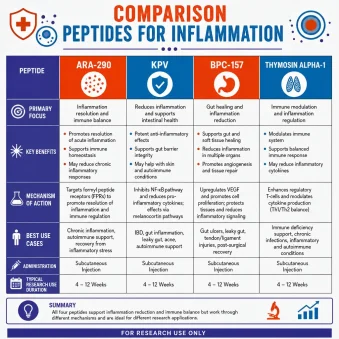
BPC-157 and TB-500 are not the only candidates discussed in the peptides for tendon repair and joint healing peptides literature. A more complete map of peptides for joint recovery and connective-tissue research includes:
| Peptide | Primary Mechanism | Discussed Use Cases |
|---|---|---|
| Collagen peptides | Amino-acid building blocks for collagen synthesis | Cartilage, joint comfort, skin, dietary supplement |
| GHK-Cu (copper peptide) | Copper-mediated signaling for collagen + antioxidant tone | Skin regeneration, wound healing, hair |
| IGF-1 LR3 | Anabolic growth factor signaling | Muscle and tissue regeneration (research-use) |
| CJC-1295 + Ipamorelin | Pulsatile growth-hormone release | Sleep-driven recovery, body composition research |
| Thymosin alpha-1 | Immune system modulation | Resilience research, post-illness recovery (see Thymogen) |
| Sermorelin | GHRH analog for endogenous GH support | Sleep, recovery, age-related decline research |
Each peptide has a distinct proposed mechanism and evidence base, and none has a controlled human trial for injury recovery. Claims that some peptides may work better in combination rest on mechanism rather than on combination studies. For a broader picture of peptide categories, see our overview of peptides and weight loss as a parallel example of mechanism-mapping.
BPC-157 Peptide Where to Buy: How to Source the Wolverine Stack Safely
Quality, not price, is what determines whether a vial contains what its label says. People often search "BPC-157 peptide where to buy" or "BPC-157 peptide: where to buy" and land on listings with wildly different prices. Counterfeit, contaminated, or degraded vials cannot deliver the stated compound. The verification checklist is identical to what we cover in the where do you get peptides guide, applied to BPC-157 and TB-500 specifically:
- US-based research peptide supplier with a verifiable business address.
- Current Certificate of Analysis (COA) with HPLC purity > 99% that matches the lot number on the vial and can be verified.
- Clean HPLC chromatograms and identity confirmation (mass spec where available).
- Cleanroom lyophilization and cold-chain shipping.
- Transparent labeling: research-use only, no medical claims.
- Customer reviews and credible community track record over time.
If a supplier refuses to share a COA, lists prices that are 60–90% below US norms, or mixes consumer marketing language with research-only labels, treat that as a hard pass. The peptide research community is small enough that reputation propagates — check forums, reviews, and credible educator endorsements before you spend a dollar. For deeper sourcing analysis, see Article 2 in this series: Where Do You Get US Made Peptides?
What the evidence does and does not cover
The evidence for these peptides comes from animal injury models, cell work and one small human chart review. No controlled human trial has tested BPC-157, TB-500 or GHK-Cu for tendon, ligament, muscle or joint injury, so no recovery plan, schedule or timeline can be drawn from the literature. The animal studies measured healing on functional and biomechanical scales over the course of each model. Sourcing and verification are covered in the guide on how to verify a peptide source.
Researching the Wolverine Stack peptide responsibly?
PrymaLab focuses on US-made research peptides, transparent COAs, and educational content built around the science — not the hype.
Explore PrymaLabInjury recovery peptides: what the studies measured
The animal studies of BPC-157 (the Sikiric group; reviewed in Seiwerth et al. 2021, Frontiers in Pharmacology 12:627533) measured healing in rat tendon, ligament and muscle injury models, with the peptide given from shortly after injury to the end of each model. The thymosin beta-4 phase 1 trial (Ruff et al. 2010, Annals of the New York Academy of Sciences) measured the safety and tolerability of single and repeated intravenous doses in healthy volunteers. None of these compounds has been tested in a controlled human trial for injury recovery.
Per-compound detail, including the side-effect data, is in the full BPC-157 research guide and the GHK-Cu peptide guide. PrymaLab supplies BPC-157 5mg, TB-500 5mg and GHK-Cu 50mg vials for laboratory research use only.
Frequently Asked Questions
What are the best peptides for injury recovery?
Measured by published research rather than popularity, BPC-157 has the largest body of animal data for tendon, ligament, muscle and gut injury, and TB-500 (thymosin beta-4) the most for skin, corneal and cardiac repair. GHK-Cu has skin-wound and collagen data. None has a controlled human trial for injury recovery, so all three remain research compounds.
Which peptides are studied for tendon repair?
BPC-157 is the most studied: rat models of transected Achilles tendon (Staresinic et al. 2003), transected ligament (Cerovecki et al. 2010) and transected quadriceps muscle (Staresinic et al. 2006), all in the Journal of Orthopaedic Research, reported improved healing on functional and biomechanical measures. TB-500 has been studied in cell migration and wound models rather than tendon specifically. IGF-1 LR3 and PEG-MGF appear in muscle-growth research, not tendon repair. Human tendon trials do not exist for any of them.
What is the Wolverine stack?
The Wolverine stack is the research-community name for BPC-157 and TB-500 used together, sold by PrymaLab as a single Wolverine Blend vial. No controlled human trial has tested the combination; the Wolverine stack guide covers the research and safety data.
Which peptides are studied for joint and cartilage injury?
BPC-157 has rat data on ligament and tendon healing and one small human report: a retrospective chart review of intra-articular BPC 157 for knee pain in which 16 of 17 enrolled patients completed follow-up and 14 of those 16 reported relief (Intra-Articular Injection of BPC 157 for Multiple Types of Knee Pain). That is a chart review, not a controlled trial. TB-500 and GHK-Cu have no specific cartilage studies of note. No peptide has been shown in a controlled human trial to regenerate cartilage, so joint claims made for these compounds run ahead of the evidence.
Are injury recovery peptides legal in the United States?
BPC-157, TB-500 and GHK-Cu are legal to buy and sell as research chemicals in the United States but are not FDA approved for any use and cannot be marketed as drugs or supplements. The World Anti-Doping Agency prohibits BPC-157 under section S0 and thymosin beta-4 and its derivatives under section S2, so tested athletes cannot use them. GHK-Cu is not on the prohibited list.
What is the Wolverine Stack peptide and what does it do?
The Wolverine Stack peptide is a research combination of BPC-157 and TB-500. BPC-157 is studied for tendon, ligament, and muscle repair via collagen and angiogenesis. TB-500, derived from Thymosin Beta-4, is studied for cell migration, blood-vessel formation, and inflammation. Together they are described as wolverine stack peptides used in research for soft-tissue and joint recovery. Neither is FDA-approved.
Which peptides are discussed for elbow injury?
For elbow tendonitis, sprains, and other soft-tissue elbow injuries, the most commonly discussed peptides are BPC-157 and TB-500, often sold together as the wolverine peptide stack. Neither has been tested in a human elbow injury trial; both are research-use only and not FDA-approved.
What are the most reported BPC 157 peptide side effects?
Reported BPC 157 peptide side effects include mild headaches, nausea or dizziness, transient blood-pressure changes, and injection-site irritation. Most are mild and short-lived. Long-term human safety data are limited because BPC-157 is not FDA-approved. Contaminated material raises the risk.
BPC-157 peptide where to buy safely?
If you are searching BPC-157 peptide where to buy, source only from reputable US-based research-use suppliers with a current Certificate of Analysis showing HPLC purity above 99 percent that matches the lot number on the vial and can be verified. Avoid offshore listings with extreme discounts and missing documentation. BPC-157 is sold for research only and is not FDA-approved.
What does BPC-157 TB-500 peptide blend scientific research show?
BPC-157 TB-500 peptide blend scientific research, drawn primarily from animal models and limited preclinical work, is mostly single-compound: BPC-157 has been linked to collagen synthesis and angiogenesis, and TB-500 to actin-mediated cell migration. Studies report faster wound and tendon healing in animal models. Robust human trials remain limited.
Are there other peptides for tendon repair and joint healing peptides?
Yes. Alongside BPC-157 and TB-500, peptides for tendon repair and joint healing peptides discussed in research include collagen peptides for cartilage support, GHK-Cu (copper peptide) for collagen synthesis, IGF-1 LR3 for muscle and tissue regeneration, CJC-1295 and ipamorelin for sleep-driven recovery, and Thymosin alpha-1 for immune modulation.
Is there a measured timeline for the Wolverine Stack in elbow pain?
No. No controlled study has measured a timeline for peptides for elbow pain. Self-reported timelines vary widely and are anecdotal.
What routes did the BPC-157 and TB-500 studies use?
The rat BPC-157 studies gave the peptide by intraperitoneal injection or in drinking water, and the thymosin beta-4 phase 1 trial used intravenous administration. In the lab, lyophilized vials are dissolved in a suitable diluent, and the solution is stored refrigerated.
Are peptides for healing a substitute for physical therapy?
No. Anecdotal reports describe the wolverine stack peptide combined with structured physical therapy, sleep, nutrition, and progressive loading, but no controlled trial has tested any of these peptides as a treatment, and none is FDA-approved.
References & Further Reading
- Sikiric, P., et al. (2018). The pharmacological properties of the novel peptide BPC 157 (PL-10). Inflammopharmacology, 26(2), 327–335.
- Chang, C.H., et al. (2014). The promoting effect of pentadecapeptide BPC 157 on tendon healing involves tendon outgrowth, cell survival, and cell migration. Journal of Applied Physiology, 116(8), 992–1000.
- Goldstein, A.L., et al. (2005). Thymosin β4: A multi-functional regenerative peptide. Annals of the New York Academy of Sciences, 1112, 87–94.
- Crockford, D., et al. (2010). Thymosin β4: structure, function, and biological properties supporting current and future clinical applications. Annals of the New York Academy of Sciences, 1194, 179–189.
- Lau, J.L., & Dunn, M.K. (2018). Therapeutic peptides: Historical perspectives, current development trends, and future directions. Bioorganic & Medicinal Chemistry, 26(10), 2700–2707.
- U.S. Food and Drug Administration. Compounding and the FDA: Questions and Answers. FDA.gov.
- World Anti-Doping Agency (WADA). The Prohibited List. Updated annually.
- Cooke, M.E., et al. (2020). Tendon healing and regeneration: Mechanisms, modeling, and therapeutic targets. Tissue Engineering, Part B: Reviews, 26(5), 466–482.
Internal references on PrymaLab: What is a peptide? · Peptides and weight loss · Oral peptide delivery · BPC-157 benefits & safety · TB-500 5mg peptide · Thymogen peptide.
Final disclaimer: This article is for educational purposes only. BPC-157, TB-500, the Wolverine Stack peptide, and other compounds discussed are sold in the United States for research purposes only and are not approved by the FDA for human therapeutic use. Statements about peptide effects have not been evaluated by the FDA. Athletic governing bodies (including WADA) prohibit certain peptides.
PrymaLab supplies these compounds for laboratory research use only, not for human or veterinary use. PrymaLab does not endorse any specific peptide vendor mentioned in this article and assumes no responsibility for third-party products or misuse of this information.
Formats stocked for the compounds in this article
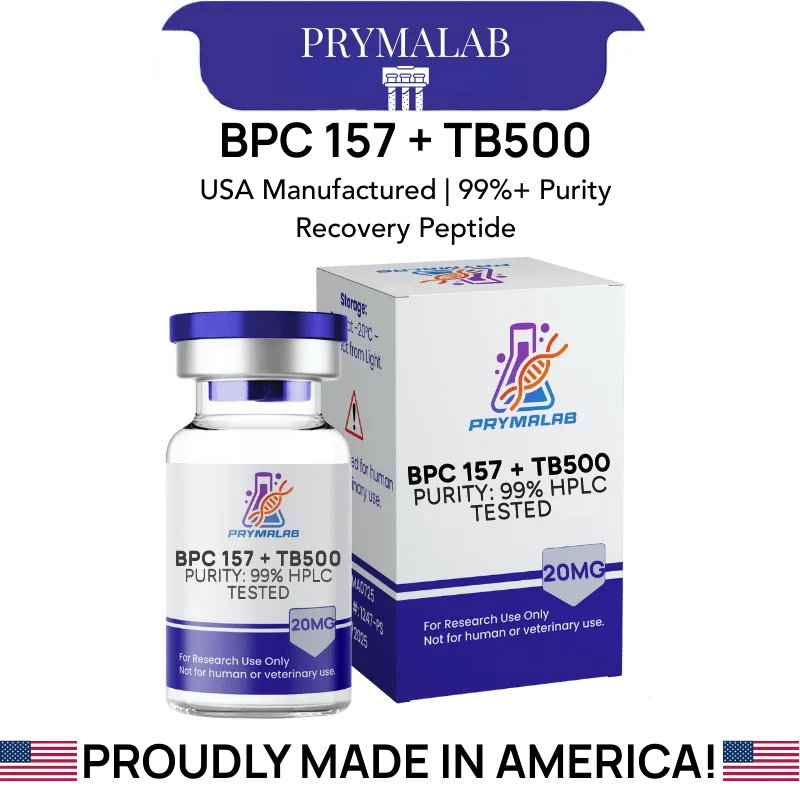
BPC 157 + TB500: BPC 157 5mg + TB500 5mg and Wolverine Stack (BPC-157 + TB-500) 20mg preloaded 3ml pen. TB-500: TB-500 5mg/ml preloaded 3ml pen and TB-500 Peptide Nasal Spray. BPC-157: BPC-157 10MG, BPC-157 5mg/ml preloaded 3ml pen, BPC-157 Peptide Nasal Spray and BPC-157 Capsules (60/500mcg). Every listing is supplied for laboratory research use with a batch certificate of analysis.