$50.99 – $429.99 / month
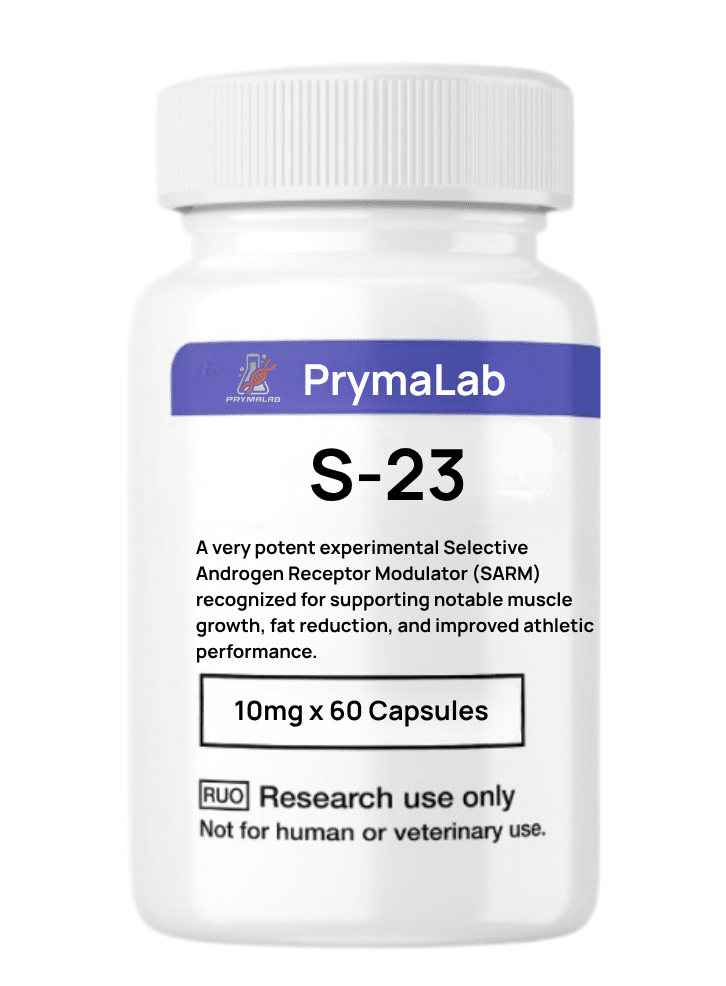
S-23 10mg capsules, 60 per bottle. One of the most potent non-steroidal SARMs with near-full androgen receptor agonism and strong anabolic effects in bone and muscle tissue. ≥99% HPLC-verified purity with COA. For research use only.
S-23 is a non-steroidal selective androgen receptor modulator (SARM) developed by GTx, Inc. and recognized as one of the most potent orally bioavailable SARMs characterized to date. S-23 binds to the androgen receptor with exceptionally high affinity (Ki of 1.7 nM), surpassing the binding strength of many established SARMs and approaching that of dihydrotestosterone, the most potent endogenous androgen.
Preclinical studies in male rats demonstrated that S-23 produced dose-dependent increases in lean muscle mass and decreases in fat mass while simultaneously reducing prostate weight, confirming tissue-selective androgen receptor modulation. Notably, S-23 has also been investigated as a potential male hormonal contraceptive, as it produced complete and reversible suppression of spermatogenesis in animal models at higher doses. This contraceptive effect was fully reversible upon cessation of dosing, with fertility restored within approximately 100 days. The compound’s oral bioavailability and potent anabolic profile have made it a subject of intense research interest in muscle biology, body composition, and reproductive physiology.
| Specification | Detail |
|---|---|
| Product Name | S-23 |
| Dosage | 10 mg per capsule |
| Quantity | 60 capsules per bottle |
| Form | Oral capsule |
| CAS Number | 1010396-29-8 |
| Molecular Formula | C18H13ClF4N2O3 |
| Molecular Weight | 416.75 g/mol |
| Purity | ≥99% (HPLC verified) |
| Testing | Third-party HPLC and MS analysis |
| Storage | Room temperature, cool dry place, away from light |
| Classification | Non-steroidal SARM |
S-23 functions as a full agonist at androgen receptors in skeletal muscle and bone tissue, activating robust anabolic transcriptional programs that drive protein synthesis, nitrogen retention, and myofiber hypertrophy. Its binding affinity (Ki = 1.7 nM) places it among the highest-affinity SARMs developed, translating to potent receptor activation at comparatively low concentrations.
In muscle tissue, S-23 recruitment of coactivator proteins at the androgen receptor drives expression of myogenic regulatory factors, IGF-1 splice variants, and anabolic target genes. In bone tissue, activation of androgen receptors in osteoblasts stimulates bone formation pathways and increases cortical bone density. Despite this potent anabolic activity, S-23 demonstrates tissue selectivity by reducing prostate weight in intact male animals, indicating antagonistic or minimal agonist activity in prostatic tissue.
The contraceptive mechanism observed in preclinical studies results from S-23’s potent suppression of gonadotropins (LH and FSH), leading to dramatically reduced intratesticular testosterone and arrested spermatogenesis. This effect is dose-dependent and fully reversible, making S-23 the first SARM seriously investigated as a potential non-hormonal male contraceptive approach that simultaneously preserves or enhances musculoskeletal tissue.
Body composition research with S-23 has produced some of the most dramatic results observed with any SARM. Preclinical data demonstrate potent lean mass increases accompanied by significant fat mass reductions, consistent with the compound’s high androgen receptor binding affinity and full agonist activity in muscle. Researchers investigating recomposition, cutting, and anabolic threshold studies frequently select S-23 for its strong dose-response characteristics.
Male contraception research has explored S-23’s ability to produce reversible azoospermia while maintaining musculoskeletal anabolic effects. The combination of gonadotropin suppression sufficient for contraception with tissue-selective anabolism represents a unique pharmacological profile among SARMs and has implications for reproductive biology and andrology research.
Bone density studies demonstrate that S-23 increases bone mineral density and cortical bone strength in both intact and gonadectomized animal models. Fat oxidation research has documented enhanced lipid metabolism, with treated animals showing significant reductions in adipose tissue mass even in the absence of caloric restriction or exercise protocols.
| Protocol | Dosage | Duration | Notes |
|---|---|---|---|
| Standard research dose | 10–25 mg/day | 8–12 weeks | Significant suppression expected |
| Beginner protocol | 10 mg/day | 6–8 weeks | Conservative starting dose |
| Advanced protocol | 20–25 mg/day | 8–12 weeks | Complete LH suppression likely |
| Timing | Split AM/PM or once daily | — | ~12-hour estimated half-life |
S-23 is one of the most suppressive SARMs characterized, and all research protocols should include comprehensive baseline and endpoint blood panels covering testosterone, LH, FSH, and SHBG. Post-cycle therapy with SERMs such as enclomiphene is considered essential in protocols lasting six weeks or longer. The compound’s potent suppressive profile makes it unsuitable for research designs requiring minimal hormonal impact.
| Parameter | S-23 | RAD-140 (Testolone) |
|---|---|---|
| AR binding affinity (Ki) | 1.7 nM | 7 nM |
| Agonist type | Full agonist | Full agonist |
| Anabolic potency | Very high | High (90:1 ratio) |
| Suppression level | Significant (contraceptive level) | Moderate to significant |
| Contraceptive potential | Yes (reversible azoospermia) | No |
| Fat loss effect | Pronounced | Moderate |
| Half-life | ~12 hours | ~60 hours (primates) |
| PCT requirement | Essential | Strongly recommended |
Store S-23 capsules at controlled room temperature between 20°C and 25°C (68°F to 77°F) in the original sealed container. Protect from direct sunlight, heat, and moisture. Under proper storage conditions, S-23 capsules maintain full potency for at least 24 months from the date of manufacture.
Every batch of PrymaLab S-23 undergoes comprehensive third-party analysis by independent, accredited laboratories using HPLC for purity and mass spectrometry for identity confirmation. Each order includes a batch-specific Certificate of Analysis documenting ≥99% purity and full contaminant screening. Pharmaceutical-grade encapsulation ensures precise 10 mg dosing, and free priority shipping is included on all domestic orders.
S-23 has the highest published androgen receptor binding affinity (Ki = 1.7 nM) among characterized non-steroidal SARMs, making it one of the most potent in terms of receptor interaction. Its full agonist activity and dramatic body composition effects in preclinical models support its classification as one of the strongest SARMs, though potency comparisons depend on the specific endpoint measured.
Yes, significantly. S-23 produces substantial suppression of the hypothalamic-pituitary-gonadal axis, reducing LH, FSH, and endogenous testosterone in a dose-dependent manner. At higher doses, S-23 has been shown to produce complete azoospermia in animal models. Post-cycle therapy is considered essential for all S-23 research protocols.
Preclinical data confirm that S-23’s suppressive effects, including azoospermia, are fully reversible upon cessation of dosing. Fertility restoration in animal models occurred within approximately 100 days, with complete recovery of spermatogenesis and gonadotropin levels. This reversibility was a key finding supporting S-23’s investigation as a potential male contraceptive.
S-23 exhibits substantially higher androgen receptor binding affinity (Ki 1.7 nM vs S4’s weaker binding) and functions as a full agonist rather than S4’s partial agonist profile. S-23 produces more potent anabolic and fat loss effects but carries significantly greater HPG axis suppression. S4 is generally considered the milder compound suitable for lower-intensity research protocols.
Due to S-23’s potent suppressive profile, robust PCT protocols using SERMs such as enclomiphene (12.5–25 mg/day) or clomiphene (25–50 mg/day) for four to six weeks are commonly incorporated into research designs. Comprehensive bloodwork monitoring LH, FSH, total testosterone, and free testosterone is recommended to confirm hormonal recovery.
PrymaLab enforces pharmaceutical research-grade quality standards for all S-23 products. Independent third-party laboratories conduct HPLC purity analysis, mass spectrometry identity verification, heavy metal screening, residual solvent testing, and microbial assessment on every batch. Batch-specific Certificates of Analysis accompany each order for full analytical transparency.
S-23 is sold strictly for laboratory research and scientific investigation purposes only. This product is not intended for human consumption, veterinary use, or therapeutic application. S-23 has not been approved by the FDA or any regulatory agency for medical use. Purchasers must be qualified researchers affiliated with accredited institutions or licensed research organizations. By purchasing this product, you confirm that it will be used exclusively in accordance with all applicable local, state, and federal regulations governing research materials.
| Weight | N/A |
|---|---|
| Dimensions | N/A |
Only logged in customers who have purchased this product may leave a review.

support@prymalab.net info@prymalab.net

30 Day return window. Satisfaction guaranteed or your money back.

All orders over %150 in value will receive free shipping.
Reviews
There are no reviews yet.