Description
PrymaLab · Research Use Only
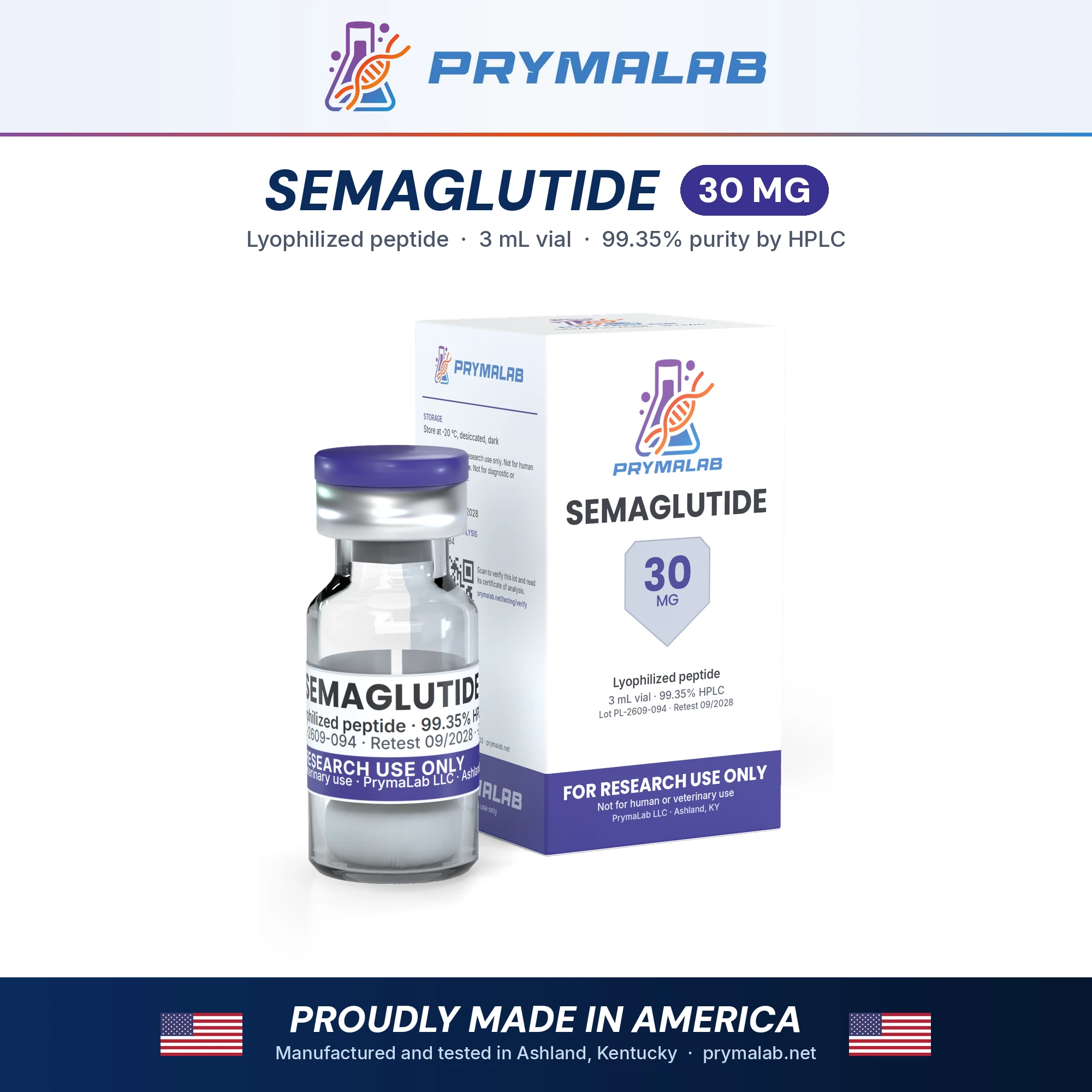
Semaglutide 30mg
The fill for the minority case where this is the compound being studied
Semaglutide 30mg is the largest of five fills here, and buying it says something about the study. A comparator arm does not need thirty milligrams. Somebody purchasing this quantity is running semaglutide as the test article, which is the less common of the two roles this compound plays.
Specification Table
| Property | Value |
|---|---|
| Compound | Semaglutide |
| CAS number | 910463-68-2 |
| Molecular weight | Approximately 4113 |
| Declared content | 30 milligrams |
| Approximate molar content | Around 7.3 micromoles |
| Position in the range | Largest of five fills in this catalogue |
| Compound differences between fills | None |
| Usual role in published work | Active comparator |
| Role this fill implies | Test article |
| What changes in that role | A concentration range is needed rather than one point |
| Acylation | A C18 diacid at lysine 26 |
| Non-natural residue | Aminoisobutyric acid at position 8. Covered on the 10mg page |
| Solution stability | Limited once reconstituted. Freezing is not a workaround |
| Practical consequence at this fill | Reconstitute a portion, or accept a shorter usable window |
| Storage | Sealed at minus 20°C. Do not freeze solution and do not agitate |
What Changes When Semaglutide Is the Subject?
The concentration range, mostly, which is what a semaglutide 30mg purchase is really buying.
A comparator arm is usually one concentration chosen from published work. A test article needs a range, because the point of studying something is to find out how the response varies.
A range means more conditions, more replicates and more material, which is the direct reason a 30 milligram fill exists.
It also changes what the material has to support analytically.
A single-concentration comparator can tolerate a nominal concentration derived from vial mass, because the same offset applies to every point in that arm and the arm is a fixed reference.
A concentration-response curve cannot. If the nominal concentration is systematically wrong, every point on the curve shifts along the x axis together, and any potency figure derived from it is wrong by the same factor.
That is the reason net peptide content stops being optional at this fill. On a comparator it is a nicety. On a test article it sets the number the study exists to produce.
I would not report a potency figure for this compound without the net content correction applied and stated, and most published figures do not say whether it was.
Does a Semaglutide 30mg Fill Fit the Stability Window?
Not if it is reconstituted at once, which is the same problem the tirzepatide 30mg page describes for a different compound.
Seven micromoles is a large amount of an acylated peptide. Reconstituted into 7 millilitres it gives a 1 millimolar stock, and a study working at 100 nanomolar would need 70 litres of assay medium to consume it.
Nobody uses 70 litres inside the useful life of a solution.
So the vial is bought for the lot rather than for the volume, and the sensible handling is to reconstitute a portion and leave the rest as solid.
That means weighing out powder, with the error that brings, or repeated entries and moisture.
Between those, weighing once at the start into three or four sealed portions is better than repeated entries, and it keeps the lot consistency the large fill was bought for.
The alternative nobody should choose is reconstituting everything and freezing aliquots. On an acylated peptide that concentrates material differentially during ice formation, which is the wrong direction for something that self-associates.
What Does a Concentration Range Require?
Enough points to fit a curve, and one semaglutide 30mg lot behind all of them.
A minimum of six concentrations spanning at least three orders of magnitude is the usual expectation for a sigmoidal fit, and more points at the inflection improve the fit more than more points at the ends.
Every one of those should come from the same stock, prepared in the same session, in the same diluent.
A curve assembled from two stocks prepared a fortnight apart has a discontinuity in it. The fit will not show you where.
That requirement pushes back against the stability argument above, because it means a substantial portion of material has to be in solution simultaneously.
The resolution is to size the reconstituted portion to one full curve plus replicates, then prepare a fresh portion for the next run.
Running a whole study from one solution is the thing to avoid.
What Should the Certificate Show?
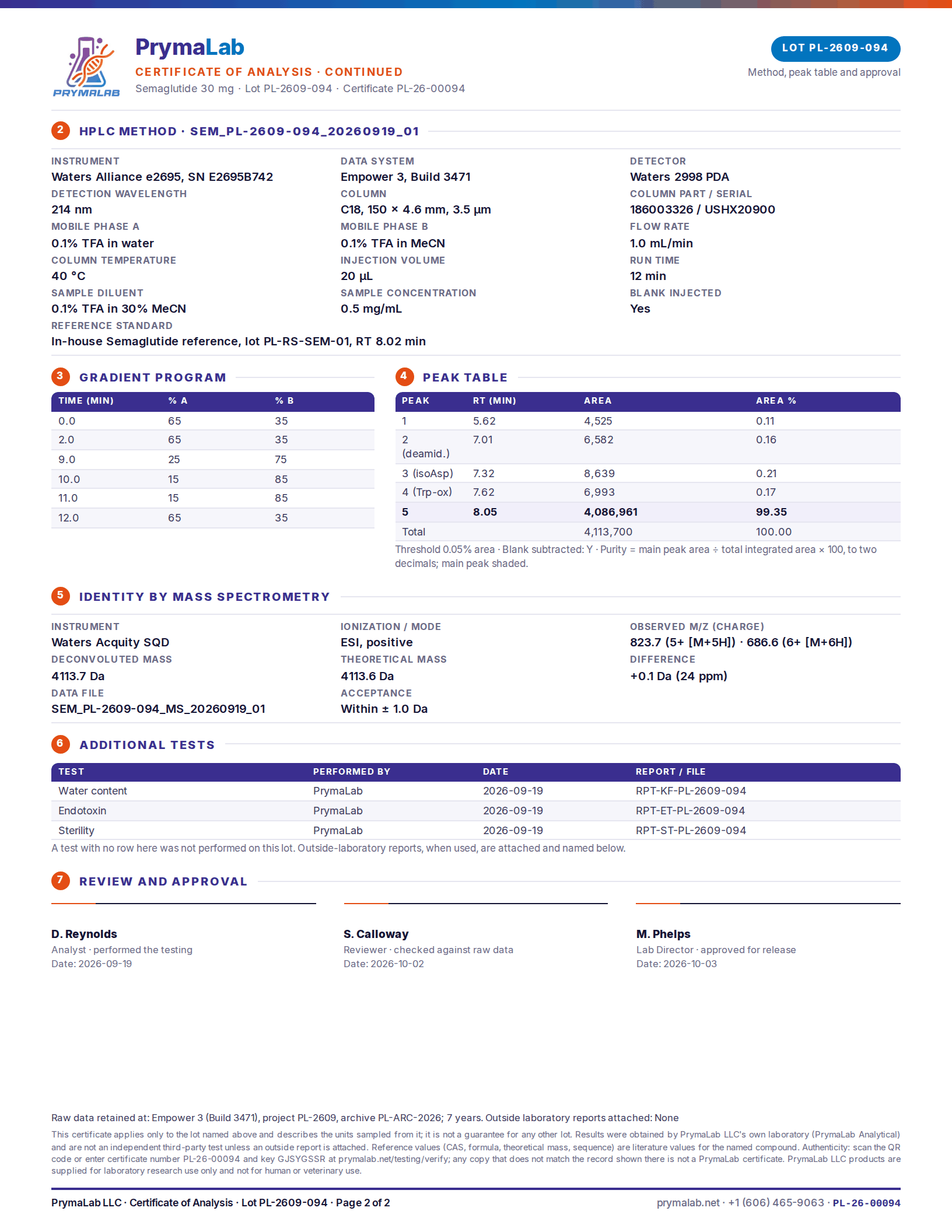
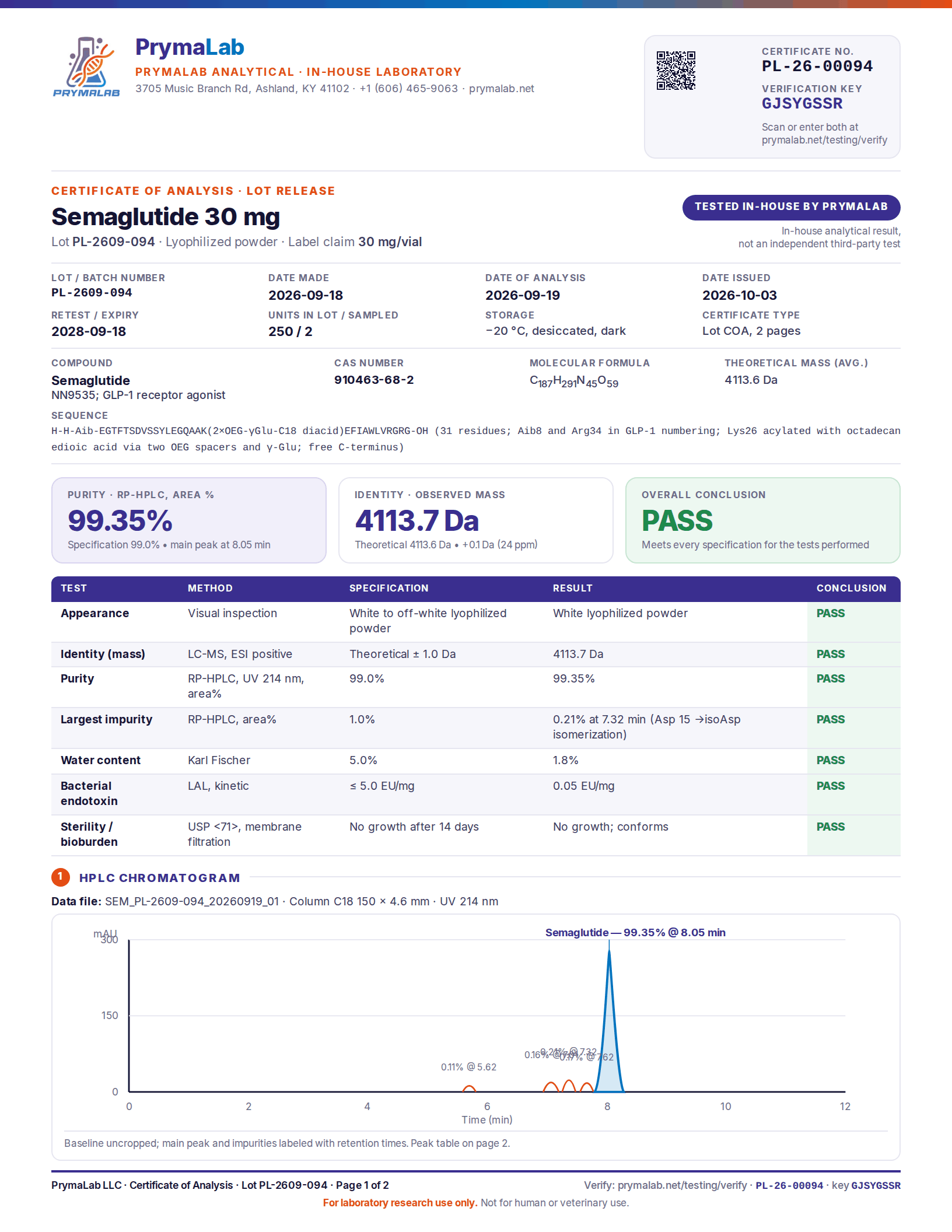
Net peptide content, with the determination stated, which on a semaglutide 30mg purchase is the field the whole study depends on.
The full sequence with the aminoisobutyric acid at position 8 and the acylation site at lysine 26 both stated.
Observed mass by spectrometry, since the non-natural residue is invisible to a default amino acid analysis panel.
Purity by chromatography, with the gradient and the column both named.
Aggregate content, by size exclusion chromatography, reported as a figure rather than as a reassurance.
A stability figure for the reconstituted solution with a temperature attached.
Salt form. Lot number and manufacturing date.
On a test-article purchase the certificate stops being paperwork and becomes an input to the result, because the potency figure the study produces is only as good as the concentration behind it.
What Does the Curve Actually Cost in Material?
Less than people expect, which is why a semaglutide 30mg vial is bought for the lot rather than for the volume.
A six-point curve in triplicate is eighteen wells. At 200 microlitres per well that is 3.6 millilitres of working solution per curve.
At a top concentration of 1 micromolar and a 4113 dalton peptide, the whole curve consumes well under a milligram once the serial dilutions are accounted for.
Run that curve ten times across a study and you are still nowhere near 30 milligrams.
So a 30 milligram vial is not sized to a study. It is sized to a supply period, and it makes sense only if the material stays good across that period as a solid.
It does. A sealed lyophilised cake at minus 20 is stable for a long time, which is the whole reason portioning works and reconstituting everything does not.
What Is the Argument Against This Fill?
Lot risk concentration. The argument against a semaglutide 30mg purchase is the mirror image of the argument for it.
One lot behind a whole dataset removes lot variation as a source of noise. It also means that if the lot is atypical, every result in the study inherits it and nothing internal to the study will reveal that.
A dataset spanning three lots has more noise and more chance of catching a bad one, because a discontinuity between arms is visible in a way a uniform offset is not.
Which of those two you prefer depends on whether the study is measuring an absolute figure or a comparison.
For a potency value that will be quoted elsewhere, one lot is worse, because a systematic error is undetectable and gets published.
For a within-study comparison, one lot is better, because the offset cancels.
That is the opposite of how the choice is usually framed, and I think the usual framing is wrong.
What Does the Solid State Buy You?
Time, and it is the reason portioning is worth the trouble.
A lyophilised cake at minus 20 degrees is chemically quiet. Water is the medium most peptide degradation runs in, and removing it slows nearly everything by orders of magnitude.
A reconstituted solution of the same material has a life measured in weeks at best.
So the difference between reconstituting 30 milligrams and reconstituting 8 is the difference between one clock running on all of it and one clock running on a quarter, with the remainder still asleep.
That framing makes the weighing error worth accepting. A two percent error on a portioned weighing costs less than a month of avoidable time in solution costs.
The exception is a laboratory without a balance suited to tens of milligrams, where the weighing error stops being two percent and the calculation changes.
How Should the Vial Be Handled?
Handle a semaglutide 30mg vial as an acylated peptide, and make the portioning decision before it is opened rather than after.
Sealed lyophilised material holds at minus 20 degrees Celsius, dark and dry.
Decide the portion size first. Opening the vial and then working out what to do with it means the cake has already been exposed.
Let the vial reach ambient temperature before opening it.
Run diluent down the wall. Leave the cake alone until it has dissolved.
No vortexing, and reconstituted solution stays refrigerated rather than going into a freezer.
Use low-binding consumables at every dilution step.
Record lot, net peptide content, the diluent and exact volume, the calculated concentration with the net content correction applied, the reconstitution date and how many portions the vial was split into.
The corrected concentration is the field worth insisting on, because a curve fitted against nominal concentrations produces a potency figure that is wrong by a known factor nobody bothered to divide out.
One final observation about who this fill suits. A laboratory studying semaglutide directly is doing something less common than it sounds, because the compound is usually the yardstick rather than the thing being measured.
If you are buying 30 milligrams, check that assumption about your own study before you order. Plenty of people discover partway through that what they needed was a comparator arm and a different test compound.
The 5mg page in this catalogue is written for that case and it is the more commonly correct purchase. This one is written for the case where semaglutide really is the subject, and that case deserves the larger fill and the portioning discipline that goes with it.
Published Literature
Selected references on the design of the molecule, on the published comparative work and on peptide storage generally. The 10mg page carries the same list.
- Lau J, Bloch P, Schaffer L, Pettersson I, Spetzler J, Kofoed J, et al. Journal of Medicinal Chemistry. 2015;58(18):7370-7380. DOI: 10.1021/acs.jmedchem.5b00726
- Frias JP, Davies MJ, Rosenstock J, Perez Manghi FC, Fernandez Lando L, Bergman BK, et al. New England Journal of Medicine. 2021;385(6):503-515. DOI: 10.1056/NEJMoa2107519
- Willard FS, Douros JD, Gabe MB, Showalter AD, Wainscott DB, Suter TM, et al. JCI Insight. 2020;5(17):e140532. DOI: 10.1172/jci.insight.140532
- Manning MC, Chou DK, Murphy BM, Payne RW, Katayama DS. Pharmaceutical Research. 2010;27(4):544-575. DOI: 10.1007/s11095-009-0045-6
Frequently Asked Questions
Who buys the largest fill?
Somebody running semaglutide as the test article rather than the comparator, which is the less common of the two roles this compound plays.
What changes in that role?
A concentration range is needed rather than a single point, which means more conditions, more replicates and more material.
Why does net peptide content stop being optional?
Because a systematically wrong nominal concentration shifts every point on a concentration-response curve together, and the potency figure derived from it is wrong by the same factor.
Does a comparator arm have that problem?
Less so. A fixed reference point tolerates a consistent offset. A curve does not, because the offset moves the answer the study exists to produce.
Can 30 milligrams be reconstituted at once?
Not usefully. Seven micromoles into 7 millilitres is a 1 millimolar stock, and consuming it at 100 nanomolar would take about 70 litres of assay medium.
So what is the vial bought for?
The lot rather than the volume. One lot behind a whole dataset, with the material reconstituted in portions.
How should it be portioned?
By weighing out sealed portions once at the start, rather than opening the vial repeatedly and letting the remaining cake take on moisture.
What about freezing aliquots instead?
Avoid it. Ice formation concentrates an acylated peptide differentially, which is the wrong direction for something that self-associates.
How many concentrations does a curve need?
At least six spanning three orders of magnitude for a sigmoidal fit, with more points near the inflection helping more than more points at the ends.
Do they all need to come from one stock?
Yes. A curve assembled from two stocks prepared a fortnight apart has a discontinuity in it, and the fit will not show you where.
How is that reconciled with the stability limit?
Size the reconstituted portion to one full curve plus replicates, then prepare fresh for the next run. One solution across a whole study is the trap a large fill sets.
What field belongs in the record here that would not elsewhere?
The concentration with the net content correction applied, rather than the nominal one. A curve fitted against nominal concentrations is wrong by a factor somebody could have divided out.
Compliance Statement
Semaglutide is sold exclusively for laboratory research use. It is not a drug, food, or cosmetic product, and it is not a dietary product of any kind. It is not approved by the FDA or any comparable authority for human or veterinary use, vial mass includes counterion and residual water so a nominal concentration derived from it carries a systematic error that shifts an entire concentration-response curve, a reconstituted solution of an acylated peptide has a limited useful life and freezing it is not a way to extend that, its published clinical record was generated with approved formulations that are not the article supplied here, and no compound in this range is offered for any human or veterinary purpose. This product is not intended to diagnose, treat, cure, or prevent any disease. It must not be given to humans or animals. Purchase is restricted to qualified researchers and institutions operating within applicable laws. All handling is the responsibility of the purchasing laboratory.


18 reviews for Semaglutide 30mg