Description
PrymaLab · Research Use Only
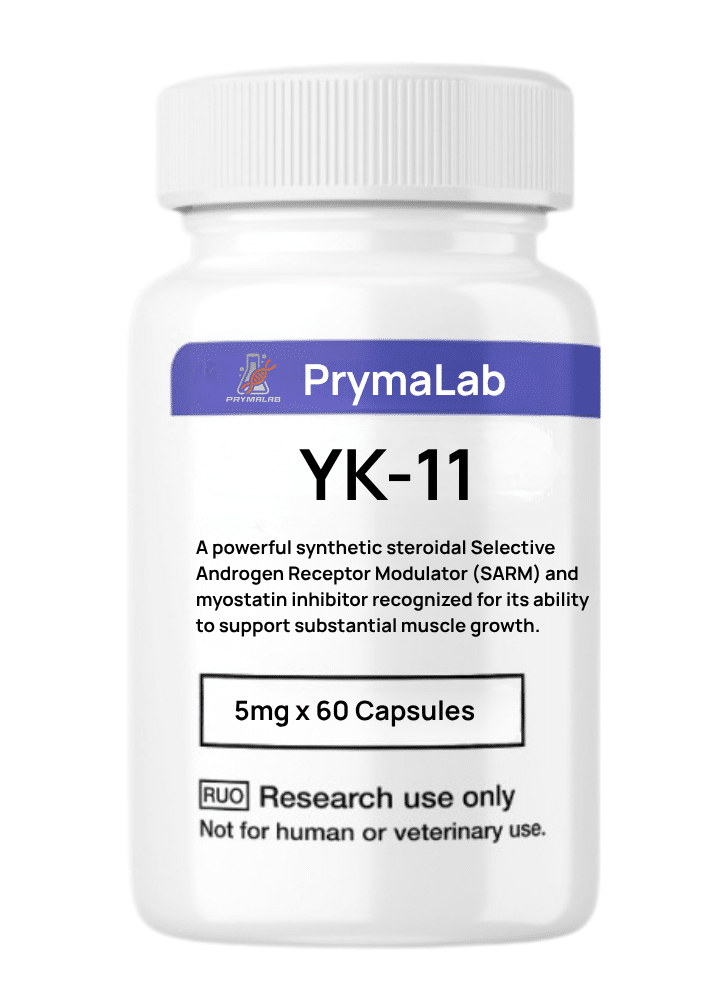
YK-11 5mg Capsules
Steroidal androgen receptor partial agonist · CAS 1370003-76-1 · Follistatin research
YK-11 myostatin inhibition is indirect, and that distinction is the single most misunderstood point about this compound. YK-11 is a steroidal androgen receptor partial agonist, CAS 1370003-76-1, which published work associates with induction of follistatin in C2C12 myoblasts. Follistatin then binds myostatin. The compound itself does not.
Specification Table
| Property | Value |
|---|---|
| Compound | YK-11 |
| Alternative name | Myostine (marketplace name, not used in the literature) |
| CAS number | 1370003-76-1 |
| Molecular formula | C25H34O6 |
| Molecular weight | 430.54 g/mol |
| Chemical class | Steroidal, dihydrotestosterone-derived gestrinone analogue |
| Molecular target | Androgen receptor (AR, NR3C4) |
| Receptor activity | Partial agonist. Activates AR without the N/C terminal interaction |
| Downstream mediator | Follistatin (FST) |
| Indirect target | Myostatin (GDF-8), via follistatin binding |
| Reported cell model | C2C12 murine myoblasts |
| Capsule strength | 5 mg |
| Appearance | White to off-white powder within a gelatin capsule shell |
| Purity | Per lot-specific certificate of analysis |
| Solubility | Soluble in DMSO and ethanol. Poorly soluble in water |
| Storage | Room temperature, sealed, protected from light and moisture |
| Stability | Not established beyond the lot expiry stated on the certificate of analysis |
| Human pharmacokinetic data | None published |
| Regulatory status | No approved human or veterinary formulation in any jurisdiction |
Does YK-11 Actually Inhibit Myostatin?
No, and the distinction is not a quibble. The compound does not bind myostatin, does not block the myostatin receptor, and does not interfere with myostatin processing. Search demand for this page runs heavily on phrases pairing YK-11 with myostatin inhibition, so the distinction is worth stating plainly rather than letting the shorthand stand.
What Kanno and colleagues reported is a two-step mechanism (Kanno et al., Biological and Pharmaceutical Bulletin, 2013). YK-11 exposure of C2C12 myoblasts induced expression of follistatin. Dihydrotestosterone, tested in parallel, did not. Follistatin is a secreted glycoprotein that binds several TGF-β family members directly, myostatin among them, and neutralises them.
So the chain runs: YK-11 activates the androgen receptor, follistatin expression rises, follistatin binds myostatin, myostatin signalling falls. Remove any link and the effect disappears. The authors demonstrated exactly that by showing the myogenic response was reversed with an anti-follistatin antibody.
Why Does YK-11 Behave Differently From Dihydrotestosterone?
Both compounds activate the androgen receptor, yet only one induced follistatin in the published comparison, which points to something more specific than generic receptor activation.
The mechanistic explanation offered is that YK-11 activates the receptor without the N/C terminal interaction. In conventional androgen signalling, the amino-terminal domain of the receptor folds back and contacts the carboxy-terminal ligand-binding domain. That intramolecular contact shapes which coregulators are recruited and therefore which genes are transcribed.
A ligand that activates the receptor while leaving that interaction unformed produces a different coregulator complex and a different transcriptional programme. This is what gene-selective androgen receptor modulation means at the molecular level, and YK-11 is one of the clearer published examples of it.
Kanno and colleagues also reported stronger induction of the myogenic regulatory factors MyoD, Myf5 and myogenin with YK-11 than with dihydrotestosterone, which is consistent with a distinct transcriptional output rather than simply a more potent androgen.
Is YK-11 a SARM or a Steroid?
Both labels get used in practice, and the resulting confusion is legitimate rather than careless.
Structurally YK-11 is a steroid. The formula C25H34O6 describes a dihydrotestosterone-derived scaffold, and it is usually described as a gestrinone analogue. That places it in a completely different structural class from andarine, RAD-140 or AC-262,536, all of which are non-steroidal.
Functionally it behaves as a selective modulator, because it activates the receptor in a way that produces a restricted and distinctive transcriptional output rather than the full androgenic programme. The label SARM describes function. The label steroid describes structure. YK-11 satisfies both, and anyone reasoning about its behaviour from the non-steroidal SARM literature is likely to reach the wrong conclusion.
What Is Not Known About YK-11?
A great deal remains unknown, and the gaps here are wider than for most compounds in this catalogue.
No human pharmacokinetic data has been published. No half-life figure exists in the peer-reviewed record. There is no long-term animal safety dataset. The follistatin mechanism rests substantially on the 2013 C2C12 work and a limited number of follow-up papers, which means it has not been extensively replicated across independent laboratories or model systems.
C2C12 cells are a murine myoblast line. They are a standard and well-validated model for myogenic differentiation, and they are also an immortalised cell line in a dish. Findings in that system establish a mechanism is possible. They do not establish that it operates at the same magnitude, or at all, in intact tissue.
A researcher choosing this compound should be choosing it because the follistatin mechanism is the object of study, not because a downstream effect is assumed to follow from it.
What Would a Well-Designed YK-11 Experiment Include?
Because the mechanism runs through an intermediate protein, the experimental design has to establish more links than a simple receptor-binding study would.
A follistatin readout is the first requirement. If the hypothesis is that YK-11 acts by inducing follistatin, then follistatin expression has to be measured, not assumed. Transcript level by quantitative PCR and protein by immunoblot or ELISA are both worth having, since the two can diverge.
A dihydrotestosterone comparator arm is the second. The entire significance of the original finding rests on YK-11 doing something that a conventional androgen does not. Without that parallel arm, an observed effect cannot be distinguished from generic androgen receptor activation.
A follistatin-blocking condition is the third, and it is the one most often omitted. Kanno and colleagues used an anti-follistatin antibody and reported that the myogenic response reversed. That reversal is what turns a correlation into a mechanism, and any design claiming the follistatin pathway without it is claiming more than it has shown.
Add a vehicle control matched for solvent concentration, and the design has four arms rather than two. That is more work, and it is the difference between a finding that survives review and one that does not.
Why YK-11 Myostatin Inhibition Is Often Overstated
Claims about YK-11 myostatin inhibition have drifted a long way from what was actually measured, and they drift in one direction only.
What the primary work established is that YK-11 induced follistatin expression in a murine myoblast cell line, and that blocking follistatin reversed the myogenic response. That is a clean finding in a defined system.
What gets claimed is considerably broader: that the compound inhibits myostatin in the way a monoclonal antibody or a soluble receptor decoy does. It does not. Those agents bind myostatin or its receptor directly and have their effect regardless of transcriptional context. YK-11 depends on a cell being able to transcribe and secrete follistatin in response to androgen receptor activation.
That dependency has real consequences for study design. A cell type that does not upregulate follistatin in response to androgen receptor signalling should show no myostatin-related effect from this compound at all. Whether that holds across tissue types has not been systematically examined, and it is the obvious next question the literature has not answered.
Handling and Storage in Laboratory Practice
Capsules are supplied at 5 mg. Weigh the contents for analytical work rather than assuming nominal fill.
As a steroidal compound YK-11 dissolves readily in DMSO and ethanol and poorly in water. Standard practice is a concentrated organic stock diluted into medium immediately before use, keeping final solvent concentration low enough to avoid confounding the cell response. In C2C12 differentiation work in particular, DMSO above roughly 0.1 percent can itself affect myotube formation, so a vehicle control matters more than usual here.
Sealed dry material keeps at ambient temperature out of the light. Capture lot, solvent, concentration and date, and record the vehicle control condition in the same place so the two are never separated.
Published Literature
All references verified against the publisher record or a primary index. The literature base for this compound is narrow, and the list reflects that honestly.
- Kanno Y, Ota R, Someya K, Kusakabe T, Kato K, Inouye Y. Biological and Pharmaceutical Bulletin. 2013;36(9):1615-1617. PMID: 23995658
- Kanno Y, Hikosaka R, Zhang SY, Inoue Y, Nakahama T, Kato K, Yamaguchi A, Tominaga N, Kohra S, Arizono K, Inouye Y. Biological and Pharmaceutical Bulletin. 2011;34(3):318-323.
- Lee SJ, McPherron AC. Proceedings of the National Academy of Sciences. 2001;98(16):9306-9311.
- Amthor H, Nicholas G, McKinnell I, Kemp CF, Sharma M, Kambadur R, Patel K. Developmental Biology. 2004;270(1):19-30.
Frequently Asked Questions
Does YK-11 myostatin inhibition work by binding myostatin?
No. YK-11 myostatin inhibition is indirect, and that distinction is the single most misunderstood point about this compound, because the shorthand suggests something the chemistry does not support. YK-11 activates the androgen receptor, follistatin expression rises in response, and follistatin then binds myostatin and neutralises it. Remove follistatin from that chain and nothing happens.
What is follistatin and why does it matter here?
A secreted glycoprotein that binds several TGF-beta family members directly, myostatin among them, and stops them signalling. In the published C2C12 work, YK-11 induced its expression where dihydrotestosterone did not, and an anti-follistatin antibody reversed the myogenic response, which is what established follistatin as the mediating step rather than a bystander.
Is YK-11 a steroid or a SARM?
Structurally it is a steroid, specifically a dihydrotestosterone-derived gestrinone analogue carrying the formula C25H34O6, while functionally it behaves as a selective modulator because the transcriptional output it produces is restricted rather than complete. Both labels are accurate. Reasoning from the non-steroidal SARM literature will mislead, since the scaffolds are unrelated.
How does YK-11 differ from dihydrotestosterone?
Both activate the androgen receptor, but published work reports that YK-11 does so without the N/C terminal interaction in which the receptor amino-terminal domain folds back and contacts the ligand-binding domain, and that difference changes which coregulators assemble. Only YK-11 induced follistatin. That was the whole finding.
What cell model was used in the primary research?
C2C12 murine myoblasts, a standard and thoroughly validated line for studying myogenic differentiation, in which Kanno and colleagues reported stronger induction of MyoD, Myf5 and myogenin with YK-11 than with dihydrotestosterone. Findings there establish that a mechanism is possible. They do not establish that it operates at the same magnitude in intact tissue.
What is the half-life of YK-11?
No published figure exists, because no human pharmacokinetic study of this compound appears in the peer-reviewed literature and no reliable animal dataset does either. Figures circulate anyway. None of them traces back to a primary study, so any specific number should be treated as unverified until someone produces the source.
Is Myostine the same as YK-11?
Yes, though Myostine is a marketplace name with no presence whatsoever in the scientific literature, which means searching indexed databases for it returns nothing useful and wastes time that a CAS lookup would not. Use YK-11 or 1370003-76-1 instead. The name appears frequently in European queries reaching this page.
Why does the vehicle control matter for YK-11 work?
YK-11 requires an organic solvent because aqueous solubility is poor, and in C2C12 differentiation experiments DMSO above roughly 0.1 percent can affect myotube formation on its own, entirely independently of anything dissolved in it. That makes a matched vehicle control mandatory. Without one, solvent and compound effects are inseparable.
How should YK-11 capsules be stored?
Sealed at ambient temperature, protected from light and moisture, where the dry powder is stable and requires nothing further. Organic stock solutions belong in the refrigerator. Set the usable window internally, since no published stability dataset covers this compound under arbitrary storage conditions.
What controls should a YK-11 experiment include?
Four arms rather than two. A follistatin readout measuring transcript and protein, a dihydrotestosterone comparator arm, a follistatin-blocking condition using an antibody, and a vehicle control matched for solvent concentration. The blocking condition is most often omitted, and it is what converts a correlation into a mechanism.
Why is a dihydrotestosterone arm necessary?
The significance of the original finding rests entirely on YK-11 doing something a conventional androgen does not. Without a parallel dihydrotestosterone arm, an observed effect cannot be distinguished from generic androgen receptor activation, and the claim that the compound is gene-selective has not been tested.
Is the follistatin mechanism established across tissue types?
No, because the primary work used C2C12 murine myoblasts and nobody has systematically examined whether the follistatin response occurs across other tissues expressing the androgen receptor. The prediction is testable and specific. A cell type that does not upregulate follistatin in response to receptor activation should show no myostatin-related effect at all.
How does YK-11 differ from a myostatin antibody?
An antibody or soluble receptor decoy binds myostatin or its receptor directly and works regardless of transcriptional context, which makes it mechanism-independent in a way YK-11 is not. YK-11 needs a cell capable of transcribing and secreting follistatin. Remove that capacity and the effect vanishes.
Why does the solvent concentration matter so much in C2C12 work?
Because DMSO above roughly 0.1 percent affects myotube formation independently of any compound dissolved in it, and YK-11 needs an organic solvent to go into solution at all, which puts the two effects directly in competition within the same readout. A matched vehicle control is not optional here. Without one, nothing in the differentiation data can be attributed confidently.
Compliance Statement
YK-11 5mg capsules is sold exclusively for laboratory research use. It is not a drug, food, or cosmetic product, and it is not a dietary product of any kind. It is not approved by the FDA or any comparable authority for human or veterinary use, and androgen receptor modulators are prohibited in competitive sport under World Anti-Doping Agency rules. This product is not intended to diagnose, treat, cure, or prevent any disease. It must not be given to humans or animals. Purchase is restricted to qualified researchers and institutions operating within applicable laws. All handling is the responsibility of the purchasing laboratory.


15 reviews for YK-11 5mg Capsules