
Description
PrymaLab · Research use only
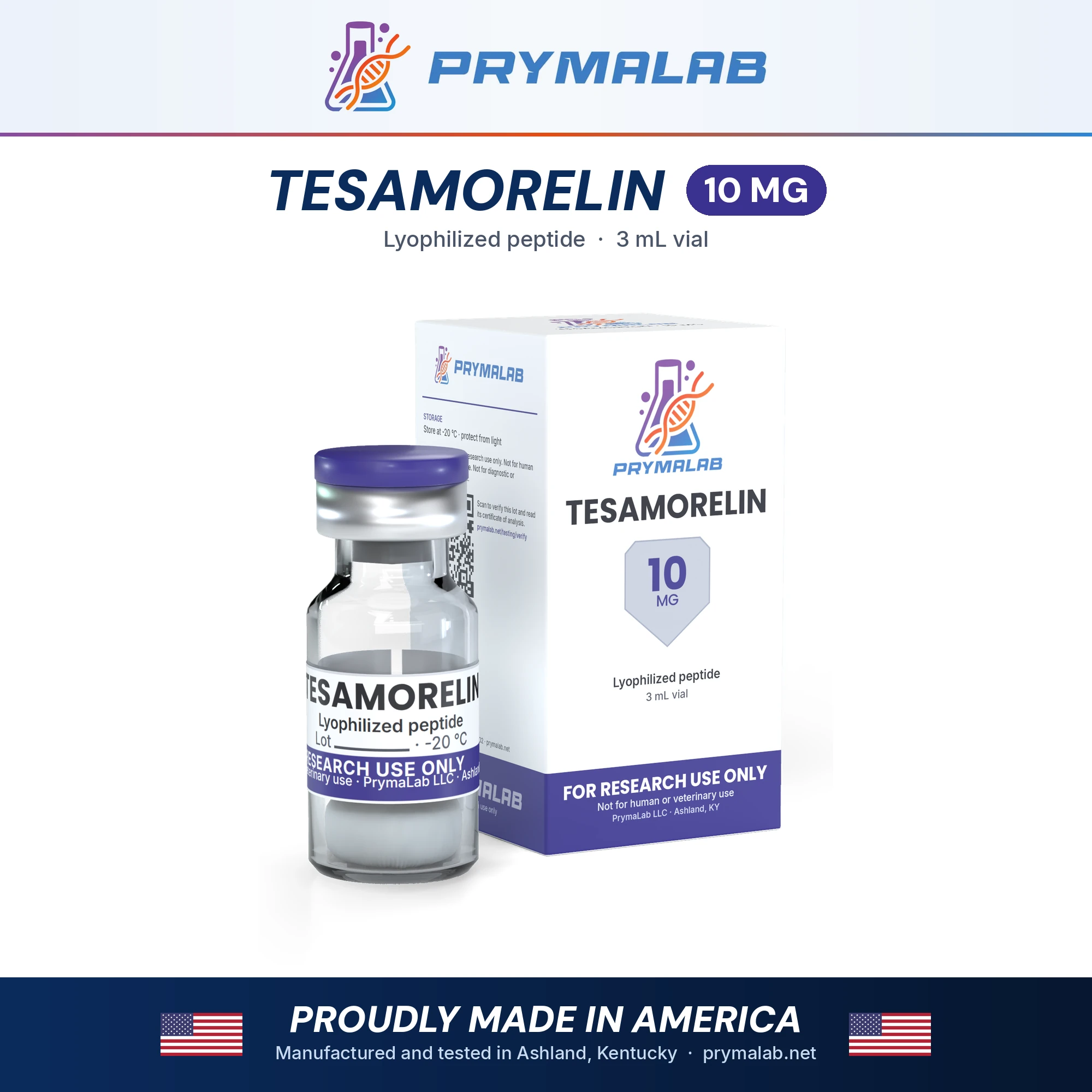
Tesamorelin 10mg
Tesamorelin, trans-3-hexenoyl GHRH(1-44) amide, freeze-dried in a 10 mg vial
Tesamorelin is the full 44-residue sequence of human growth hormone-releasing hormone, amidated at the C-terminus, with a trans-3-hexenoyl group added at the N-terminus. This listing is a 10 mg vial of freeze-dried powder; the same peptide is also sold in solution in a preloaded pen. Most of the published work on tesamorelin is clinical: randomised trials in adults with HIV and abdominal fat accumulation, and a trial of cognition in older adults.
Specifications
| Property | Value |
|---|---|
| Compound | Tesamorelin (trans-3-hexenoyl-GHRH(1-44)-NH2) |
| CAS number | 218949-48-5 |
| Molecular formula | C221H366N72O67S |
| Label claim | 10 mg per vial |
| Form | Lyophilized (freeze-dried) powder or cake in a sealed glass vial with a rubber stopper and aluminium crimp cap |
| Safety data sheet | PL-SDS-162 |
Handling notes
The safety data sheet classifies tesamorelin as a category 2 reproductive toxicant, H361: suspected of damaging fertility or the unborn child. The sheet asks for it to be stored locked up, sealed, desiccated and away from light (its storage text gives −20 °C as typical for peptides), and for the vial to reach room temperature before it is opened so moisture does not condense on the powder. Reconstituted solutions are held at 2 to 8 °C, protected from light.
Measuring the concentration of a tesamorelin solution by UV absorbance needs care. Its peptide chain is the 44-residue GHRH sequence, which contains two tyrosines and no tryptophan or cysteine1. Pace and colleagues showed that absorbance at 280 nm comes from tryptophan, tyrosine and cystine, that coefficients predicted from composition are less reliable for proteins without tryptophan, and that measuring the coefficient beats predicting it2.
What the research covers
What tesamorelin is
Tesamorelin is built on GHRH itself. Guillemin and colleagues isolated the 44-residue hormone in 1982 from a pancreatic tumour that had caused acromegaly, and its synthetic copy stimulated growth hormone secretion with full activity in vitro and in vivo1. Tesamorelin keeps that whole sequence, described in one trial report as GHRH(1-44)3, and a 2012 trial called it a stabilised analogue of human GHRH4. The stabilising change is the N-terminal trans-3-hexenoyl group named on the safety data sheet; the abstracts cited here do not report how it alters the peptide’s breakdown.
Trials in adults with HIV
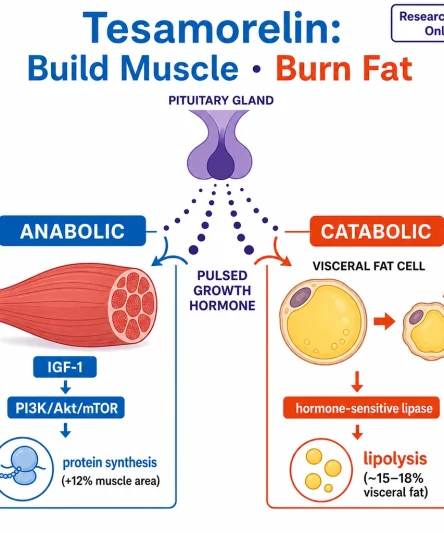
Most of the trials cited here enrolled people with HIV who had accumulated abdominal fat during antiretroviral therapy. In a 26-week randomised, placebo-controlled trial of 412 patients, 86% of them men, visceral adipose tissue measured by CT fell 15.2% with tesamorelin and rose 5.0% with placebo; triglycerides and the total-to-HDL cholesterol ratio also improved, and IGF-I rose 81%5. Adverse events did not differ significantly between groups, although more patients on tesamorelin withdrew because of one, and glycaemic measures showed no significant differences5. A second, 12-month trial of 404 patients found a 6-month change in visceral fat of −10.9% against −0.6% with placebo, about 18% in those who continued to 12 months, and a quick loss of the change in those switched to placebo3.
Later trials turned to the liver. In a 6-month trial of 50 patients at Massachusetts General Hospital, tesamorelin reduced visceral fat and liver fat compared with placebo; fasting glucose rose at two weeks but the change over six months was not significant, and the authors called the study preliminary6. A 12-month multicentre trial in 61 people with HIV and non-alcoholic fatty liver disease found a greater fall in hepatic fat fraction than with placebo, an absolute difference of 4.1 percentage points, and 35% of the tesamorelin group against 4% on placebo ended below the 5% threshold7. Glucose and glycated haemoglobin did not differ, and local skin complaints at the treatment site were more common with tesamorelin7.
A trial in older adults
Baker and colleagues randomised 152 adults aged 55 to 87, 66 of them with mild cognitive impairment, to tesamorelin or placebo for 20 weeks4. The analysis of everyone randomised showed a favourable effect on a cognitive composite in both groups, clearest for executive function; IGF-I rose 117% while staying within the physiological range, and fasting insulin rose within the normal range in the impaired group4. Adverse events were mild but were reported by 68% of treated adults against 36% on placebo4.
What is not established
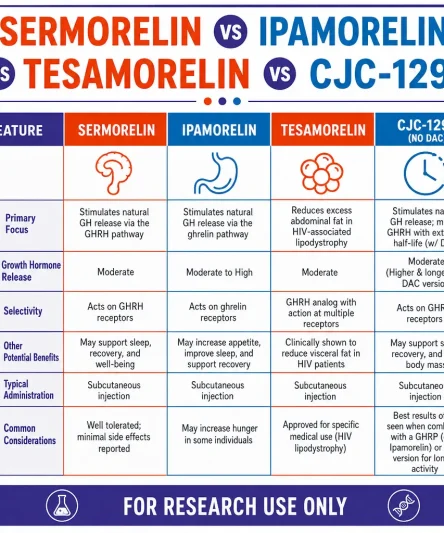
The trials enrolled specific groups, mostly people with HIV and abdominal fat accumulation, and in the one study that tested withdrawal the changes faded once treatment stopped3. The liver trials were small, and both called for longer studies of clinical importance and liver histology6,7. The cognition trial lasted 20 weeks and its authors asked for longer trials4. None of the trials used research material such as this vial. The comparison of sermorelin, ipamorelin and tesamorelin places tesamorelin among the other GHRH analogues.
How each lot is tested
Every lot is tested in PrymaLab’s own laboratory in Ashland, Kentucky before release: RP-HPLC for purity, LC-MS for identity, Karl Fischer titration for water, LAL for endotoxin and USP <71> for sterility. Published certificates are listed on the results page and can be checked by number and key on the verify page. These are in-house results from PrymaLab Analytical, not an independent test, and the lab is not accredited to ISO 17025. The third-party testing guarantee on this page still applies: if any independent laboratory finds the wrong compound, or less than the stated purity or amount, the order is refunded and the cost of the test is reimbursed.
Frequently asked questions
How does tesamorelin differ from sermorelin?
Sermorelin is only the first 29 residues of GHRH and carries no added group. Tesamorelin keeps all 44 residues of the native hormone, with its C-terminal amide, and adds a trans-3-hexenoyl group at the N-terminus. Both act on the GHRH receptor.
What does the H361 classification mean in the lab?
It means the safety data sheet classes tesamorelin as suspected of damaging fertility or the unborn child. Store it locked up, keep the vial closed and labelled, and follow the sheet's handling and protective measures when weighing or reconstituting it.
How should the vial be stored before and after reconstitution?
Keep the sealed vial cold, dry and away from light, as the safety data sheet describes, and let it reach room temperature before opening. Once reconstituted, hold the solution at 2 to 8 °C, protected from light, for a period your laboratory has established.
What do the clinical trials show, and what do they leave open?
Randomised trials in adults with HIV measured lower visceral and liver fat and higher IGF-I with tesamorelin than with placebo, and one trial in older adults measured cognition. The effects faded after stopping, the liver work was small, and none of the trials used research material.
How do I check the testing for this product?
The testing section on this page explains what PrymaLab's in-house testing covers. Published certificates are listed on the results page and can be checked by certificate number and key on the verify page.
Can this product be used in people or animals?
No. Tesamorelin has been through clinical trials, but this vial is research material sold for laboratory use only. It is not approved for human or veterinary use and must not be given to people or animals.
References
- Guillemin R, Brazeau P, Böhlen P, et al. Growth hormone-releasing factor from a human pancreatic tumor that caused acromegaly. Science. 1982;218(4572):585-7. DOI · PubMed
- Pace CN, Vajdos F, Fee L, et al. How to measure and predict the molar absorption coefficient of a protein. Protein Sci. 1995;4(11):2411-23. DOI · PubMed
- Falutz J, Potvin D, Mamputu JC, et al. Effects of tesamorelin, a growth hormone-releasing factor, in HIV-infected patients with abdominal fat accumulation: a randomized placebo-controlled trial with a safety extension. J Acquir Immune Defic Syndr. 2010;53(3):311-22. DOI · PubMed
- Baker LD, Barsness SM, Borson S, et al. Effects of growth hormone–releasing hormone on cognitive function in adults with mild cognitive impairment and healthy older adults: results of a controlled trial. Arch Neurol. 2012;69(11):1420-9. DOI · PubMed
- Falutz J, Allas S, Blot K, et al. Metabolic effects of a growth hormone-releasing factor in patients with HIV. N Engl J Med. 2007;357(23):2359-70. DOI · PubMed
- Stanley TL, Feldpausch MN, Oh J, et al. Effect of tesamorelin on visceral fat and liver fat in HIV-infected patients with abdominal fat accumulation: a randomized clinical trial. JAMA. 2014;312(4):380-9. DOI · PubMed
- Stanley TL, Fourman LT, Feldpausch MN, et al. Effects of tesamorelin on non-alcoholic fatty liver disease in HIV: a randomised, double-blind, multicentre trial. Lancet HIV. 2019;6(12):e821-e830. DOI · PubMed
Research use only
For laboratory research use only. Tesamorelin 10mg is not a drug, food, cosmetic or dietary supplement, is not approved by the FDA or any comparable authority for human or veterinary use, and must not be given to people or animals. It is sold to qualified researchers and institutions, and the buyer is responsible for lawful handling and disposal.
Other formats of Tesamorelin
Tesamorelin is also stocked as Tesamorelin 10mg preloaded 3ml pen. Each listing states its own quantity and concentration, and the pen and vial comparison explains what changes between formats.







10 reviews for Tesamorelin 10mg