Description
PrymaLab · Research Use Only
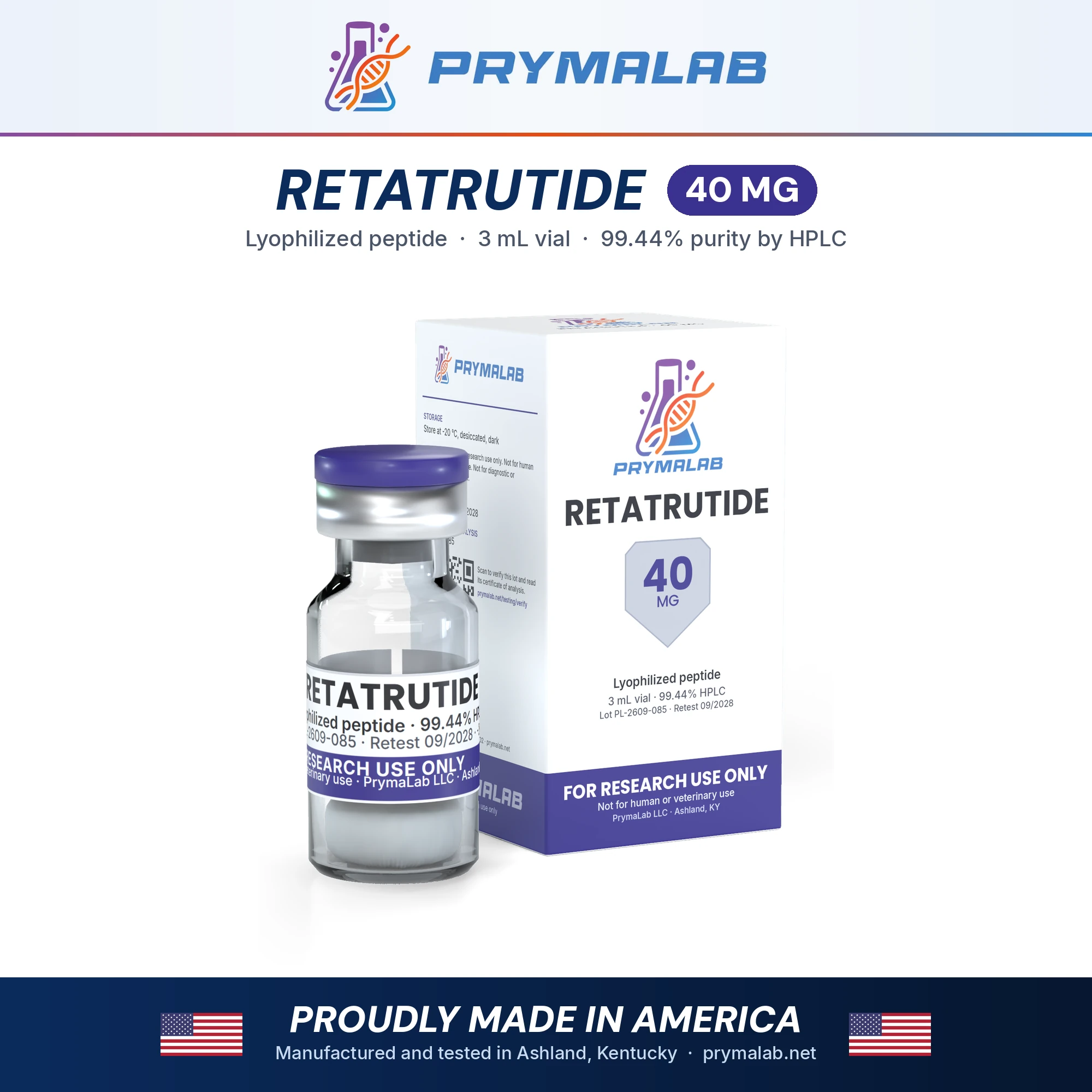
Retatrutide 40mg
LY3437943 · lot-verified research vial · 39 residues
Retatrutide 40mg is a lyophilized vial of LY3437943, CAS 2381089-83-2, approximately 8.17 micromoles. At this quantity the analytical questions matter more than the handling ones, because a single lot will underwrite a substantial body of work.
Specification Table
| Property | Value |
|---|---|
| Compound | Retatrutide |
| Development code | LY3437943 |
| CAS number | 2381089-83-2 |
| Vial content | 40 mg lyophilized powder |
| Molar content at MW 4894.58 | Approximately 8.17 µmol |
| Synthesis complexity | Three non-coded residues plus a three-part side-chain conjugate |
| Molecular formula | C228H350N48O66 |
| Molecular weight | Contested. 4894.58 and 4731.33 both circulate. See the note on the 5mg page |
| Residue count | 39 |
| C-terminus | Amidated |
| Peptide backbone | Based on the GIP sequence rather than GLP-1 |
| Non-coded residue, position 2 | α-aminoisobutyric acid (Aib) |
| Non-coded residue, position 13 | α-methyl-leucine |
| Non-coded residue, position 20 | α-aminoisobutyric acid (Aib) |
| Lipid conjugation | Lysine 17 side chain bears PEG2-γ-Glu-eicosanedioic acid |
| Molecular targets | GIP receptor, GLP-1 receptor, glucagon receptor |
| Reported EC50, GIPR | 0.0643 nM |
| Reported EC50, GLP-1R | 0.775 nM |
| Reported EC50, GCGR | 5.79 nM |
| Originating organisation | Eli Lilly |
| Appearance | White lyophilized powder |
| Purity | Per lot-specific certificate of analysis |
| Solubility | Water soluble. Slightly alkaline buffer aids dissolution |
| Storage, lyophilized | -20°C, protected from light and moisture |
| Storage, reconstituted | 2-8°C, protected from light |
| Regulatory status | Investigational. No approved formulation in any jurisdiction |
What Does Retatrutide Purity Testing Actually Measure?
Purity on a Retatrutide 40mg certificate is a narrower claim than most buyers assume, and knowing what it excludes is more useful than knowing the number.
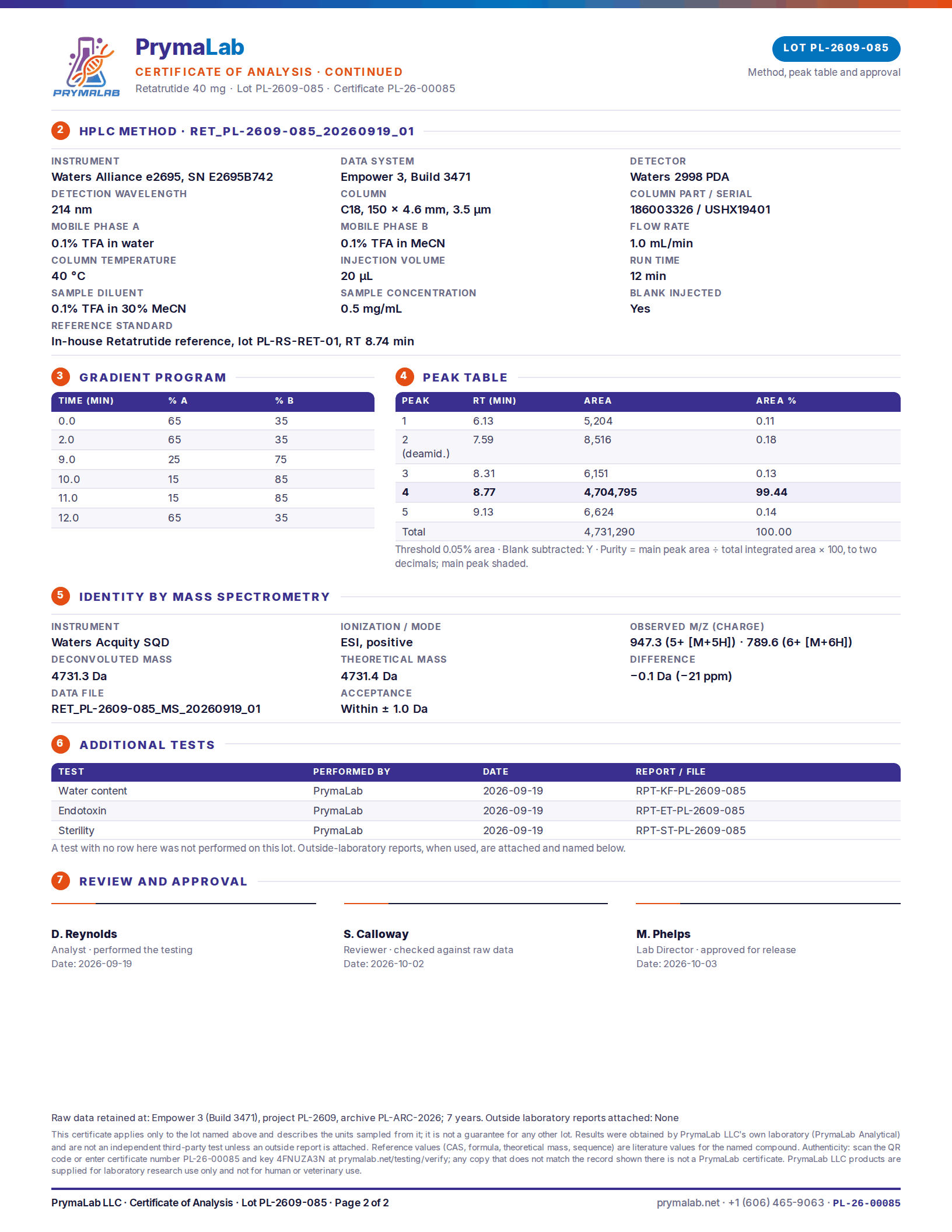
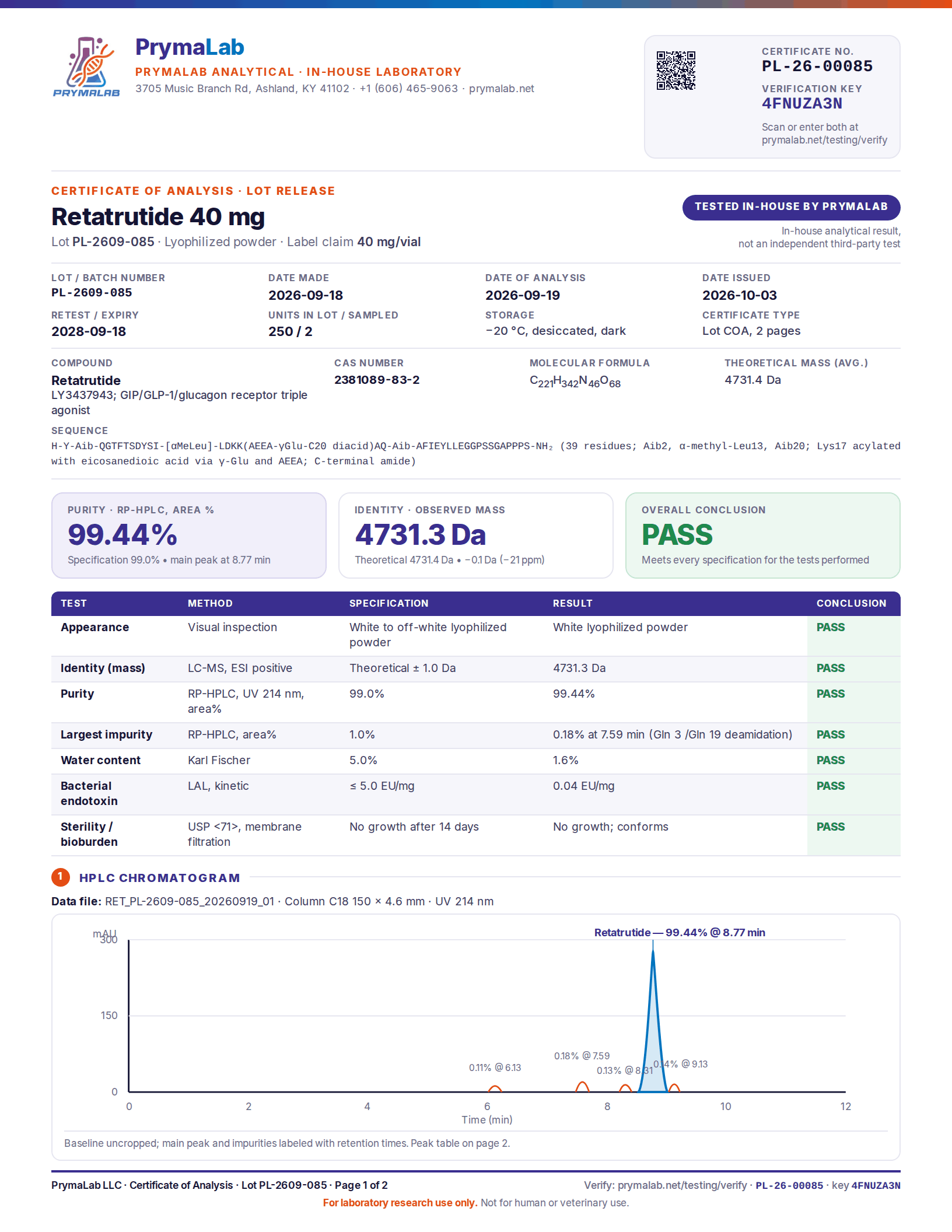
The standard method is reversed-phase high-performance liquid chromatography with ultraviolet detection, usually at 214 nm where the peptide bond absorbs. Purity is reported as the area of the main peak divided by total integrated area.
That figure measures the proportion of ultraviolet-absorbing material eluting as the main peak, and it does not measure how much of the vial is peptide, which is net peptide content and a separate determination.
It also cannot see anything that does not absorb or does not elute. Residual salts, counterion and water are invisible to it, which is how a preparation can read 98 percent pure and still be substantially less than 98 percent peptide by weight.
Resolution sets the ceiling on what the number means. At 39 residues the closely related impurities differ from the target by a single residue or a single modification, and a fast gradient will co-elute them under the main peak.
Asking for the chromatogram rather than the number is the single most informative request a buyer can make, because peak shape shows immediately whether the method resolved anything.
What Can Go Wrong in This Particular Synthesis?
Four failure modes are specific to this molecule, and each of them produces a signature that can be distinguished from the others given the right instrument.
Incomplete lipid conjugation is the most consequential. The three-part assembly at lysine 17 is the hardest step, and a preparation missing it weighs several hundred daltons less and loses the albumin binding that gives the molecule its duration.
Substitution of coded residues for the non-coded ones produces a peptide of correct length and near-correct mass. Replacing Aib with alanine costs 14 daltons per position, which is resolvable by high-resolution mass spectrometry and invisible to a bench instrument.
Deletion sequences arise at any of 39 coupling steps and differ from the target by one residue mass, and they are the reason gradient resolution matters, because they chromatograph close to the target.
Incomplete carboxy-terminal amidation leaves a free acid one dalton heavier, and that single dalton is the hardest defect to detect and requires high-resolution instrumentation.
A certificate reporting only a purity percentage speaks to none of these directly. A certificate reporting mass, an impurity profile and confirmation of the modifications speaks to all four.
What Should a Retatrutide Certificate of Analysis Contain?
For a compound this complex the useful certificate has seven fields, and most supplier documents carry two or three.
Measured mass by high-resolution mass spectrometry, stated as the figure the instrument returned rather than a catalogue value.
Purity by reversed-phase chromatography, with the gradient and the detection wavelength both stated, and ideally with the chromatogram itself attached rather than summarised.
An impurity profile rather than a single percentage, identifying what the non-target material is. Ninety-five percent pure with unconjugated peptide as the balance is a different product from 95 percent with unrelated by-products.
Net peptide content, distinguishing peptide mass from total weighed mass including counterion and residual water.
Counterion identity, which for a sequence carrying two adjacent lysines is what determines how large that correction turns out to be in practice.
Confirmation of the three non-coded residues and of the lysine 17 conjugation, by amino acid analysis or tandem mass spectrometry.
Water content by Karl Fischer. At this fill size it is large enough to matter.
Why Does Retatrutide Lot Verification Matter at This Scale?
Retatrutide 40mg will underwrite more experiments than a smaller vial, which changes the calculus on independent testing.
A single lot spanning a long programme holds material variation constant, which is the argument for buying larger. The corresponding risk is that a defective lot invalidates everything drawn from it rather than one experiment.
Independent verification before committing is therefore worth more here than at 5mg, and mass spectrometry with a well-resolved chromatogram together take an afternoon and a negligible fraction of the material.
Verify before the first experiment rather than after an anomalous result, since retrospective testing on a partially consumed vial answers a narrower question and by then the programme has already been run.
Where a facility lacks the instrumentation, contract analytical services will run both for a modest fee, and the cost is small against the cost of a repeated study.
Record the verification alongside the lot number. A result challenged two years later is defensible if the material characterisation sits in the same notebook.
Where Should Reta Peptide Buy Decisions Land?
The shorthand reta appears throughout supplier listings and forums, and it refers to the same 39-residue molecule as the full name.
That informality is worth noting because it correlates with documentation quality. A listing using only the shorthand, with no CAS number and no measured mass, is describing a product the seller may not have characterised.
The questions that separate suppliers are the certificate fields above. A seller who can produce a chromatogram and a mass spectrum has handled the material analytically. One quoting a purity percentage from a supplier data sheet has not.
CAS 2381089-83-2 should appear on the documentation. Its absence is not proof of anything but its presence indicates the seller is describing a defined substance rather than a category.
Price differences across suppliers for this compound are large, and they track documentation more closely than they track anything else.
What Does Retatrutide 40mg Commit a Programme To?
Eight point one seven micromoles underwrites a substantial body of work, and Retatrutide 40mg therefore concentrates risk into one synthesis lot.
That concentration is the point. Holding material constant across a study removes a confound that is very difficult to detect afterwards, and lot-to-lot variation in a triply modified conjugated peptide is real rather than theoretical.
The corresponding exposure is that a defective lot invalidates everything drawn from it. Verifying Retatrutide 40mg before the first experiment rather than after an anomaly is the whole argument of this page.
Verification consumes a negligible fraction. A milligram covers mass spectrometry and a resolved chromatogram with material to spare.
Record the verification alongside the lot number, so that a result questioned later has its material characterisation in the same notebook.
How Should 40mg Be Reconstituted and Stored?
Retatrutide 40mg at eight point one seven micromoles is a large molar quantity for a compound with sub-nanomolar potency, so dividing before reconstitution is worth considering.
Weighing out portions of dry powder keeps the unused fraction in the stable state, and lyophilized material at -20°C is stable for far longer than the same material in solution. An analytical balance and attention to static are required.
Where full reconstitution is preferred, 8 ml gives roughly 1.02 mM and keeps the ladder arithmetic consistent with the smaller formats.
Aliquot immediately, freeze, and thaw once only, because a lipidated peptide nucleates aggregation at its hydrophobic tail and repeat thaws cost more here than for a plain sequence.
Let the sealed vial warm fully before breaking the seal. Moisture condensing onto hygroscopic cake is the commonest quiet spoilage route, and the larger the fill the more it costs.
Record lot, verification results, measured mass, the molecular weight used, diluent, volume, concentration and date.
A closing note on what verification does not tell you. Mass and purity confirm the molecule and its cleanliness; neither speaks to whether the material has been stored well since it was made.
Water content by Karl Fischer partly covers that gap, since a lyophilized cake that has taken up moisture has been exposed to humidity at some point.
Asking for the manufacture date alongside the analysis date closes most of the rest, because a certificate dated two years before shipment describes material as it was, not as it is.
One last observation about chromatograms. A single sharp peak looks reassuring and can mean the gradient was too fast to separate anything.
A slightly messier trace from a shallow gradient is more informative than a clean one from a steep gradient, which inverts the instinct most buyers bring to the document.
A final word on who should verify. Where a laboratory runs regulated work, independent characterisation is usually required rather than optional, and the supplier certificate is supporting evidence rather than the record.
Where the work is exploratory the calculus is looser, but the argument for verifying a fill this size holds either way because the cost is trivial against what depends on it.
Published Literature
References verified against the publisher record. Analytical guidance above reflects standard peptide characterisation practice rather than anything specific to the published pharmacology.
- Coskun T, Urva S, Roell WC, Qu H, Loghin C, Moyers JS, O’Farrell LS, Briere DA, Sloop KW, Thomas MK, Pirro V, Wainscott DB, Willard FS, Abernathy M, Morford L, Du Y, Benson C, Gimeno RE, Haupt A, Coskun T. Cell Metabolism. 2022;34(9):1234-1247.
- Urva S, Coskun T, Neff LM, Yeo KP, Loghin C, Ma X, Landry J, Bray R, Milicevic Z, Haupt A. The Lancet. 2022;400(10366):1869-1881.
- Jastreboff AM, Kaplan LM, Frias JP, Wu Q, Du Y, Gurbuz S, Coskun T, Haupt A, Milicevic Z, Hartman ML. New England Journal of Medicine. 2023;389(6):514-526.
- Willard FS, Douros JD, Gabe MB, Showalter AD, Wainscott DB, Suter TM, Capozzi ME, van der Velden WJ, Stutsman C, Cardona GR, et al. JCI Insight. 2020;5(17):e140532.
- Finan B, Yang B, Ottaway N, Smiley DL, Ma T, Clemmensen C, Chabenne J, Zhang L, Habegger KM, Fischer K, et al. Nature Medicine. 2015;21(1):27-36.
Frequently Asked Questions
What is Retatrutide 40mg?
A lyophilized vial of LY3437943, CAS 2381089-83-2, approximately 8.17 micromoles. At this quantity a single lot will underwrite a substantial body of work, which makes the analytical questions more important than the handling ones.
What does a purity figure measure?
The proportion of ultraviolet-absorbing material eluting as the main peak on reversed-phase chromatography. It does not measure how much of the vial is peptide, which is net peptide content and a separate determination.
What is invisible to that measurement?
Anything that does not absorb or does not elute. Residual salts, counterion and water are all invisible, which is how a preparation can read 98 percent pure and be substantially less than 98 percent peptide by weight.
Why does gradient resolution matter?
Because at 39 residues the closely related impurities differ from the target by a single residue or modification, and a fast gradient co-elutes them under the main peak. A purity figure from an unresolved chromatogram overstates what it measured.
What is the single most useful request?
The chromatogram rather than the number. Peak shape shows immediately whether the method resolved anything, and no percentage conveys that.
What is the most consequential synthesis failure?
Incomplete lipid conjugation at lysine 17. It is the hardest step, and a preparation missing it weighs several hundred daltons less and loses the albumin binding that gives the molecule its duration.
How would substituted residues show up?
As a small mass shift. Replacing Aib with alanine costs 14 daltons per position, which high-resolution mass spectrometry resolves and a bench instrument does not. The peptide would be correct length with different protease resistance.
Which defect is hardest to detect?
Incomplete carboxy-terminal amidation, which leaves a free acid one dalton heavier than the amide. That single dalton requires high-resolution instrumentation to see reliably.
How many fields should a certificate carry?
Seven for a compound this complex: measured mass, purity with method stated, an impurity profile, net peptide content, counterion identity, confirmation of the modifications, and water content. Most supplier documents carry two or three.
Why verify independently at this size?
Because a defective lot invalidates everything drawn from it rather than one experiment. Mass spectrometry and a resolved chromatogram take an afternoon and a negligible fraction of the material, and doing it first beats doing it after an anomaly.
Is reta the same compound?
Yes, the shorthand refers to the same 39-residue molecule. It is worth noting because informal naming correlates with documentation quality, and a listing with no CAS number and no measured mass may describe uncharacterised material.
Compliance Statement
Retatrutide 40mg is sold exclusively for laboratory research use. It is not a drug, food, or cosmetic product, and it is not a dietary product of any kind. It is not approved by the FDA or any comparable authority for human or veterinary use, it is an investigational compound with no approved formulation in any jurisdiction, and material supplied as a research chemical is not a clinical product. This product is not intended to diagnose, treat, cure, or prevent any disease. It must not be given to humans or animals. Purchase is restricted to qualified researchers and institutions operating within applicable laws. All handling is the responsibility of the purchasing laboratory.


18 reviews for Retatrutide 40mg