
Description
PrymaLab · Research use only
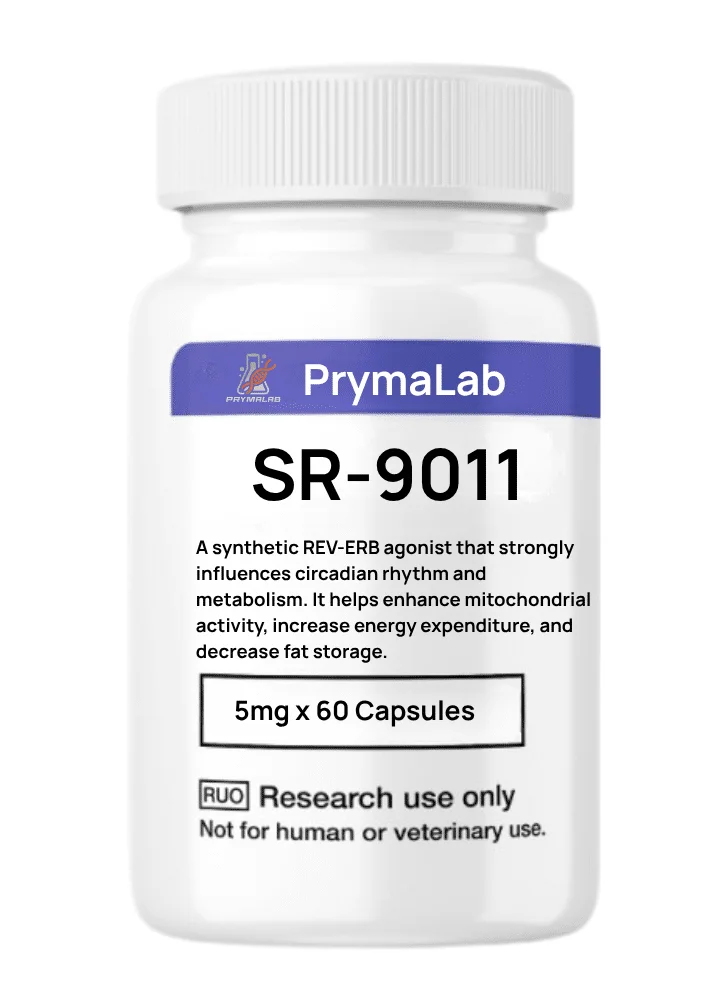
SR-9011 5mg Capsules
Synthetic Rev-erb agonist from Scripps, 5 mg per capsule in a cellulose fill
SR9011 is a synthetic agonist of Rev-erbα and Rev-erbβ, two nuclear receptors that act as repressors inside the circadian clock. It is a small molecule of about 479 Da, neither a peptide nor a SARM. This listing is a bottle of hard gelatin capsules, each holding 5 mg of SR9011 blended with microcrystalline cellulose. Research on SR9011 consists of mouse and cell studies of circadian rhythm, metabolism and Rev-erb biology, and no person has been given it in a published study.
Specifications
| Property | Value |
|---|---|
| Compound | SR-9011 (SR9011, REV-ERB agonist) |
| CAS number | 1379686-29-9 |
| Molecular formula | C23H31ClN4O3S |
| Contents | SR-9011: 5 mg per capsule |
| Form | Hard gelatin capsules containing the active substance blended with microcrystalline cellulose, packed in a sealed bottle |
| Storage, sealed | Store at room temperature (15–25 °C) in the tightly closed original container, dry and protected from light |
| Safety data sheet | PL-SDS-155 |
What is in each capsule
According to the safety data sheet, each capsule holds 5 mg of SR9011, about 1.2% of the capsule contents by weight, in a microcrystalline cellulose fill inside a gelatin shell. SR9011 itself is classified as harmful if swallowed (H302), a skin irritant (H315) and a serious eye irritant (H319); the cellulose and gelatin are not classified. Keep the bottle tightly closed in its original container at 15 to 25 °C, dry and out of the light.
SR9011 or SR9009
SR9011 and SR9009, the compound sold as stenabolic, were made in the same Scripps Research Florida program and published together in 2012. Their CAS numbers are consecutive, 1379686-29-9 for SR9011 and 1379686-30-2 for SR9009, and supplier listings often print one under the other’s name. The safety data sheet for these capsules pairs 1379686-29-9 with the formula C23H31ClN4O3S, which is SR9011. The two are different molecules with different masses, so mass spectrometry tells them apart, and results reported for one should not be assumed for the other.
What the research covers
How Rev-erb works
Rev-erbα is a potent transcriptional repressor in the core of the mammalian clock, and it also regulates clock output in metabolic tissues such as liver and brown fat1. Its natural ligand is heme. Yin and colleagues showed in 2007 that heme binds Rev-erbα reversibly and governs its contact with a nuclear receptor corepressor complex, and that heme suppressed hepatic gluconeogenic genes and glucose output through Rev-erbα2. A synthetic agonist such as SR9011 therefore deepens the repression of the receptor’s target genes rather than switching genes on.
The 2012 mouse study
Solt and colleagues described potent synthetic Rev-erb agonists that were active in living animals3. In mice the compounds changed circadian behaviour and the 24-hour pattern of core clock gene expression in the hypothalamus, and altered the rhythm of metabolic genes in liver, skeletal muscle and fat, with a rise in energy expenditure3. In diet-induced obese mice an agonist reduced fat mass and improved dyslipidaemia and hyperglycaemia3. The abstract gives directions of effect, not sizes. A 2014 review by Kojetin and Burris counted Rev-erb, with the related ROR receptors, among nuclear receptors that synthetic ligands had shown to be druggable4.
What is not established
Everything known about SR9011 comes from mice and cells. No clinical trial of SR9011 or SR9009 has been registered or published, and the mouse studies did not give the compounds by mouth, which the developers attributed to their lack of oral availability. These capsules therefore have no supporting absorption data at all. Later work found that SR9009 changes cell metabolism and survival even in cells lacking both Rev-erb receptors, so effects of this compound family cannot simply be credited to Rev-erb. The SR9011 and SR9009 guide covers that knockout result, a 2018 cancer study and the WADA listing that now names SR9011 among the metabolic modulators.
How each lot is tested
Every lot is tested in PrymaLab’s own laboratory in Ashland, Kentucky before release. Published certificates are listed on the results page and can be checked by number and key on the verify page. These are in-house results from PrymaLab Analytical, not an independent test, and the lab is not accredited to ISO 17025. The third-party testing guarantee on this page still applies: if any independent laboratory finds the wrong compound, or less than the stated purity or amount, the order is refunded and the cost of the test is reimbursed.
Frequently asked questions
Is SR9011 a SARM or a peptide?
Neither. It is a small synthetic molecule that binds Rev-erbα and Rev-erbβ, repressor proteins in the circadian clock. It has no amino acids and no activity at the androgen receptor, although it is often sold alongside SARMs and sometimes mislabelled as one.
Has SR9011 been tested in people?
No. No clinical trial has been registered or published, and there are no human pharmacokinetic or safety data of any kind. Every finding comes from mice or cultured cells, and none of those studies used capsules or gave the compound by mouth.
How should the bottle be stored?
Tightly closed in the original container at 15 to 25 °C, dry and protected from light. The safety data sheet lists SR9011 as harmful if swallowed and as a skin and eye irritant, so the bottle should stay labelled and away from anyone not trained to handle it.
Is SR9011 for human use?
No. It is a laboratory research compound with no approval as a drug and no status as a supplement. The capsules are sold for research only and must not be given to people or animals; it is also prohibited in sport by WADA.
References
- Everett LJ, Lazar MA. Nuclear receptor Rev-erbα: up, down, and all around. Trends Endocrinol Metab. 2014;25(11):586-92. DOI · PubMed
- Yin L, Wu N, Curtin JC, et al. Rev-erbalpha, a heme sensor that coordinates metabolic and circadian pathways. Science. 2007;318(5857):1786-9. DOI · PubMed
- Solt LA, Wang Y, Banerjee S, et al. Regulation of circadian behaviour and metabolism by synthetic REV-ERB agonists. Nature. 2012;485(7396):62-8. DOI · PubMed
- Kojetin DJ, Burris TP. REV-ERB and ROR nuclear receptors as drug targets. Nat Rev Drug Discov. 2014;13(3):197-216. DOI · PubMed
Research use only
For laboratory research use only. SR-9011 5mg Capsules is not a drug, food, cosmetic or dietary supplement, is not approved by the FDA or any comparable authority for human or veterinary use, and must not be given to people or animals. It is sold to qualified researchers and institutions, and the buyer is responsible for lawful handling and disposal.








Reviews
There are no reviews yet.