
Description
PrymaLab · Research use only
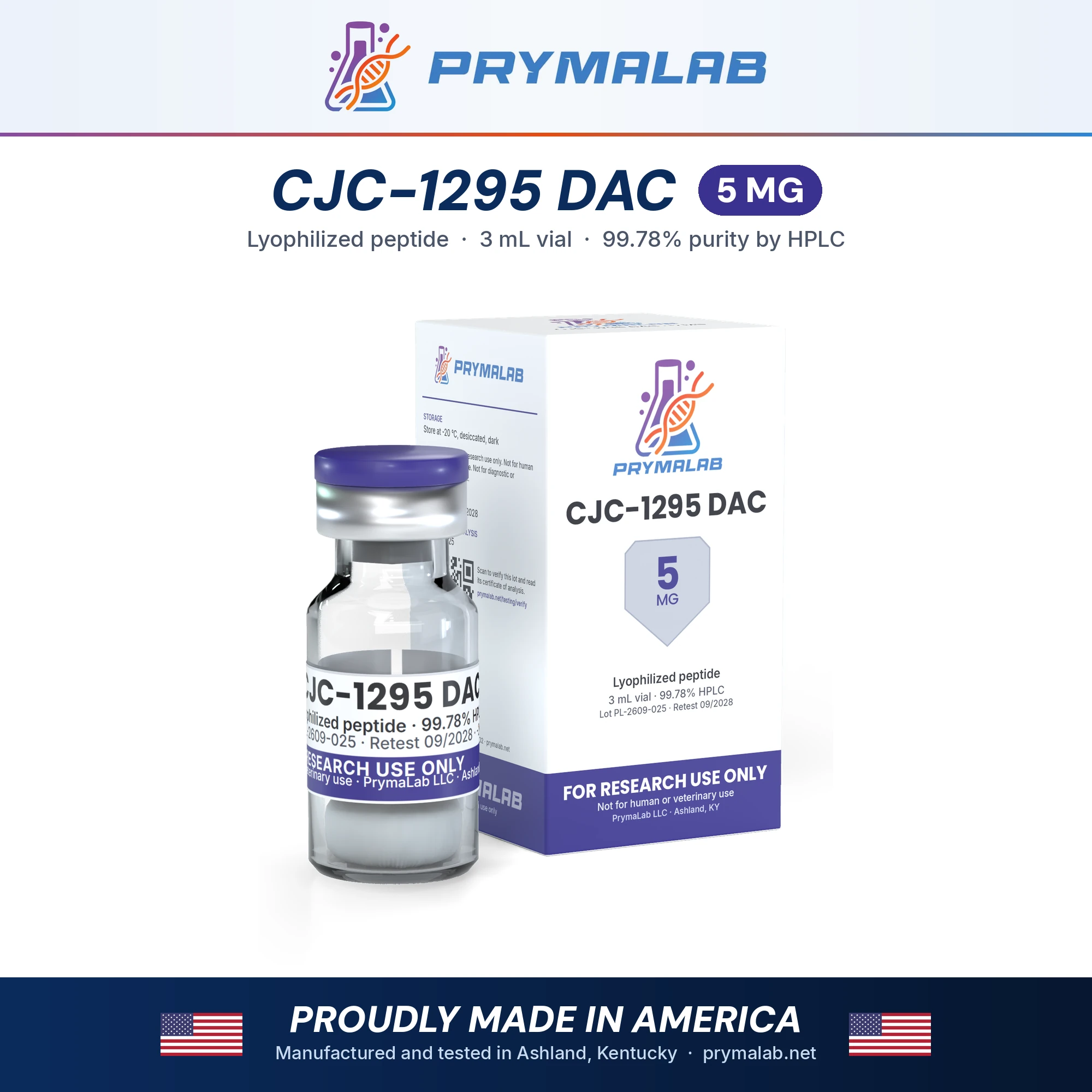
CJC-1295 DAC 5MG
CJC-1295 with DAC: modified GRF(1-29) plus a maleimide-bearing lysine, 5 mg vial
CJC-1295 with DAC is a 30-residue analogue of growth hormone-releasing hormone: the four-substitution GRF(1-29) chain, extended by a C-terminal lysine that carries a 3-maleimidopropionyl group, the drug affinity complex. The maleimide is there to bond covalently to serum albumin. This listing is a 5 mg vial of freeze-dried powder. Research on the compound covers its albumin binding and growth hormone release in rats and mice, and short trials in healthy adults.
Specifications
| Property | Value |
|---|---|
| Compound | CJC-1295 (with DAC) DAC:GRF; Modified GRF(1–29) carrying a C-terminal Lys(Nε-3-maleimidopropionyl) Drug Affinity Complex |
| CAS number | 446262-90-4 |
| Molecular formula | C165H269N47O46 |
| Theoretical mass | 3647.3 Da |
| Sequence / structure | H-Y-[D-Ala]-DAIFTQSYRKVLAQLSARKLLQDILSR-K(Nε-3-maleimidopropionyl)-NH₂ (30 residues; C-terminal amide; the maleimide couples to serum albumin Cys34 in vivo) |
| Label claim | 5 mg/vial |
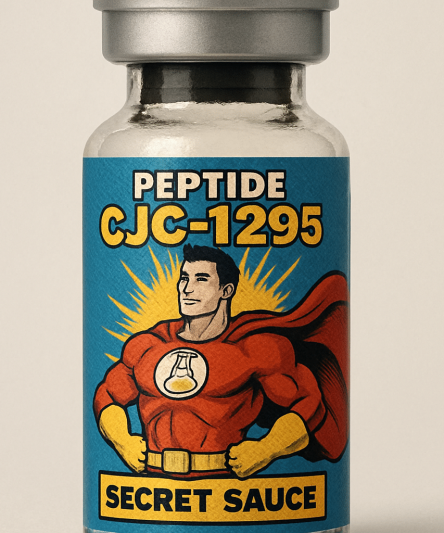
| Form | Lyophilized (freeze-dried) powder or cake in a sealed glass vial with a rubber stopper and aluminium crimp cap |
| Storage, sealed | −20 °C, desiccated, dark |
| Purity specification | 99.0% or higher by RP-HPLC |
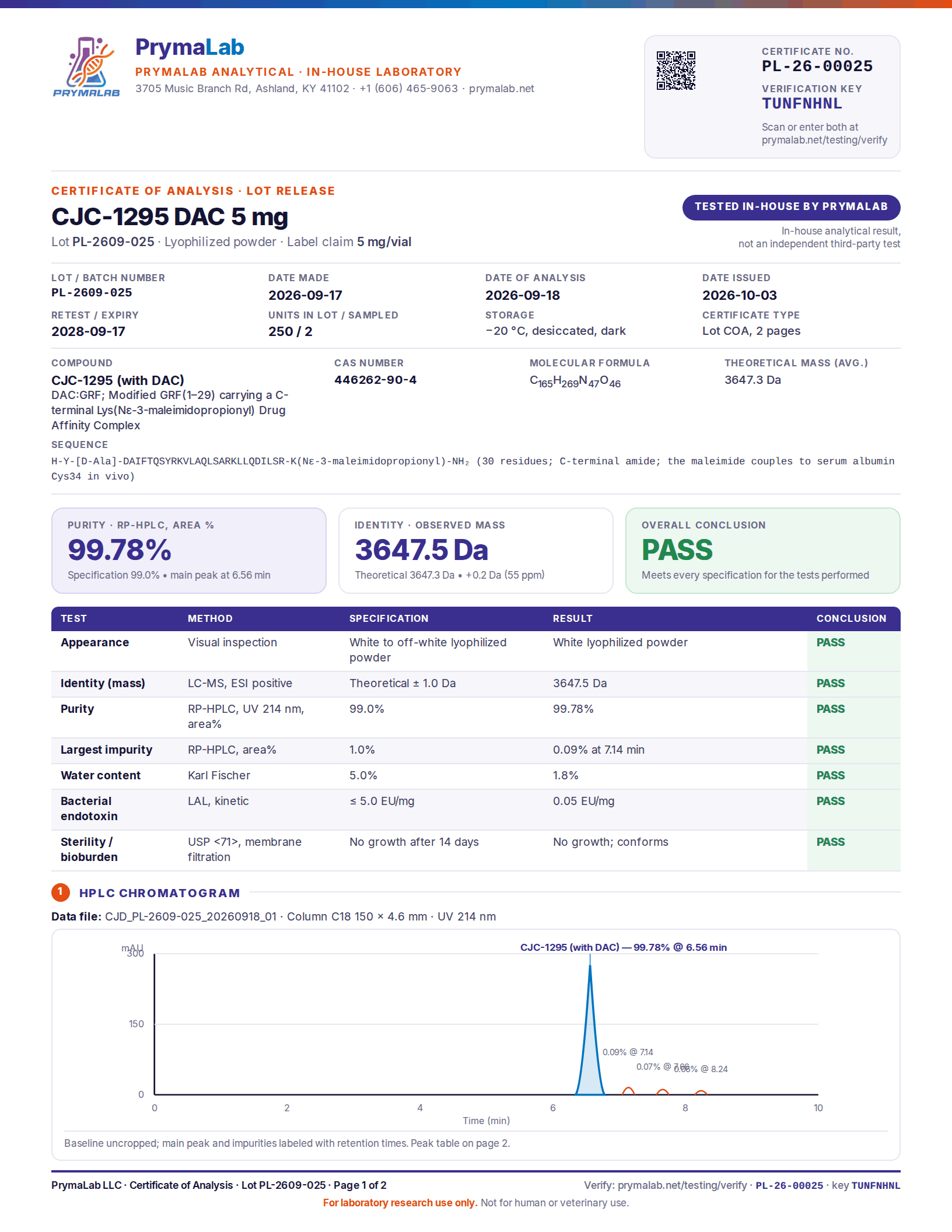
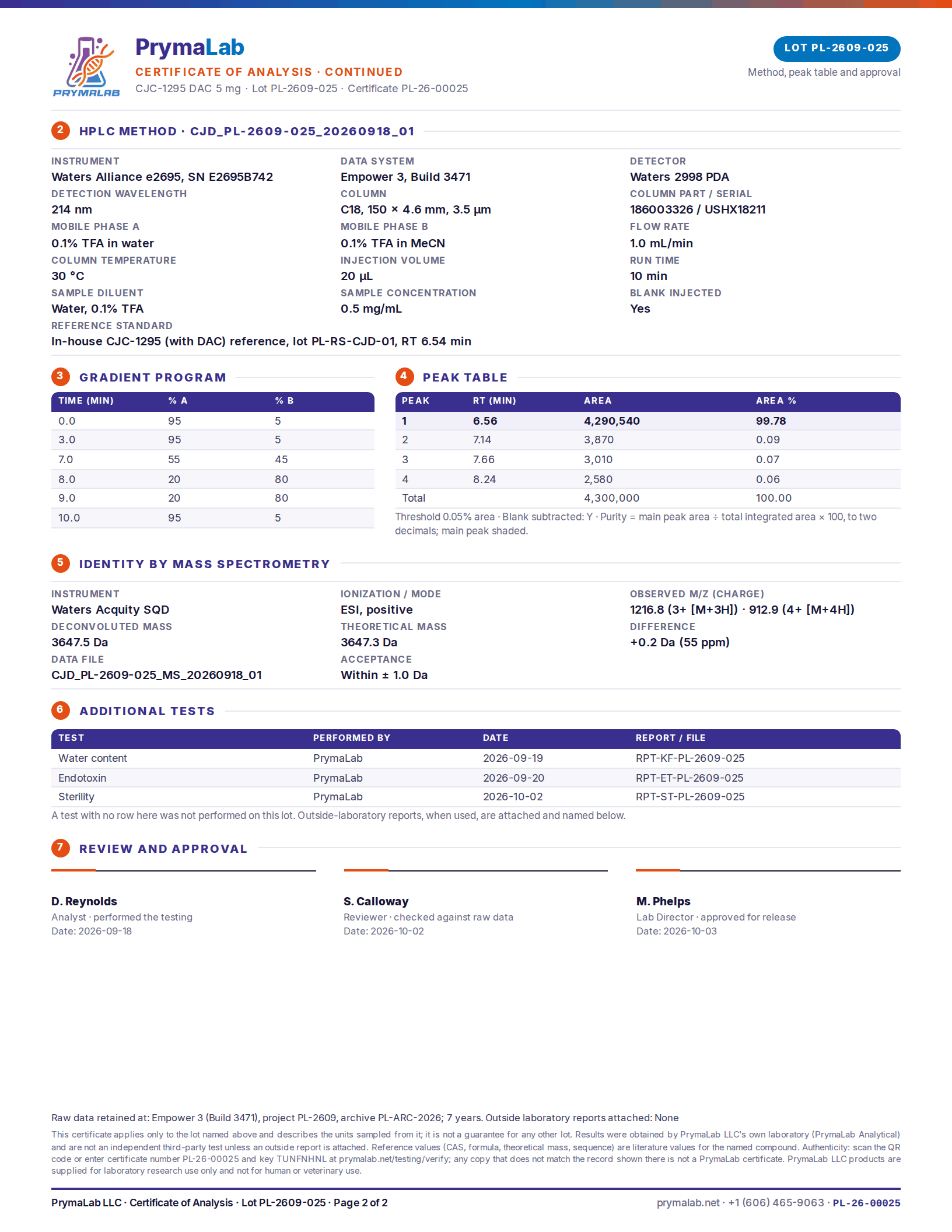
| Lot certificate | Results for the lot now shipping are in the certificate panel on this page |
| Safety data sheet | PL-SDS-042 |
Which CJC-1295 this vial contains
This is the DAC form. The certificate gives the sequence as H-Y-[D-Ala]-DAIFTQSYRKVLAQLSARKLLQDILSR-K(Nε-3-maleimidopropionyl)-NH₂: the 29 residues of modified GRF(1-29), then a 30th residue, lysine, whose side-chain amine carries the maleimide, and a C-terminal amide. The theoretical mass is 3647.3 Da. CJC-1295 without DAC, often sold as modified GRF(1-29), stops at residue 29 and has no maleimide, so it is lighter and cannot bind albumin. The LC-MS identity result on the certificate separates the two. They are different compounds, not different strengths of one compound.
The maleimide is reactive by design. Jetté and colleagues made their albumin conjugates by reacting the maleimido peptides with human serum albumin outside the body1, and the reaction is with a free thiol, so serum, albumin or thiol-containing reagents in a medium are not a neutral background for this peptide. From the stated mass, 5 mg is about 1.4 µmol, a little less after the certificate’s water content.
What the research covers
How the drug affinity complex works
Jetté and colleagues set out to extend the plasma half-life of growth hormone-releasing factor by giving it a reactive group that bonds, in the body, to the free thiol on cysteine 34 of serum albumin1. They made three maleimido derivatives of human GRF(1-29). Conjugated to human serum albumin, all three were more stable against DPP IV in vitro and stayed active in cultured rat pituitary cells1. CJC-1295, the compound they selected, gave a fourfold larger growth hormone area under the curve over two hours than GRF(1-29) in rats and was still present in plasma beyond 72 hours1. A Western blot of rat plasma found CJC-1295 immunoreactivity on the albumin band from 15 minutes onward, still there after 24 hours1.
Growth in GHRH knockout mice
Alba and colleagues tested CJC-1295 in mice lacking the GHRH gene, a model in which repeated treatment with a short-acting GHRH analogue had failed to normalise growth2. Young knockout mice were treated for five weeks under three different schedules2. One schedule kept body weight and length normal, the other two raised them above placebo without full normalisation, and femur and tibia lengths were normal under two of the three2. Total pituitary RNA and growth hormone mRNA rose, and immunohistochemistry pointed to proliferation of somatotroph cells2.
Trials in healthy adults
Teichman and colleagues ran two randomised, placebo-controlled, double-blind trials in healthy adults aged 21 to 61, lasting 28 and 49 days3. After a single treatment, mean plasma growth hormone rose two- to tenfold for six days or more and IGF-I 1.5- to threefold for 9 to 11 days, and the estimated half-life was 5.8 to 8.1 days3. With repeated treatment, mean IGF-I stayed above baseline for up to 28 days, the authors saw evidence of a cumulative effect, and no serious adverse reactions were reported3.
Ionescu and Frohman then looked at the pattern of secretion. They sampled growth hormone every 20 minutes over 12 overnight hours in healthy men aged 20 to 40, before and one week after a single treatment4. Pulse frequency and pulse size did not change, but trough growth hormone rose 7.5-fold, mean growth hormone 46% and IGF-I 45%4. The IGF-I rise did not track any measure of pulsatile secretion, and the authors pointed to the higher troughs as the likely driver4.
What is not established
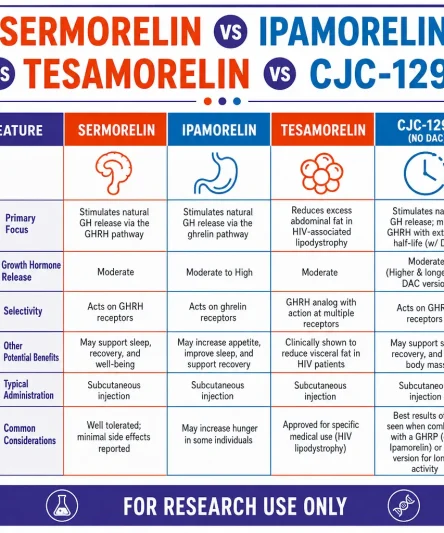
The human data come from short studies in healthy adults, and the abstracts report no long-term outcomes. The animal work is in rats and in one mouse knockout model. Whether a sustained rise in baseline growth hormone suits a given research question is not settled by these papers. None of them used PrymaLab material. The CJC-1295 and ipamorelin guide compares the DAC and no-DAC forms, and sermorelin vs ipamorelin vs tesamorelin places both among the other GHRH analogues.
How each lot is tested
Every lot is tested in PrymaLab’s own laboratory in Ashland, Kentucky before release: RP-HPLC for purity, LC-MS for identity, Karl Fischer titration for water, LAL for endotoxin and USP <71> for sterility. The results for the lot now shipping are in the certificate panel on this page, and the certificate number, key and QR code can be checked on the verify page. These are in-house results from PrymaLab Analytical, not an independent test, and the lab is not accredited to ISO 17025. The third-party testing guarantee on this page still applies: if any independent laboratory finds the wrong compound, or less than the stated purity or amount, the order is refunded and the cost of the test is reimbursed.
Frequently asked questions
How does this differ from CJC-1295 without DAC?
This molecule has a 30th residue, a lysine carrying a maleimide group that bonds to serum albumin, and a theoretical mass of 3647.3 Da. The no-DAC peptide stops at residue 29, has no maleimide and cannot bind albumin. The multi-day half-life measured in healthy adults belongs to this DAC form.
Does the maleimide change how the vial should be handled?
Storage is the same as for other freeze-dried peptides: sealed at −20 °C, dry and dark, warmed to room temperature before opening. In solution the maleimide stays reactive toward free thiols, so the choice of buffer and medium matters more than it does for most peptides.
How do I check the certificate for the vial I received?
Match the lot number on the vial to the certificate shown in the panel on this page, or check it on the verify page by number and key. The LC-MS mass should sit near 3647.3 Da, well above the no-DAC peptide.
What do the human studies show, and what do they leave open?
In healthy adults the DAC form raised growth hormone and IGF-I for days after a single treatment, with an estimated half-life of 5.8 to 8.1 days, and pulses were kept while troughs rose. The studies were short, report no long-term outcomes and did not use this product.
Can this product be used in people or animals?
No. It is sold for laboratory research only, is not approved by the FDA or any other authority for human or veterinary use, and must not be given to people or animals.
References
- Jetté L, Léger R, Thibaudeau K, et al. Human growth hormone-releasing factor (hGRF)1-29-albumin bioconjugates activate the GRF receptor on the anterior pituitary in rats: identification of CJC-1295 as a long-lasting GRF analog. Endocrinology. 2005;146(7):3052-8. DOI · PubMed
- Alba M, Fintini D, Sagazio A, et al. Once-daily administration of CJC-1295, a long-acting growth hormone-releasing hormone (GHRH) analog, normalizes growth in the GHRH knockout mouse. Am J Physiol Endocrinol Metab. 2006;291(6):E1290-4. DOI · PubMed
- Teichman SL, Neale A, Lawrence B, et al. Prolonged stimulation of growth hormone (GH) and insulin-like growth factor I secretion by CJC-1295, a long-acting analog of GH-releasing hormone, in healthy adults. J Clin Endocrinol Metab. 2006;91(3):799-805. DOI · PubMed
- Ionescu M, Frohman LA. Pulsatile secretion of growth hormone (GH) persists during continuous stimulation by CJC-1295, a long-acting GH-releasing hormone analog. J Clin Endocrinol Metab. 2006;91(12):4792-7. DOI · PubMed
Research use only
For laboratory research use only. CJC-1295 DAC 5MG is not a drug, food, cosmetic or dietary supplement, is not approved by the FDA or any comparable authority for human or veterinary use, and must not be given to people or animals. It is sold to qualified researchers and institutions, and the buyer is responsible for lawful handling and disposal.







1 review for CJC-1295 DAC 5MG