Description
PrymaLab · Research Use Only
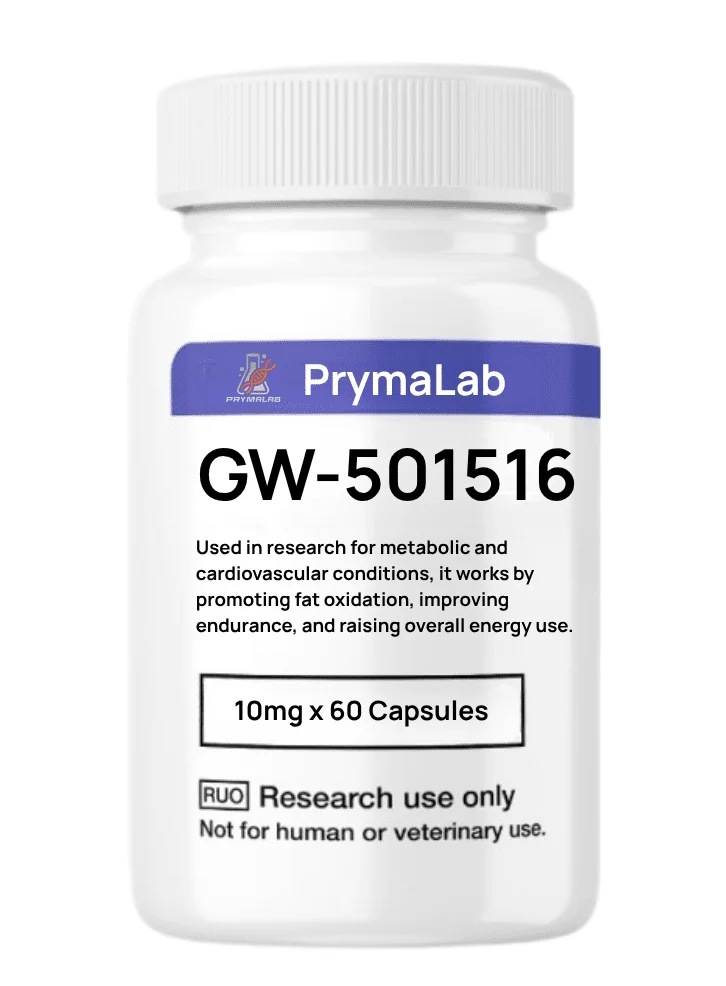
GW-501516 (Cardarine) 10mg Capsules
PPARδ agonist · CAS 317318-70-0 · 60 capsules · Development discontinued 2007
GW-501516 Cardarine PPAR agonist capsules contain a highly selective peroxisome proliferator-activated receptor delta agonist, CAS 317318-70-0, with reported half-maximal effective concentration near 1 nM and approximately thousand-fold selectivity over the PPARα and PPARγ subtypes. Clinical development was discontinued in 2007.
Specification Table
| Property | Value |
|---|---|
| Compound | GW-501516 |
| Common names | Cardarine, Endurobol |
| Development code | GSK-516 |
| CAS number | 317318-70-0 |
| Molecular formula | C21H18F3NO3S2 |
| Molecular weight | 453.50 g/mol |
| Chemical class | Thiazole-phenoxyacetic acid, non-steroidal |
| Molecular target | Peroxisome proliferator-activated receptor delta (PPARδ, also PPARβ/δ, NR1C2) |
| Reported potency | EC50 approximately 1 nM |
| Receptor selectivity | Approximately 1000-fold over human PPARα and PPARγ |
| Originating organisations | Ligand Pharmaceuticals and GlaxoSmithKline, 1990s |
| Development status | Discontinued 2007 |
| Reason for discontinuation | Carcinogenicity across multiple organs in two-year rodent studies |
| Organs affected in rodent studies | Liver, bladder, ovaries, testes |
| Anti-doping status | Prohibited by WADA since January 2009. Currently class S4.5, metabolic modulators |
| Capsule strength | 10 mg |
| Count per bottle | 60 capsules |
| Appearance | White to off-white powder within a gelatin capsule shell |
| Purity | Per lot-specific certificate of analysis |
| Solubility | Soluble in DMSO. Poorly soluble in water |
| Storage | Room temperature, sealed, protected from light and moisture |
| Regulatory status | No approved human or veterinary formulation in any jurisdiction |
Why Did Development of GW-501516 Stop?
This section comes first because it is the most consequential fact about the compound, and a page that buries it is not a technical page.
GlaxoSmithKline halted development in 2007. Two-year rodent studies found the compound produced tumours across multiple organ systems, including liver, bladder, ovaries and testes. The finding was not a marginal signal in one tissue. It was a broad carcinogenic profile at exposures relevant to the intended indication.
Reporting on the decision notes that establishing lifetime safety in humans would have required a trial spanning decades, which is not a feasible development path for a metabolic compound intended for chronic use. The programme ended there.
Any laboratory working with this compound should handle it as a known rodent carcinogen and apply the containment, waste-handling and personal protective measures that classification implies. That is a practical instruction about laboratory safety, not a statement about any other context.
What Does the GW-501516 Cardarine PPAR Agonist Actually Target?
PPARδ, also written PPARβ/δ and formally designated NR1C2, is a nuclear receptor that heterodimerises with the retinoid X receptor and regulates transcription of genes governing fatty acid transport and oxidation.
The reported half-maximal effective concentration of roughly 1 nM makes GW-501516 a potent agonist. More useful than the potency figure is the selectivity: approximately thousand-fold over PPARα and PPARγ. Those two subtypes are the targets of the fibrate and thiazolidinedione compound classes respectively, so a compound that separates cleanly from both is a genuinely useful pharmacological tool for isolating delta-subtype effects.
That selectivity is why the compound retains value as a research reagent despite its development history. If the experimental question is what PPARδ activation does in a given tissue, few tools separate the subtypes as cleanly.
What Was Measured in the Muscle Fibre Studies?
Search data reaching this page includes queries about muscle fibre type and the slow-twitch to fast-twitch distinction, which points at a specific body of work.
PPARδ activation in skeletal muscle shifts the transcriptional programme toward oxidative metabolism. Genes governing fatty acid uptake, mitochondrial β-oxidation and oxidative phosphorylation are upregulated. In rodent studies this associates with a higher proportion of type I oxidative fibres relative to type II glycolytic fibres.
The mechanistic reading is that the receptor is acting as a metabolic transcription factor and the fibre-type shift is a downstream consequence of sustained changes in substrate handling, rather than a direct effect on contractile protein isoforms. Work in transgenic mice overexpressing PPARδ in muscle produced a comparable phenotype, which supports the receptor rather than an off-target action as the driver.
These are rodent findings in rodent muscle. No equivalent controlled human dataset exists, and the development history makes it unlikely one will be generated.
How Should the Anti-Doping Status Be Handled?
The World Anti-Doping Agency added GW-501516 to its prohibited list in January 2009. It was initially listed under gene doping and now sits in class S4.5, metabolic modulators.
For laboratories this has a practical implication beyond compliance. Analytical methods for detecting the compound and its metabolites in biological matrices are an active area of published work, including hair analysis by liquid chromatography with tandem mass spectrometry. Researchers developing or validating detection methods form a legitimate and substantial part of the user base for reference material.
Any work involving athlete populations, or samples that could enter anti-doping analysis, should confirm the current WADA list and the requirements of the relevant sport-governing body before beginning.
How Is GW-501516 Detected in Biological Samples?
Detection methodology is an active published area for this compound, driven by anti-doping analysis rather than by pharmacology, and it constitutes a substantial legitimate use for reference material.
Liquid chromatography with tandem mass spectrometry is the core technique. The molecule contains two sulfur atoms and a trifluoromethyl group, which produce a characteristic isotope signature and fragmentation behaviour that make it comparatively straightforward to identify against a complex background.
Metabolite detection extends the window considerably. Sulfoxide and sulfone metabolites, formed by oxidation at the thioether positions, persist after the parent compound has cleared, so methods targeting them detect exposure over a longer period than parent-compound assays alone.
Hair analysis has been published as an alternative matrix, using liquid chromatography with tandem mass spectrometry and confirmation by high-resolution mass spectrometry. Hair offers a retrospective window that urine cannot, since incorporation into the growing shaft records exposure over months.
Laboratories developing or validating these methods need certified reference material and a documented chain of custody. That requirement is a legitimate reason to hold the compound and has nothing to do with the pharmacology described elsewhere on this page.
What the Endurance Findings Actually Showed
A well-known 2008 study from Evans and colleagues at the Salk Institute is frequently cited as demonstrating that this compound increases endurance. The finding is more specific than that summary suggests, and the specificity is the interesting part.
The work examined PPARδ activation alongside exercise in mice. The compound alone produced transcriptional changes consistent with a shift toward oxidative metabolism. The substantial change in running performance appeared when the compound was combined with exercise training rather than given to sedentary animals.
That distinction matters for interpretation. The receptor is acting as a transcriptional amplifier of an adaptive programme that exercise itself initiates, not as a substitute for the stimulus. A sedentary animal given the compound does not acquire the phenotype of a trained one.
The AMPK pathway featured in the same body of work, which is where the connection to exercise-mimetic framing originates. As with everything else on this page, these are mouse findings, and no controlled human dataset exists.
Handling and Storage in Laboratory Practice
Handle as a known rodent carcinogen. That means containment appropriate to the classification, gloves and eye protection as a minimum, weighing in a ventilated enclosure, and waste routed through the appropriate stream rather than general disposal.
The compound is supplied at 10 mg per capsule. DMSO is the standard stock solvent and aqueous solubility is poor, so precipitation on dilution into medium is the usual failure mode. Confirm working concentration analytically where the experiment depends on it.
Sealed dry material is stable at ambient temperature, away from light and moisture. Alongside the usual lot, solvent, concentration and date, the hazard classification means the record should also name who prepared each stock and where it now sits.
Published Literature
Every entry below was confirmed against the publisher record or a primary index. The list covers receptor pharmacology and detection methodology rather than the discontinued development programme.
- Oliver WR Jr, Shenk JL, Snaith MR, Russell CS, Plunket KD, Bodkin NL, Lewis MC, Winegar DA, Sznaidman ML, Lambert MH, Xu HE, Sternbach DD, Kliewer SA, Hansen BC, Willson TM. Proceedings of the National Academy of Sciences. 2001;98(9):5306-5311.
- Wang YX, Zhang CL, Yu RT, Cho HK, Nelson MC, Bayuga-Ocampo CR, Ham J, Kang H, Evans RM. PLoS Biology. 2004;2(10):e294.
- Narkar VA, Downes M, Yu RT, Embler E, Wang YX, Banayo E, Mihaylova MM, Nelson MC, Zou Y, Juguilon H, Kang H, Shaw RJ, Evans RM. Cell. 2008;134(3):405-415.
- Thevis M, Schänzer W. Journal of Steroid Biochemistry and Molecular Biology. 2016;162:79-88.
Frequently Asked Questions
What is the GW-501516 Cardarine PPAR agonist?
GW-501516 Cardarine PPAR agonist capsules contain a highly selective PPAR-delta agonist, CAS 317318-70-0, with reported half-maximal effective concentration near 1 nanomolar and roughly thousand-fold selectivity over the alpha and gamma receptor subtypes. Supplied at 10 mg per capsule, 60 per bottle, for laboratory research use only.
Why was GW-501516 discontinued?
GlaxoSmithKline halted development in 2007 after two-year rodent studies found the compound produced tumours across multiple organ systems, including liver, bladder, ovaries and testes. Establishing lifetime human safety would have required a trial spanning decades, which was not a viable development path. Laboratories should handle it as a known rodent carcinogen.
What does PPAR-delta do?
PPAR-delta, formally NR1C2, is a nuclear receptor that partners with the retinoid X receptor and regulates transcription of genes governing fatty acid transport and oxidation. Activation in skeletal muscle shifts the transcriptional programme toward oxidative metabolism, upregulating fatty acid uptake, mitochondrial beta-oxidation and oxidative phosphorylation.
How selective is GW-501516 across PPAR subtypes?
Approximately thousand-fold over human PPAR-alpha and PPAR-gamma. Those subtypes are the targets of the fibrate and thiazolidinedione classes respectively. Clean separation from both makes GW-501516 a useful pharmacological tool for isolating delta-subtype effects, which is why it retains research value despite its development history.
What did the muscle fibre research report?
Rodent studies associate PPAR-delta activation in skeletal muscle with a higher proportion of type I oxidative fibres relative to type II glycolytic fibres. The mechanistic reading is that this follows from sustained changes in substrate handling rather than direct action on contractile protein isoforms. Transgenic mice overexpressing PPAR-delta in muscle showed a comparable phenotype.
Is GW-501516 banned in sport?
Yes. The World Anti-Doping Agency added it in January 2009, initially under gene doping and now in class S4.5, metabolic modulators. Analytical detection of the compound and its metabolites in biological matrices is an active published research area, including hair analysis by liquid chromatography with tandem mass spectrometry.
What laboratory precautions apply?
Handle as a known rodent carcinogen. Containment appropriate to that classification, gloves and eye protection at minimum, weighing in a ventilated enclosure, and waste routed through the appropriate hazardous stream. Record who prepared each stock solution and where it is stored, in addition to the usual lot and concentration documentation.
Is Cardarine a SARM?
No. Cardarine does not interact with the androgen receptor at all. It is a PPAR-delta agonist, a metabolic nuclear receptor ligand from a different pharmacological class entirely. It is frequently catalogued alongside SARMs by suppliers, which is where the confusion originates, but the mechanisms share nothing.
How should the capsules be stored?
Ambient temperature, sealed, away from light and moisture, where the dry powder is stable. DMSO is the usual stock solvent because aqueous solubility is poor. Precipitation as you dilute into culture medium is the failure mode to watch for.
How is GW-501516 detected in biological samples?
Liquid chromatography with tandem mass spectrometry. Two sulfur atoms and a trifluoromethyl group produce a characteristic isotope signature and fragmentation behaviour. Sulfoxide and sulfone metabolites, formed by oxidation at the thioether positions, persist after the parent clears and extend the detection window considerably.
Why is hair analysis used?
Hair offers a retrospective window that urine cannot, since incorporation into the growing shaft records exposure over months rather than days. Published methods use liquid chromatography with tandem mass spectrometry and confirmation by high-resolution mass spectrometry. Method development of this kind is a substantial legitimate use for reference material.
Did the endurance research show the compound works alone?
Not in the way the summaries suggest. The frequently cited 2008 work found substantial change in running performance when the compound was combined with exercise training rather than given to sedentary animals. The receptor amplifies an adaptive programme that exercise initiates. It does not substitute for the stimulus.
What metabolites are targeted in detection work?
Sulfoxide and sulfone metabolites, formed by oxidation at the thioether positions. They persist after the parent compound clears, which extends the detection window considerably beyond what a parent-only assay achieves. This matters for anti-doping method development, an active published area for this compound.
Why does the selectivity margin make this a useful research tool?
PPAR-alpha and PPAR-gamma are the targets of the fibrate and thiazolidinedione classes respectively. A compound separating cleanly from both by roughly a thousandfold isolates delta-subtype effects in a way few other tools manage. That is why it retains value as a reagent despite the development history described above.
What laboratory classification should this compound be handled under?
As a known rodent carcinogen. That means containment appropriate to the classification, gloves and eye protection as a minimum, weighing inside a ventilated enclosure, and waste routed through the hazardous stream rather than general disposal. Records should also name who prepared each stock and where it is held.
Compliance Statement
GW-501516 Cardarine capsules is sold exclusively for laboratory research use. It is not a drug, food, or cosmetic product, and it is not a dietary product of any kind. It is not approved by the FDA or any comparable authority for human or veterinary use, development was discontinued in 2007 following carcinogenicity findings in two-year rodent studies, and the compound is prohibited in competitive sport under World Anti-Doping Agency rules. This product is not intended to diagnose, treat, cure, or prevent any disease. It must not be given to humans or animals. Purchase is restricted to qualified researchers and institutions operating within applicable laws. All handling is the responsibility of the purchasing laboratory.


19 reviews for GW-501516 (Cardarine) (10mg/capsule) 60 Capsules