
Description
PrymaLab · Research use only
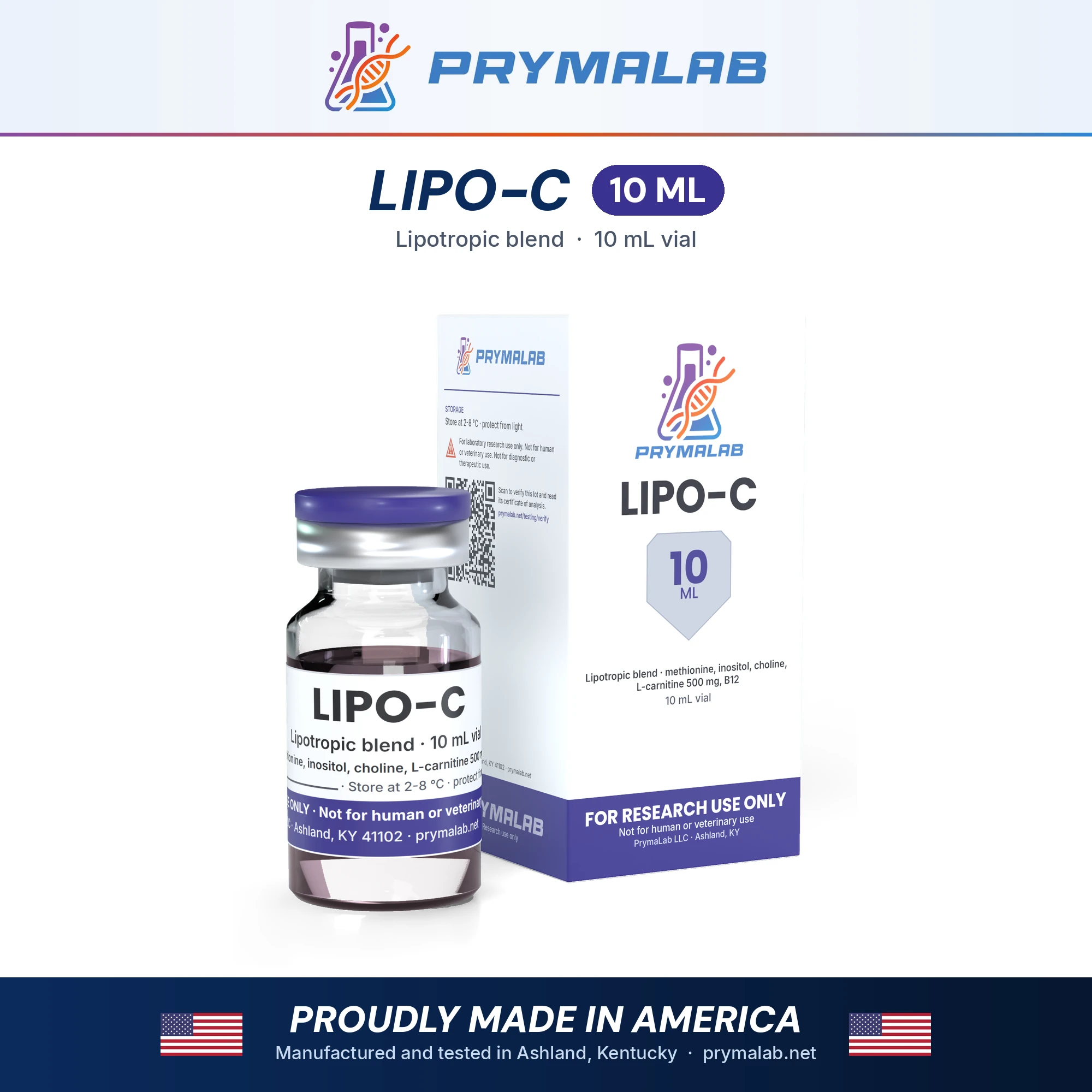
Pryma Lipo-C (FAT BLASTER)
Methionine, inositol, choline and vitamin B12 in solution; no peptide in the vial
Lipo-C is a mixture, not a peptide: according to its safety data sheet it is a sterile aqueous solution of four nutrients, L-methionine, myo-inositol, choline and cyanocobalamin (vitamin B12). This listing is a sealed glass vial of that solution, preserved with benzyl alcohol. The published literature behind the ingredients is nutritional biochemistry, above all the work on choline as an essential nutrient and on what happens to the liver when a diet lacks it.
Specifications
| Property | Value |
|---|---|
| Components | L-Methionine myo-Inositol Choline (as chloride or bitartrate) Cyanocobalamin (vitamin B12) |
| Methionine CAS number | 63-68-3 |
| Inositol CAS number | 87-89-8 |
| Choline CAS number | 67-48-1 |
| Cyanocobalamin CAS number | 68-19-9 |
| Form | Sterile aqueous solution in a sealed glass vial with a rubber stopper |
| Storage, sealed | Store at 2–8 °C, protected from light; do not freeze |
| Safety data sheet | PL-SDS-101 |
What is in the vial
The safety data sheet (PL-SDS-101) lists four active ingredients, each present at under 10% w/v, with the amounts printed on the vial label. L-methionine (CAS 63-68-3) is a single sulfur-containing amino acid. Myo-inositol (CAS 87-89-8) is a six-carbon sugar alcohol. Choline (CAS 67-48-1) is a quaternary ammonium nutrient, supplied as its chloride or bitartrate salt. Cyanocobalamin (CAS 68-19-9) is vitamin B12, a large cobalt-containing molecule with the formula C63H88CoN14O14P. None of the four is a peptide, and none is classified as hazardous.
The solvent is bacteriostatic water with 0.9% benzyl alcohol as an antimicrobial preservative, and sterile water makes up the balance. Benzyl alcohol is listed as harmful if swallowed or inhaled, a serious eye irritant and a possible skin sensitiser. Store the vial upright at 2 to 8 °C, protected from light and tightly closed, and do not freeze it.
About the name
The product name carries the words fat blaster, and blends like this one are often sold as lipotropic. In nutrition science, lipotropic described substances that prevent fat from building up in the liver, and choline is the best-documented example in the research cited on this page, which concerns liver fat in people on choline-deficient diets. The abstracts cited here say nothing about body fat or body weight. No study cited here tested this solution or any combination of these four ingredients, and this page makes no claim that the product reduces fat or weight.
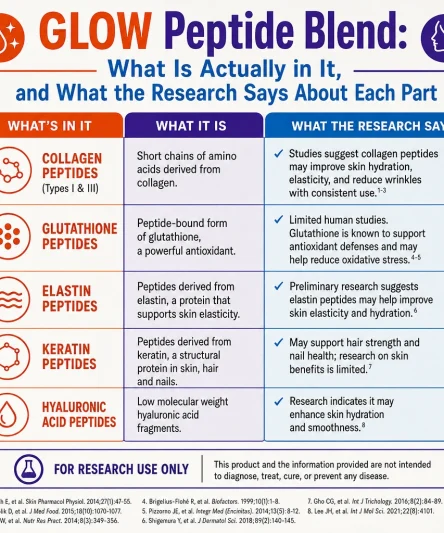
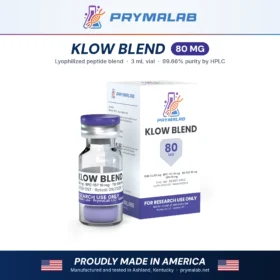
PrymaLab’s peptide blends are a different kind of product, mixtures of actual peptides; see the GLOW peptide blend guide and the KLOW blend guide. For compounds that have been tested for weight in people, the guide to peptides studied for weight loss separates human trial results from animal work and from claims that were never tested.
What the research covers
Choline as a nutrient
Choline is the ingredient with the deepest literature behind it. Zeisel and Blusztajn described it in 1994 as a modulator of basic signalling processes within cells, a structural element of membranes and a nutrient needed during critical periods of brain development1. They judged the normal human diet to provide enough of it, and named the groups at risk of deficiency: growing infants, pregnant and lactating women, people with cirrhosis and patients fed intravenously1. The Institute of Medicine recognised choline as an essential nutrient in 19982. A 2009 review by Zeisel and da Costa traced its roles from cell structure to neurotransmitter synthesis and attributed much of the variation in individual requirements to common genetic polymorphisms2. The same review reported that mean intakes in older children, men, women and pregnant women fell well below the adequate intake level, and that choline deficiency was thought to bear on liver disease, atherosclerosis and possibly neurological disorders2.
Choline and liver fat
The old idea of a lipotropic substance survives most clearly in the work on choline and the liver. Corbin and Zeisel reviewed it in 2012: the liver is the main organ of choline metabolism, and people eating low-choline diets developed fatty liver and liver damage3. The mechanisms they listed for that damage were abnormal phospholipid synthesis, defects in lipoprotein secretion, oxidative damage from mitochondrial dysfunction and endoplasmic reticulum stress3. How much choline a person needed before this happened was modulated by estrogen and by single-nucleotide polymorphisms in genes of choline and folate metabolism3. The review also described the gut microbiome as an influence on the fatty liver phenotype3.
Methionine, inositol and vitamin B12
Methionine connects to choline through one-carbon metabolism. Zeisel and Blusztajn wrote that choline metabolism is closely interrelated with the metabolism of methionine and folate1, and Corbin and Zeisel tied liver function to one-carbon and energy metabolism3. Beyond that link, the reviews cited here do not study methionine, myo-inositol or cyanocobalamin individually, so this page describes those three by identity only and attributes no effect to them.
What is not established
Every finding above concerns choline in the diet, and most of it concerns what happens when there is too little. None of the cited abstracts reports a study of a solution like this one, and none reports a measurement of body weight or body fat. The safety data sheet gives each ingredient only as under 10% w/v, with exact amounts on the label, so a finding from one preparation would not carry over to another with different proportions. None of the studies used PrymaLab material.
How each lot is tested
Every lot is tested in PrymaLab’s own laboratory in Ashland, Kentucky before release: RP-HPLC for purity, LC-MS for identity, Karl Fischer titration for water, LAL for endotoxin and USP <71> for sterility. Published certificates are listed on the results page and can be checked by number and key on the verify page. These are in-house results from PrymaLab Analytical, not an independent test, and the lab is not accredited to ISO 17025. The third-party testing guarantee on this page still applies: if any independent laboratory finds the wrong compound, or less than the stated purity or amount, the order is refunded and the cost of the test is reimbursed.
Frequently asked questions
Is Lipo-C a peptide?
No. None of its four active ingredients is a peptide. Methionine is a single amino acid, myo-inositol is a sugar alcohol, choline is a quaternary ammonium nutrient and cyanocobalamin is vitamin B12. The blend is sold alongside PrymaLab's peptides, but it is a nutrient solution.
What exactly is in the vial?
L-methionine, myo-inositol, choline (as its chloride or bitartrate salt) and cyanocobalamin, each under 10% w/v, in bacteriostatic water with 0.9% benzyl alcohol. The amount of each is printed on the vial label, and the safety data sheet lists CAS numbers and hazards for every component.
Does Lipo-C reduce body fat or weight?
This page makes no such claim. The research cited here concerns choline as a nutrient and fatty liver in choline-deficient diets. No cited study tested this solution, and none measured body fat or body weight. The words fat blaster in the product name are a trade name, not a research finding.
Why is vitamin B12 in the blend?
Cyanocobalamin is vitamin B12, a cobalt-containing compound listed on the safety data sheet at under 10% w/v. The references on this page do not study it, so the page identifies it and gives its CAS number but attributes no effect to it, alone or in combination.
How should the vial be stored?
At 2 to 8 °C, protected from light, upright and tightly closed, as the safety data sheet states. Do not freeze it. The preservative, benzyl alcohol, is listed as an eye irritant and possible skin sensitiser, so handle the solution as the sheet describes.
Is Lipo-C for human use?
No. It is sold for laboratory research only. It is not a drug, a dietary supplement or a cosmetic, is not approved by the FDA for any use in people or animals, and must not be given to either.
References
- Zeisel SH, Blusztajn JK. Choline and human nutrition. Annu Rev Nutr. 1994;14:269-96. DOI · PubMed
- Zeisel SH, da Costa KA. Choline: an essential nutrient for public health. Nutr Rev. 2009;67(11):615-23. DOI · PubMed
- Corbin KD, Zeisel SH. Choline metabolism provides novel insights into nonalcoholic fatty liver disease and its progression. Curr Opin Gastroenterol. 2012;28(2):159-65. DOI · PubMed
Research use only
For laboratory research use only. Pryma Lipo-C (FAT BLASTER) is not a drug, food, cosmetic or dietary supplement, is not approved by the FDA or any comparable authority for human or veterinary use, and must not be given to people or animals. It is sold to qualified researchers and institutions, and the buyer is responsible for lawful handling and disposal.







16 reviews for Pryma Lipo-C (FAT BLASTER)