Description
PrymaLab · Research Use Only
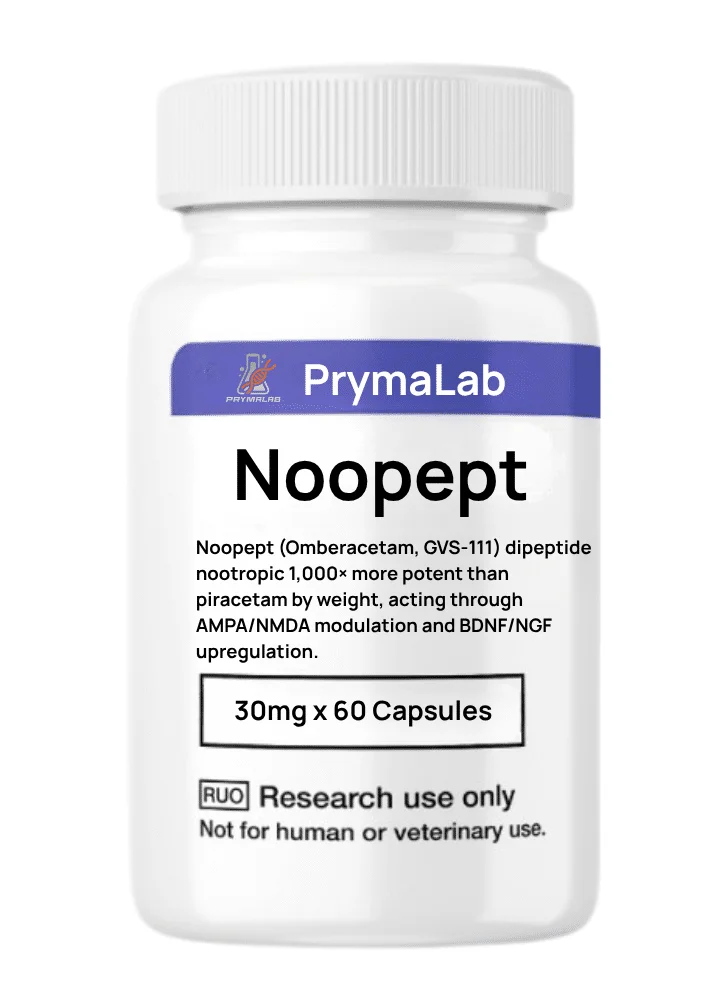
Noopept (Omberacetam) 30mg Capsules
N-phenylacetyl-L-prolylglycine ethyl ester · CAS 157115-85-0 · GVS-111
Noopept omberacetam capsules contain N-phenylacetyl-L-prolylglycine ethyl ester, CAS 157115-85-0, a dipeptide derivative developed at the Zakusov Institute of Pharmacology under the code GVS-111. Molecular formula C17H22N2O4, molecular weight 318.37. It is structurally unrelated to the pyrrolidinone racetams despite frequent comparison with them.
Specification Table
| Property | Value |
|---|---|
| Compound | Omberacetam |
| Common name | Noopept |
| Development code | GVS-111 |
| CAS number | 157115-85-0 |
| Molecular formula | C17H22N2O4 |
| Molecular weight | 318.37 g/mol |
| Exact mass | 318.1580 |
| Systematic name | N-phenylacetyl-L-prolylglycine ethyl ester |
| Chemical class | Proline-glycine dipeptide derivative |
| Reported metabolite | Cycloprolylglycine (cyclo-L-prolylglycine), an endogenous cyclic dipeptide |
| Reported receptor interaction | Affinity described at AMPA and NMDA glutamate receptors |
| Originating institution | Zakusov Institute of Pharmacology, Russia |
| Regulatory status, Russia and CIS | Marketed as a nootropic in Russia and neighbouring states |
| Regulatory status, United States | No approved formulation. Not a permitted dietary ingredient |
| Capsule strength | 30 mg |
| Appearance | White to off-white powder within a gelatin capsule shell |
| Purity | Per lot-specific certificate of analysis |
| Solubility | Soluble in ethanol and DMSO. Sparingly soluble in water |
| Storage | Room temperature, sealed, protected from light and moisture |
| Stability | Ester group susceptible to hydrolysis under humid or alkaline conditions |
Is Omberacetam Actually a Racetam?
The name suggests yes. The chemistry says no, and the distinction is not pedantry.
Piracetam and its structural relatives are built around a 2-pyrrolidinone ring. That ring is the defining feature of the racetam class. Omberacetam contains a proline residue, which is a cyclic amino acid, but the molecule as a whole is a dipeptide derivative: a phenylacetyl group attached to proline, joined to glycine, esterified with ethanol.
It was designed as a peptide analog of piracetam, which is where the naming convention came from and why comparison is inevitable. The design intent was to reproduce the pharmacological profile in a peptide framework rather than to make another pyrrolidinone.
The practical consequence sits in the stability behaviour. An ethyl ester on a dipeptide backbone hydrolyses under conditions that leave a pyrrolidinone ring untouched. Handling assumptions carried over from piracetam will be wrong.
What Is Cycloprolylglycine and Why Does It Matter?
Omberacetam is metabolised in part to cycloprolylglycine, a cyclic dipeptide formed when the proline and glycine residues close into a diketopiperazine ring.
What makes this interesting is that cycloprolylglycine is not a foreign metabolite. It occurs endogenously in mammalian brain tissue and was characterised as a naturally occurring compound before its connection to omberacetam was established. That gives the pharmacology an unusual shape: a synthetic compound whose metabolite is an endogenous signalling molecule.
Published work from the originating group proposes that a meaningful portion of the observed activity is attributable to this metabolite rather than to the parent compound alone. If that is correct, then studies measuring parent compound concentration are measuring the wrong analyte, which is a real methodological consideration for anyone designing pharmacokinetic work here.
The endogenous-metabolite framing also explains why potency comparisons against piracetam produce such large ratios. Comparing administered mass of two compounds is not the same as comparing the concentrations of their respective active species.
What Do the Potency Comparisons With Piracetam Mean?
The figure in wide circulation is that omberacetam is up to a thousand times more potent than piracetam. That number appears in supplier literature and in secondary sources, generally without the qualification it needs.
It originates from comparisons of the mass required to produce equivalent activity in specific animal behavioural assays. Piracetam is used at gram-scale amounts. Omberacetam is used at milligram-scale. The ratio between those amounts is where the thousandfold figure comes from.
Potency in that sense describes the amount needed, not the magnitude of effect achievable, and the two are routinely conflated. A compound can be far more potent while producing an effect of similar or smaller size. The comparison also depends entirely on which assay was used, and the figure should not be treated as a general constant.
For a researcher the useful reading is narrow: omberacetam is active at far lower amounts than piracetam in the assays where the comparison was made. Nothing more should be inferred from the number.
What Is the State of the Evidence on Noopept Omberacetam Capsules?
Most of the primary literature is Russian, published in Russian-language journals or in translated form in outlets such as the Bulletin of Experimental Biology and Medicine. The originating group at the Zakusov Institute produced the majority of it.
That is not a criticism of the work, which includes detailed pharmacological characterisation. It does mean the evidence base is geographically concentrated, replication by independent laboratories outside Russia is limited, and some primary sources are difficult to access in English.
Human clinical data exists but is limited in scale by the standards applied to compounds approved in the United States or European Union. The compound is marketed as a nootropic in Russia and neighbouring states. It has no approved status in the United States and is not a permitted dietary ingredient there.
Researchers should read the primary sources rather than the secondary summaries where possible, because the secondary literature on this compound is unusually prone to repeating unqualified claims.
How Are the Ester and Its Metabolite Measured?
A compound whose activity may be attributable partly to a metabolite creates a specific analytical requirement: measuring the parent alone will not describe the exposure.
Liquid chromatography with tandem mass spectrometry handles both analytes, but they behave differently enough that a single method needs care. The parent ester is comparatively lipophilic and retains well on a reversed-phase column. Cycloprolylglycine is small, polar and poorly retained, and it will elute near the void volume on a standard gradient unless the method is adjusted for it.
Hydrophilic interaction chromatography is the usual answer for the metabolite, either as a separate method or through a column-switching arrangement. Laboratories that attempt both analytes on one conventional reversed-phase method typically end up with poor quantification of the metabolite and do not always notice.
Sample handling introduces its own artefact. The ester continues to hydrolyse in aqueous biological matrices after collection, so a delay between sampling and analysis shifts the measured ratio between parent and product. Prompt processing, or an esterase inhibitor in the collection tube, heads off an artefact that would otherwise be mistaken for metabolism.
What the Receptor Data Does and Does Not Say
Descriptions of this compound routinely mention AMPA and NMDA receptor affinity, and the claim needs qualification that it rarely receives.
Affinity at a receptor is not the same as agonism, antagonism or allosteric modulation, and secondary sources frequently collapse these into a single vague statement about the compound acting on glutamate receptors. The published characterisation describes modulation rather than direct activation, which is a meaningfully different pharmacological claim.
There is also the metabolite question raised earlier. If cycloprolylglycine accounts for a substantial share of the activity, then receptor data generated with the parent compound may not describe what is actually happening in a system where metabolism has occurred. In vitro receptor work using the parent alone cannot resolve this.
None of this means the receptor characterisation is wrong. It means the chain from receptor interaction to observed behavioural effect has more unverified links in it than the summary descriptions suggest, and a researcher should know which links are measured and which are inferred.
Handling and Storage in Laboratory Practice
The ethyl ester is the vulnerable point. Ester hydrolysis proceeds under humid conditions and accelerates at alkaline pH, producing the free acid, which is a different compound with different properties.
Keep material dry and sealed at room temperature, away from light. Do not store working solutions in alkaline buffer. Where an aqueous preparation is unavoidable, prepare it fresh and use it promptly rather than holding it, and consider verifying the intact ester analytically if the experiment runs long.
Ethanol and DMSO are suitable stock solvents. Aqueous solubility is limited. Record lot number, solvent, concentration, preparation date, and the storage interval before use, since for an ester-containing compound that interval is a genuine experimental variable rather than a housekeeping detail.
Published Literature
Verified against the publisher record or a primary index. Read the list with the caveat above in mind, because it comes to four entries drawn largely from one research group with limited independent replication beyond it.
- Ostrovskaya RU, Gudasheva TA, Zaplina AP, Vahitova JV, Salimgareeva MH, Jamidanov RS, Seredenin SB. Bulletin of Experimental Biology and Medicine. 2008;146(3):334-337.
- Ostrovskaya RU, Romanova GA, Barskov IV, Shanina EV, Gudasheva TA, Victorov IV, Voronina TA, Seredenin SB. Behavioural Pharmacology. 1999;10(5):549-553.
- Gudasheva TA, Voronina TA, Ostrovskaya RU, Rozantsev GG, Vasilevich NI, Trofimov SS, Kravchenko EV, Skoldinov AP, Seredenin SB. European Journal of Medicinal Chemistry. 1996;31(2):151-157.
- Vahitova YV, Sadovnikov SV, Borisevich SS, Ostrovskaya RU, Gudasheva TA, Seredenin SB. Acta Naturae. 2016;8(1):82-89.
Frequently Asked Questions
What are noopept omberacetam capsules?
Noopept omberacetam capsules contain N-phenylacetyl-L-prolylglycine ethyl ester, CAS 157115-85-0, a proline-glycine dipeptide derivative developed in Russia under the code GVS-111. Molecular formula C17H22N2O4, molecular weight 318.37, supplied at 30 mg per capsule for laboratory research use only.
Is omberacetam a racetam?
Not structurally. Racetams are built around a 2-pyrrolidinone ring. Omberacetam is a dipeptide derivative: a phenylacetyl group on proline, joined to glycine, esterified with ethanol. It was designed as a peptide analog of piracetam, which is where the naming and the comparison originate, but the scaffolds differ.
What is cycloprolylglycine?
A cyclic dipeptide formed when the proline and glycine residues of omberacetam close into a diketopiperazine ring. It occurs endogenously in mammalian brain tissue and was characterised as a naturally occurring compound independently. Published work from the originating group proposes it accounts for a meaningful portion of the observed activity.
Why does the metabolite matter for study design?
If a substantial part of the activity is attributable to cycloprolylglycine rather than the parent compound, then pharmacokinetic work measuring only parent compound concentration is measuring the wrong analyte. Any design intending to relate exposure to effect should account for the metabolite explicitly.
Is omberacetam really a thousand times stronger than piracetam?
The figure comes from comparing the mass required to produce equivalent activity in specific animal behavioural assays, where piracetam is used at gram scale and omberacetam at milligram scale. Potency in that sense means amount needed, not size of effect. The two are routinely conflated in secondary sources.
What receptors does omberacetam interact with?
Published characterisation describes affinity at AMPA and NMDA glutamate receptors, and the compound is generally categorised as a modulator rather than a direct agonist at these sites. The relationship between that receptor interaction and the metabolite pathway is not fully resolved in the literature.
Where does the primary research come from?
Predominantly from the Zakusov Institute of Pharmacology in Russia, published in Russian-language journals or in translation. The characterisation work is detailed, but the evidence base is geographically concentrated and independent replication outside Russia is limited. Reading primary sources is advisable, since secondary summaries frequently repeat unqualified claims.
Why is the ester group a storage concern?
Ethyl esters hydrolyse under humid conditions and accelerate at alkaline pH, producing the free acid, a different compound with different properties. Keep material dry and sealed. Avoid holding working solutions in alkaline buffer, and prepare aqueous solutions fresh rather than storing them.
What is the regulatory status in the United States?
There is no approved formulation and omberacetam is not a permitted dietary ingredient in the United States. It is marketed as a nootropic in Russia and neighbouring states. This product is supplied for laboratory research use only and is not intended for human or veterinary use anywhere.
How are the parent compound and metabolite measured together?
They behave differently enough that one method needs care. The parent ester is comparatively lipophilic and retains well on reversed-phase columns. Cycloprolylglycine is small and polar and elutes near the void volume unless the method is adjusted. Hydrophilic interaction chromatography is the usual answer for the metabolite.
Why does sample handling affect the measurement?
The ester continues to hydrolyse in aqueous biological matrices after collection, so any delay between sampling and analysis shifts the measured ratio between parent and product. Prompt processing, or an esterase inhibitor in the collection tube, heads off an artefact that would otherwise be mistaken for metabolism.
Does receptor affinity mean the compound activates those receptors?
Not necessarily, and the distinction is routinely lost in secondary sources. Affinity describes binding. Agonism, antagonism and allosteric modulation are separate pharmacological behaviours. The published characterisation describes modulation rather than direct activation, which is a meaningfully narrower claim than the summaries generally make.
Why might receptor data not describe what happens in vivo?
Because of the metabolite. If cycloprolylglycine accounts for a substantial share of activity, then receptor work performed with the parent compound alone may not describe a system where metabolism has already occurred. In vitro data using only the parent cannot resolve that question either way.
Compliance Statement
Noopept omberacetam capsules is sold exclusively for laboratory research use. It is not a drug, food, or cosmetic product, and it is not a dietary product of any kind. It is not approved by the FDA or any comparable authority for human or veterinary use, and it is not a permitted dietary ingredient in the United States. This product is not intended to diagnose, treat, cure, or prevent any disease. It must not be given to humans or animals. Purchase is restricted to qualified researchers and institutions operating within applicable laws. All handling is the responsibility of the purchasing laboratory.


15 reviews for Noopept (Omberacetam) 30mg Capsules