Description
PrymaLab · Research Use Only
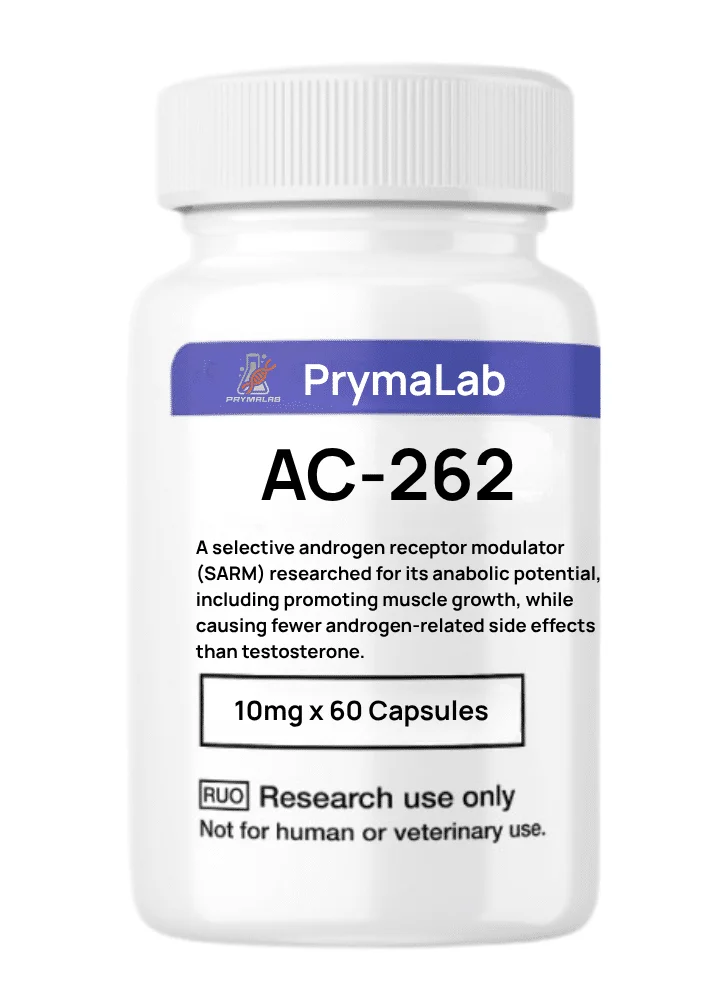
AC-262 (Accadrine) 10mg Capsules
Selective androgen receptor modulator · CAS 870888-46-3 · AC-262,536
AC-262 Accadrine SARM capsules contain AC-262,536, a selective androgen receptor modulator originally characterised at Acadia Pharmaceuticals. Published pharmacology reports a binding constant of 5.01 nM at the androgen receptor and partial agonist activity with a half-maximal effective concentration near 1.58 nM in luciferase reporter assays.
Specification Table
| Property | Value |
|---|---|
| Compound | AC-262,536 |
| Common name | Accadrine |
| CAS number | 870888-46-3 |
| Molecular formula | C18H18N2O |
| Molecular weight | 278.36 g/mol |
| Formal chemical name | 4-[(3-endo)-3-hydroxy-8-azabicyclo[3.2.1]oct-8-yl]-1-naphthalenecarbonitrile |
| Chemical class | Azabicyclo-naphthalenecarbonitrile, non-steroidal |
| Molecular target | Androgen receptor (AR, NR3C4) |
| Reported binding constant | Ki = 5.01 nM |
| Reported potency | EC50 = 1.58 nM (luciferase reporter assay) |
| Receptor selectivity | Selective for AR over a panel of 47 additional human nuclear receptors at 10 µM |
| Receptor activity | Partial agonist relative to testosterone |
| Originating laboratory | Acadia Pharmaceuticals |
| Capsule strength | 10 mg |
| Appearance | White to off-white powder within a gelatin capsule shell |
| Purity | Per lot-specific certificate of analysis |
| Solubility | Soluble in DMSO. Limited aqueous solubility |
| Storage | Room temperature, sealed, protected from light and moisture |
| Stability | Not established beyond the lot expiry stated on the certificate of analysis |
| Regulatory status | No approved human or veterinary formulation in any jurisdiction |
What Is AC-262,536 and Where Did It Come From?
AC-262,536 emerged from a discovery programme at Acadia Pharmaceuticals, and its formal chemical name gives away the structure: 4-[(3-endo)-3-hydroxy-8-azabicyclo[3.2.1]oct-8-yl]-1-naphthalenecarbonitrile. That is a tropane-like bicyclic amine attached to a naphthalene bearing a nitrile group.
Structurally it has nothing in common with the aryl-propionamide compounds that dominate the SARM literature. Andarine and its relatives came out of the University of Tennessee programme and share a common scaffold. AC-262,536 came from a different chemical starting point entirely, which is one reason its receptor profile is worth examining separately rather than assuming class behaviour.
The compound is sometimes marketed under the name Accadrine. That name does not appear in the peer-reviewed literature. Searching indexed databases for Accadrine will return nothing useful, so use AC-262,536 or the CAS number when looking for primary sources.
How Selective Is the AC-262 Accadrine SARM for the Androgen Receptor?
This is where the published data is unusually specific, and it is the most useful thing on this page.
Piu and colleagues screened AC-262,536 against a panel of 47 additional human nuclear receptors at a concentration of 10 µM and found it selective for the androgen receptor across that panel (Piu et al., Journal of Steroid Biochemistry and Molecular Biology, 2008). Ten micromolar is roughly two thousand times the reported binding constant of 5.01 nM, so the selectivity margin is wide.
That counter-screen is worth considerably more to a study design than any single affinity number. Nuclear receptors share structural architecture, and cross-reactivity with glucocorticoid, mineralocorticoid or progesterone receptors is a common confounder in this compound class. A clean 47-receptor panel narrows the interpretation of any observed effect considerably.
The functional numbers sit alongside it: a binding constant of 5.01 nM, a half-maximal effective concentration of 1.58 nM in a luciferase reporter readout, and partial agonism measured against testosterone as the reference.
What Did the Castrated-Rat Work Measure?
The same 2008 characterisation included a two-week study in castrated male rats at 3, 10 and 30 mg/kg. Two endpoints carry most of the interpretive weight.
Levator ani muscle weight increased. This muscle is androgen-responsive and is the conventional anabolic marker in castrated-rodent models. Prostate and seminal vesicle weights, by contrast, showed weak androgenic activity relative to testosterone, and that divergence is the selectivity signature the SARM field looks for.
The third finding is less discussed and arguably more mechanistically interesting: plasma luteinizing hormone, which rises after castration, was suppressed. LH suppression indicates the compound is reaching the hypothalamic-pituitary axis and engaging androgen receptors there, not only in peripheral tissue. Any interpretation of the anabolic readout has to account for that central activity.
How Much Literature Exists on This Compound?
Not much, and researchers should know that before designing anything around the compound.
The Piu 2008 paper is the primary characterisation and remains the main source for essentially every number quoted about AC-262,536, including the ones in the specification table above. Subsequent independent replication is sparse. There is no published human pharmacokinetic data, no long-term animal safety dataset, and no clinical development programme that reached a reportable stage.
Compare that with andarine, which has a multi-paper preclinical record from an academic group, or with GW-501516, which accumulated a two-year rodent carcinogenicity dataset before development stopped. AC-262,536 has a single well-executed pharmacology paper and comparatively little else.
That makes it a reasonable tool compound for receptor-level work where the binding and selectivity data are what matter. It makes it a poor choice for anything requiring an established safety or exposure profile, because that profile does not exist.
How Does AC-262,536 Sit Against Other Compounds Here?
Placing the AC-262 Accadrine SARM in context is more useful than describing it alone, because the choice a researcher faces is nearly always between compounds rather than about one in isolation.
Against andarine: both are non-steroidal, both are partial agonists, both show the levator ani versus prostate separation. Andarine has the deeper literature and a multi-paper academic record. AC-262,536 has the better-documented selectivity counter-screen, and forty-seven receptors is a more thorough exclusion than andarine’s published characterisation ever offered.
Against YK-11 there is no useful structural comparison to draw, since YK-11 is steroidal and operates by inducing follistatin. If the experimental question concerns the myostatin axis, AC-262,536 is not the compound.
Against RAD-140 and its ester: RAD-140 has a published discovery paper and early clinical evaluation. AC-262,536 has one thorough pharmacology paper and nothing after it. Neither has the depth of the andarine record.
The practical summary is that AC-262,536 earns its place on receptor selectivity rather than on breadth of evidence. For a study needing confidence that an observed effect is androgen receptor-mediated and not cross-talk from a related nuclear receptor, the counter-screen data is the reason to choose it.
Why the Naming Causes Practical Problems
Compound naming looks like a trivial issue until it costs someone an afternoon in a database.
This molecule carries at least four labels. AC-262,536 with the comma is how the originating publication writes it. AC-262536 without the comma is how most chemical catalogues list it. AC-262 is the abbreviated form used in commerce. Accadrine is a marketplace name with no scientific presence whatsoever.
Database search behaviour differs across all four. The comma breaks tokenisation in some search interfaces and is ignored in others, so AC-262,536 and AC-262536 do not reliably return the same set. Searching AC-262 alone returns unrelated compounds sharing the prefix.
The reliable identifier is the CAS number, 870888-46-3, which is unambiguous across every chemical database. Where a literature search is part of the work, start there rather than with any of the names.
Handling and Storage in Laboratory Practice
Supplied as 10 mg capsules. Analytical workflows normally empty and weigh the contents rather than relying on nominal fill weight.
DMSO is the standard stock solvent. Aqueous solubility is limited, so watch for precipitation when diluting into buffer or culture medium, and confirm the working concentration analytically if the experiment depends on it. Precipitation that occurs after filtration will not be visible but will reduce delivered concentration.
Hold dry material sealed and dry at ambient temperature, out of direct light. Capture lot, solvent, concentration and date in the record. With a published record this thin, internal documentation is doing work that the literature would otherwise do.
Published Literature
References confirmed against the publisher record or a primary index. Note the short list: it reflects the actual state of the literature rather than an editorial choice.
- Piu F, Gardell LR, Son T, Schlienger N, Lund BW, Schiffer HH, Vanover KE, Davis RE, Olsson R, Bradley SR. Journal of Steroid Biochemistry and Molecular Biology. 2008;109(1-2):129-137. PMID: 18164613
- Narayanan R, Mohler ML, Bohl CE, Miller DD, Dalton JT. Nuclear Receptor Signaling. 2008;6:e010.
- Bhasin S, Jasuja R. Current Opinion in Clinical Nutrition and Metabolic Care. 2009;12(3):232-240.
Frequently Asked Questions
What is the AC-262 Accadrine SARM?
The AC-262 Accadrine SARM is supplied as capsules containing AC-262,536, a selective androgen receptor modulator characterised at Acadia Pharmaceuticals, with CAS number 870888-46-3, molecular formula C18H18N2O and molecular weight 278.36. Published data reports a binding constant of 5.01 nM alongside partial agonist activity. Supplied at 10 mg per capsule for laboratory research use only.
Is Accadrine the same as AC-262,536?
Yes, though only one of those names appears anywhere in the scientific literature, which matters a great deal if you are trying to find primary sources rather than marketplace listings. AC-262,536 is the designation used in the pharmacology paper. Accadrine is a commercial name with no presence in indexed databases.
How selective is AC-262,536 for the androgen receptor?
Published work screened it against 47 additional human nuclear receptors at 10 micromolar and reported selectivity for the androgen receptor across that entire panel, which is a considerably more thorough exclusion than most compounds in this class have behind them. The counter-screen concentration sits roughly two thousandfold above the active range.
What is the difference between the Ki and EC50 figures?
The binding constant of 5.01 nM describes how tightly the compound occupies the receptor, while the half-maximal effective concentration of 1.58 nM describes the concentration producing half the maximal transcriptional response in a luciferase reporter assay. They measure different things. Reporting both is more informative than either alone.
What did the rat study measure?
A two-week study in castrated male rats at 3, 10 and 30 mg/kg tracked levator ani muscle weight as the anabolic marker, prostate and seminal vesicle weights as the androgenic marker, and plasma luteinizing hormone. All three moved. That combination is what makes a small dataset genuinely useful.
Why does LH suppression matter?
Luteinizing hormone rises after castration because androgen negative feedback disappears, so suppressing that rise indicates the compound is engaging androgen receptors in the hypothalamic-pituitary axis rather than only in peripheral tissue. Central activity is occurring simultaneously. Any reading of the muscle data has to account for it.
How much research exists on AC-262,536?
Considerably less than for most compounds in this class, which is the single most important thing to know before designing anything around it. The 2008 Piu characterisation supplies essentially every published figure. There is no human pharmacokinetic data, no long-term animal safety dataset, and very little independent replication.
Is AC-262,536 structurally related to andarine?
No, and treating them as members of a shared chemical family will produce wrong predictions, because andarine is an aryl-propionamide from the University of Tennessee programme while AC-262,536 is an azabicyclo-naphthalenecarbonitrile from a separate effort at Acadia. They share a target and a functional label. Nothing else.
How should AC-262 capsules be stored?
Sealed at ambient temperature, away from light and moisture, using DMSO for stock solutions since aqueous solubility is limited and precipitation on dilution into buffer or culture medium is the predictable failure mode. Watch for it during preparation. Record lot, solvent, concentration and date for every stock made.
How does AC-262,536 compare with andarine?
Both are non-steroidal partial agonists showing the levator ani versus prostate separation, but andarine carries the deeper literature and a multi-paper academic record built over roughly six years. AC-262,536 has the better counter-screen. Forty-seven receptors is a more thorough exclusion than andarine ever received.
When is AC-262,536 the right choice?
When a study needs confidence that an observed effect is genuinely androgen receptor-mediated rather than cross-talk from a structurally related nuclear receptor, since that is exactly what the counter-screen data supports. It is a poor choice elsewhere. No established exposure or safety profile exists to design around.
What does the formal chemical name tell you?
The name 4-[(3-endo)-3-hydroxy-8-azabicyclo[3.2.1]oct-8-yl]-1-naphthalenecarbonitrile describes a tropane-like bicyclic amine joined to a naphthalene carrying a nitrile group, with the endo designation fixing stereochemistry at the hydroxyl. That architecture is unrelated to aryl-propionamides. Andarine and its relatives share none of it.
Which identifier should be used for literature searches?
CAS 870888-46-3, without exception, because the compound carries at least four names and database tokenisation handles them inconsistently enough to cost a real afternoon. AC-262,536 and AC-262536 do not reliably return the same set. Searching AC-262 alone pulls unrelated compounds sharing the prefix.
What was the concentration range in the rat study?
Three, ten and thirty milligrams per kilogram, given over two weeks to castrated males, with levator ani weight tracked as the anabolic marker and prostate and seminal vesicle weight as the androgenic one. Plasma luteinizing hormone was measured alongside. Having all three endpoints move is what makes the dataset informative.
Why does partial agonism produce tissue selectivity?
A full agonist drives the receptor into a conformation that recruits the complete coactivator set, whereas a partial agonist stabilises a different conformation whose transcriptional output depends on which coregulator proteins happen to be abundant in that particular tissue. Coregulator expression varies. That variation is where the selectivity comes from.
Compliance Statement
AC-262 Accadrine SARM capsules is sold exclusively for laboratory research use. It is not a drug, food, or cosmetic product, and it is not a dietary product of any kind. It is not approved by the FDA or any comparable authority for human or veterinary use, and selective androgen receptor modulators are prohibited in competitive sport under World Anti-Doping Agency rules. This product is not intended to diagnose, treat, cure, or prevent any disease. It must not be given to humans or animals. Purchase is restricted to qualified researchers and institutions operating within applicable laws. All handling is the responsibility of the purchasing laboratory.


19 reviews for AC-262 (Accadrine) 10mg Capsules