Description
PrymaLab · Research Use Only
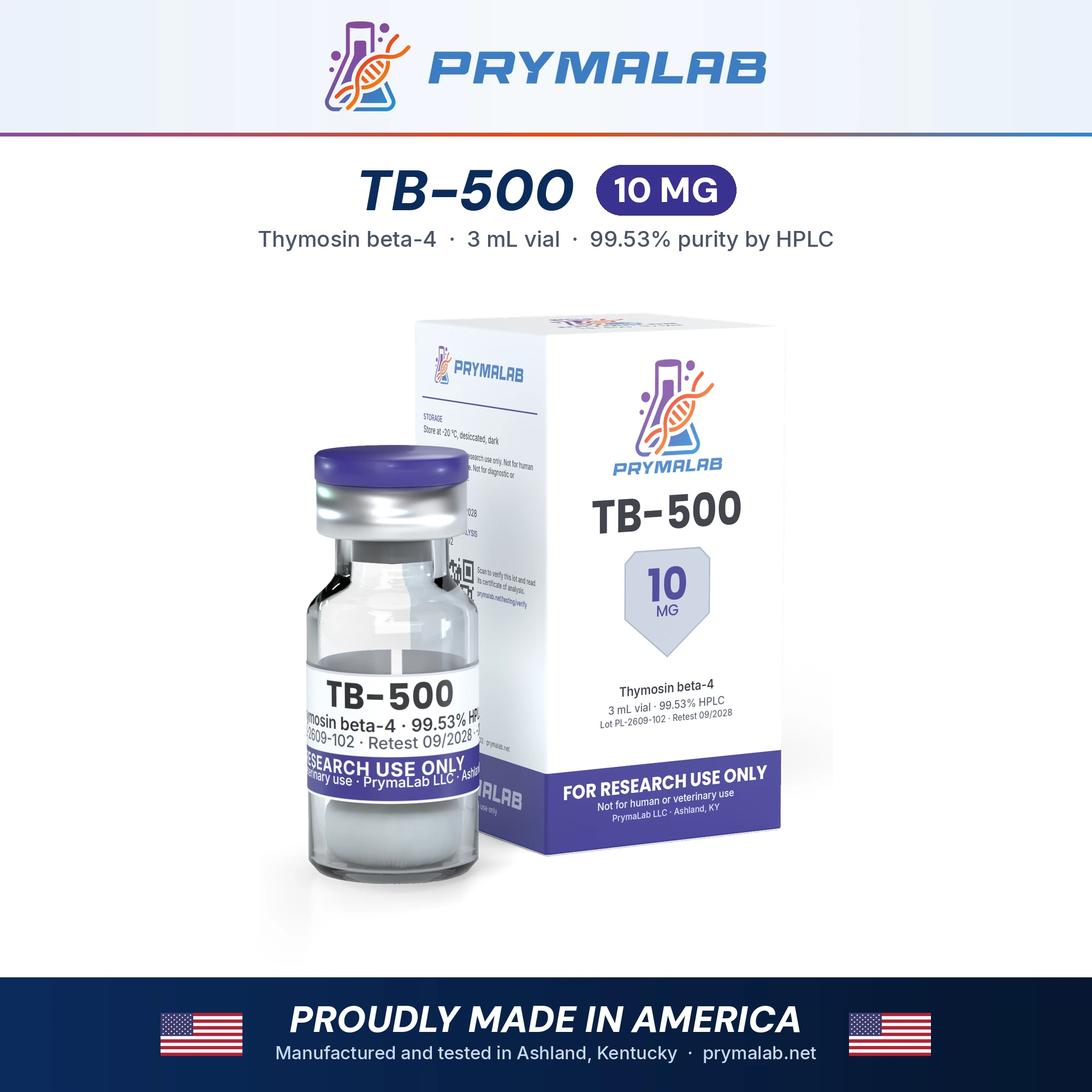
TB-500 10mg
Three related articles share this name · only one is in the vial
TB-500 is a trade name rather than a chemical description. At least three different articles circulate as tb-500 peptide, and working out which one is in a particular vial takes one number from the certificate. A surprising share of suppliers cannot provide it, which is itself informative.
Specification Table
| Property | Value |
|---|---|
| Name as sold | TB-500 |
| What the name describes | A trade designation rather than a defined chemical entity |
| Article one | Thymosin beta-4, the full 43-residue protein |
| Mass of article one, acetylated | Approximately 4,963 g/mol |
| CAS for thymosin beta-4 | 77591-33-4 |
| Article two | A shortened synthetic construct built around the actin-binding region |
| Mass of article two | Depends on the construct. Far below 4,963 and usually under 1,000 |
| Article three | The four-residue amino-terminal fragment, sold separately in this catalogue |
| Which this vial contains | Per the lot-specific certificate. Ask for the sequence and the observed mass |
| Acetylation | The natural protein is acetylated at the amino terminus. Synthetic material may not be |
| Mass difference from acetylation | 42 daltons |
| Regulatory status | No approved human or veterinary formulation in any jurisdiction |
| Appearance | White lyophilized powder |
| Purity | Per lot-specific certificate of analysis |
| Storage, lyophilized | 2-8°C short term, -20°C for extended storage, protected from light and moisture |
Which TB-500 Peptide Is Actually in the Vial?
Which tb-500 peptide a vial contains is the question this page exists to answer. One number answers it.
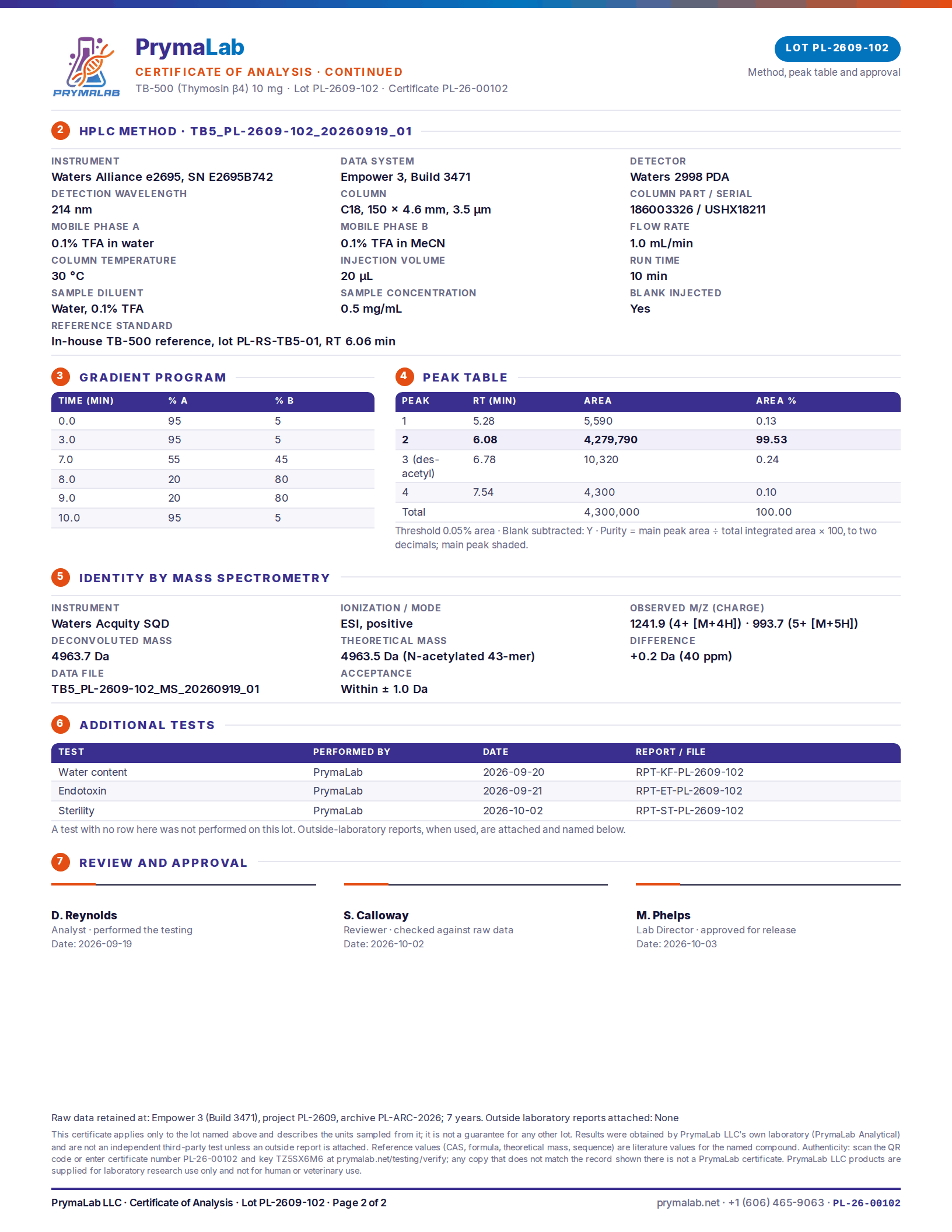
Sold as tb-500 peptide, the full protein is 43 residues and runs close to 4,963 daltons with its amino-terminal acetyl group in place.
A shortened synthetic construct built around the actin-binding region is a fraction of that. Depending on how much sequence is included it typically falls under 1,000 daltons.
The amino-terminal four-residue fragment is smaller again, around 490 daltons, and this catalogue sells it as a separate article rather than under this name.
Those three figures are separated by factors rather than percentages, so any mass spectrometer distinguishes them without effort.
So an observed mass answers the identity question completely. A certificate without one leaves it open.
What complicates the market is that all three have a defensible claim to the name. The designation was applied historically rather than defined chemically.
A supplier selling the full protein as tb-500 peptide is not necessarily being dishonest, and neither is one selling the shortened construct.
They are selling different things, and a study that switched between them without noticing would produce a discontinuity in its data with no obvious cause.
The only defence is the number, and asking for it costs one email.
What Does the Acetyl Group Do?
A second identity question sits underneath the first and it is smaller in mass and not smaller in consequence.
The natural protein carries an acetyl group on its amino terminus, added after translation, and that modification is present on essentially all of the protein found in tissue.
Synthetic material may or may not reproduce it, because acetylation is an extra step and the unmodified peptide is cheaper to make.
The mass difference is 42 daltons. On a 4,963 dalton protein that is under one percent, which is inside the error of a nominal-resolution instrument and outside the error of a high-resolution one.
On a shortened construct of a few hundred daltons the same 42 daltons is a much larger proportion and correspondingly easier to see.
The modification is not decorative. An acetylated amino terminus is uncharged where an unmodified one carries a positive charge. That changes the electrostatics of the whole end of the molecule.
It also removes the substrate that aminopeptidases recognise, so the acetylated form resists amino-terminal trimming that the unmodified form does not.
For an experiment the consequence is that acetylated and unmodified material are not interchangeable, and a certificate should say which was supplied.
Most do not, which makes it the second question worth asking after the mass.
One further practical note. Where a certificate quotes only a nominal mass rather than an observed one, the acetylation question cannot be answered from the document at all.
A calculated figure reflects what the supplier intended to make, whereas an observed figure reflects what they actually made. Only the second settles it.
Why Does the Name Cover So Much Ground?
The confusion has a history worth knowing, because it makes the rest of the market considerably easier to read.
The protein itself was characterised as an actin-binding molecule present at high concentration inside cells. Its established function is holding monomeric actin in a form that cannot polymerise.
A short region of the sequence was identified as carrying the actin-binding interaction, which raised the obvious question of whether that region alone would reproduce the effects attributed to the whole protein.
Constructs built around that region were made and tested, and the designation TB-500 attached itself to material in that space without ever being pinned to one structure.
From there the name spread to cover the full protein as well, since suppliers selling the full protein into the same market had a commercial reason to use the term buyers were searching for.
No naming authority was involved at any point, which is why tb-500 peptide still covers three articles.
It also means the published literature is not directly transferable between the articles, since a result obtained with the full protein does not automatically describe a shortened construct.
Checking which article a paper used is therefore part of reading this literature.
The recovery hub sets out how this article sits against the others in that part of the catalogue.
What Should a TB-500 Certificate Show?
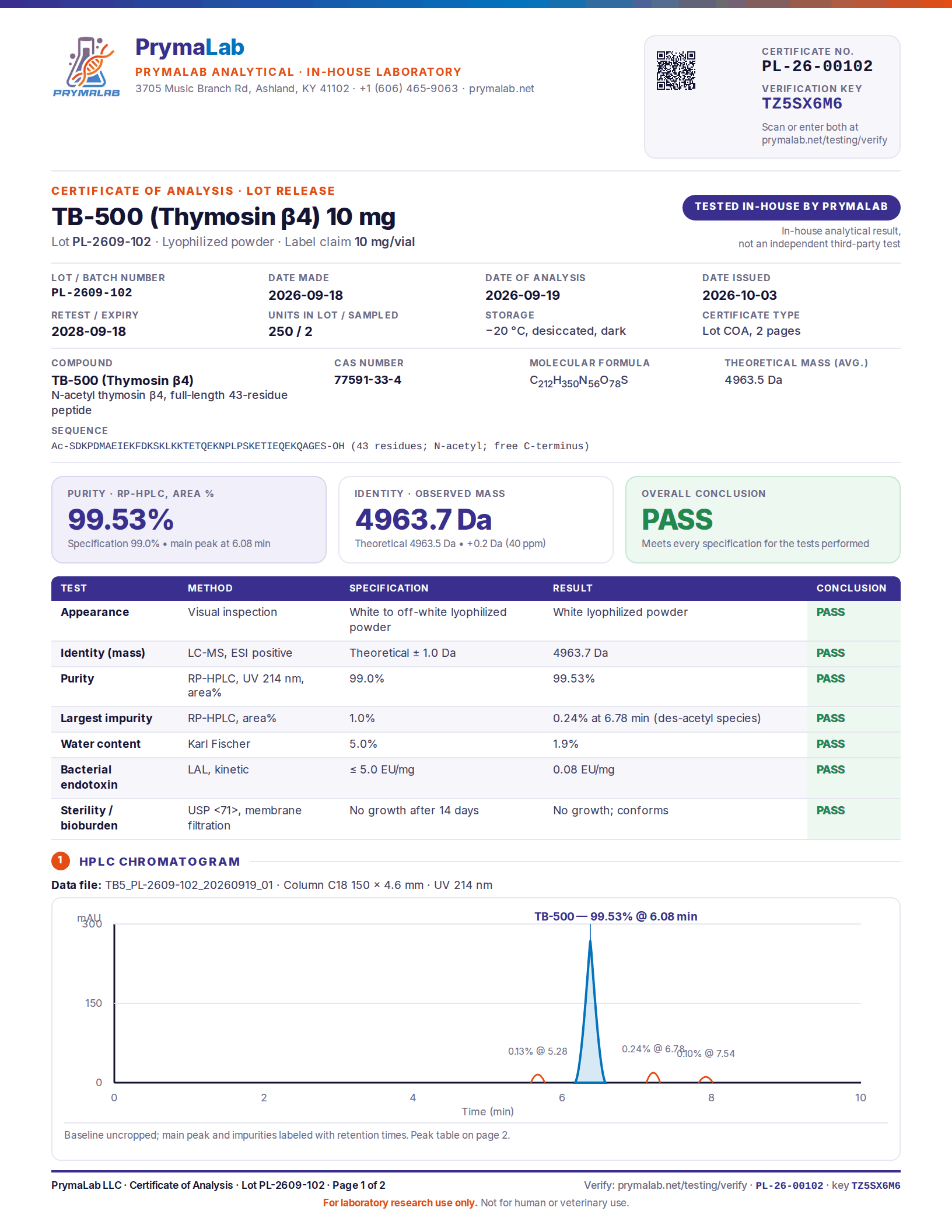
A tb-500 peptide certificate carries six fields, and the first two settle the identity question the rest of the document depends on.
The sequence written out in full, or at minimum the residue count, since forty-three residues identifies the full protein and anything materially shorter identifies a construct.
The observed mass set beside the calculated one, with the calculated figure printed. That single pair of numbers separates all three articles.
Whether the amino terminus is acetylated, stated explicitly rather than left to inference from the mass.
Purity by reverse-phase HPLC with the chromatogram supplied. On a 43-residue protein deletion sequences are a real population and they resolve by retention more reliably than by mass.
Instrument resolution, since a 42 dalton acetyl group on a 4,963 dalton protein is under one percent and a single deletion is smaller again.
Counterion identity and net peptide content, plus lot number and synthesis date.
A certificate that names the article precisely, rather than printing the trade designation alone, is written by a supplier who knows which of the three they made.
How Should a Study Record Which Article It Used?
A compound with three plausible identities needs a recording habit that a single-molecule article does not.
Naming the supplier and the catalogue number is the minimum and it is not sufficient on its own, because suppliers change what they ship under a designation without changing the designation.
The observed mass from the certificate belongs in the record alongside them, because that is the field that pins the identity.
Acetylation status belongs there too, for the same reason and with the same weight.
Where a sequence was supplied, recording the residue count is enough for most purposes and recording the sequence itself costs nothing.
Those four fields together let a second laboratory establish, years later, which of the three articles produced a given result.
Without them a published result is attached to a trade name, and a trade name in this family does not identify a molecule.
The same discipline applies when reading rather than writing. A paper reporting work with this designation should be checked for the same fields before its figures are carried into a new design.
Where a paper does not state them, its results describe an article of unknown identity, which is a real limitation on how far they can be relied on.
None of this is unusual practice in protein work. It is unusual in this market, which is where the gap sits.
How Should the Vial Be Handled?
Handling tb-500 peptide depends on which article is in the vial, which is a further reason to establish that first.
The full protein behaves like a protein rather than a peptide. Gentle reconstitution therefore matters more than it would for a short construct.
Sealed lyophilized material holds at 2 to 8 degrees Celsius for short periods and at minus 20 for extended storage, protected from light and moisture.
Bring the vial to ambient temperature before opening, then add diluent down the wall and leave it to stand rather than shaking it.
Do not vortex a 43-residue article. Interface denaturation is a real loss route at that size and it is not reversible.
Aliquot on first reconstitution without exception, since freeze-thaw damage on a long chain shows up as aggregation rather than as a mass change and is therefore invisible.
The sequence carries several lysines and glutamates, so it is highly charged and readily soluble, which is one of the few things that makes it easy to work with.
Use low-binding consumables at working dilutions, since adsorption at low concentration is substantial for a molecule this size.
Record lot, the article identity as established from the certificate, net peptide content, diluent volume and date. That identity field has no equivalent elsewhere in this catalogue and it is the one that makes the work reproducible.
A closing note on why the identity field belongs in the storage record rather than only on the order.
Suppliers change what they ship under a designation without announcing it, so the identity established at receipt is a property of that lot and not of the product line.
Published Literature
Selected references on the protein, on its actin interaction and on the region that later constructs were built around.
- Safer D, Elzinga M, Nachmias VT. Journal of Biological Chemistry. 1991;266(7):4029-4032. PMID: 1999384
- Goldstein AL, Hannappel E, Kleinman HK. Trends in Molecular Medicine. 2005;11(9):421-429. DOI: 10.1016/j.molmed.2005.07.004
- Hannappel E. Annals of the New York Academy of Sciences. 2010;1194:27-35. DOI: 10.1111/j.1749-6632.2010.05485.x
- Philp D, Kleinman HK. Expert Opinion on Biological Therapy. 2010;10(2):261-268. DOI: 10.1517/14712590903455888
Frequently Asked Questions
What is TB-500?
A trade designation rather than a chemical description. At least three different articles circulate as tb-500 peptide, and which one is in a given vial is a question for the certificate.
What are the three articles?
The full 43-residue protein at roughly 4,963 daltons, a shortened synthetic construct built around the actin-binding region, and a four-residue amino-terminal fragment at around 490 daltons.
How do I tell them apart?
By observed mass. The three figures are separated by factors rather than percentages, so any mass spectrometer distinguishes them without difficulty.
Is one of them the correct one?
All three have a defensible claim to the name, because the designation was applied historically rather than defined chemically. They are different articles and a study should not switch between them.
What does the acetyl group do?
The natural protein carries one on its amino terminus. It leaves that end uncharged where an unmodified terminus carries a positive charge, and it blocks aminopeptidase trimming.
How large is that difference?
Forty-two daltons. On the full protein that is under one percent and needs high-resolution mass spectrometry. On a shortened construct it is a much larger proportion.
Does synthetic material carry it?
It may or may not. Acetylation is an extra synthesis step and the unmodified peptide is cheaper to make, so a certificate should state which form was supplied.
Why has the name spread so far?
No naming authority was ever involved. The designation attached to constructs built around the actin-binding region, then spread to the full protein because suppliers used the term buyers search for.
Does the literature transfer between them?
Not automatically. A result obtained with the full protein does not describe a shortened construct, so checking which article a paper used is part of reading this literature.
What does the protein do inside cells?
Its established function is binding monomeric actin and holding it in a form that cannot polymerise. It is present at high concentration intracellularly.
How should the full-length article be reconstituted?
Gently. Add diluent down the wall and leave it to stand rather than shaking, and do not vortex, because interface denaturation at that size is a real and irreversible loss route.
What extra field should the record carry?
The article identity as established from the certificate. That field has no equivalent elsewhere in this catalogue and it is the one that makes the work reproducible.
Compliance Statement
TB-500 is sold exclusively for laboratory research use. It is not a drug, food, or cosmetic product, and it is not a dietary product of any kind. It is not approved by the FDA or any comparable authority for human or veterinary use, the designation covers at least three chemically distinct articles and the lot-specific certificate is the only document that establishes which one is supplied, published results obtained with one article do not automatically describe another, and no compound in this range is offered for any human or veterinary purpose. This product is not intended to diagnose, treat, cure, or prevent any disease. It must not be given to humans or animals. Purchase is restricted to qualified researchers and institutions operating within applicable laws. All handling is the responsibility of the purchasing laboratory.
Other formats of TB-500
TB-500 is also stocked as TB-500 5mg/ml preloaded 3ml pen, TB-500 Peptide Nasal Spray, TB-500 (Thymosin Beta-4) 5mg, BPC-157 + TB500 (10mg/10mg) "Wolverine Blend", BPC-157 Capsules (60/500mcg), BPC-157 Peptide Nasal Spray, BPC 157 5mg + TB500 5mg and BPC-157 5mg/ml preloaded 3ml pen. Each listing states its own quantity and concentration, and the pen and vial comparison explains what changes between formats.

-10MG-New.png)


-10MG-New-444x533.png)


20 reviews for TB-500 (Thymosin Beta-4) 10mg