Description
PrymaLab · Research Use Only
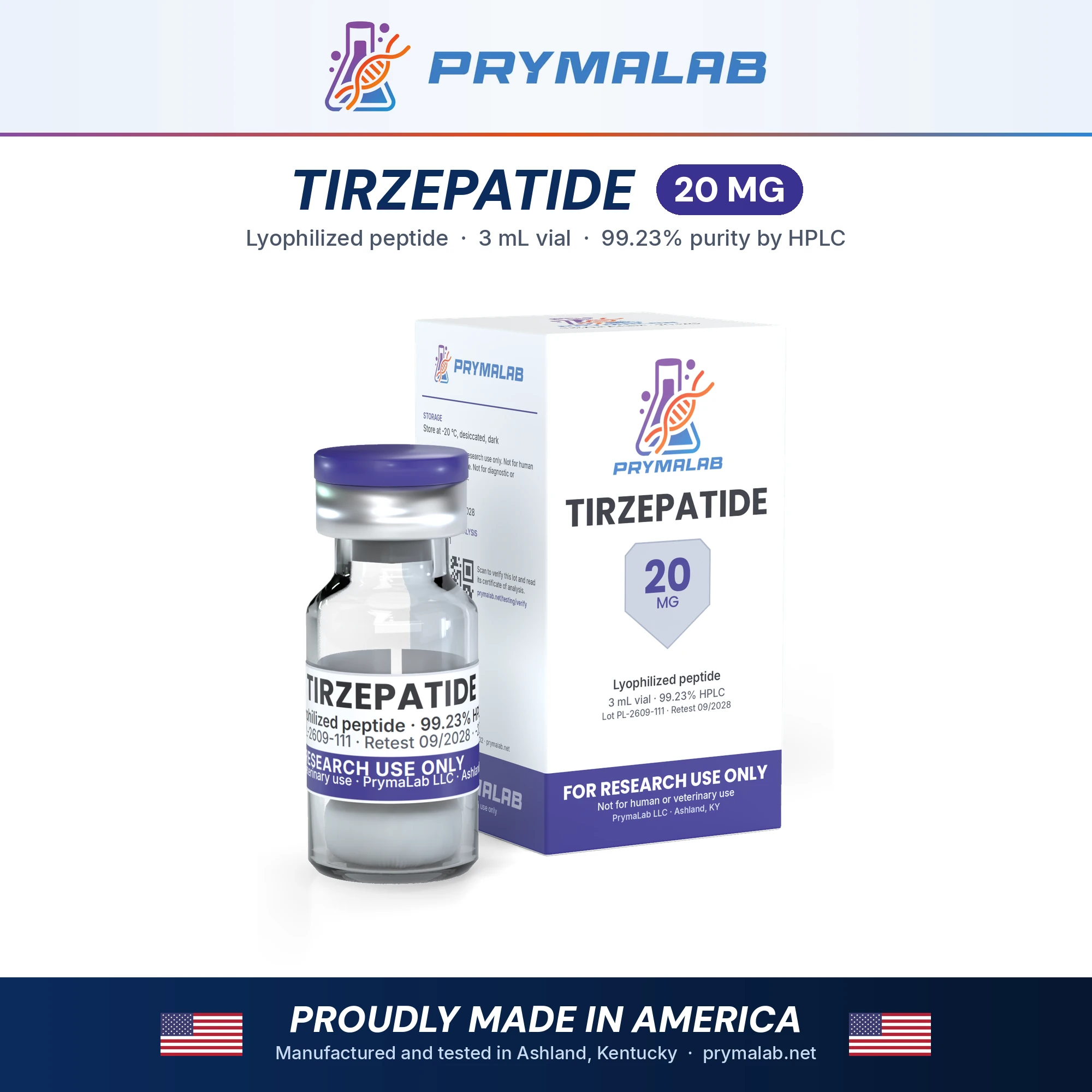
Tirzepatide 20mg
The last fine step before the gaps in the range widen
Tirzepatide 20mg is the fourth of ten fill sizes and the last one reachable in a five milligram step. Above it the range jumps in tens and then in twenties, which means how closely you can match a requirement to a vial depends on where in the range that requirement falls.
Specification Table
| Property | Value |
|---|---|
| Compound | Tirzepatide |
| CAS number | 2023788-19-2 |
| Declared content | 20 milligrams |
| Molecular weight | Approximately 4.8 kDa. Read the exact figure from the lot certificate |
| Approximate molar content | Around 4 micromoles |
| Position in the range | Fourth of ten |
| Full range in this catalogue | 5, 10, 15, 20, 30, 40, 50, 60, 80 and 100 milligrams |
| Step size below this fill | Five milligrams |
| Step size above this fill | Ten milligrams, then twenty at the top |
| Consequence | Matching a requirement to a vial gets coarser as the range goes up |
| Compound differences between fills | None |
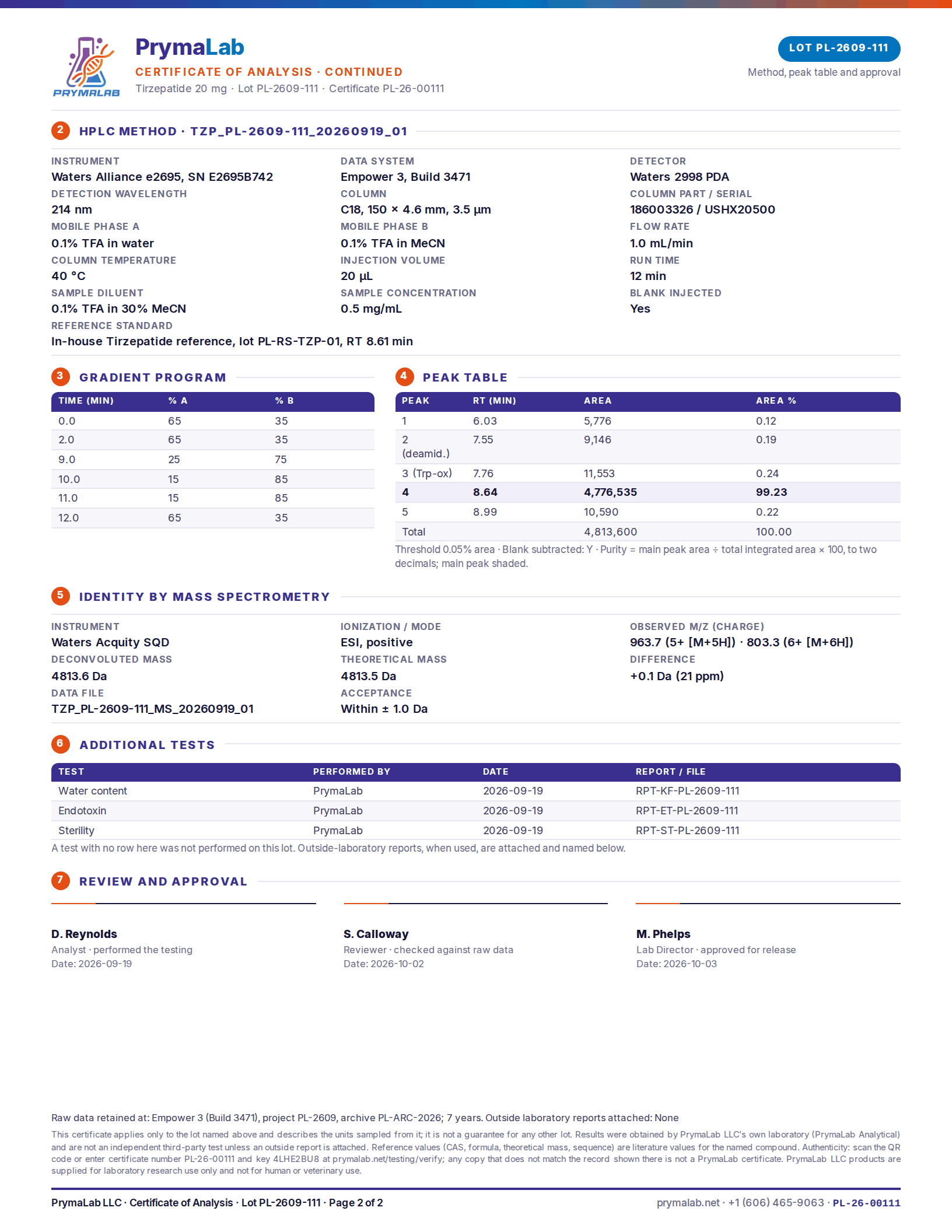
| Acylation | A C20 fatty diacid |
| Solution stability | Limited once reconstituted. Freezing is not a workaround |
| Pharmacology | Covered on the 10mg page |
| Storage | Sealed at minus 20°C. Do not freeze solution and do not agitate |
Why Does Tirzepatide 20mg Sit Where It Does?
Tirzepatide 20mg sits there because the range was built for buyers rather than for a chemistry reason, and buyers cluster at the bottom.
Look at the spacing. Five, ten, fifteen, twenty, then thirty, forty, fifty, sixty, eighty, a hundred.
The first four are five milligrams apart. The next four are ten apart from one another. The last two are twenty.
Nothing about the molecule changes across that range, so the spacing reflects demand: most purchases are small, so the small end gets fine resolution and the large end gets whatever.
The practical effect is that your ability to match a vial to a requirement depends on where the requirement lands.
A study needing 18 milligrams buys 20 and wastes two. A study needing 70 buys 80 and wastes ten, or buys 60 and comes up short.
As a percentage of the purchase, the waste at the top of the range is similar. In absolute terms it is five times worse, and on a compound with a solution stability limit the absolute figure is what gets discarded.
So the range is finest where the quantities matter least.
Is 20mg the Right Fill for Most Studies?
For a lot of in vitro work a tirzepatide 20mg vial is the right size, and I would defend that rather than hedge it.
Four micromoles reconstituted into 4 millilitres gives a 1 millimolar stock. Diluted to a working concentration of 100 nanomolar that is 40 litres of assay medium, which is more than any cell study consumes.
The quantity is generous. The binding constraint is time in solution rather than volume, which the 30mg page covers.
Where 20 milligrams is a good fit is a study that runs over a few weeks, uses several conditions, and wants one lot behind all of them.
Where it is wrong is a single pilot, which should use the 5 milligram fill, and anything at animal scale, which will need more.
The mistake I see most often is buying by price per milligram, which points at the large fills and ignores that a large fill reconstituted at once starts one clock on all of it.
What Concentration Should the Stock Be?
Whatever makes a tirzepatide 20mg dilution series identical to the one you would run from any other fill in this range.
That sounds like a small thing and it removes a real error source.
A laboratory that reconstitutes every vial into a round number of millilitres gets a different stock concentration from every fill size, which means the dilution factors change whenever the purchase size changes.
Changing dilution factors between experiments is where transcription errors enter, and they are invisible afterwards because every number in the sheet looks plausible.
Picking a target stock concentration and calculating the volume against it fixes that permanently.
For this fill at roughly 4.8 kilodaltons, 4.17 millilitres gives exactly 1 millimolar, which is the number worth aiming at. Round it to 4.2 and record the actual volume rather than the intended one.
The rounding matters more than it looks: 4 millilitres against 4.17 is a four percent concentration difference, which is the same order as the net peptide content correction most people never apply.
What Should the Certificate Show?
A tirzepatide 20mg certificate needs the same fields every fill in this range needs.
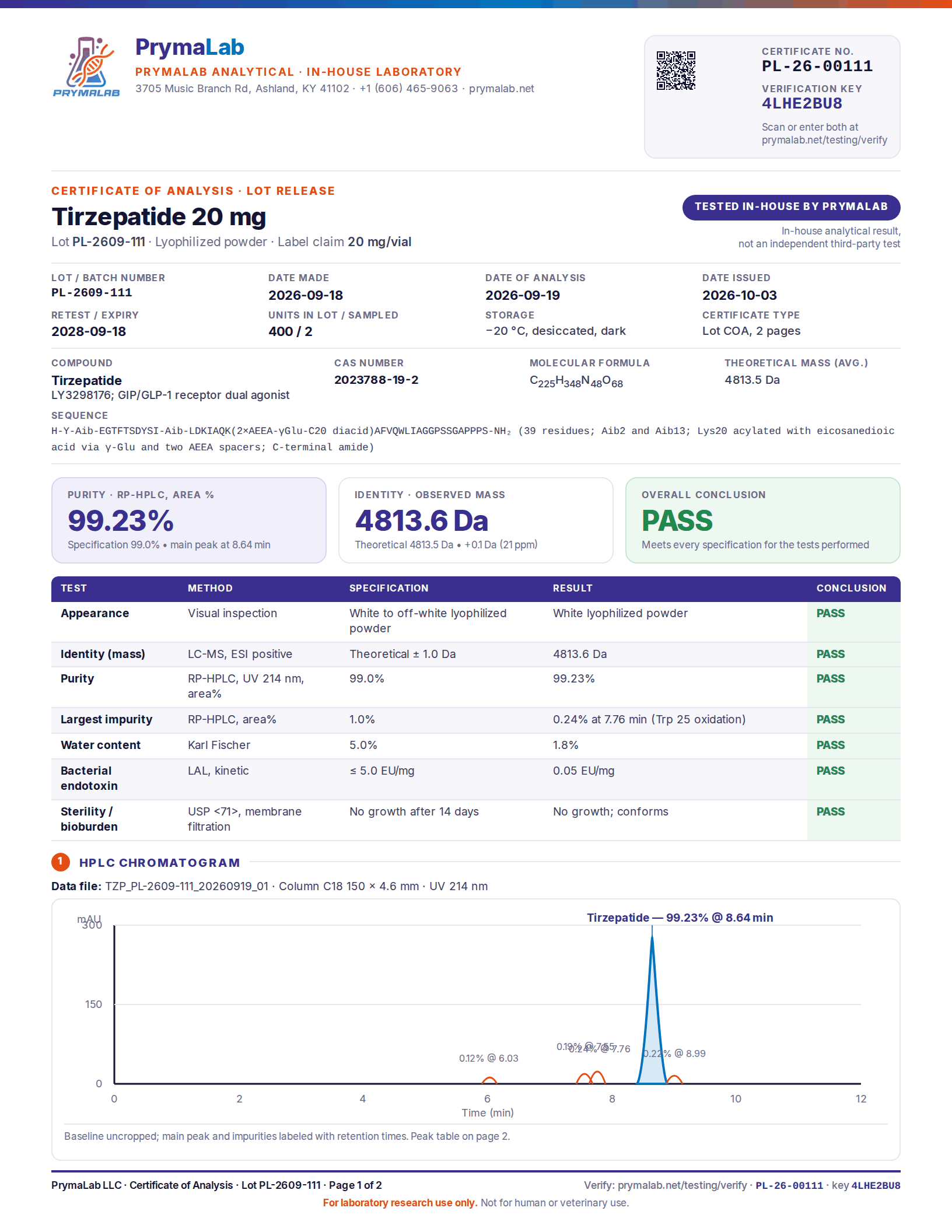
Net peptide content with the determination named.
The sequence written out in full, with the position of the acylation stated on the same line.
Observed mass by spectrometry, since incomplete acylation produces a predictable mass difference.
Purity by chromatography with the method named.
Aggregate content, measured by size exclusion chromatography rather than inferred.
Salt form, lot number and manufacturing date.
A stability figure for the reconstituted solution, with a temperature attached.
On a mid-range fill the stability figure and the net content figure are the two that actually change a decision. The rest confirms you bought the right compound.
What Would a Better Range Look Like?
Geometric rather than mixed. Nobody is going to rebuild the range around tirzepatide 20mg or anything else, so this is a thought experiment.
A range doubling at each step, 5 then 10 then 20 then 40 then 80, would hold the proportional resolution constant across all of it. Five sizes instead of ten, and the worst-case overbuy would be the same percentage at every point.
What exists instead is fine at the bottom and coarse at the top, which optimises for the largest number of purchases rather than for the largest purchases.
From a supplier point of view that is correct. From a buyer point of view it means the people spending the most money get the least precision, which is an odd arrangement and a common one.
None of this is a reason to avoid any particular fill. Work out the requirement before looking at the list. Looking first anchors you to whatever size is nearest, and nearest is not evenly spaced across this range.
What Belongs in the Purchase Record?
The fill size. On a ten-size article that sounds like an accounting detail and is not.
A laboratory reordering by whatever is in stock accumulates lots without deciding to, because the size on the label is the thing that gets noticed while the lot number is the thing that matters.
A purchase log listing date, size and lot takes seconds per entry and answers a question that comes up later: how many materials does this dataset span.
Keep a single line per vial, written when it arrives rather than when it is opened. Vials get opened out of order.
That is a boring recommendation and it is the one that turns a shelf of vials into something a methods section can be written from.
What Does the Fill Not Change?
The molecule, the receptor behaviour, the storage temperature and every handling rule.
All of that comes from the 10mg page and none of it moves with vial size. Listings sometimes present a fill as a variant of the compound. It is not one.
What does move is the amount, the number of lots a study spans, and how well the purchase matches the requirement.
On a range this uneven, the third of those is the one that varies most between fills, and it is the one nobody thinks about at the point of ordering.
Work out what the study needs first. Then go and look at the list.
How Should the Vial Be Handled?
As an acylated peptide. The 10mg page sets out the full argument and none of it changes here.
Sealed lyophilised powder holds at minus 20 degrees Celsius, dark and dry.
Bring the vial to ambient temperature before opening, then run diluent down the wall and let the cake dissolve.
Do not vortex. The fatty chain makes the molecule surface active and an interface is where it associates.
Do not freeze the reconstituted solution.
Aliquot into single-use volumes on the first reconstitution, so the working stock is opened once and never thawed twice.
Use low-binding consumables from the first dilution onward.
Record lot, net peptide content, the diluent and its exact volume, the calculated stock concentration, the reconstitution date and the fill size.
Fill size belongs in the record on any article sold in ten presentations, because it is the cheapest available proxy for how many lots a dataset spans.
One closing note on the range argument, since it applies beyond this compound. Any catalogue offering many sizes of one article is making a statement about who buys it, and reading that statement takes about ten seconds and tells you where the demand sits.
Ten sizes with fine steps at the bottom means most buyers are small. Three sizes evenly spaced means nobody had a strong view. Neither fact is written anywhere, and both are visible from the list of sizes alone.
It is a small thing to notice and it costs nothing. On this compound it tells you that a 20 milligram purchase puts you above the median buyer and below the point where the range stops being helpful, which is a reasonable place to sit for most laboratory work.
The pages for the 5mg and 30mg fills in this catalogue take the two arguments either side of that position, and reading all three together is the fastest way to work out which one you actually want.
None of the three will tell you a size is best, because none of them is. What they will do is name the specific thing each fill costs you, which is the information a list of prices leaves out entirely.
That is the whole purpose of writing a page per fill rather than one page with a size dropdown on it.
Published Literature
Selected references on the receptor pharmacology, on the structural basis of dual engagement and on peptide storage generally. The 10mg page carries the same list.
- Willard FS, Douros JD, Gabe MB, Showalter AD, Wainscott DB, Suter TM, et al. JCI Insight. 2020;5(17):e140532. DOI: 10.1172/jci.insight.140532
- Sun B, Willard FS, Feng D, Alsina-Fernandez J, Chen Q, Vieth M, et al. Proceedings of the National Academy of Sciences. 2022;119(13):e2116506119. DOI: 10.1073/pnas.2116506119
- Frias JP, Davies MJ, Rosenstock J, Perez Manghi FC, Fernandez Lando L, Bergman BK, et al. New England Journal of Medicine. 2021;385(6):503-515. DOI: 10.1056/NEJMoa2107519
- Manning MC, Chou DK, Murphy BM, Payne RW, Katayama DS. Pharmaceutical Research. 2010;27(4):544-575. DOI: 10.1007/s11095-009-0045-6
Frequently Asked Questions
How are the ten fill sizes spaced?
Unevenly. Five, ten, fifteen, twenty, then thirty, forty, fifty, sixty, eighty, a hundred. Five at the bottom, then ten, then twenty at the top.
Why does the spacing matter?
Because how closely a vial can match a requirement depends on where the requirement falls. A study needing 18 milligrams buys 20. One needing 70 buys 80 and wastes ten, or buys 60 and comes up short by ten.
Is the waste worse at the top?
In absolute terms, about five times worse. As a percentage it is similar, and on a compound with a solution stability limit the absolute figure is what gets discarded.
Why is the range spaced that way?
Demand. Nothing about the molecule changes across it. The fine resolution sits at the small end because that is where most purchases are, and the coarse steps sit where the money is.
How much working solution does 20mg give?
Around 4 micromoles. Into 4 millilitres that is a 1 millimolar stock, which diluted to 100 nanomolar is about 40 litres of assay medium.
So quantity is not the constraint?
No. Time in solution is, which the 30mg page covers. An acylated peptide has a limited useful life once dissolved.
What suits a 20mg fill?
A study running over a few weeks across several conditions that wants one lot behind all of them.
What does not suit it?
A single pilot, which should use the 5 milligram fill, and anything at animal scale, which will need more.
How should the stock concentration be chosen?
To make the downstream dilution series identical across fill sizes. Reconstituting every vial into a round volume gives a different stock concentration for every fill and changes the dilution factors.
What volume gives 1 millimolar here?
About 4.17 millilitres at roughly 4.8 kilodaltons. Rounding to 4 instead is a four percent concentration difference, which is the same order as the net content correction most people skip.
Which certificate fields change a decision?
The reconstituted stability figure and net peptide content. The rest confirms you bought the right compound.
Does fill size change the handling?
No. Everything on this fill follows the acylated peptide rules the 10mg page sets out.
Compliance Statement
Tirzepatide is sold exclusively for laboratory research use. It is not a drug, food, or cosmetic product, and it is not a dietary product of any kind. It is not approved by the FDA or any comparable authority for human or veterinary use, vial mass includes counterion and residual water and is not equivalent to peptide mass, a reconstituted solution of an acylated peptide has a limited useful life and freezing it is not a way to extend that, it engages two receptors unequally and published findings cannot be attributed to either without a receptor-null system or a selective antagonist run alongside, and no compound in this range is offered for any human or veterinary purpose. This product is not intended to diagnose, treat, cure, or prevent any disease. It must not be given to humans or animals. Purchase is restricted to qualified researchers and institutions operating within applicable laws. All handling is the responsibility of the purchasing laboratory.


18 reviews for Tirzepatide 20mg