Description
PrymaLab · Research use only
BPC 157 5mg + TB500 5mg
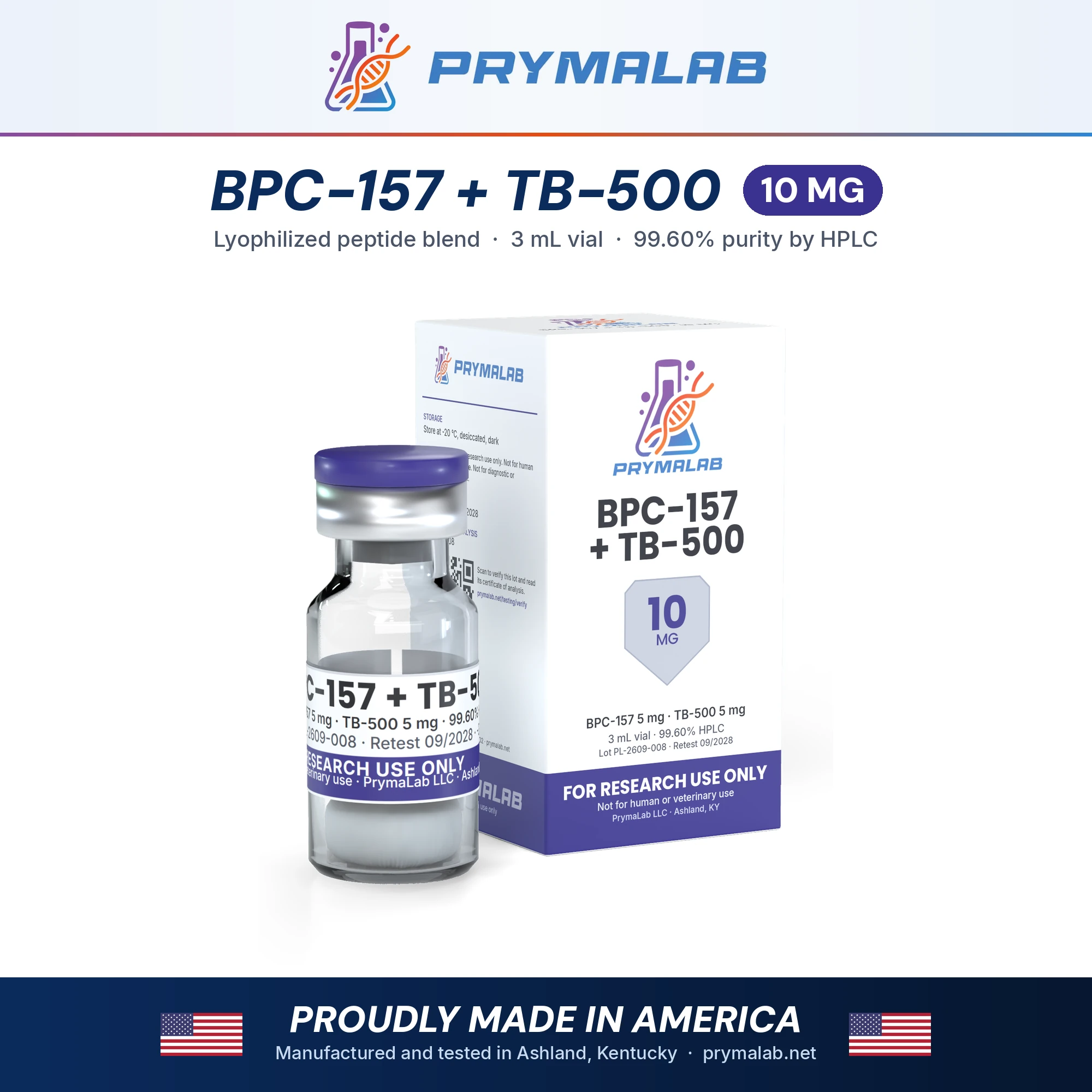
BPC-157 and full-length TB-500, 5 mg each, freeze-dried together in one vial
This vial is the Wolverine blend, two research peptides freeze-dried together in equal amounts by weight. It holds 5 mg of BPC-157, a synthetic 15-residue peptide based on a sequence from human gastric juice, and 5 mg of TB-500, which at PrymaLab means full-length N-acetyl thymosin beta-4. A 10 mg + 10 mg fill and a pen are also sold. Each peptide has its own literature on tissue repair, mostly in animals; no published work characterises the blend itself.
Specifications
| Property | Value |
|---|---|
| Components | BPC-157 (Body Protection Compound-157; pentadecapeptide) TB-500 (Thymosin β4); N-acetyl thymosin β4, full-length 43-residue peptide |
| BPC-157 CAS number | 137525-51-0 |
| TB-500 (Thymosin β4) CAS number | 77591-33-4 |
| Label claim | BPC-157 5 mg + TB-500 (Thymosin β4) 5 mg (10 mg in total) |
| Form | Lyophilized (freeze-dried) powder or cake in a sealed glass vial with a rubber stopper and aluminium crimp cap |
| Storage, sealed | −20 °C, desiccated, dark |
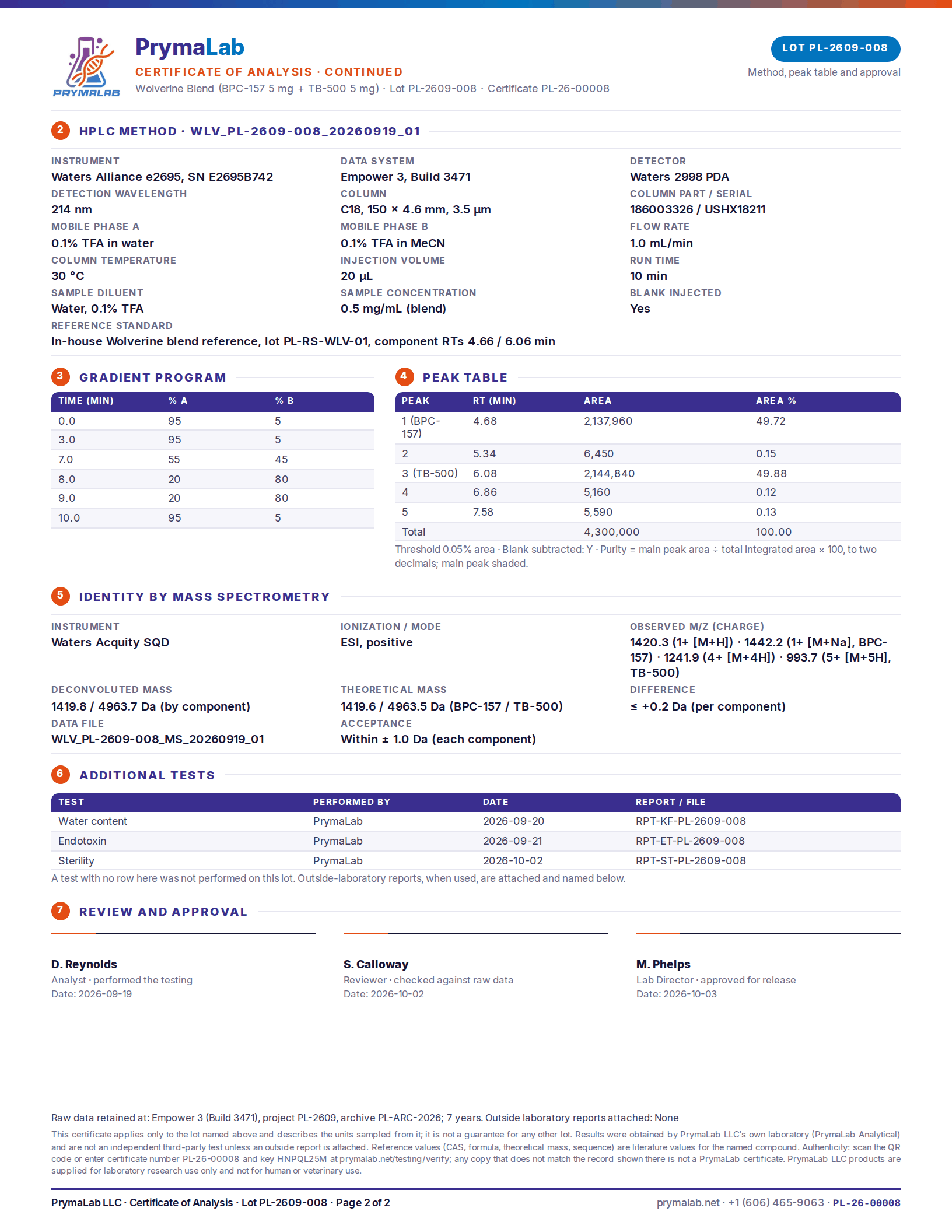
| Purity specification | 99.0% or higher by RP-HPLC |
| Lot certificate | Results for the lot now shipping are in the certificate panel on this page |
| Safety data sheet | PL-SDS-187 |
Fills in this range
BPC-157 + TB-500 blend is sold in 2 fills. The compound and the testing are the same in every fill; only the amount in the vial changes.
| Fill | Listing |
|---|---|
| 5 mg + 5 mg | BPC 157 5mg + TB500 5mg (this page) |
| 10 mg + 10 mg | BPC-157 + TB500 (10mg/10mg) "Wolverine Blend" |
What is in the vial
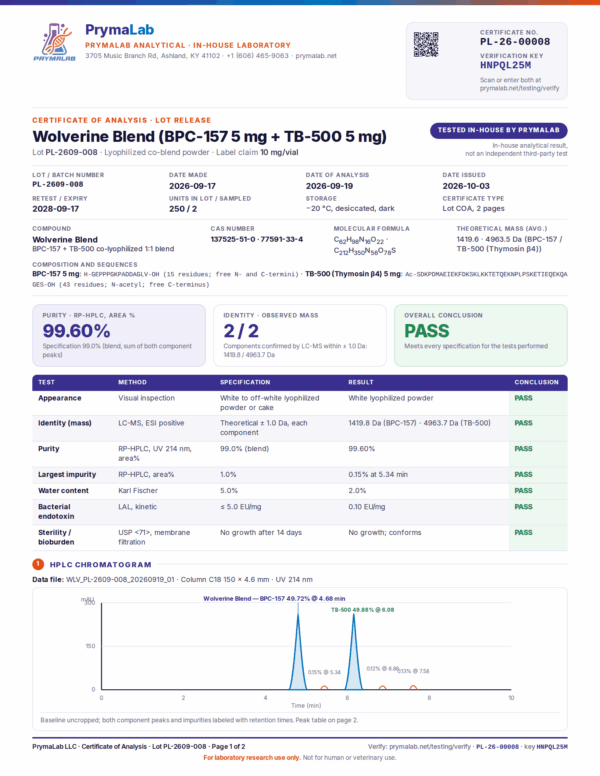
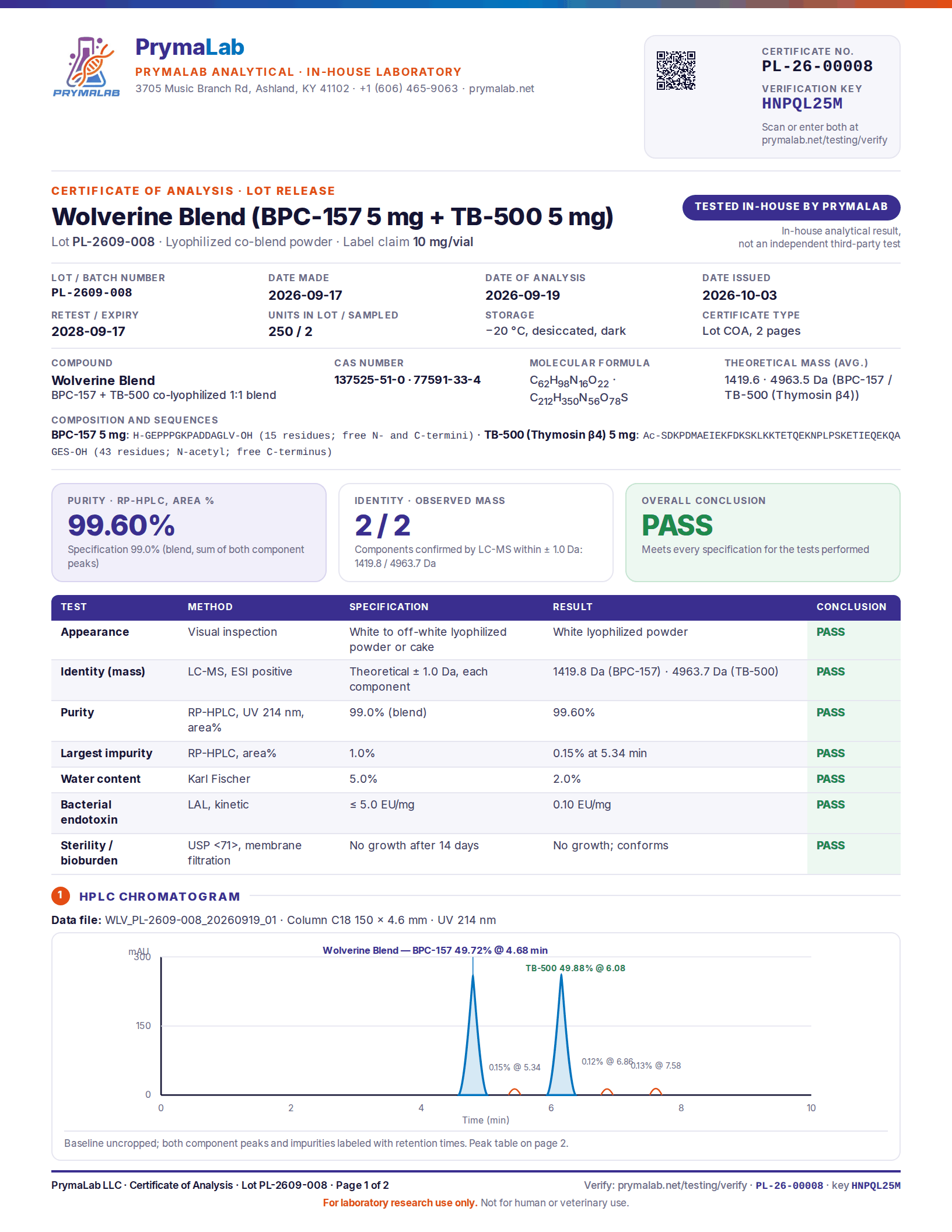
The certificate lists both sequences. BPC-157 is H-GEPPPGKPADDAGLV-OH, 15 residues with free ends, theoretical mass 1419.6 Da. TB-500 is Ac-SDKPDMAEIEKFDKSKLKKTETQEKNPLPSKETIEQEKQAGES-OH, the complete 43-residue thymosin beta-4 chain with an acetylated N-terminus, theoretical mass 4963.5 Da. LC-MS on the certificate reports a mass for each, so both identities can be checked for the lot in hand.
Equal weights are not equal numbers of molecules. At those masses, 5 mg of BPC-157 is about 3.5 µmol and 5 mg of thymosin beta-4 about 1.0 µmol, roughly three and a half BPC-157 molecules for every TB-500 molecule. The name TB-500 is not always used this way: Esposito and colleagues found the acetylated 17-23 fragment Ac-LKKTETQ, not the whole protein, in a product sold under that name1. A seven-residue fragment would show a far smaller mass on LC-MS.
What the research covers
Two peptides with separate literatures
Each half of this blend was studied on its own, by different groups and in different models. Much of the BPC-157 literature comes from Predrag Sikiric’s group in Zagreb, whose 2011 review described an anti-ulcer peptide, stable in human gastric juice, with effects on lesions of the oesophagus, stomach, intestine, liver and pancreas in rats, strong angiogenic potential and links to the nitric oxide system2. Thymosin beta-4 has a different history. Goldstein, Hannappel and Kleinman described it in 2005 as the major actin-sequestering molecule in eukaryotic cells, with a key role in skin and corneal wound healing, and set out possible applications in ulcerated tissue and after heart attack or stroke3.
The one study of the combination
Tendon is where the two literatures meet. In a 2026 rat study, Biçer and colleagues cut and repaired the Achilles tendon in 32 male rats and divided them into control, BPC-157, TB-500 and combined groups of eight4. After four weeks they tested load to failure and scored the tissue by histology, histochemistry and immunohistochemistry for collagen types I and III4. The abstract reports higher maximum load to failure than controls in the BPC-157 and TB-500 groups, statistically significant only for TB-500, and does not name the combined group in that result4. It describes its TB-500 as synthetic thymosin beta-4 without saying whether that was the whole chain4.
Human data on each peptide
For BPC-157 the human record is thin. A 2025 scoping review counted three pilot studies, on knee pain, interstitial cystitis and intravenous safety and pharmacokinetics; none reported adverse effects, and the authors noted that rigorous, large-scale trials were lacking5. Thymosin beta-4 has a randomized, placebo-controlled phase 1 study of intravenous synthetic peptide in four cohorts of ten healthy volunteers, in which adverse events were infrequent and mild or moderate, with no serious events6. None of these human studies combined the two peptides.
What is not established
No published work characterises the blend itself. Nothing in these references describes how BPC-157 and thymosin beta-4 behave together in one vial, whether either affects the other’s stability as powder or in solution, or whether the pair does anything the separate peptides do not. The single combination experiment is one rat study with eight animals per group4. Most BPC-157 findings come from rodents, a large share from one laboratory, and the only pharmacokinetic data are from rats and beagle dogs, in which intact BPC-157 had an elimination half-life under 30 minutes and was quickly broken down into small peptide fragments and amino acids7. None of this work used PrymaLab material.
The Wolverine Stack guide covers the literature in more depth.
How each lot is tested
Every lot is tested in PrymaLab’s own laboratory in Ashland, Kentucky before release: RP-HPLC for purity, LC-MS for identity, Karl Fischer titration for water, LAL for endotoxin and USP <71> for sterility. The results for the lot now shipping are in the certificate panel on this page, and the certificate number, key and QR code can be checked on the verify page. These are in-house results from PrymaLab Analytical, not an independent test, and the lab is not accredited to ISO 17025. The third-party testing guarantee on this page still applies: if any independent laboratory finds the wrong compound, or less than the stated purity or amount, the order is refunded and the cost of the test is reimbursed.
Frequently asked questions
Which TB-500 is in this blend?
Full-length thymosin beta-4: 43 residues, acetylated at the N-terminus, theoretical mass 4963.5 Da. Some products sold as TB-500 have contained only a seven-residue fragment, so check the LC-MS result on the certificate, which reports a separate mass for each of the two peptides.
Has this blend been studied?
Not as a product. No published work characterises BPC-157 and thymosin beta-4 together in one vial. One 2026 rat study compared each peptide and the pair after Achilles tendon repair, and its abstract names a significant gain in load to failure only for TB-500 alone.
How does the 5 + 5 mg vial differ from the 10 + 10 mg vial and the pen?
The 10 + 10 mg vial holds twice as much of each peptide in the same 1:1 ratio by weight and has its own lot and certificate. The pen holds 20 mg of the two peptides combined, already in solution. This vial keeps both as dry powder at −20 °C until it is reconstituted.
How should the vial be stored?
Sealed at −20 °C, dry and dark, and brought to room temperature before opening so that moisture does not condense on the powder. Once reconstituted, keep it at 2 to 8 °C away from light and use it within the period your laboratory has set, since no cited study measured the mixture's stability.
Is the blend for human or veterinary use?
No. It is sold for laboratory research only, is not approved by the FDA or any other authority, and must not be given to people or animals. Wolverine is a trade nickname and does not describe any demonstrated effect.
References
- Esposito S, Deventer K, Goeman J, et al. Synthesis and characterization of the N-terminal acetylated 17-23 fragment of thymosin beta 4 identified in TB-500, a product suspected to possess doping potential. Drug Test Anal. 2012;4(9):733-8. DOI · PubMed
- Sikiric P, Seiwerth S, Rucman R, et al. Stable gastric pentadecapeptide BPC 157: novel therapy in gastrointestinal tract. Curr Pharm Des. 2011;17(16):1612-32. DOI · PubMed
- Goldstein AL, Hannappel E, Kleinman HK. Thymosin beta4: actin-sequestering protein moonlights to repair injured tissues. Trends Mol Med. 2005;11(9):421-9. DOI · PubMed
- Biçer O, Adanir O, Güleryüz Y, et al. Effects of BPC-157 and TB-500 on Achilles tendon healing in rats: A histopathological and biomechanical study. Jt Dis Relat Surg. 2026;37(3):822-837. DOI · PubMed
- McGuire FP, Martinez R, Lenz A, et al. Regeneration or Risk? A Narrative Review of BPC-157 for Musculoskeletal Healing. Curr Rev Musculoskelet Med. 2025;18(12):611-619. DOI · PubMed
- Ruff D, Crockford D, Girardi G, et al. A randomized, placebo-controlled, single and multiple dose study of intravenous thymosin beta4 in healthy volunteers. Ann N Y Acad Sci. 2010;1194:223-9. DOI · PubMed
- He L, Feng D, Guo H, et al. Pharmacokinetics, distribution, metabolism, and excretion of body-protective compound 157, a potential drug for treating various wounds, in rats and dogs. Front Pharmacol. 2022;13:1026182. DOI · PubMed
Research use only
For laboratory research use only. BPC 157 5mg + TB500 5mg is not a drug, food, cosmetic or dietary supplement, is not approved by the FDA or any comparable authority for human or veterinary use, and must not be given to people or animals. It is sold to qualified researchers and institutions, and the buyer is responsible for lawful handling and disposal.
Other formats of BPC 157 + TB500
BPC 157 + TB500 is also stocked as Wolverine Stack (BPC-157 + TB-500) 20mg preloaded 3ml pen, BPC-157 5MG, BPC-157 10MG, BPC-157 Capsules (60/500mcg), BPC-157 Peptide Nasal Spray, BPC-157 5mg/ml preloaded 3ml pen and TB-500 5mg/ml preloaded 3ml pen. Each listing states its own quantity and concentration, and the pen and vial comparison explains what changes between formats.







Reviews
There are no reviews yet.